


More news on this day
A new wave of disruption is rippling across Europe’s summer flight network as Faro’s Gago Coutinho, Verona Villafranca, Cagliari Elmas and the Paris twin hubs of Orly and Le Bourget grapple with a volatile mix of strikes, weather shocks, staffing strains and new border controls that is already testing passenger patience before the peak holiday rush.
Get the latest news straight to your inbox!
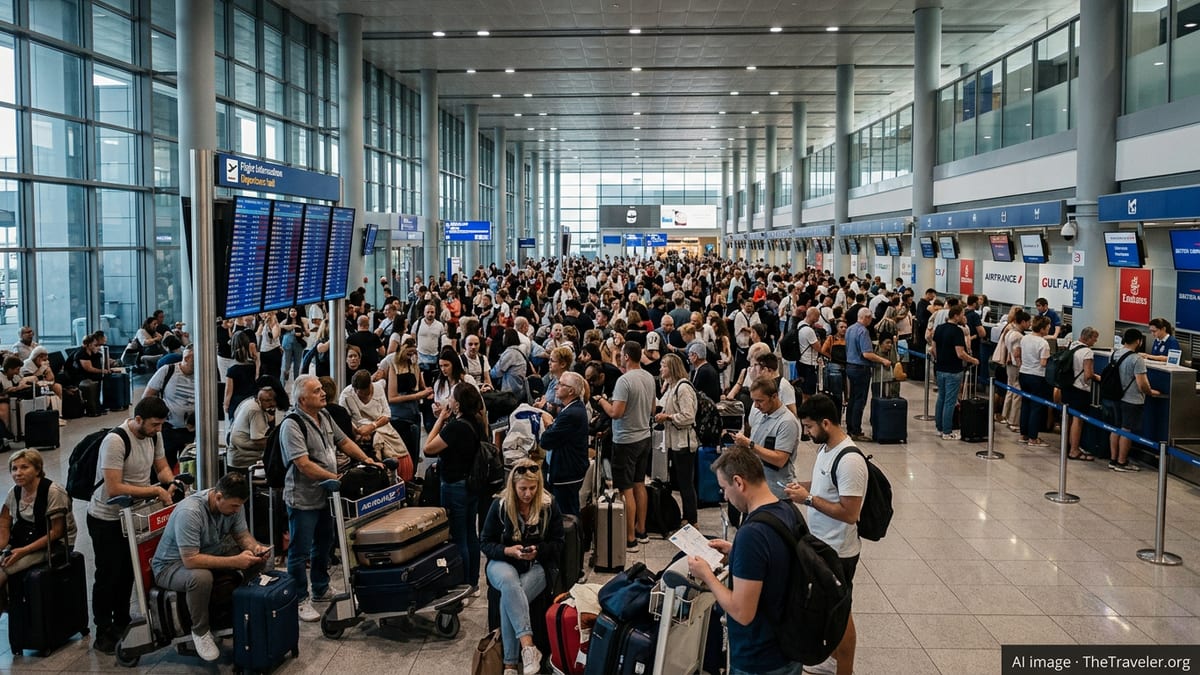
Southern Gateway Airports Strain Under Early-Season Pressure
In Portugal’s Algarve, Faro’s Gago Coutinho International Airport has emerged as an early flashpoint for holidaymakers. Recent traveler accounts describe sharply diverging experiences at the gateway, with some passengers clearing passport control in minutes while others report queues stretching beyond two hours during busy departure banks. This inconsistency has sharpened concerns that the airport’s infrastructure and staffing will struggle to keep pace with high summer demand.
Border control procedures linked to the European Union’s incoming Entry/Exit System have added to the uncertainty. Public discussion among travelers indicates that the rollout has been patchy, with reports of both smooth processing and prolonged waits at automated kiosks. While April and early May generally remain quieter in Faro, anecdotal evidence suggests that June weekend peaks are already stretching capacity, foreshadowing more serious pressure in July and August.
Italian regional hubs are facing similar stress. At Verona Villafranca, increased leisure traffic tied to Lake Garda tourism and preparations for higher volumes ahead of the 2026 Winter Olympics are converging on facilities that are still in transition, with terminal upgrades in progress. Travelers have flagged tight connection plans as risky, noting that even minor delays on rail or bus links can cascade into missed flights when security lines lengthen without warning.
Cagliari Elmas in Sardinia is likewise moving into a pivotal season with a growing network. Airport operator updates highlight double-digit growth in seats and routes for Summer 2026, including new domestic and international links, signaling a push to capture more Mediterranean demand. That expansion, however, is unfolding against a backdrop of operational strain that has already manifested in episodes of acute disruption.
From Fog to Strikes: Cagliari Elmas as a Case Study in Fragility
Cagliari Elmas offers a stark illustration of how quickly conditions can unravel. Over Easter Monday in early April, a dense fog bank forced multiple arrivals to divert to alternative airports and triggered hours of delays for passengers waiting in Sardinia and on the mainland. Local media coverage described suspended operations in the early morning, a buildup of delayed flights and a knock-on effect on the day’s schedule as aircraft and crews fell badly out of position.
The weather-related shock came on top of rising labor tensions. In May, local news reports detailed a four-hour strike and protest action planned at Elmas, rooted in disputes over pay, welfare measures and performance bonuses. Although the stoppage window was limited, the prospect of even short, targeted strike actions has underscored how sensitive tightly scheduled summer operations are to any reduction in staffing, particularly at compact island airports with limited redundancy.
At the same time, airlines are aggressively building out their Elmas schedules. Company and airport announcements for Summer 2026 point to at least a dozen new routes, with carriers such as Aeroitalia adding links to other Italian cities and beyond. Industry analysis indicates that Sardinia’s main airport is pushing toward a more international, year-round profile, with millions of additional seats in the market compared with 2025.
For passengers, this combination of rapid growth, labor unease and infrastructure constraints has translated into a more fragile travel environment. Even when flights operate, comparatively small disruptions, from morning fog to a brief work stoppage, can rapidly spill over into long queues, missed connections and mounting frustration in the terminal.
Paris Orly and Le Bourget Face Coordinated Strike Threats
Further north, the Paris system, long a bellwether for European aviation, is confronting its own flashpoint. Notices circulated in recent days describe a one-day strike scheduled for 18 June affecting segments of the workforce at Charles de Gaulle, Orly and Le Bourget. Public advisories warn of possible disruption to passenger handling and ground operations, although the exact level of impact will depend on participation and any last-minute adjustments.
The planned action comes at a delicate moment for France’s air traffic network. Data published by European air navigation authorities for recent months highlight air traffic control capacity and staffing as the leading cause of en route delays on the continent, with France among the most affected states. Even outside formal strike days, the system is operating close to its limits at peak times, leaving little margin to absorb additional shocks.
Le Bourget’s role as a major business aviation hub and host to large events, including the Paris Air Show, adds another variable. While most leisure travelers pass through Orly and Charles de Gaulle, any disruption at Le Bourget can complicate airspace management over the capital region and limit options for diversions or repositioning flights, indirectly affecting commercial operations.
Airport operator communications in recent months have simultaneously emphasized strong traffic recovery and ambitious plans for enhanced connectivity and decarbonisation initiatives. The tension between rising volumes, environmental commitments and finite runway and staffing capacity is increasingly visible in day-to-day operations, particularly when labor groups deploy strategic strike calls during key travel periods.
Verona and Faro Highlight Border and Staffing Bottlenecks
Verona Villafranca and Faro are emerging as test cases for how mid-sized tourist airports handle the layered pressures of new border technologies, tight staffing and surging seasonal demand. In Verona, traveler discussions suggest that passage through security and check-in can be swift during off-peak hours but highly unpredictable when charter and low-cost waves coincide. Local transport connections, such as hourly bus links from the city and Lake Garda, mean that even modest delays en route to the airport can leave passengers with dangerously thin margins.
Concerns about the Entry/Exit System are adding complexity. Reports from non-EU travelers indicate that registration for the new biometric scheme can be straightforward when staffing and kiosks are fully available, but there is little room for error if multiple flights arrive simultaneously. With British and other third-country holidaymakers forming a substantial share of Verona’s inbound leisure market, any slowdown at border control quickly propagates into baggage and landside areas.
At Faro, similar dynamics are at play. Public commentary from recent visitors ranges from descriptions of extremely rapid arrivals to accounts of long queues both at security and passport control, particularly at peak weekend and evening departures. The variability has prompted many travelers to adjust behavior, with some choosing to arrive three hours or more before departure even for intra-European flights.
Airport and operator initiatives, including terminal upgrades and energy and sustainability projects, are designed to future-proof Faro and support continued growth in summer traffic. Yet these improvements coexist with immediate operational realities: limited space at checkpoints, pressure on ground handling teams and the need to integrate new border control processes without the option to significantly expand the terminal footprint in the short term.
Network Effects Turn Local Disruptions Into Continental Gridlock
Underlying the troubles at Faro, Verona, Cagliari and the Paris airports is a broader European pattern. Analytical reports on air traffic management performance across the continent show that overall demand has returned to or exceeded pre-pandemic levels, while key parts of the air traffic control network still struggle with staffing and capacity. As a result, small disruptions more often trigger outsized knock-on effects.
Industry data over the past decade attribute a large share of delay minutes and costs to air traffic control constraints rather than airline or airport-specific problems. With Mediterranean leisure routes heavily concentrated in daytime peaks, bottlenecks at a handful of control centers or high-density terminal areas can send shockwaves through the entire network, leading to missed slots, aircraft rotations out of sequence and rolling delays that persist for days.
In this context, localized shocks at Gago Coutinho, Verona Villafranca, Cagliari Elmas, Orly or Le Bourget rarely remain local. A fog closure in Sardinia can strand aircraft needed for mainland rotations; a brief walkout among ground staff in Paris can force airlines to consolidate flights, displacing capacity on onward connections; a bottleneck at Faro’s passport control can delay departures enough to miss tightly scheduled arrival slots at congested airports further north.
As Europe moves toward the peak of Summer 2026, publicly available indicators suggest that capacity margins remain thin and that passengers should be prepared for a season marked by heightened volatility. For travelers moving through these southern and central hubs, extra time, flexible itineraries and close attention to developing strike and weather information are likely to be critical tools for navigating an increasingly fragile network.