


More news on this day
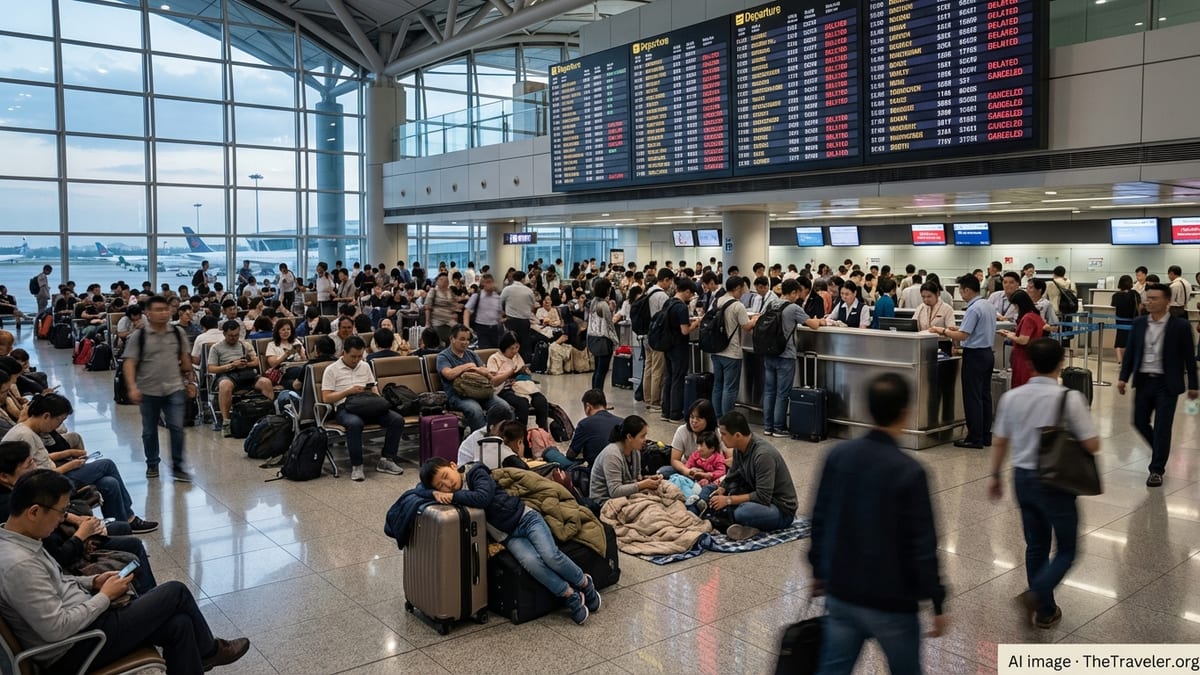
Operations at Beijing Daxing International Airport faced significant disruption this week, with reports indicating around 40 grounded flights and more than 220 schedule hold-ups across major Chinese carriers, affecting domestic, regional and long-haul connections through one of the country’s newest aviation hubs.
Get the latest news straight to your inbox!
Major Chinese Carriers Caught in Daxing Disruption
Publicly available operational data and scheduling platforms show that several of China’s largest airlines experienced notable irregularities at Beijing Daxing, including China Eastern, Air China, China Southern, China United and XiamenAir. Collectively, these carriers recorded roughly 40 grounded or cancelled services in a short window, alongside more than 220 flights facing departure or arrival delays.
The problems at Daxing, located to the south of the Chinese capital, affected a mix of domestic trunk routes and regional services, many of them typically operating at high frequencies. China Eastern and China Southern, two of the airport’s key tenants, appeared among the most heavily affected, while smaller but strategically important operators such as China United and XiamenAir also reported disruptions on routes feeding secondary cities.
While delay and cancellation figures at large hub airports can fluctuate quickly over the course of a day, the pattern at Daxing marked an unusually sharp spike compared with recent weeks. Monitoring sites tracking departure performance indicated that the number of affected flights was materially higher than normal for a comparable weekday at the airport.
The clustered nature of the disruptions, and the concentration among carriers with large Daxing operations, underscored the airport’s role as a central node in China’s domestic aviation network and an increasingly important transit point for regional and long-haul travel.
Domestic Network Strain and Knock-on Effects
The immediate impact of the grounded flights and schedule hold-ups was felt most acutely across China’s domestic route map. Daxing links Beijing with major commercial centers such as Shanghai, Guangzhou, Shenzhen and Chengdu, as well as a dense web of flights to provincial capitals and tourist destinations. When multiple departures from a hub are delayed or cancelled within a short period, aircraft and crew rotations can quickly become misaligned.
Travel-data dashboards and airline status feeds showed cascading changes on routes connecting Daxing with cities in eastern and southern China, as well as inland hubs. Some affected services were retimed by between 30 minutes and several hours, while others were removed from the schedule and flagged as cancellations. As aircraft failed to arrive on time in Beijing, subsequent departures from Daxing and onward stations also faced reshuffling.
Industry observers note that China’s domestic market has seen a strong rebound in demand, particularly around weekends, holidays and peak business travel periods. High load factors on many routes leave carriers with limited spare capacity to re-accommodate stranded passengers at short notice, magnifying the practical impact of a wave of delays, even when the number of outright cancellations remains relatively contained.
For travelers, the disruption translated into longer waits in terminal buildings, unexpected overnight stays in Beijing or intermediate cities, and a greater reliance on last-minute rebooking options. Online discussion forums reflected a rise in passenger reports of missed meetings, tour adjustments and altered family travel plans tied to the Daxing irregularities.
Hong Kong, Regional Hubs and Global Transit Links Affected
The disruption at Daxing also resonated beyond mainland China, affecting itineraries that connect through Beijing to Hong Kong, regional Asian destinations and long-haul intercontinental flights. Some China Eastern, Air China and China Southern services using Daxing as a transfer point feed passengers into onward flights serving Hong Kong, Southeast Asia, Japan and South Korea, among other markets.
According to published coverage and live timetable snapshots, delays on Daxing departures to major Chinese hubs created mismatches with onward departures to Hong Kong and key regional gateways. In some cases, passengers arriving late in connecting cities such as Shanghai or Guangzhou found that onward flights had already departed, forcing involuntary re-routing or extended layovers.
Long-haul connections also came under strain. Daxing is used by Chinese carriers as a staging point for international services to Europe and, increasingly, to the Middle East and Oceania. When domestic feeder flights arrive late or not at all, travelers on through-tickets risk missing their onward legs, particularly on once-daily routes that do not offer easy same-day alternatives.
As a result, the disruption at a single Chinese hub had a ripple effect on global transit flows, demonstrating how tightly integrated China’s domestic and international networks have become. The pattern echoed previous episodes at other major hubs, where concentrated delays in one time band can alter traffic flows across multiple continents within a 24-hour period.
Possible Drivers: Weather, Congestion and Operational Pressures
At the time of the disruption, no single clear-cut cause was publicly identified for the cluster of delays and groundings at Daxing. However, operational data and historical patterns at large East Asian hubs point to a combination of familiar stress factors, including localized weather issues, airspace congestion and the complexity of ramping up flight volumes to meet rising demand.
Thunderstorms and low-visibility conditions around Beijing in the early summer months can prompt temporary flow-control measures, limiting the rate at which aircraft can take off or land. Even modest reductions in capacity can quickly translate into longer queues for departure slots, particularly at a rapidly growing facility such as Daxing, which was designed to absorb part of the capital’s heavy traffic from the older Beijing Capital International Airport.
Operational pressures within individual airlines may also play a role. Chinese carriers have been rebuilding international networks while maintaining dense domestic schedules, putting strain on aircraft utilization and crew planning. When disruptions arise, carriers must balance regulatory obligations to passengers with the need to protect critical trunk routes and long-haul services, sometimes leading to targeted groundings of lower-priority flights.
Analysts observing Chinese aviation trends have noted that the broader industry is still adjusting to new travel patterns, including shifting demand between Beijing’s two main airports and the evolution of regional routes following geopolitical and economic changes in East Asia.
What Travelers Should Expect in the Short Term
For passengers planning to travel through Beijing Daxing in the coming days, the recent disruption serves as a reminder to build contingency into itineraries. Publicly available advisories and airline communications consistently recommend allowing ample connection time, particularly for journeys involving a domestic-to-international transfer or separate tickets on different carriers.
Travel experts generally advise monitoring flight status closely via airline apps and airport information screens, especially in the 24 hours leading up to departure. When delays begin to accumulate at a hub, rebooking options are usually more flexible for those who act early, before alternative flights reach capacity.
The events at Daxing also highlight the value of understanding fare rules and conditions of carriage. Major Chinese airlines publish their policies on delays, cancellations and missed connections, setting out when passengers may be entitled to rebooking, refunds or, in some cases, meal and hotel support. Being familiar with these frameworks can help travelers navigate disruption more effectively at the check-in desk or service counter.
Looking ahead, industry watchers will be tracking on-time performance and scheduling adjustments at Daxing to gauge how quickly operations normalize. While the airport retains considerable capacity and modern infrastructure, the latest flight chaos underscores that even state-of-the-art hubs remain vulnerable to the complex interplay of weather, airspace limits and high-density scheduling that defines contemporary air travel in China and beyond.