


More news on this day
Greece is heading into the heart of the 2026 summer season with mounting flight delays, as continuing disruption across Middle East airspace channels more traffic over the eastern Mediterranean and magnifies long-standing bottlenecks in the country’s aviation system.
Get the latest news straight to your inbox!
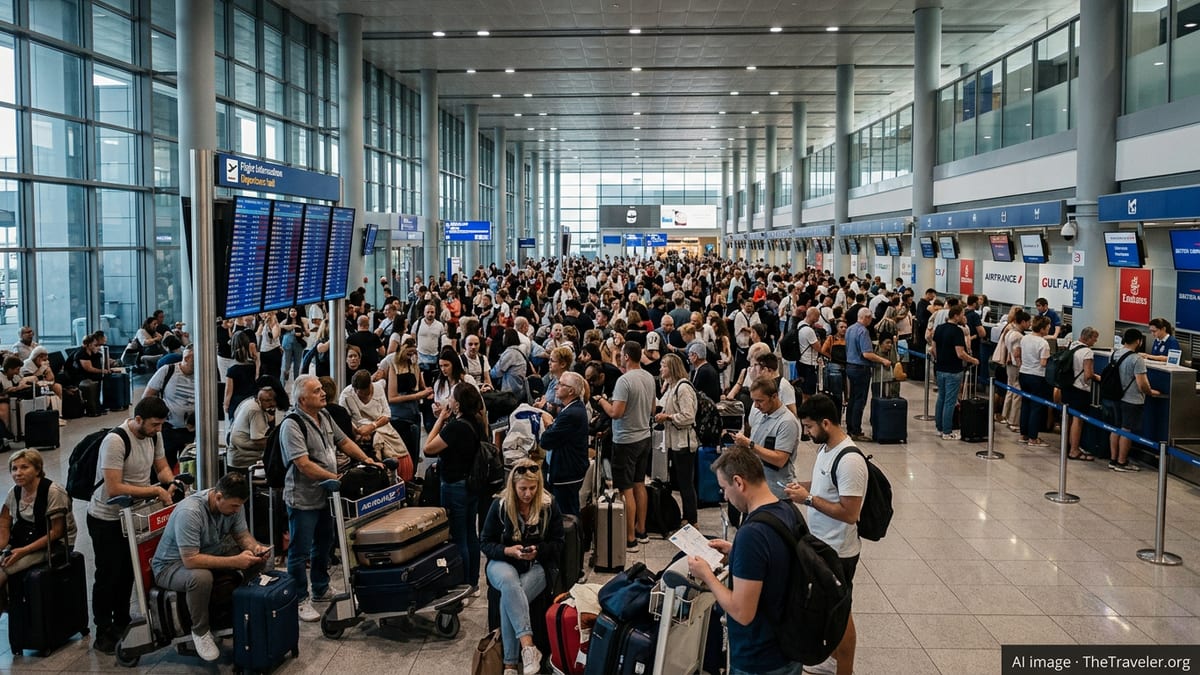
Rerouted Middle East traffic crowds the eastern Mediterranean
Conflict across parts of the Middle East and the 2026 Iran war have reshaped some of the world’s busiest air corridors, cutting direct routes between Europe, the Gulf and Asia and forcing airlines to adopt longer, more northerly or westerly paths. Publicly available conflict-zone guidance from European regulators advises carriers to avoid or, in some cases, prohibits them from using key segments of Iranian, Iraqi and Lebanese airspace, with additional caution levels in several Gulf states. The result is a squeeze on remaining corridors connecting Europe with hubs in the Gulf and South Asia.
Analyses by Eurocontrol and other aviation bodies indicate that a significant share of flights that once crossed the Middle East on more direct tracks are now skirting conflict areas, often routing via Turkey, Egypt and the central and eastern Mediterranean. Industry briefings describe this as a structural rerouting for the 2026 summer schedules rather than a short-lived diversion, with some carriers adding block time and adjusting fleet plans on Europe–Gulf and Europe–Asia services.
For Greece, located at the junction of these altered flows, the knock-on effect is increased overflight volume in the Athinai Flight Information Region and higher complexity for air traffic controllers managing a mix of long-haul overflights and dense seasonal holiday traffic. Aviation risk consultancies tracking route choices show Athens-area airspace appearing more frequently as an alternative to eastern Mediterranean corridors that are now constrained by security advisories or outright prohibitions.
While many of these aircraft never touch down in Greece, the additional coordination required to sequence them safely alongside departures and arrivals to Greek airports adds to sector workload. That pressure becomes more visible once peak leisure demand to islands such as Santorini, Mykonos and Crete begins to ramp up from late June through August.
Athens International Airport under strain ahead of peak season
The rising complexity in regional airspace is colliding with local constraints at Greece’s main gateway. Athens International Airport, which handled strong traffic growth in 2025 and early 2026, has already experienced several high-profile disruption events this year linked to technical checks and infrastructure issues. Published coverage in Greek and international media highlighted extensive delays on specific days in June after inspections of key landing guidance systems narrowed available runway capacity, prompting cascading schedule knock-ons.
Earlier in the year, reports detailed radar and communications faults impacting operations at the Athens Area Control Center, temporarily reducing capacity and forcing traffic management initiatives. Aviation unions have repeatedly pointed to aging systems and staffing pressures, warning that overtime limitations during the busy summer period could further restrict the ability to absorb surges in demand or to recover quickly after weather or technical incidents.
Airport financial filings and presentations to investors underline that management is coordinating closely with air navigation services to “facilitate” traffic flows for summer 2026 and reduce peak-hour congestion. The operator has also moved toward tighter slot coordination from the winter 2026/27 season, signaling recognition that Athens is transitioning from a primarily schedule-flexible airport to one that requires more formal capacity management as volumes grow.
Despite these efforts, Athens continues to feature among Europe’s more delay-prone large airports in certain Eurocontrol snapshots, especially on busy holiday weekends. With additional rerouted long-haul traffic now sharing regional airspace, the margin for error around the Greek capital’s skies is narrowing just as millions of tourists prepare to transit through the airport.
Greek carriers adjust to volatile Middle East links
Greek airlines are having to navigate both the operational and commercial fallout of the Middle East crisis. Aegean Airlines, the country’s largest carrier, has described the region as the main challenge for its 2026 plans in recent public statements, outlining suspensions or reductions across a string of destinations in Israel, the Gulf and surrounding countries. Company updates indicate that routes touching seven Middle Eastern markets have been affected, representing a mid-single-digit percentage share of its total capacity.
While some services have been paused entirely due to security and airspace concerns, others have continued under modified routings, longer flight times or revised schedules. Trade publications report that Greek carriers have been reallocating part of this freed-up capacity back into intra-European leisure markets, particularly on links to island destinations where demand remains robust. However, this rebalancing does not fully offset the operational complexity created when remaining Middle East flights must weave around closed or constrained airspace.
For passengers, the practical impact is greater unpredictability on itineraries connecting through Greek hubs to or from the wider region. Flight-tracking data and timetable changes indicate extended journey times on some eastbound routes, while last-minute retimings remain a risk if new advisories emerge. Travel industry commentary suggests that, for summer 2026, Greece’s airlines are prioritizing schedule stability on core European holiday routes even if that means slower recovery of certain Middle Eastern links.
The ripple effects are also felt in cargo, where the Middle East traditionally plays a key role in connecting Asia, Europe and Africa. Aviation logistics analyses show capacity on these lanes reduced since the start of the conflict, contributing to higher freight rates and more circuitous routings that sometimes involve Greek or neighboring airports as intermediate stops or technical points.
Eurocontrol data show rising delays tied to regional disruption
Eurocontrol’s regular network performance overviews provide one of the clearest snapshots of how regional tensions are feeding into delay statistics. Recent editions highlight that overall European delay minutes remain below the worst years of the past decade, but they also single out specific hotspots where en route and airport delays are climbing due to a combination of staffing constraints, infrastructure limitations and geopolitical rerouting.
In the eastern Mediterranean, Greece appears among the states where network performance is described as sensitive to developments in neighboring airspace. Delay indicators for Athens and other Greek airports have drifted upward compared with the same period last year, with Eurocontrol commentary linking a portion of this to flow-management measures put in place to handle rerouted Middle East traffic and to temporary capacity reductions during technical inspections.
Industry operational bulletins aimed at airlines and business aviation operators echo these findings, advising that the compression of routes around the Gulf and eastern Mediterranean is generating more frequent use of tactical reroutes, level capping and holding patterns. Operators planning flights across the region are urged to anticipate longer flight times, potential slot restrictions and last-minute routing changes, particularly at peak hours when Greek and neighboring airspace can become saturated.
Although not all of this disruption is directly visible to holidaymakers, it translates into more frequent departure and arrival delays, tighter turnaround windows and a higher likelihood of missed connections when schedules are disrupted early in the day. This environment places additional importance on robust staffing and technology at key control centers, areas where Greek air navigation services have acknowledged the need for modernization.
What summer travelers to and through Greece should expect
For travelers heading to Greece in the coming weeks, the interaction of surging seasonal demand, infrastructure constraints and regional rerouting means that punctuality is likely to be more fragile than headline averages may suggest. Publicly available delay data and recent disruption episodes at Athens point to elevated risk around afternoon and evening peaks, when inbound flows from northern Europe converge with outbound departures to islands and long-haul overflights.
Travel advisories from airlines, airports and passenger-rights organizations consistently recommend that passengers build extra buffer time into their plans, especially when connecting through Athens or using Greek hubs to reach the Middle East or beyond. Longer minimum connection times, flexible tickets where possible and careful monitoring of flight status on the day of departure are recurrent themes in this guidance.
Observers also highlight the importance of understanding European passenger-protection rules, which can offer compensation or assistance in certain circumstances involving lengthy delays or cancellations. However, they note that disentangling causes such as regional airspace restrictions, weather and local technical issues can be complex, and outcomes may vary case by case.
Looking ahead to the peak of the summer season, sector specialists suggest that the extent of disruption in Greece will depend heavily on whether Middle East airspace conditions stabilize and on how quickly ongoing upgrades to Greek air traffic systems progress. Until then, the convergence of rerouted long-haul flows and domestic tourism demand will keep the country’s skies among the most closely watched in Europe.