


Within an hour of central Rome, the hills of Lazio hide a constellation of grand villas, from imperial ruins to Renaissance palaces. Yet even in this distinguished company, Villa d’Este in Tivoli stands apart. Its shimmering cascades, intricate symbolism and remarkably intact gardens have made it a reference point for landscape design across Europe. For travelers deciding which villa to prioritize on a short trip from Rome, understanding what makes Villa d’Este different can turn a simple day outing into one of the most memorable experiences of a visit to Italy.
Get the latest updates straight to your inbox!
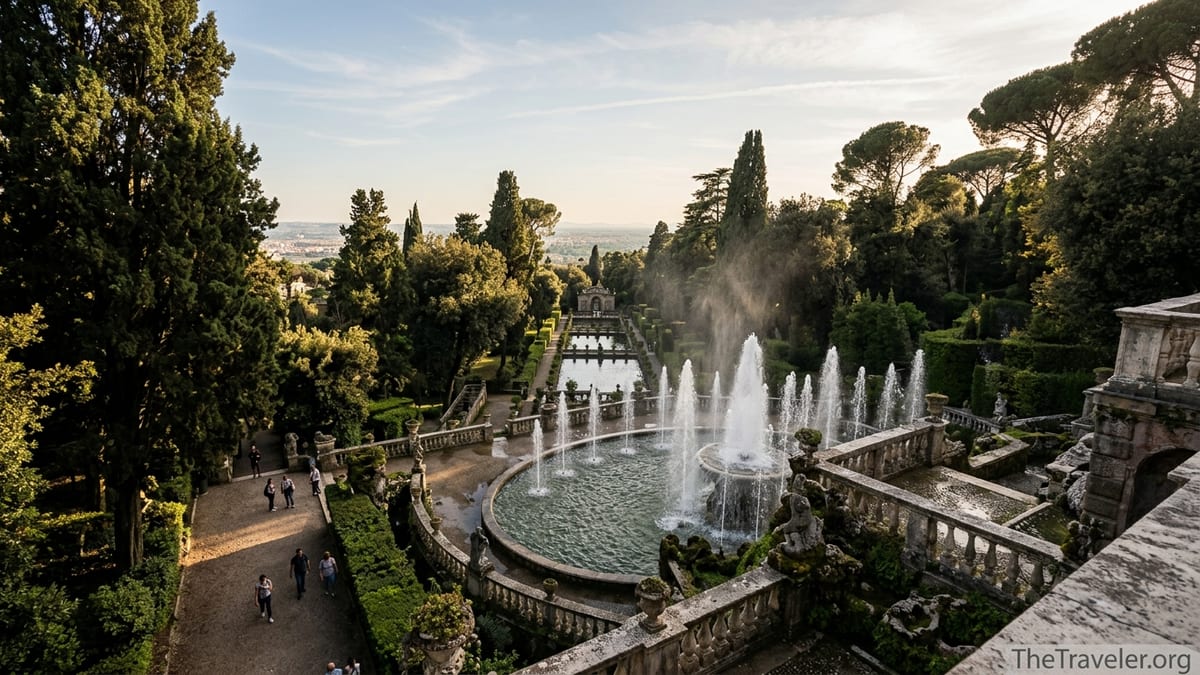
A Water Garden Like Nowhere Else in Lazio
Many historic villas near Rome have lovely gardens, but Villa d’Este is essentially a garden of water. Terraces tumble down a steep hillside carpeted not just with cypress and stone pines, but with fountains in almost every direction. UNESCO describes it as an outstanding illustration of a 16th century Italian garden, and it is the sheer density and variety of hydraulic features that strikes visitors first. As you step out from the main palazzo, you are met not by a simple lawn, but by a cool shimmer of jets and cascades that continue almost uninterrupted as you descend.
The numbers help explain the impact. Villa d’Este’s complex includes dozens of major fountains and nymphaea, hundreds of individual spouts and water jets and more than two hundred basins, all arranged along axial paths, staircases and terraces. The celebrated Avenue of the Hundred Fountains alone stretches for around 130 meters, lined with an almost continuous curtain of water trickling and spurting from carved masks, lilies and obelisks. Travelers who have visited other villas in the region, such as Villa Lante in Bagnaia or the gardens of Palazzo Farnese at Caprarola, are often surprised by how completely water dominates at Tivoli, whereas elsewhere it tends to play a more restrained, decorative role.
What you do not see, but quickly sense, is the ingenuity behind it all. The entire system at Villa d’Este works purely through gravity, without modern pumps. Water is channeled from the Aniene River through underground conduits, building pressure as it drops down the slope. For visitors, this adds a subtle thrill. Standing by the powerful Oval Fountain and feeling a cold mist on your face on a hot July afternoon, you are witnessing technology that has been functioning, with periodic restoration, since the 1500s. Few other villas near Rome offer such a direct encounter with Renaissance engineering in action.
By contrast, the gardens at Hadrian’s Villa, just a short drive away, offer large pools and classical nymphaea, but there the water features feel like fragments of a ruined imperial city. At Villa d’Este they are still alive. That sense of movement and sound, the steady rush and trickle that follows you from terrace to terrace, is a defining difference that most travelers notice within minutes of arrival.
Immersive Renaissance Symbolism, Readable for Modern Visitors
Like many aristocratic residences around Rome, Villa d’Este was designed as a statement as much as a home. Cardinal Ippolito II d’Este, who commissioned the complex in the mid 1500s, wanted a residence that proclaimed both his political ambitions and his classical learning. The result is one of the most complete symbolic programs of any Renaissance garden in Italy. The fountains and sculptures form a narrative about power, virtue, nature and the relationship between Tivoli and Rome.
One of the clearest examples is the so called Rometta fountain. This miniature representation of Rome includes a tiny Tiber River, model bridges and fortified walls. In the 16th century, visitors could look from this model city toward the real Rome, visible on the distant horizon. Today atmospheric haze and modern development often soften that line of sight, but you can still stand here and understand the intended metaphor: the cardinal’s villa as a kind of hinge between his adopted town and the center of papal power.
Another key element is the long perspective created by the Oval Fountain at the upper level, the Avenue of the Hundred Fountains and the Rometta at the lower end. The sequence symbolically follows the path of water from the mountains around Tivoli, through the Aniene valley, and on to Rome. Even without a guide, most travelers can feel that there is a story embedded in this descent. When you compare this with the gardens at Palazzo Farnese in Caprarola, which focus more on demonstrating dynastic power through architecture and elaborate frescoed interiors, or with the playful surprises of Villa Lante’s garden, the narrative at Villa d’Este feels more linear and immersive.
For visitors who enjoy making sense of art and architecture on their own, Villa d’Este is also more approachable than some Roman palaces. Information panels and guidebooks sold at the entrance explain the main symbolic themes in straightforward language. You do not need a degree in art history to appreciate that the Fountain of the Dragons, for example, was built to honor a papal visit, or that the musical water organ once amazed guests with sacred melodies powered only by falling water. The mix of spectacle and meaning is part of what keeps the villa feeling alive rather than museum like.
Perfectly Preserved Terraces vs Fragmented Ruins
Travelers often combine Villa d’Este with a morning at Hadrian’s Villa, another UNESCO site just a few kilometers away. The contrast could not be sharper. Hadrian’s vast complex spreads over roughly 120 hectares and survives mostly as ruins of baths, libraries and palaces, set around reflective pools like the famous Canopus. It offers a powerful sense of ancient Rome, but you must imagine the original colors, furnishings and gardens. Villa d’Este, by contrast, gives a surprisingly intact impression of a 16th century aristocratic retreat.
As you move through the palace at Tivoli, you still pass along frescoed corridors where mythological figures, landscapes and decorative motifs cover ceilings and walls. Many are softly faded, but enough color remains that you can understand the original richness. Step out onto a loggia and the garden below retains its basic structure of terraces, axial paths and clipped hedges. While the planting schemes have evolved and modern conservation limits some water flows in dry periods, the overall composition is recognizably the one that influenced garden designers from France to Russia in the centuries that followed.
By comparison, when you visit Villa Lante or Palazzo Farnese, you encounter gardens of the same era but on a more compact or differently organized scale. Villa Lante is famous for its geometric parterres and playful chain of water that flows down the hillside like a sculpted stream. Palazzo Farnese impresses with its pentagonal fortress like plan, frescoed “Room of Maps” and imposing approach road that climbs straight through the town of Caprarola. Yet in both cases, the combination of intact interior decoration, fully developed water garden and commanding hillside site is less comprehensive than at Villa d’Este.
This makes Villa d’Este particularly rewarding for first time visitors to Italy who may only have one day to devote to historic villas outside Rome. In a single visit you can experience a lavish Renaissance residence, a fully articulated garden and a still functioning feat of hydraulic engineering. The fact that all of this is contained within a compact site in the small town center of Tivoli, within walking distance of cafes and the bus stop back to Rome, adds practical convenience to its historical richness.
Atmosphere and Visitor Experience: Sound, Shade and Cool Air
Practical experience matters when you are choosing a day trip, and here too Villa d’Este feels different from other villas near Rome. In summer, Rome can be hot and airless by midday. Tivoli sits higher in the hills, and the villa’s steeply stepped gardens are laced with shade from centuries old cypresses, magnolias and evergreen oaks. The constant evaporation from fountains and cascades adds a perceptible coolness, particularly noticeable along shaded paths like the Avenue of the Hundred Fountains or in recessed grottoes.
Many travelers mention the soundscape as one of the most memorable aspects of a visit. Instead of city traffic, you hear a layered composition of splashes, trickles and low thunder from the great waterfalls. Around you, small groups pause for photos near the Organ Fountain or lean on stone balustrades overlooking the valley. Even when the site is busy during high season, you can often find quieter corners by following side paths or descending to lower terraces, where jets splash into rounded basins flanked by carved river gods and mossy rockwork.
By comparison, the experience at some other villas is more architectural than sensory. At Palazzo Farnese, the highlight for many visitors is touring the grand interior spaces: spiral staircases, frescoed galleries and the great circular courtyard. The garden is pleasant but secondary. At Villa Lante, the atmosphere is more intimate and playful, with smaller scale fountains and neatly clipped box hedges. Both are beautiful in their way, but neither surrounds you with water and movement to the same immersive degree as Villa d’Este.
Practical details underscore these differences. Tickets for Villa d’Este are managed as a state museum, and the villa is usually open throughout the week with seasonal variations in closing time, often around late afternoon or early evening. Entry fees are moderate compared with major Roman monuments, and combination tickets or reduced rates are sometimes available, especially outside peak season. For a typical traveler in 2026, budgeting the cost of a cappuccino in Rome for the train, plus a reasonable entrance fee in Tivoli, buys several hours in an environment that feels worlds away from the city heat.
How Villa d’Este Fits into a Day Trip from Rome
Another way Villa d’Este distinguishes itself is its ease of integration into a Rome itinerary. Tivoli lies roughly 30 kilometers east of the capital. Regional trains from Termini or Tiburtina stations, combined with a short local bus ride or a 20 to 25 minute walk through town, usually bring you to the villa in about an hour each way, depending on connections. Organized day tours often combine Villa d’Este with Hadrian’s Villa, providing private coach transfers between the two sites and back to Rome.
Other villas in the region require more planning. Reaching Villa Lante in Bagnaia or Palazzo Farnese in Caprarola by public transport from Rome typically involves a combination of regional trains to Viterbo or other nearby towns and then local buses or taxis. This can turn a visit into a more involved excursion, rewarding for dedicated architecture or garden enthusiasts but less straightforward for first time visitors with limited time. Many travelers therefore start by visiting Villa d’Este, where the logistics are simpler, and then consider a second, more adventurous villa excursion only if their schedule allows.
Once in Tivoli, the compact historic center makes the day feel relaxed rather than rushed. From the bus stop you can stroll past cafes and small shops to reach the entrance on Piazza Trento. After touring the villa and gardens, it is easy to find a trattoria nearby for lunch or an early dinner, with typical menus offering pasta dishes such as tonnarelli cacio e pepe and grilled meats, often at prices lower than central Rome. This combination of culture, scenery and simple local food helps Villa d’Este feel like a full day out rather than just a museum visit.
Travelers who want a deeper dive into the area’s history can add a short walk or quick bus ride to Hadrian’s Villa either before or after Villa d’Este. Doing so highlights the chronological leap from a 2nd century imperial retreat to a 16th century cardinal’s palace. In practice, most visitors find that even a half day at Villa d’Este alone provides enough impressions to last for years, from the first glimpse of the cascade through cypress branches to the final view back up the terraces as the afternoon light turns the stone a warm honey color.
The Takeaway
What ultimately sets Villa d’Este apart from other historic villas near Rome is the way it fuses engineering, art and atmosphere into a single coherent experience. Its gravity fed waterworks remain among the most complex and best preserved in Europe. Its garden design, with long axial views and layered symbolism linking Tivoli to Rome, still reads clearly five centuries after it was conceived. Unlike ruined imperial complexes, it offers an almost intact picture of Renaissance taste, from frescoed salons to terraced parterres.
At the same time, Villa d’Este is not just an art historical monument. It is somewhere you feel with your senses. The cool spray on a summer afternoon, the shifting play of light across wet stone, the background music of falling water and the glimpses of the Roman plain far below give it a distinct mood that other villas, however grand, do not quite match. For travelers deciding whether it is worth leaving the city for a day, the answer is that Villa d’Este is not simply another villa. It is a destination that can redefine what you expect from a garden, and a reminder of how powerfully thoughtful design can transform a hillside into an unforgettable landscape.
FAQ
Q1. How much time should I plan for a visit to Villa d’Este?
Most visitors find that two to three hours is enough to tour both the palace and the main garden terraces at a comfortable pace. If you enjoy photography or lingering in quiet corners, consider allowing up to four hours, especially in good weather.
Q2. Is Villa d’Este suitable for children and less mobile travelers?
The gardens involve many steps and sloping paths, which can be challenging for anyone with limited mobility or for families with strollers. However, there are some level areas near the palace and along certain terraces where you can still enjoy views of the fountains. Comfortable shoes and taking your time on the stairways make the visit manageable for most people.
Q3. Can I visit Villa d’Este and Hadrian’s Villa on the same day?
Yes, many travelers successfully visit both sites in one day, often starting at Hadrian’s Villa in the morning and moving to Villa d’Este after lunch. You should expect a fairly full schedule, with transport between the two by local bus, taxi or organized tour, but it is a rewarding way to experience both ancient and Renaissance Tivoli.
Q4. How does Villa d’Este compare with Villa Lante and Palazzo Farnese?
Villa d’Este is more focused on dramatic fountains and expansive terraces, with a strong sense of movement and sound. Villa Lante offers a more intimate, geometric garden with playful water features, while Palazzo Farnese impresses primarily through its fortress like plan and frescoed interiors. If you have time for only one, Villa d’Este usually provides the most varied experience.
Q5. When is the best time of year to visit Villa d’Este?
Spring and early autumn are often ideal, with mild temperatures, longer daylight and abundant greenery in the gardens. Summer visits can be hot but are made more pleasant by the shade and water features. Winter can be quieter and atmospheric, though some fountains may have reduced flow during maintenance or in very cold weather.
Q6. Do the famous water organ and special fountain effects still operate?
The historic water organ and some mechanical effects have undergone restoration over the years and may operate on limited schedules or during specific demonstrations, depending on conservation needs. Travelers should be prepared that not every historic sound effect or mechanism will be functioning during an ordinary visit, even though most fountains run regularly.
Q7. Are guided tours necessary to appreciate Villa d’Este?
Guided tours are not strictly necessary, as the main routes are clearly marked and basic information is available on site and in guidebooks. However, a knowledgeable guide or a detailed audio guide can enrich the experience by explaining the symbolism behind the fountains and pointing out details that are easy to miss when exploring on your own.
Q8. What should I wear and bring for a visit?
Comfortable walking shoes with good grip are advisable due to uneven stone paths and steps that can be slippery when wet. In warm months, light clothing, sun protection and a refillable water bottle make the visit more pleasant. A small umbrella or light rain jacket can be useful in spring or autumn showers, when the gardens can still be very beautiful.
Q9. Can I take photos inside the palace and gardens?
Photography for personal use is generally allowed in both the gardens and most interior areas, though the use of flash or tripods may be restricted to protect delicate frescoes and to avoid obstructing other visitors. It is advisable to check any posted signs or ask staff if you are unsure about specific equipment.
Q10. Is Villa d’Este a good choice for a first day trip outside Rome?
Yes, Villa d’Este is often recommended as an excellent first excursion beyond Rome. It is relatively easy to reach, combines art, history and nature in one compact site and offers a welcome change of atmosphere from the busy city streets, all within a manageable day’s schedule.