


France’s rail network is one of the most extensive in Europe, and for travelers the two acronyms you will see most often are TER and TGV. One is the backbone of local and regional mobility, the other is the country’s flagship high speed service. Understanding how each works in practice is essential if you want to balance time, budget and spontaneity on a French itinerary. This guide walks through the real-world differences, with concrete examples that will help you decide which option makes more sense for your trip.
Get the latest updates straight to your inbox!
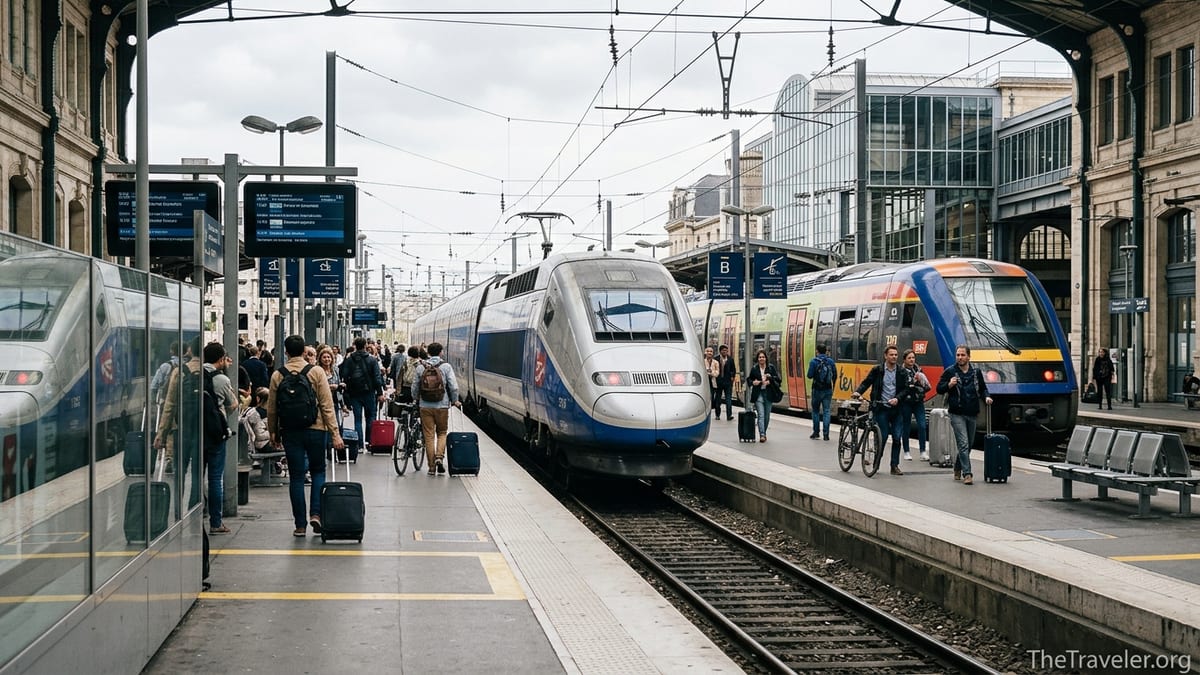
Understanding TER and TGV in Plain Language
TER stands for Transport express régional, the brand used for regional trains that connect towns and smaller cities within each French region. They are primarily funded and managed by regional councils in partnership with SNCF, the national rail operator. In practice, TER trains feel like commuter or regional trains: more stops, more basic onboard services, and a focus on short and medium-distance trips. You are likely to use a TER between places like Lyon and Grenoble, Nice and Cannes, or Bordeaux and Arcachon.
TGV, short for Train à grande vitesse, is France’s famous high speed service running on dedicated high speed lines where possible. These trains link major hubs such as Paris, Lyon, Marseille, Bordeaux and Lille at up to around 300 km/h on certain stretches. In everyday terms, a TGV is what gets you from Paris to Lyon in about 2 hours instead of roughly 5 hours by regional routes, with reserved seats, luggage racks and a smoother, long-distance feel.
Both TER and TGV are part of the same national network, but they serve different functions. TER is about geographic coverage and everyday mobility, reaching thousands of smaller stations across the 28,000 kilometers of track in France. TGV is about speed on the busiest domestic and international corridors. Understanding that division of roles makes it easier to decide which one fits a particular leg of your journey.
For travelers, the key distinction is not just speed but also flexibility and price structure. TER tickets are generally simpler and more flexible, while TGV tickets behave more like airline fares: they can be very cheap if you buy far in advance, and quite expensive at the last minute or on busy days. That difference will strongly influence which option makes sense for you.
Speed and Itinerary Design: When Time Really Matters
If you are trying to cover long distances between major cities, the time savings with TGV are substantial. For example, a typical Paris to Lyon TGV can take around 2 hours for a distance of about 460 kilometers. The same origin and destination using mostly slower lines or regional trains can easily stretch to 4.5 to 5 hours, often with at least one change. On a short trip of five or six days, that difference might mean an extra afternoon of sightseeing rather than sitting on a train.
Consider a coastal itinerary in the south of France. A TGV from Paris to Nice often takes around 5.5 to 6 hours. If you tried to assemble that journey with TER and slower Intercités services, you might be looking at 8 hours or more with multiple changes. On the other hand, once you are already on the Riviera, the speed difference between TER and TGV for short hops is much smaller. Nice to Cannes by TER is typically about 30 to 40 minutes; a faster train does not save enough time to justify a higher fare on such a short segment.
There are also routes where only one type of train is realistically available. On some corridors, like Paris to Poitiers or Paris to Bordeaux, the main direct services are largely TGV. Travelers using passes that only cover TER and Intercités may discover that there is no equivalent regional service for the same direct route, meaning you would need to detour through secondary lines or accept a slow, multi-change journey. Checking what actually runs on your date, not just what seems logical on a map, is crucial.
Think about your itinerary in tiers. For long, cross-country jumps such as Paris to Marseille, Paris to Bordeaux or Lyon to Lille, TGV almost always makes sense if you can afford it. For medium legs of one to three hours, like Lyon to Grenoble or Marseille to Avignon, the time difference between TER and TGV can be moderate, so other factors like price and flexibility may dominate. For short hops under an hour, such as Nice to Antibes or Bordeaux to Saint-Émilion via Libourne, TER is usually the natural choice.
Fares, Passes and Realistic Cost Comparisons
In everyday use, TER and TGV feel very different at the booking stage. TER fares are generally more stable, set at a regional level, and many routes have simple, walk-up prices. If you search on SNCF’s main booking platform for a route like Marseille to Arles or Toulouse to Albi, you will typically see TER tickets anywhere from roughly 10 to 20 euros in second class, even if you purchase close to departure, aside from occasional promotional or peak variations.
TGV fares behave more like airline tickets, especially on busy trunk routes. On Paris to Lyon, for instance, advance-purchase second-class TGV tickets can start around 25 to 35 euros on off-peak departures if you book weeks in advance. The same train closer to departure, or on a Friday evening at the start of school holidays, can easily cost well over 80 euros in second class and considerably more in first. On holiday weekends or around major events, it is not unusual to see prices climb higher still, especially on the most convenient departure times.
For younger travelers or those staying longer, special products can tilt the balance toward TER. In summer 2024, for example, a nationwide Rail Pass experiment allowed travelers aged 16 to 27 to ride TER and most Intercités trains unlimited for a month for a flat 49 euros, while excluding TGV services. A similar focus on regional and Intercités services appears in many regional discount passes which systematically offer percentage reductions on TER but do not include high speed trains. These kinds of offers effectively make TER the backbone of budget-friendly, spontaneous travel within France.
International rail passes such as Eurail and Interrail also influence the calculation. Passholders often find that reservations on French TGVs come with an additional supplement per journey. Depending on the specific route and date, these reservation fees can be modest or quite noticeable when multiplied across several segments. By contrast, TER services usually do not require reservations at all, so passholders can board without paying extra beyond the cost of the pass itself. If you hold a pass and want to minimize extra charges, stitching together a route with TER services can be more economical, at the cost of greater travel time.
Flexibility, Reservations and Day-of-Travel Experience
One of the biggest practical differences between TER and TGV is how flexible they are on the day of travel. TGV seats are always reserved: your ticket is typically valid for a specific train, carriage and seat number. If you miss your train, changing to another one can incur change fees or require purchasing a completely new ticket, depending on the fare conditions you chose. On days of disruption, this can lead to crowds at ticket counters and customer-service desks as travelers try to rebook.
TER services, in contrast, usually operate on a turn-up-and-go basis. Second-class seating is unreserved, and your ticket is typically valid for a set date and route rather than a specific train, although exact rules can vary by region and fare type. In practice, that means if your morning in Avignon runs long, you can often simply take the next TER to Arles without any formal change process, as long as your ticket or pass is valid for that day. For travelers who value spontaneity or who are nervous about tight connections, this flexibility is a major advantage.
Onboard, the experience also differs. TGV trains generally have more comfortable seating for long distances, with reclining seats, power outlets on many units, and better noise insulation. They often include a bar or café car selling snacks, drinks and simple meals. Business travelers commuting between Paris and major cities rely heavily on this environment to work on laptops during their journey. TER trains can be quite varied, from older single-level carriages to modern double-deck units, but the overall feel is more utilitarian: good for an hour or two, less ideal for a six-hour cross-country trek unless you are very budget-conscious.
For cyclists and hikers, TER networks often provide more straightforward bike carriage options and stop at more rural stations close to trailheads. For example, if you want to cycle along the Loire à Vélo routes, TER services between towns like Tours, Blois and Orléans tend to be more practical than TGV, which mainly serves major nodes. The same applies in the Alps, where regional services connect valley towns more tightly than long-distance high speed lines that simply cross the region.
Where Each Option Shines: Concrete Route Examples
The easiest way to decide between TER and TGV is to look at actual itineraries. Suppose you are visiting Normandy from Paris and want to reach Rouen and the coastal town of Dieppe. Paris to Rouen is often served by fast Intercités or regional-style trains rather than TGV, and Rouen to Dieppe is a clearly regional link. Here, using TER or equivalent non-TGV services makes complete sense; there is no meaningful high speed alternative for the last stretch, and ticket prices remain moderate even for late bookings.
Now imagine you are backpacking from Barcelona to Paris with a few days in between. To move quickly, taking a TGV or other high speed service between cities like Perpignan, Montpellier, Lyon and Paris will drastically reduce your total transit time. A leg such as Montpellier to Paris can fall to roughly 3.5 hours by high speed train instead of a long all-day ride on slower services. If your overall trip across Europe is short, those hours saved can be worth the premium, especially if you plan ahead and snag lower advance fares.
In Provence, travelers often combine both types of train in a single day. A common pattern is to arrive by TGV to Avignon TGV station from Paris in about 2 hours and 40 minutes, then switch to a TER to reach smaller destinations like Arles, Orange or Nîmes. The TGV handles the long trunk journey, while TER distributes you into the region’s smaller cities. Trying to do everything with TER from Paris would be significantly slower and more complicated, but relying only on TGV would leave you stuck at big hubs without access to villages and mid-sized towns.
On the French Riviera, the case for TER is strong once you are in the region. The dense coastal TER line between Nice, Antibes, Cannes and onward toward Marseille allows you to travel at relatively low cost with frequent departures, which is ideal for day trips. A traveler staying in Nice might use a single TGV to arrive from Paris or Lyon, then rely exclusively on TER for several days of exploring coastal and inland towns such as Menton, Grasse or Vence via nearby stations and bus connections.
How to Decide: Key Traveler Profiles
For a short city-hopping trip where time is more valuable than money, TGV-centric planning is usually best. Think of a North American traveler spending 8 days in France who wants to see Paris, Lyon and Marseille. In that scenario, using TGV between those hubs keeps each long transfer in the two-to-three-hour range, leaving large blocks of free time for sightseeing. Buying tickets several weeks in advance, particularly for midweek daytime trains, can keep the cost at a reasonable level relative to the value of that saved time.
Budget travelers, especially students and backpackers on flexible schedules, often gravitate toward TER. They may choose a slower but cheaper string of regional trains to move between regions, and then use TER heavily within each region for side trips. A traveler with a month-long stay may accept a 5-hour regional journey from Bordeaux to Toulouse if it saves a significant amount over TGV and fits a leisurely schedule. Regional passes or youth-oriented products that focus on TER and Intercités can make this style particularly cost-effective in summer.
Families may opt for a hybrid strategy. Parents traveling with children often prefer faster high speed services for the longest jumps, to limit boredom and fatigue, but then rely on TER for shorter excursions from a base city. For example, a family could take a TGV from Paris to Bordeaux, stay several days, and then use TER for quick outings to Arcachon for the beach or Saint-Émilion for a village and vineyard experience. This splits the trip into one or two expensive but time-saving high speed legs and multiple inexpensive regional jaunts.
Finally, rural explorers and slow travelers who are more interested in villages, vineyards and hiking routes than in big museums and monuments will likely spend much of their time on TER. In regions like Brittany, Occitanie or the Auvergne, it is the regional trains that connect small towns and trailheads. For them, TGV might only appear at the very beginning or end of the trip, to enter or leave France’s main high speed corridors.
The Takeaway
Choosing between TER and TGV in France is less about one being universally better and more about matching each to the right leg of your journey. TGV is unbeatable for long distances between major cities, slashing travel times and offering a comfortable, reserved-seat environment that feels more like medium-haul air travel on rails. The price you pay is higher fares and less flexibility if your plans change at the last minute.
TER, on the other hand, is the workhorse of regional mobility. It reaches far more destinations, tends to be cheaper and simpler to use, and lends itself to spontaneous day trips and slow, exploratory travel. For many visitors, the sweet spot is a mix of both: use TGV to bridge the longest gaps efficiently, then rely on TER to actually discover the character of each region once you arrive.
Before you book, sketch your itinerary on a map, then test a few sample journeys in a booking engine for both options. Compare not just ticket prices, but also total journey times, the number of changes and how tightly you are willing to schedule your days. With that information, you can use France’s impressive rail network to support the style of trip you actually want, rather than letting the timetable dictate your experience.
FAQ
Q1. What is the main difference between TER and TGV in France?
TER are regional trains serving short and medium distances with many stops, while TGV are long-distance high speed trains connecting major cities at much higher speeds.
Q2. Is TGV always faster than TER?
On long routes between major hubs, TGV is significantly faster. On short hops of under an hour, such as Nice to Cannes, the time difference between TGV or other fast services and TER is often small.
Q3. Are TER tickets cheaper than TGV tickets?
Generally yes, especially for last-minute travel. TER prices are more stable, while TGV prices vary widely based on demand and how far in advance you book.
Q4. Do I need reservations for TER trains?
Most TER trains do not require or offer seat reservations; you simply board with a valid ticket or pass. TGV services always use reserved seating tied to a specific train.
Q5. Can I use a Eurail or Interrail pass on TER and TGV?
You can usually use such passes on both, but TGV requires a paid seat reservation on top of the pass. TER normally does not, making it cheaper to use with a pass.
Q6. Which should I choose for a short trip, like one week in France?
If you are visiting multiple far-apart cities in a week, prioritize TGV for the long transfers and use TER only for short regional day trips once you reach each base.
Q7. Is TER safe and comfortable for longer journeys?
TER is generally safe and reasonably comfortable, but it is designed for regional rather than long-haul travel. For journeys over four or five hours, most travelers find TGV more comfortable.
Q8. How early should I book TGV tickets?
It is wise to book TGV tickets as early as practical, especially for weekends, holidays and popular routes, since the cheapest fare levels sell out first and prices often rise with demand.
Q9. Can I combine TER and TGV on the same ticket?
Many itineraries are sold as combined journeys, for example TGV from Paris to a regional hub and TER onward to a smaller town. Booking them together can simplify connections and ticket checks.
Q10. Which option is better if I want spontaneous day trips?
TER is usually better for spontaneity. With frequent departures, generally lower prices and no seat reservations, you can decide late and still travel without penalty in most cases.