


More news on this day
Jet fuel prices are rising again, and airlines are responding with a twin strategy: accelerate investment in cleaner fuels while using data and automation to squeeze more efficiency from every flight. For travelers, the shift could shape everything from ticket prices and route maps to how “green” a journey really is in the decade ahead.
Get the latest news straight to your inbox!
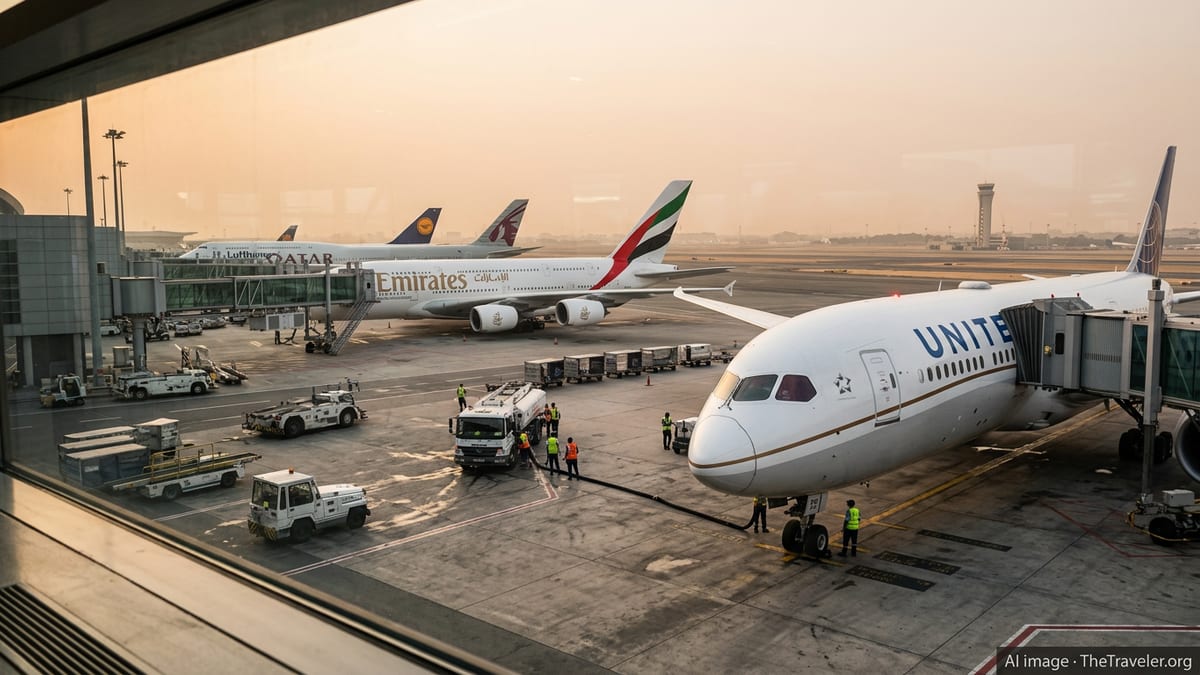
Fuel Costs Return as a Major Threat to Airfares
After a period of relative stability in 2024 and early 2025, jet fuel has re-emerged as a major cost pressure for airlines worldwide. Industry analyses published in mid-2026 point to a mix of geopolitical tensions, refinery constraints and structural tightness in middle distillate supplies that have pushed average jet prices well above long-term norms. In some regions, estimates show jet fuel trading at a premium to crude oil that rivals the energy shocks seen earlier in the decade.
Economic outlooks from global airline associations indicate that fuel now accounts for roughly a third of many carriers’ operating costs, up from closer to a quarter in calmer years. This swing leaves airlines with an uncomfortable choice: absorb the hit and risk margins, or push more of the burden onto passengers through surcharges and higher base fares. The answer so far has been a combination of modest fare increases, capacity adjustments on marginal routes and aggressive efforts to cut fuel burn per flight.
At the same time, travel demand has remained resilient. Forecasts released in 2025 and 2026 suggested global passenger volumes surpassing pre-pandemic levels, even as households contend with broader cost-of-living pressures. That combination of strong demand and higher operating costs is nudging airlines to use fuel more efficiently rather than rely solely on price hikes that could dampen future growth.
For travelers, this means fuel remains a hidden driver of ticket prices and route availability. Long, thin routes with less premium demand are especially exposed, and are often the first to see schedule reductions if fuel markets tighten further.
Sustainable Aviation Fuel Grows, but From a Very Small Base
Airlines and policymakers increasingly present sustainable aviation fuel, or SAF, as the central lever for cutting emissions while keeping long-haul flying viable. SAF can be made from waste oils, agricultural residues or synthetic pathways using renewable electricity, and can be blended with conventional jet fuel in existing aircraft and infrastructure. Industry roadmaps from groups such as IATA describe SAF as potentially providing up to two-thirds of the sector’s needed emissions reductions by mid-century.
Production, however, remains far from matching the rhetoric. Recent data compiled in 2025 and summarized in the 2026 industry annual review indicate global SAF output of roughly 1.9 million tonnes in 2025, equal to well under 1 percent of total jet fuel consumption. Research on SAF markets in Europe and beyond highlights that most announced projects are still in early stages, and that reaching policy targets will require an exponential build-out of new plants, supply chains and feedstock arrangements.
Price is an even bigger hurdle. Technical assessments by European regulators and academic studies show current SAF prices typically running three to ten times higher than conventional jet fuel, depending on feedstock and technology. Even with long-term offtake agreements, airlines pay a premium that can only be partially recovered through tickets or corporate customer contracts. Without strong policy support, many analysts warn that SAF use would remain confined to showcase flights and limited blending mandates.
For the moment, most large carriers are pursuing a similar playbook: sign multi-year SAF purchase agreements, invest directly in some production projects, and use green surcharges, loyalty program partnerships and corporate deals to share the cost. Leisure travelers may notice small opt-in contributions at booking, but the bulk of the SAF bill is currently baked into overall fare structures.
Policy Incentives Aim to Bridge the Cost Gap
Governments in major aviation markets are attempting to close the gap between ambition and economics with a mix of mandates and subsidies. In the European Union, the ReFuelEU Aviation regulation requires fuel suppliers at larger airports to include a minimum share of SAF starting at 2 percent in 2025, rising progressively toward 2050. Parallel guidance from European safety and environment bodies underscores that meeting these goals will demand rapid scale-up of production and investment in new infrastructure.
In the United States, federal measures under the Inflation Reduction Act provide tax credits for SAF blends that achieve verifiable lifecycle emissions reductions, with additional clean fuel production credits scheduled from 2025. Publicly available information from the Treasury, Internal Revenue Service and Department of Energy describes these incentives as intended to draw in private capital, de-risk new technologies and build a domestic supply base of low-carbon fuels.
Other jurisdictions, including the United Kingdom and several Asia-Pacific states, are moving toward their own SAF mandates or financial support schemes. European policy documents also signal a gradual shift in tax treatment away from conventional kerosene and toward more favorable treatment of low-carbon fuels, aiming to align price signals with climate objectives. Analysts note that, collectively, these policies are beginning to shape where new SAF plants are built and which routes see early adoption.
For travelers, the impact of these measures will be indirect but significant. As mandates tighten, SAF costs are likely to be spread across ticket prices, especially on routes from regions with the most ambitious requirements. At the same time, credible policy support may help prevent even sharper fare increases later by accelerating the move to more efficient, less volatile fuel sources.
Smarter Operations: AI, New Flight Profiles and Leaner Ground Work
Alongside fuel switching, airlines are turning to operational efficiency to blunt both cost and climate risks. Advances in flight-planning software, trajectory-based operations and AI-driven route optimization allow carriers to account more precisely for wind patterns, airspace constraints and weather systems. Case studies from air navigation projects and research on trajectory optimization suggest that more flexible, data-rich routing can cut fuel burn by several percent on a typical long-haul flight.
Aircraft manufacturers and airlines are also experimenting with collaborative initiatives that connect cockpit crews, dispatch centers and air traffic controllers in near real time. Demonstrator programs using widebody jets on long-range routes have reported meaningful savings by flying at more efficient altitudes and speeds and minimizing holding patterns. While individual changes may seem modest, industry technical notes show that even a 1 percent improvement in fleetwide fuel efficiency can save hundreds of millions of dollars and avoid millions of tonnes of carbon dioxide each year.
On the ground, airlines and airports are phasing in electric ground vehicles, single-engine taxi procedures and reduced auxiliary power unit use at the gate. Engineering analyses of aircraft fuel economy indicate that cutting APU time, optimizing flap settings on approach and reducing excess fuel and water carried on board can each shave a small percentage off total consumption. Taken together across thousands of daily flights, these measures form a critical, lower-cost bridge while SAF and new aircraft technologies scale up.
For passengers, smarter operations may translate into more direct routings, slightly longer or shorter schedules depending on wind-optimized paths, and occasional changes in onboard services driven by weight-saving efforts. Most of these shifts are subtle, but they are central to how airlines manage fuel bills under persistent price pressure.
What Travelers Should Watch in the Years Ahead
As fuel costs and climate policies reshape aviation economics, several trends are likely to become more visible to travelers. First, fare structures may evolve, with more explicit surcharges linked to SAF use or carbon intensity, particularly on long-haul and premium-heavy routes. Some carriers already highlight the share of SAF used on certain flights or offer customers options to contribute to additional low-carbon fuel purchases at checkout.
Second, route networks could tilt toward more efficient aircraft and hubs that offer better access to SAF and optimized airspace. Industry outlooks suggest that newer, fuel-sipping models will be prioritized on long-distance routes, while older, less efficient jets may be retired faster if fuel markets remain tight. Airports investing in on-site renewable energy and low-carbon ground operations may gain an advantage in attracting airline capacity.
Third, the credibility of “green” claims around flying is likely to come under increased scrutiny. Academic research on alternative aviation fuels and policy assessments in Europe and North America emphasize the importance of robust lifecycle accounting, sustainable feedstocks and transparent reporting. Travelers may see more standardized metrics on emissions per passenger and clearer differentiation between genuine SAF use and traditional offset schemes.
The overall message for passengers is that the cost and carbon profile of flying are converging as central concerns for airlines. Higher fuel prices are accelerating actions that were already on the agenda because of climate goals, from SAF investments to AI-enabled efficiency. While the transition will not be seamless, the choices airlines make now about fuels and operations will shape the affordability and sustainability of global travel for years to come.