


Immigration enforcement in Thailand has entered a more data-driven and security-focused phase, with authorities explicitly targeting overstays, misuse of visas, and unregistered foreign residents. For existing and prospective foreign residents, understanding how enforcement is evolving is increasingly important for evaluating the practical risk environment of a long-term stay in the country.
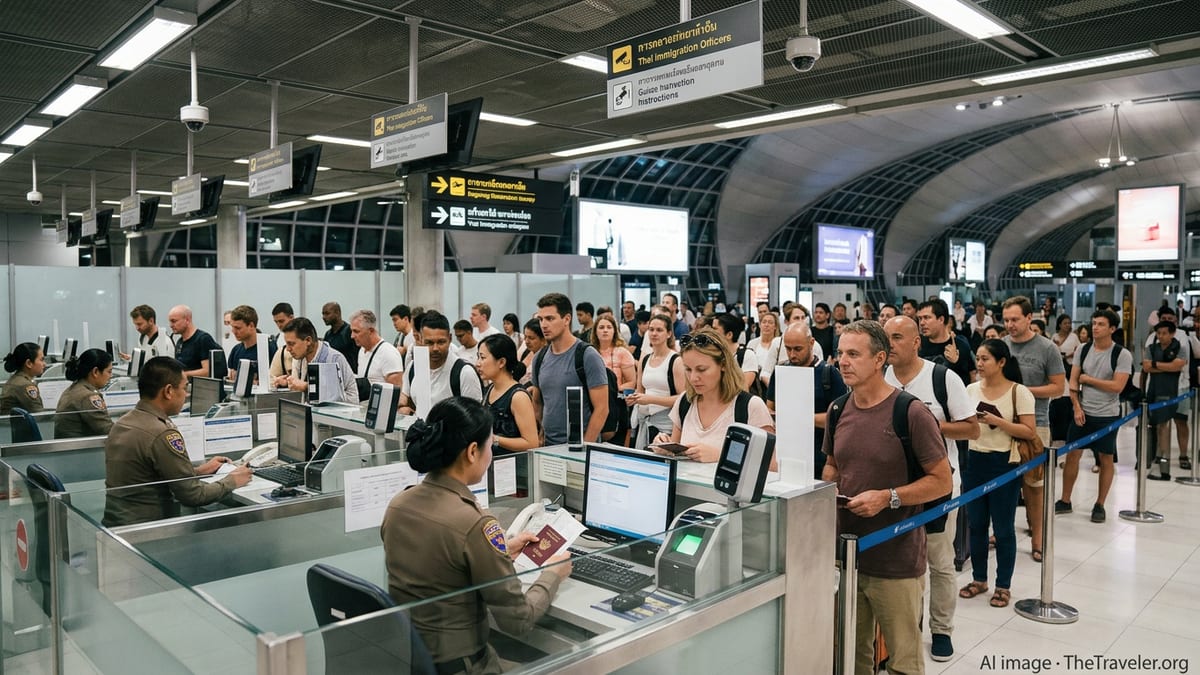
Overview of Thailand’s Immigration Enforcement Direction
Thailand’s immigration enforcement strategy has shifted from primarily tourism-focused control to a broader internal security and compliance model. Authorities now consistently link immigration policy to the fight against transnational crime, cyber scams, and undocumented labor, which has led to visibly tighter checks on certain categories of foreign nationals. Periodic “crackdown” campaigns are now framed as ongoing policy rather than temporary initiatives.
Recent official statements indicate that immigration units nationwide are being directed to increase active operations, intelligence-led investigations, and systematic reporting of results. A March 2026 policing directive emphasized strengthened coordination between immigration offices and the Center for Suppression of Transnational Criminals and Illegal Immigration, with local commanders tasked to intensify checks on foreigners who may be using Thailand as a base for illegal activity or as a long-term haven without proper documentation.
At the same time, authorities stress that enforcement must not harm tourism and legitimate investment, repeatedly referencing the goal of attracting “quality” visitors and residents while filtering out those viewed as security or reputational risks. For law-abiding foreign residents, the trend is toward more formal monitoring and paperwork, but not necessarily arbitrary targeting, provided all reporting and status conditions are strictly observed.
Overstay Controls and Penalty Practices
Overstaying permission to stay remains one of the primary enforcement priorities. Police and immigration communications over 2024 and 2025 have repeatedly highlighted arrest campaigns targeting foreigners who have overstayed by months or years in key hubs such as Pattaya, Phuket, and island destinations. Publicized arrests of individuals with overstays in the hundreds or even more than one thousand days are used to reinforce the government’s message that “long-term overstayers” are no longer tolerated as a routine feature of the system.
Thailand’s legal framework provides for daily fines for overstay, as well as bans on re-entry for longer violations. In practice, enforcement distinguishes between short, voluntary overstay discovered at an exit point and overstay detected in-country through police operations. Foreigners who present themselves at immigration or at an airport with a modest overstay typically face an administrative fine, whereas those located by police during raids can be detained, prosecuted, and deported, with an accompanying multi-year ban on return. Reported cases of large overstays emphasize that immigration officers now pursue in-country arrests, rather than simply waiting for offenders to attempt departure.
Recent policy adjustments have modestly increased maximum potential fines and stressed that repeat offenders can face higher sanctions and closer scrutiny on subsequent visa or stay applications. However, enforcement practice still includes narrowly defined humanitarian exemptions. In late February and early March 2026, the Immigration Bureau explicitly waived or deferred overstay penalties for foreigners stranded by major disruptions to airspace linked to conflict in the Middle East, while simultaneously ordering officers to screen such cases carefully to avoid exploitation of these temporary measures by criminals or deliberate overstayers.
The operational trend for foreign residents is clear: even accidental or brief overstays are less likely to be informally overlooked than in the past, and systematic data use increases the chance that long-term offenders will be located rather than simply aging out their status invisibly.
Crackdown Campaigns and Targeted Groups
Immigration enforcement in Thailand is increasingly organized around targeted campaigns, often following high-level instructions from the prime minister or national police chief. Recent campaigns have focused on “visa runners” repeatedly entering on short-term permissions without establishing a legitimate basis for long-term residence, as well as on foreigners using ostensibly legal visas to mask work, crime, or unregistered economic activity.
In late 2025 and early 2026, regional immigration offices were ordered to crack down on visa runners who exit and re-enter the country solely to reset short-term permission to stay without changing the underlying basis of their presence. Immigration officers have reported being instructed to scrutinize frequent border crossers more closely, particularly in provinces that serve as overland gateways. Foreigners who previously relied on serial entries under tourist privileges may now find themselves questioned, refused re-entry, or directed to obtain a more appropriate visa category abroad.
Another area of focus is the misuse of education visas and other “soft” categories. Instructions issued in March 2026 call for strict review of student visa extensions, especially for applicants who are not genuinely attending classes or whose course of study is inconsistent with their profile. Similarly, immigration and police units have been tasked with identifying foreigners claiming disruption from overseas unrest solely to extend stays without a genuine protection need, signaling a more skeptical approach to humanitarian pretexts.
There is also sustained attention on nationals of neighboring countries working informally, on individuals connected to scam centers and cybercrime operations in the wider region, and on those suspected of involvement in drug or human trafficking networks. While such groups are not representative of the broader foreign resident population, the enforcement apparatus designed to pursue them often has spillover effects on all foreigners in the form of increased ID checks, residence verification visits, and document scrutiny during routine interactions.
Address Registration and TM30 Enforcement Trends
Thailand’s TM30 system, derived from Section 38 of the Immigration Act, requires heads of household, property owners, landlords, and hotel managers to notify immigration when a foreigner resides at their property. Although the rule has existed for decades, systematic enforcement has increased over the last several years as authorities seek more granular location data on foreigners within the country.
Recent legal guidance reinforces that property controllers must file a TM30 within a short period, typically within 24 hours of a foreigner’s arrival at the residence. Hotels, licensed accommodation providers, and corporate landlords are generally accustomed to these processes, but private landlords and individual owners remain inconsistent in compliance. Foreign residents regularly report that immigration offices may refuse to process visa extensions, status changes, or 90-day reports if TM30 records are missing or outdated, effectively using service access as an enforcement tool. Fines can be imposed on property owners for non-compliance, with higher penalties or escalated attention where multiple foreigners are housed without proper notification.
Enforcement intensity varies by province, with major centers such as Bangkok, Chiang Mai, Phuket, and Koh Samui typically applying the rules more rigorously. At the same time, there have been limited relief measures, including clarifications that not every overnight absence requires fresh reporting in all cases and that a single TM30 registration may cover a defined stay period. Nonetheless, regulatory commentary in 2025 highlighted that the government has also tightened oversight on short-term rentals and unlicensed hospitality operations, in part by using TM30 data cross-checked against information from booking platforms and local authorities.
For foreign residents, the practical impact is that proof of proper address registration has become a de facto prerequisite for smooth interaction with immigration services. Where landlords do not understand or resist their obligations, residents can face indirect consequences such as delayed extensions or the need to negotiate access to ownership documents. This trend meaningfully raises the compliance burden associated with long-term residence, even though the formal obligation technically rests with the property owner rather than the foreigner.
Ongoing 90-Day Reporting and Location Monitoring
Separate from TM30, Thailand requires foreigners who remain in the country for more than 90 consecutive days on a given permission to stay to submit a location report at 90-day intervals. This “90-day report” is not a visa or extension in itself but functions as a periodic confirmation of the foreigner’s address and presence. Educational institutions, major employers, and international offices at universities routinely remind foreign staff and students of these requirements, underlining their continued importance to the monitoring system.
Guidance materials updated in 2024 and 2025 indicate that the 90-day count is typically based on the last date of entry into Thailand, and the report can be submitted in person, by mail, or electronically, depending on the current functionality of immigration’s online systems. Failure to report on time usually results in a modest administrative fine when the individual next interacts with immigration. However, repeated late reports can attract greater scrutiny, and reports from foreign residents suggest that some offices are becoming less tolerant of chronic non-compliance.
Technically, leaving the country resets the 90-day clock, meaning that frequent travelers may have fewer reports to file. Still, as border and internal controls strengthen, residents who stay largely continuously in Thailand for work or retirement must plan around this recurring requirement. In practice, 90-day reporting, TM30 registration, and visa extension appointments combine to create multiple touchpoints through which immigration maintains updated data on foreign residents.
Digital tools are increasingly central to this monitoring. Several universities and large employers distribute step-by-step guidance for completing online reports and emphasize that system outages or errors do not exempt foreigners from their underlying obligations. The overall trend is toward normalizing regular electronic contact between foreign residents and immigration authorities, with lower tolerance for those who remain “off the radar” between visa issuance and renewal.
Short-Term Humanitarian Relief vs Systemic Tightening
While enforcement has clearly tightened, Thai authorities also show a pattern of temporary relief measures in response to exceptional events that could trap foreigners in non-compliance through no fault of their own. For example, when natural disasters or transportation disruptions have made timely departure impossible, the Immigration Bureau has periodically announced waivers or suspensions of overstay fines for affected tourists and residents, provided they can demonstrate genuine impact and intent to comply with the law.
The most recent instance is the March 2026 response to airspace closures linked to conflict in the Middle East, in which immigration officials were instructed to grant leniency on overstay fines to those unable to depart on schedule, while still processing them through standard security checks. An earlier case involved waivers for foreigners stranded by severe flooding in southern provinces. These measures signal that the system can distinguish between willful overstay and unavoidable delay, which is relevant for risk assessment by long-term residents concerned about unforeseen disruptions.
However, these relief actions coexist with instructions to prevent abuse of humanitarian channels. Police leadership has specifically warned immigration officers to examine closely any extension requests citing unrest or instability abroad, viewing such claims as potential cover for individuals seeking to prolong stays without meeting the usual criteria. Similarly, when amnesties or temporary waivers are issued, authorities typically insist on thorough identity verification and record-keeping to maintain security objectives.
For foreign residents evaluating the broader enforcement trend, the implication is a “hard shell, soft center” approach: rules are more strictly enforced on a day-to-day basis, but narrowly defined flexibility remains available in exceptional circumstances, usually contingent on documentation, timely communication with authorities, and a clean compliance history.
The Takeaway
Thailand’s immigration enforcement environment for foreign residents is increasingly structured, data-driven, and security-oriented. Key trends include intensified crackdowns on overstays and serial visa runners, targeted scrutiny of perceived high-risk groups and visa categories, and more systematic use of address registration and 90-day reporting to maintain visibility over the foreign population. While this does not equate to hostility toward legitimate residents, it does mean that informal or “grey zone” arrangements that were previously tolerated are now significantly riskier.
For individuals considering relocation, the practical message is that long-term residence in Thailand can remain viable but demands higher procedural discipline. Residence addresses must be correctly registered, reporting timelines carefully observed, and reasons for stay aligned with the chosen immigration status. Those who plan around these enforcement realities, maintain thorough documentation, and work with landlords or employers familiar with compliance practices are more likely to experience a predictable regulatory environment. Conversely, reliance on casual advice, ad hoc border runs, or lax record-keeping is increasingly incompatible with Thailand’s emerging immigration enforcement model.
FAQ
Q1. How aggressively is Thailand currently enforcing overstay rules for foreign residents?
Enforcement of overstay rules has become significantly more active, with police and immigration units conducting targeted operations to locate long-term overstayers, especially in major tourist and expatriate centers. Short voluntary overstays discovered at departure generally result in fines, but in-country detection can lead to detention, deportation, and future entry bans.
Q2. Are foreign residents still able to rely on border runs to maintain long-term stays?
Serial border runs are now much less reliable as a long-term solution. Immigration officers have been instructed to scrutinize frequent re-entries, question the genuine purpose of stay, and in some cases refuse entry or limit the permission period. Individuals intending to reside for extended periods are expected to use visa and stay categories that match their actual activities.
Q3. How important is TM30 address registration for day-to-day life as a foreign resident?
TM30 registration has become a practical cornerstone of compliance. While the formal obligation rests with landlords or property owners, foreign residents commonly face indirect consequences if TM30 records are missing, including difficulties with visa extensions, 90-day reporting, or other immigration services. Ensuring that the residence is properly registered greatly reduces friction.
Q4. Is the 90-day reporting requirement being strictly enforced?
The 90-day reporting rule continues to be enforced, although first-time or minor delays usually result in a standard fine rather than severe penalties. Nonetheless, repeated late reports or a pattern of neglect can attract closer scrutiny. Authorities increasingly expect long-term residents to treat 90-day reporting as a routine compliance obligation.
Q5. Does enforcement vary significantly between different regions of Thailand?
Yes, enforcement intensity and practices can vary by province and even by local immigration office. Major centers such as Bangkok, Chiang Mai, Phuket, and key island destinations generally apply address registration and reporting rules more rigorously, and they host more active enforcement operations targeting overstays and visa misuse.
Q6. How does current enforcement affect foreign retirees and long-stay residents who follow the rules?
For compliant retirees and long-stay residents, the main impact is more frequent interaction with immigration systems and a greater need for accurate paperwork. Routine checks, TM30 verification, and strict documentation standards at extensions are now normal, but individuals who maintain full compliance are not typically the focus of crackdowns.
Q7. Are there any situations where Thailand relaxes immigration enforcement, such as during crises?
Thai authorities periodically relax certain penalties in response to exceptional events, such as natural disasters or large-scale transport disruptions that prevent timely departure. In these cases, immigration may temporarily waive or defer overstay fines for affected foreigners, provided they can show evidence of genuine impact and cooperate promptly with officials.
Q8. How are education and other “soft” visas treated under the new enforcement trends?
Education and similar visas are subject to closer inspection. Immigration officers are being instructed to verify that applicants genuinely attend courses and that the program is credible. Suspicion that a visa is being used primarily as a pretext for long-term stay without genuine study can result in denial of extensions or cancellation.
Q9. What practical steps can a prospective foreign resident take to minimize immigration risk?
Practical steps include selecting an immigration status aligned with actual activities, maintaining a landlord or employer willing to handle TM30 properly, tracking 90-day reporting dates, preserving complete copies of immigration documents, and avoiding any informal arrangements that involve unreported work or unregistered accommodation.
Q10. Is Thailand becoming generally less welcoming to foreign residents due to enforcement tightening?
Current trends reflect a shift toward stricter rule enforcement rather than a blanket rejection of foreign residents. The authorities continue to court tourists, investors, and skilled professionals, but expect higher levels of transparency and compliance. For residents able to adapt to this more regulated environment, Thailand remains a feasible long-term base.