


Thailand offers relative day to day safety for most expatriates but presents a complex stability profile shaped by recurring political interventions, localized security challenges, and growing climate related disruption. This briefing consolidates key dimensions of stability risk into a practical dashboard so relocating professionals and their employers can benchmark Thailand against other destinations and design appropriate risk tolerances, assignment policies, and contingency plans.
Framework: How to Read a Thailand Stability Risk Dashboard
For relocation purposes, stability risk in Thailand can be broken into four primary dimensions: political institutional risk, public security and crime, social unrest and rule of law, and physical and climate hazard exposure. Each dimension affects different categories of expatriates in distinct ways, from senior executives and dependants to rotational staff and remote workers.
Political and institutional risk in Thailand centers on the interaction between elected governments, the military, and the monarchy, as well as the predictability of policy direction. Public security covers violent and non violent crime, policing, and everyday personal safety. Social unrest and rule of law focus on protest dynamics, the application of security and defamation laws, and the risk of arbitrary action. Physical and climate risks relate to floods, storms, heat, and infrastructure resilience, especially in Bangkok and key industrial regions.
For most corporate and NGO assignments, the key questions are not whether Thailand is broadly safe it usually is in daily life but how often disruptions occur, how predictable they are, and how serious the tail risks might be. The dashboard below highlights the main structural features that expatriates should factor into relocation decisions between now and the late 2020s.
Risk levels in this analysis are expressed qualitatively such as low, moderate, elevated, or high rather than with precise numerical scores, in order to reflect inherent uncertainty and regional variation within Thailand.
Political and Institutional Stability Risk
Thailand’s political system has experienced recurring military interventions and party dissolutions over the past two decades, which creates an elevated background level of institutional risk compared with many OECD destinations. A military coup occurred in 2014 and, while no coup has taken place since, the underlying civil military tensions remain a structural feature of Thai politics.
The general election held in May 2023 produced a strong victory for a reform oriented party, but that party was subsequently blocked from forming a government and then dissolved by the Constitutional Court in August 2024 for its stance on reforming the royal defamation law. This followed earlier dissolutions of major opposition parties in 2019 and 2020, indicating that legal interventions against successful reformist movements are now a recurring pattern rather than an exception.
In 2025, the dismissal of a prime minister and ongoing legal scrutiny of influential political figures underscored the continued role of courts and the military aligned establishment in shaping political outcomes. These events have not translated into widespread violence, but they do reinforce a perception of political volatility and policy uncertainty, especially on issues related to constitutional reform and the monarchy.
For expatriates, the practical implications are twofold. First, headline political risk is elevated: governments can change course quickly through judicial or military intervention, affecting medium term regulatory and business planning. Second, while day to day life in major cities usually continues without interruption during political disputes, periodic states of emergency or curfews in specific areas are possible, as seen in past crises. Corporate mobility policies should treat Thai political risk as structurally higher than in most Western democracies but lower than in active conflict or revolutionary environments.
Public Security, Crime, and Everyday Safety
Thailand generally records a relatively low intentional homicide rate compared with several regional peers, with estimates around the low to mid single digits per 100,000 inhabitants, and serious violent crime against foreigners remains statistically uncommon. Large tourist and expat hubs such as Bangkok, Chiang Mai, and major resort areas are heavily policed, supported by tourist police units geared to assist foreign nationals.
Crime risks for expatriates are more likely to involve non violent incidents such as petty theft, scams, and occasionally property crime. Common patterns include overcharging, fraudulent investment schemes, or card skimming operations. High profile fraud cases have involved foreign led groups operating from Thailand targeting victims abroad, illustrating that white collar crime networks can be present even though physical risks to resident expatriates remain limited.
The leading single safety concern for long term residents is road traffic. Thailand consistently ranks among countries with high rates of road fatalities, particularly involving motorcycles and night time driving. Expatriates who commute by motorbike, frequently travel intercity by road, or live in provinces with limited public transport face higher exposure than those using mass transit and professional drivers in central Bangkok.
From a relocation risk perspective, Thailand’s public security environment can be described as generally safe but with notable operational hazards. Policies that encourage defensive driving training, restrict motorcycle use by assignees and dependants, and include robust travel insurance can materially reduce exposure. For families evaluating relocation, the probability of encountering everyday crime is moderate, while serious targeted violence remains low in most areas outside of specific conflict affected southern provinces.
Social Unrest, Protest Risk, and Rule of Law Concerns
Thailand has experienced several waves of large scale political protest in the last 15 years, including youth led demonstrations from 2020 onward that directly questioned the political role of the monarchy. These protests have periodically occupied intersections and public spaces in Bangkok and other cities, at times leading to clashes, arrests, and the imposition of emergency measures, although sustained mass violence has been rare in recent years.
The dissolution of the Future Forward Party in 2020 and later its successor in 2024 contributed to renewed demonstrations and heightened political tensions, although turnout has ebbed and flowed as authorities enforced restrictions on assembly and deployed legal mechanisms against activists. Expatriates are rarely direct targets of such unrest but may experience disruption in the form of traffic closures, delays in access to business districts, or temporary relocation of offices during peak protest periods.
A distinctive feature of Thailand’s stability landscape is the stringent royal defamation framework often referred to as lese majeste, which allows for lengthy prison sentences for perceived insults to the monarchy. Use of this provision increased after 2020, and politicians and activists have received multi year sentences for speeches or online comments. This environment introduces an element of legal risk around speech, social media activity, and participation in politically sensitive debates, including for foreigners.
From a relocation standpoint, the main rule of law concern is not random legal insecurity for expatriates in daily life, but the presence of highly sensitive red lines around the monarchy and certain political topics. Corporate assignees and their families need clear briefings on local laws governing speech, protest participation, and online content. Well informed expatriates who avoid involvement in domestic political activism generally face low direct risk, but the broader protest cycle can still influence perceptions of stability and the operational continuity of offices in central Bangkok.
Regional Security: Southern Insurgency and Localized Threats
Thailand’s most persistent internal security challenge is the long running separatist insurgency in the southernmost provinces bordering Malaysia, particularly in parts of Pattani, Yala, Narathiwat, and some districts of Songkhla. Periodic attacks have included bombings and shootings targeting local security forces, schools, and public venues. While overall casualty levels have trended lower than peak years, the conflict remains unresolved and can occasionally flare.
Most expatriate assignments are concentrated in Bangkok, central Thailand, the Eastern Economic Corridor, Chiang Mai, and major resort provinces that are outside the core conflict zone. For relocations that do involve the deep south, risk controls must be substantially more robust, including security vetted housing, movement protocols, and close monitoring of local conditions.
Beyond the southern insurgency, localized security issues can occasionally emerge in border areas linked to trafficking or in nightlife districts associated with organized crime. For the majority of corporate transferees who live in established residential neighborhoods and work in formal sectors, exposure to these risks is limited, but due diligence on specific cities and districts remains important.
In stability dashboards used by multinational employers, Thailand is typically rated as medium risk overall, but with a clear internal distinction between low to moderate risk urban cores such as central Bangkok and higher risk southern border provinces. Relocation policy should reflect this geographic differentiation rather than treating the country as a single homogenous risk environment.
Climate, Natural Hazards, and Infrastructure Resilience
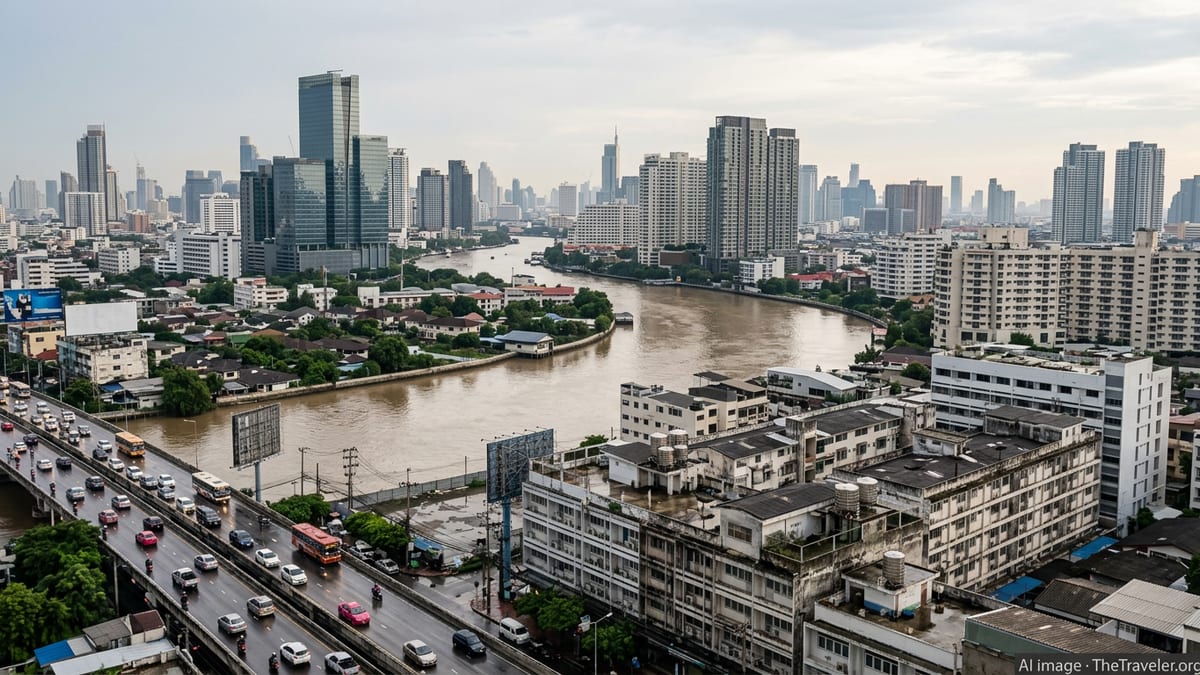
Natural hazard and climate related risk is a critical structural factor for long term expatriate assignments in Thailand. River floods are identified as the most significant natural hazard nationwide, with Thailand ranking among the countries with the highest exposure to flood impacts globally on several comparative indices. Low lying areas of the Chao Phraya watershed, including Bangkok, are particularly vulnerable during intense monsoon seasons.
Bangkok in particular scores close to the maximum levels on some urban flood risk indices, reflecting a combination of sinking land, high population density, and heavy economic concentration in flood prone zones. Past major floods have disrupted industrial estates, logistics, and normal city life for weeks, underscoring the potential for severe episodic disruption rather than continuous chronic instability.
More recent assessments emphasize that climate change is already amplifying heavy rainfall, heatwaves, and coastal erosion. Surveys in 2025 indicated that nearly all schools in Thailand had experienced disruption from extreme weather in recent years, with a high proportion reporting interruptions to essential utilities and transport.
For expatriates, this translates into a growing probability of temporary disruptions to commuting, schooling, and office operations, especially during the rainy season and in flood exposed districts.
From a relocation risk dashboard perspective, climate and natural hazard risk in Thailand should be categorized as elevated and rising. Risk mitigation for long term assignees includes careful selection of residential areas and office locations outside the most flood prone zones where possible, robust business continuity and remote work plans for flooding episodes, and explicit incorporation of climate hazard resilience into location selection for regional hubs.
Stability Risk Profile by Expat Segment
Different expatriate profiles experience Thailand’s stability risks in distinct ways. Senior executives and regional headquarters staff in Bangkok are most exposed to macro political volatility and climate related infrastructure disruption. While personal security risks remain moderate, business continuity planning around potential protests near government districts and flood impacts on transport nodes is essential.
Families with school age children focus more on everyday safety and environmental resilience. Crime and violent unrest are not primary concerns in most mainstream residential districts, but traffic safety, air quality episodes in northern cities during burning seasons, and school level preparedness for floods and extreme heat are important factors in relocation decision making.
Rotational staff in industrial estates along the Eastern Economic Corridor and in central plains provinces combine comparatively low crime exposure with heightened vulnerability to seasonal flooding and logistics interruption. Employers often manage this by concentrating staff in larger, better serviced provincial cities or in Bangkok and providing secure transport to and from worksites.
Assignments in southern border provinces represent a distinct risk class due to insurgency related threats. These roles usually fall under internal high risk deployment frameworks rather than standard expatriate relocation policies and may involve additional insurance, security, and rotation arrangements.
The Takeaway
Thailand’s stability risk environment for expatriates is best characterized as operationally manageable but structurally complex. Day to day life in key urban centers is generally safe, and most resident foreigners complete assignments without experiencing serious incidents. However, the combination of recurring political interventions, geographically concentrated insurgency, strict defamation and security laws, and pronounced climate and flood vulnerability places Thailand in a higher risk band than many advanced economies.
Relocation decisions should therefore focus less on isolated crime statistics and more on institutional patterns and environmental exposure. Political volatility typically manifests through court rulings and party dissolutions rather than widespread street violence, but it can influence policy predictability and business confidence. Climate related hazards, particularly flooding in Bangkok and central Thailand, are among the most material long term stability risks and warrant structured contingency planning.
For organizations, the practical response is not to avoid Thailand categorically, but to calibrate risk management: thorough pre assignment briefings on laws and political sensitivities, traffic and travel safety protocols, considered selection of residential and office locations, and tested business continuity plans for protest or flood scenarios. For individual expatriates and families, Thailand can be a viable medium risk relocation destination, provided that expectations are realistic and appropriate safeguards are in place.
FAQ
Q1. How politically stable is Thailand for long term expatriate assignments?
Thailand has a history of military interventions and court led dissolutions of major political parties, most recently in 2024, which creates elevated institutional volatility compared with many Western democracies. However, these events rarely translate into prolonged violent unrest in major business districts, so day to day life for expatriates is usually only indirectly affected.
Q2. Are expatriates typically targeted during political protests or unrest?
Available evidence suggests expatriates are rarely targeted during protests. Demonstrations are primarily focused on domestic political issues. The main risks for foreigners are incidental, such as traffic disruption, exposure to crowd control measures if present at protest sites, and occasional closures around government areas.
Q3. How safe is Thailand in terms of violent crime against foreigners?
Serious violent crime against foreigners is relatively uncommon in Thailand compared with some regional peers, and homicide rates are in the low single digits per 100,000 inhabitants. The more common issues for expatriates involve petty theft, scams, and road accidents rather than targeted violence.
Q4. What are the main everyday safety risks expatriates should plan for?
The leading day to day safety concern is road traffic, especially motorcycle accidents and night driving on intercity routes. Other routine risks include petty theft in crowded areas, occasional financial scams, and seasonal air quality issues in some northern cities, all of which can be mitigated with prudent behavior and employer policies.
Q5. How significant is the southern insurgency for most expatriates?
The separatist insurgency is largely confined to specific southern border provinces and does not directly affect Bangkok, the Eastern Economic Corridor, or main expatriate hubs. Most foreign assignees never travel to the conflict area. Those who do work there typically fall under enhanced security protocols distinct from standard relocation arrangements.
Q6. What should expatriates know about speech laws and political sensitivity?
Thailand enforces strict royal defamation and related security laws that can carry lengthy prison sentences. Criticism of the monarchy, participation in certain protests, or sharing sensitive content online can have serious legal consequences. Expatriates are generally advised to avoid involvement in domestic political activism and to exercise caution on social media.
Q7. How exposed is Bangkok to flooding and climate related disruption?
Bangkok is considered highly exposed to river and urban flooding due to its low elevation, land subsidence, and concentration along the Chao Phraya River. Major flood events can disrupt transport, utilities, and business operations. Climate change is expected to increase the intensity of heavy rainfall, making flood risk an important consideration for long term relocations.
Q8. Does climate risk affect the whole country equally?
No. Flood and storm risk is highest in low lying central regions, parts of Bangkok’s metropolitan area, and some coastal and riverine provinces. Northern areas may face more acute seasonal air pollution and heatwaves, while certain coastal zones are vulnerable to erosion. Expatriate exposure depends heavily on specific city, district, and housing location.
Q9. How do Thai authorities handle security and crime involving foreigners?
Thailand has dedicated tourist and immigration police units that focus on areas with high foreign resident and visitor concentrations. While enforcement capacity can vary by location, major urban centers generally respond quickly to incidents involving foreigners, and serious cases attract significant attention from central authorities.
Q10. Is Thailand an appropriate destination for expatriate families with children?
For many families, Thailand can be an acceptable medium risk destination, particularly in established expatriate neighborhoods and with access to international schools. The key considerations are road safety, flood and climate resilience of housing and schools, and clear family guidelines on avoiding political demonstrations and sensitive speech topics.