


More news on this day
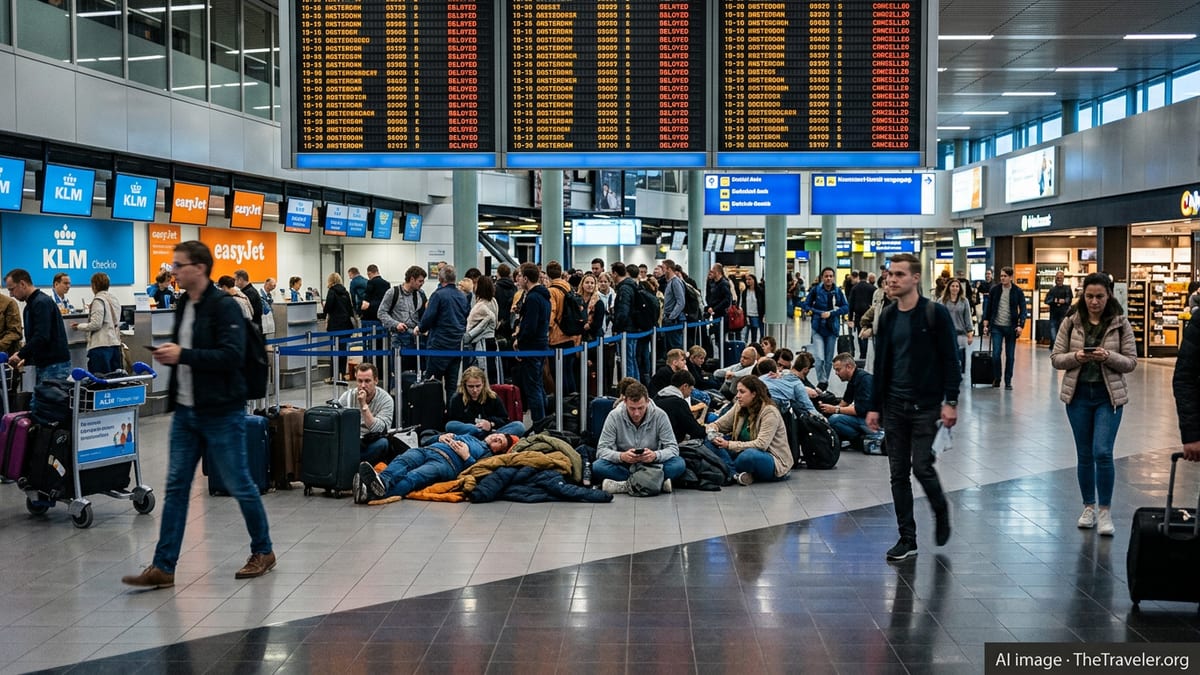
Travelers at Amsterdam’s Schiphol Airport faced widespread disruption on Thursday as KLM, easyJet, and Kuwait Airways suspended a series of flights to Paris, London, New York, and Dubai, contributing to at least 278 cancellations and nine significant delays across one of Europe’s busiest hubs.
Get the latest news straight to your inbox!
Operational Shock at One of Europe’s Busiest Hubs
Amsterdam Schiphol, a critical gateway for European and intercontinental travel, saw large sections of its departure boards wiped out as airlines trimmed or halted services on high-demand routes. Publicly available flight tracking data and disruption dashboards showed hundreds of flights scrubbed or heavily delayed within a single operating window, with KLM, easyJet, and Kuwait Airways among the most visibly affected carriers.
The disruptions were most acutely felt on trunk routes linking Schiphol to Paris and London, as well as long haul departures to New York and Dubai. These city pairs form the backbone of many travelers’ onward connections across Europe, North America, and the Gulf region, meaning cancellations quickly cascaded into missed links, lengthy rebookings, and overnight stays for many passengers.
Reports from aviation analytics platforms indicate that the 278 cancellations and nine delays were spread across short and medium haul European services and selected long haul flights, concentrating the impact into key time banks during the day. That left some departure lounges packed while nearby gates stood empty, as airlines worked to consolidate operations onto a reduced schedule.
Although Schiphol has weathered multiple waves of disruption over the past several years, from staffing shortages to severe weather and fuel-related schedule cuts, the sudden alignment of several carriers suspending prominent routes on the same day magnified the effect for travelers on the ground.
KLM Cuts and Suspensions Hit Paris, London, New York, and Dubai
KLM, Schiphol’s dominant home carrier, has already been operating under pressure in recent weeks as rising fuel costs and adjustments linked to airspace restrictions forced a rethinking of its network. The airline has publicly acknowledged scrapping more than 150 to 160 intra-European flights over the coming period, particularly to cities such as London and Düsseldorf, as part of cost-saving and capacity-management measures tied to higher jet fuel prices.
On Thursday, those earlier structural cuts converged with additional operational issues, resulting in a cluster of cancellations on hallmark routes between Amsterdam, Paris, and London, as well as transatlantic and Gulf services. Long haul sectors to New York and Dubai, which typically rely on widebody aircraft and are central to the carrier’s intercontinental portfolio, were among the services suspended, further tightening capacity on already busy corridors.
Information from KLM’s published travel alerts shows that flights to and from Dubai have been suspended for an extended period into mid-June in response to regional security considerations, while the airline simultaneously confronts a broader environment of elevated fuel prices. This has reduced flexibility in the schedule and made it harder to absorb additional day-of-operation disruption when irregularities arise.
At Schiphol, the net effect was a sudden thinning of options for passengers trying to reach key connecting hubs in Paris and London or long haul destinations like New York and Dubai. Many travelers whose flights were canceled were shifted onto later departures, routed via alternative European hubs, or left waiting for space on already crowded services.
EasyJet and Kuwait Airways Add to the Disruption
While KLM’s scale at Schiphol meant its actions carried the greatest numerical impact, the suspension of selected services by easyJet and Kuwait Airways further compounded the disruption on Thursday. EasyJet, a major low cost operator on routes between the Netherlands and the United Kingdom and France, has also been contending with higher fuel bills and periodic operational challenges across its European network.
According to recent industry coverage, the carrier has warned of cost pressures stemming from fuel and has experienced multiple pockets of schedule disruption at key bases. At Schiphol, cancellations involving flights to London intensified the squeeze on capacity for short haul passengers, especially those relying on low cost services to position themselves for onward long haul journeys from UK or French hubs.
Kuwait Airways, which provides important connectivity between Europe and the Gulf region, also appears in disruption tallies as flights linked to Amsterdam faced suspension. These changes unfolded against a wider backdrop of route adjustments by Gulf and European airlines responding to security concerns and airspace constraints in parts of the Middle East, adding yet another layer of complexity for travelers aiming to reach Dubai or connect onward to Asia and Africa.
The combined effect of cancellations by a network carrier, a major low cost airline, and a Gulf-based operator meant that alternative routings were not always readily available, particularly for same day travel. Passengers with tight itineraries found themselves competing for limited remaining seats across a shrinking pool of departures.
Why the Numbers Matter: 278 Cancellations and 9 Delays
Flight disruption statistics rarely tell the full human story, but the figures logged at Schiphol on Thursday were significant even by the standards of a large European hub. More than 278 cancellations represent several tens of thousands of potential passenger journeys altered, while nine flagged delays, many of them extended, triggered missed connections and overnight stays for those already en route.
Data from passenger rights platforms and flight tracking services illustrate how such disruption clusters can ripple across the wider network. When a morning bank of departures from Amsterdam to Paris and London is reduced, connecting flows to North American and Middle Eastern long haul services can be disrupted far beyond the Netherlands. Likewise, the suspension of nonstop links to New York and Dubai forces passengers onto indirect routings that may involve multiple additional takeoffs, landings, and security checks.
Consumer advocacy resources tracking delays and cancellations across Europe have noted that elevated fuel prices, regional security tensions, and lingering staffing constraints continue to make schedules more fragile. Even when overall cancellation percentages remain relatively low in percentage terms, concentrated spikes at a single hub can still overwhelm airport facilities and strain airline customer service channels.
For Schiphol, which has previously confronted operational caps and congestion, such episodes highlight how quickly conditions can deteriorate when several carriers simultaneously trim or suspend services on marquee routes that underpin long haul connectivity.
What Passengers Can Expect in the Coming Days
Travel industry observers suggest that conditions at Schiphol may remain volatile in the short term, particularly for flights involving Paris, London, New York, and Dubai. KLM’s publicly available updates indicate that suspensions of services to Dubai will stretch into mid-June, while recent statements about broader intra-European cuts point to a leaner schedule on key short haul corridors that feed its long haul network.
EasyJet’s capacity decisions, driven in part by fuel costs and operational considerations at its various bases, may continue to influence the availability of lower priced options between Amsterdam and major Western European cities. At the same time, ongoing adjustments by Gulf and European airlines to routes touching the Middle East suggest that nonstop options to hubs such as Dubai could remain sensitive to short notice changes.
Passenger rights guidance across the European Union emphasizes that travelers affected by cancellations or lengthy delays may be entitled to rerouting, refunds, or compensation in specific circumstances. However, the complexity of overlapping causes, including fuel economics and security-driven airspace changes, means outcomes can vary considerably from case to case.
For now, the experience at Schiphol underscores a broader reality for international travelers in 2026: even on flagship routes linking Amsterdam with Paris, London, New York, and Dubai, schedules can shift rapidly. Those planning to pass through the Dutch hub in the coming days are likely to face an environment where early checks of flight status, flexible itineraries, and contingency plans are increasingly essential parts of any trip.