


Clingmans Dome, also known by its Cherokee name Kuwohi, is the highest point in Great Smoky Mountains National Park and one of the most photographed overlooks in Appalachia. Yet many visitors reach the parking lot only to find clouds instead of views, no available parking, or even a locked access road. The biggest mistake happens long before anyone sets foot on the paved trail: they underestimate how much advance planning this “short walk” actually requires.
Get the latest updates straight to your inbox!
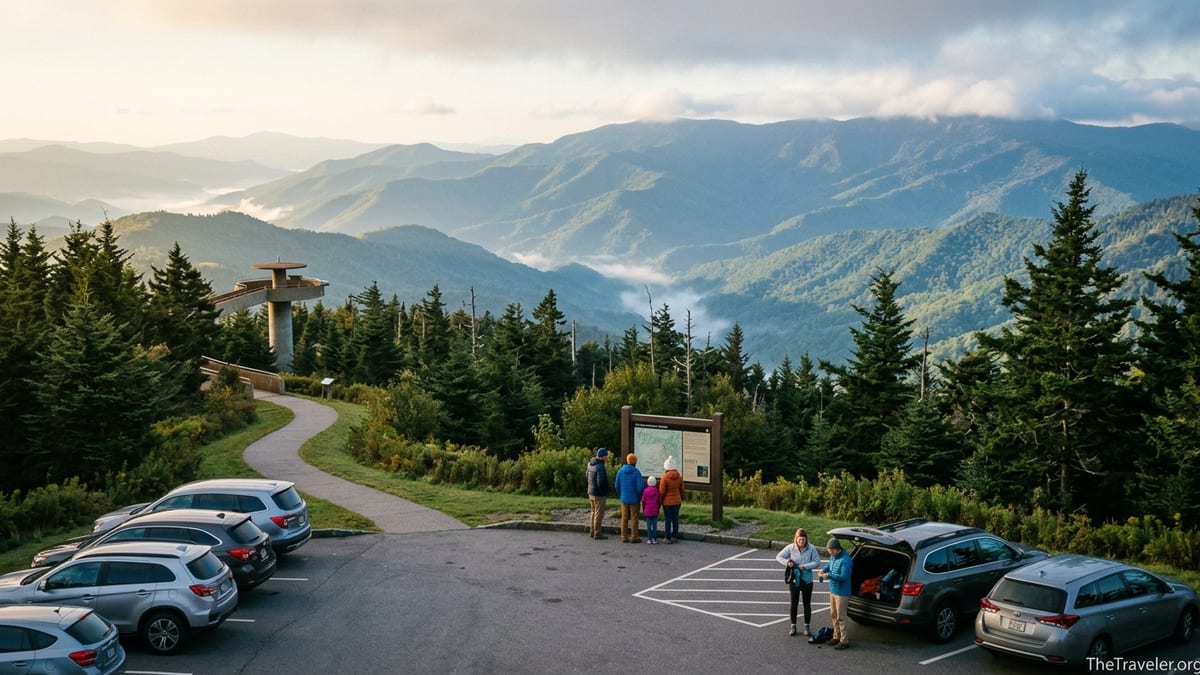
The Real Problem Starts With Assumptions
The classic Clingmans Dome story sounds like this: a family staying in Gatlinburg finishes a pancake breakfast, checks the time, and decides on a whim to “run up to the Dome” before lunch. They picture a quick drive, a brief stroll, a clear view, and then shopping back in town. By the time they reach Newfound Gap Road, traffic is crawling, the Clingmans Dome Road turnoff is backed up, and when they finally arrive at the top the main parking lot is overflowing. Rangers are turning cars around, and the family never even sets foot on the trail.
That disappointment traces back to one mistaken assumption: that Clingmans Dome is an easy add-on instead of a destination that demands its own window of time, weather check, and logistics. The road that climbs from Newfound Gap Road to the parking area is seven miles of switchbacks to more than 6,600 feet of elevation. Conditions at the top are usually 10 to 20 degrees cooler and significantly windier than Gatlinburg or Cherokee in the valleys, and clouds often sit right on the summit. Travelers who do not plan for these differences are likely to find views socked in, kids underdressed, and energy spent before the walk even begins.
On busy summer and fall weekends, especially around October foliage and holiday periods, it is common for the Forney Ridge parking lot to hit capacity by mid-morning. Local guides and Gatlinburg hoteliers routinely warn guests that arriving at noon in July means circling for a spot or being turned away outright. In online trip reports, visitors describe lines of cars stretching back down Clingmans Dome Road, with drivers waiting half an hour or more for someone to leave. The sense of frustration in those accounts rarely comes from the steep half-mile walk; it comes from realizing that a lack of planning has wasted half a day.
Just as problematic is the assumption that Clingmans Dome is accessible year-round by car. While the observation tower itself stands above the trees in every season, the seven-mile access road typically closes to vehicles from early December through March due to snow and ice at higher elevations. Visitors who build a winter itinerary around driving to the Dome frequently discover a locked gate near Newfound Gap and no alternate plan. The view is still reachable on foot via long backcountry routes, but for the average family in jeans and sneakers, the day’s marquee stop simply vanishes.
Misreading the Seasons and the Schedule
Seasonal timing is the second major piece most visitors get wrong before they ever step out of the car. On paper, it sounds simple: Great Smoky Mountains National Park is open 24 hours a day, year-round, and park brochures emphasize that there is no entrance fee. Many readers scan that sentence and assume that everything inside the park, including Clingmans Dome Road, must follow the same schedule. In reality, the park operates a patchwork of seasonal road openings, facility hours, and winter closures that fluctuate with weather and maintenance needs.
According to recent National Park Service guidance, the seven-mile access road to Clingmans Dome usually opens around April 1 and closes around November 30, though heavy snow or ice can shut it earlier, and late spring storm systems occasionally trigger temporary closures even in April or May. Visitors arriving in early spring often see azaleas blooming in Gatlinburg and assume mountain roads will be equally clear. They are surprised when they check the park’s current conditions page or electronic road signs and discover that Clingmans Dome Road is still gated due to lingering ice, even while lower elevation roads are fully dry.
Even during the main season when the road is open, day length matters. In June, sunset views from the observation tower might not occur until after 8:45 p.m., so visitors who start up from Pigeon Forge at 7:30 p.m. can realistically make it in time. In late October, however, sunset can come closer to 6:40 p.m., and the same departure time leaves them driving mountain roads in the dark and missing the color in the sky. A common complaint in autumn trip reports is realizing midway up Newfound Gap Road that the sun is already dropping behind ridge lines, with no pullouts left that offer a proper vantage.
Winter creates its own expectations gap. Online photos of Clingmans Dome covered in rime ice and fresh snow lure visitors into planning December visits with the expectation of a quick drive to a winter wonderland. Yet because Clingmans Dome Road is closed to cars during those months, the only access is by skiing or hiking more than seven miles each way from the gate or via demanding high-elevation trails like the Appalachian Trail from Newfound Gap. A family who arrives at the locked gate in sneakers, expecting a 10-minute stroll from the parking lot to the tower, usually adapts by snapping a photo of the closure sign and heading back to Gatlinburg outlets instead.
Underestimating Parking and the New Smokies Parking Tag
For decades, visitors could pull into almost any Smokies parking area without thinking about permits. That changed in March 2023, when Great Smoky Mountains National Park introduced a parking tag program. Anyone parking for more than 15 minutes now needs a paid tag displayed on their windshield. This new requirement has caught many Clingmans Dome visitors off guard. They drive all the way up, find a rare open slot, and only then notice the warning on the information kiosk indicating that a tag is mandatory.
Parking tags are readily available at visitor centers like Sugarlands near Gatlinburg or Oconaluftee near Cherokee, and there is usually a machine at the Clingmans Dome parking area that can issue a daily or weekly tag. But on peak days, the line for the kiosk can stretch across the lot, and a surprising number of travelers report wasting their prime early-morning window standing behind other drivers fumbling with credit cards and screens. Others park, head for the trail without a tag, and return to find a warning notice on their windshield and a sour taste in what should have been a highlight.
Equally disruptive is failing to account for how quickly the lot fills on popular days. Local outfitters in Pigeon Forge and Bryson City now routinely advise guests to reach Clingmans Dome parking by 8:30 or 9 a.m. if they want to be sure of a space in summer or during October foliage. Social media posts from recent seasons describe midday scenes where rangers closed Clingmans Dome Road temporarily because there was simply nowhere for additional vehicles to go. In one widely shared account, a traveler who left Gatlinburg after lunch spent nearly an hour in slow traffic up the spur road, only to be turned around at a barricade just shy of the top.
The parking crunch encourages rushed decisions. Drivers who have just crept along Clingmans Dome Road for 45 minutes feel pressure to keep whatever marginal space they are able to squeeze into, even if it is partially off pavement or blocks traffic. That stress, combined with thin mountain air and excited kids, often sets an anxious tone even before anyone steps onto the steep walkway. Planning ahead by purchasing a parking tag in town, arriving early, and building a flexible schedule that does not hinge on a single time slot turns the entire arrival into a calmer experience.
Ignoring Weather and Visibility Until It Is Too Late
Perhaps the most heartbreaking mistake happens with blue skies back in town. Visitors check conditions from a Gatlinburg hotel balcony or a Cherokee creekside cabin, see clear sunshine, and assume that visibility at 6,643 feet will be equally good. Yet the climate around Clingmans Dome is akin to a temperate rainforest, with frequent clouds and fog wrapping the higher ridges. It is not uncommon for Newfound Gap and the summit to sit inside a thick cloud even when sunshine dominates in the valleys.
Real-world examples of this pattern are easy to find. Trip reports on hiking forums and travel blogs routinely mention driving up in T-shirts to a crystal-clear morning in Pigeon Forge, only to arrive at Clingmans Dome shivering in a windbreak of cold, damp air with less than 50 feet of visibility. One parent described bundling their kids in every spare sweatshirt and beach towel in the car to make the half-mile climb, just so they could say they had reached the top, and then standing alone in a gray cloud where the famous layered ridges were completely invisible.
Wind and temperature are equally misunderstood. Weather averages around the Great Smoky Mountains suggest that winter highs in nearby Gatlinburg hover around 50 degrees Fahrenheit, while similar elevations on surrounding peaks see highs in the 30s and lows in the teens. At Clingmans Dome’s elevation, even a mild October day in town can translate to wind chills near freezing. Add the exposure on the observation tower ramp and families in shorts and sandals quickly decide to turn around at the first switchback. All of this stems from a simple lack of pre-trip weather checks for the specific elevation and a failure to pack layers in the car.
Smart planning builds weather into the day’s structure before departure. That can mean checking a forecast that specifically lists conditions at or near the summit elevation, scanning recent photos from local webcams or social media to confirm whether the peaks are in the clear, and even planning a backup viewpoint like Newfound Gap or an overlook on the Foothills Parkway if clouds settle over the highest ridge. Travelers who do this work before leaving town can pivot quickly and avoid spending the best hours of the day driving in and out of fog banks.
Misjudging Time, Distance, and the Effort Involved
Another early misstep is treating Clingmans Dome as a quick side errand on the way to something else. On a map it looks close: roughly 23 to 25 miles from Gatlinburg or Cherokee to the Forney Ridge parking area, depending on where in town you begin. Travelers with city-driving instincts see that distance and picture a 30-minute drive. In practice, Newfound Gap Road is a winding mountain highway with lower speed limits, frequent pullouts, and heavy traffic in summer and fall. Under good conditions, the drive from Gatlinburg to the Clingmans Dome road turnoff can take 45 minutes, and from there the seven-mile spur climbs slowly enough that reaching the parking area often takes another 20 minutes or more.
When visitors underestimate that drive time, everything else compresses. A family that leaves Gatlinburg at 10:30 a.m. may not start walking the trail until nearly noon, putting them on the steep uphill at the hottest and most crowded part of the day. A couple aiming for a September sunset might miscalculate civil twilight and find themselves descending the trail in the dark without flashlights. Tour companies in the region have adapted by building dedicated half-day or sunset itineraries to the Dome, but independent travelers frequently still wedge it between outlet shopping and a Dollywood reservation on the same day.
Time miscalculations also skew expectations of the walk itself. The paved trail to the observation tower is only about half a mile each way, but it climbs roughly 330 vertical feet at a grade that many visitors find surprisingly strenuous. Out-of-state tourists who have spent most of their visit in car-based locations like Pigeon Forge go-kart tracks or Gatlinburg’s main strip sometimes attempt the climb in flip-flops while carrying toddlers. The combination of altitude, incline, and crowds can stretch a short walk into a 30- to 45-minute effort each way, especially with photo stops.
Travelers who acknowledge this before they go typically build in at least two full hours for the experience: roughly one hour for the round-trip walk at a relaxed pace, 20 to 30 minutes on the tower itself, and additional time for bathroom breaks, information boards, and photos from the parking lot viewpoints. They also keep snacks and water in the car, since there are no concession stands at the top. In contrast, visitors who assume that “half a mile” equates to an effortless stroll often wind up turning back early or hurrying anxious companions along, which diminishes what should be a memorable summit.
Skipping Cultural Context and Alternative Viewpoints
Focusing narrowly on the iconic observation tower can also be a pre-trip mistake. Clingmans Dome, known traditionally to the Cherokee people as Kuwohi or Kuwahi, carries deep cultural and spiritual significance that many modern visitors never learn about. Park programs and interpretive materials increasingly highlight that this summit was part of Cherokee stories and seasonal movements long before it was crowned with a concrete tower in the 1960s. Travelers who arrive with that context in mind often experience the place differently, pausing to appreciate both the natural and cultural layers of the landscape rather than simply racing to the highest point for a photo.
Similarly, assuming that the tower is the only worthwhile vantage can lead to overcrowding and frustration. On days when the parking lot is full and the main path feels like a procession, alternative overlooks around the Smokies may offer a more relaxed experience. Newfound Gap, a major pass along the same crest road, provides sweeping views and access to the Appalachian Trail with far less climbing and, often, easier parking at off-peak hours. The Foothills Parkway to the northwest offers dramatic, layered-mountain vistas that some photographers prefer for sunset because of its orientation and fewer crowds.
Visitors who research these options beforehand are less likely to treat a clouded-in or overrun Clingmans Dome visit as a failure. Instead, they can pivot: watching sunrise from Newfound Gap, then heading to Clingmans Dome mid-morning if conditions look promising, or abandoning the tower altogether on a foggy day and enjoying lower-elevation hikes like Laurel Falls, Grotto Falls, or the quieter Balsam Mountain area. In trip reports where travelers adopt this flexible mindset, Clingmans Dome becomes one highlight among many rather than a make-or-break moment.
Understanding that the mountain’s current official name is evolving toward Kuwohi in park interpretation is also part of traveling thoughtfully. Recent public discussions and interpretive updates have emphasized the Cherokee name on signage and ranger programs, acknowledging both the cultural history and the complex legacy of older naming practices. Learning a bit about that story before arriving not only deepens the experience but also encourages more respectful conversations on the trail and tower.
How to Plan Clingmans Dome Correctly Before You Go
Planning Clingmans Dome as its own intentional outing, rather than a last-minute add-on, changes the entire dynamic of the visit. In practice, this means setting aside a dedicated morning or evening, checking seasonal road status, and building a simple checklist before leaving your hotel or cabin. For visitors staying in Gatlinburg, a realistic summer plan might be to depart town by 7:30 a.m., stop briefly at Sugarlands Visitor Center to confirm conditions and purchase a parking tag, then drive Newfound Gap Road at a relaxed pace with enough time to enjoy pullouts if traffic is light.
Weather checks should be specific, not generic. Instead of glancing at a smartphone forecast for Gatlinburg and calling it good, savvy visitors look up mountain forecasts for elevations above 6,000 feet, watch for mentions of low clouds or dense fog, and consider shifting the Clingmans Dome visit to another day if the summit is likely to be socked in. Many local guides recommend pairing a Clingmans Dome attempt with another flexible activity nearby, such as a short hike at Newfound Gap or a scenic drive along the Blue Ridge Parkway from the North Carolina side, so that the day stays rewarding even if the highest viewpoint does not cooperate.
Packing and clothing choices should also be decided before departure. Year-round, it is wise to bring a light insulating layer, a windproof shell, and closed-toe shoes with some grip, even in summer. For families traveling with small children or older relatives, considering trekking poles or allowing extra time for the uphill walk can transform the experience from a rushed ordeal into a shared adventure. Simple additions like a thermos of hot chocolate in shoulder season or a wide-brim hat and sunscreen in July make the tower stop more comfortable and encourage everyone to linger on the summit instead of hurrying back down.
Finally, expectations should reflect reality. Rather than chasing a single perfect postcard moment, plan for small wins: watching clouds race past below the tower, spotting wildflowers along the trail in June, or seeing the first reds and golds of fall color at higher elevations in late September even when the valleys are still green. Travelers who go in with this mindset, supported by a bit of advance research and flexibility, rarely feel that their time at Clingmans Dome was wasted, even if the distant ridges fade in and out of mist.
The Takeaway
The biggest mistake visitors make at Clingmans Dome happens long before they reach the steep half-mile walkway. It begins with assuming that a famously crowded, high-elevation destination in America’s most visited national park can be dropped casually into the middle of a day, without checking road status, parking requirements, weather, or drive times. That assumption sets up everything that follows: closed gates, full parking lots, shivering children, and whiteout views from a tower that social media promised would deliver endless blue ridges.
Planning Clingmans Dome well is less about secret tricks and more about respect, both for the mountain itself and for your own limited vacation hours. Treat Kuwohi as a destination with its own rhythms, shaped by weather, seasons, and the daily flow of traffic. Build your schedule around early or late light, secure your parking tag in advance, pack layers and water, and have an alternate viewpoint in mind. Do all of that before the walk begins, and you will arrive at the base of the trail not hurried or frustrated, but ready to climb slowly into one of the Smokies’ most expansive views.
FAQ
Q1. When is the best time of day to visit Clingmans Dome?
The most rewarding times are usually early morning or late afternoon, when parking is easier, temperatures are cooler, and light is softer for views and photos.
Q2. Do I need a parking tag to visit Clingmans Dome?
Yes, if you plan to park for more than 15 minutes anywhere in Great Smoky Mountains National Park, including Clingmans Dome, you must display a valid parking tag.
Q3. Is the road to Clingmans Dome open year-round?
No, the seven-mile access road typically closes to vehicles in winter, roughly from early December through March, though exact dates vary with weather and maintenance.
Q4. How long should I plan for a visit to Clingmans Dome?
Most visitors should budget at least two hours for the drive, parking, and the half-mile walk to the observation tower and back at a relaxed pace.
Q5. Is the trail to the observation tower suitable for young children and older adults?
The trail is short but quite steep. Many children and active older adults can complete it with rest breaks, but those with mobility issues may find the grade challenging.
Q6. What should I wear for a visit to Clingmans Dome?
Dress in layers, with a windproof outer layer and sturdy closed-toe shoes. Even in summer, conditions at 6,600 feet can be much cooler and windier than in town.
Q7. Can I see good views from the parking lot if I do not hike to the tower?
Yes, the parking area offers impressive vistas, but the observation tower usually provides the broadest 360-degree views above most of the surrounding trees.
Q8. What happens if the parking lot is full when I arrive?
On very busy days, rangers may turn vehicles around or temporarily close Clingmans Dome Road. Arriving early in the day or visiting on weekdays helps avoid this problem.
Q9. Are there restrooms or services at Clingmans Dome?
There are basic restroom facilities and a seasonal visitor contact station, but no full-service restaurant or store, so bring your own water and snacks.
Q10. What other viewpoints should I consider if Clingmans Dome is fogged in?
Newfound Gap, the Foothills Parkway, and overlooks near the Blue Ridge Parkway on the North Carolina side can all offer excellent views when the highest ridges are in cloud.