

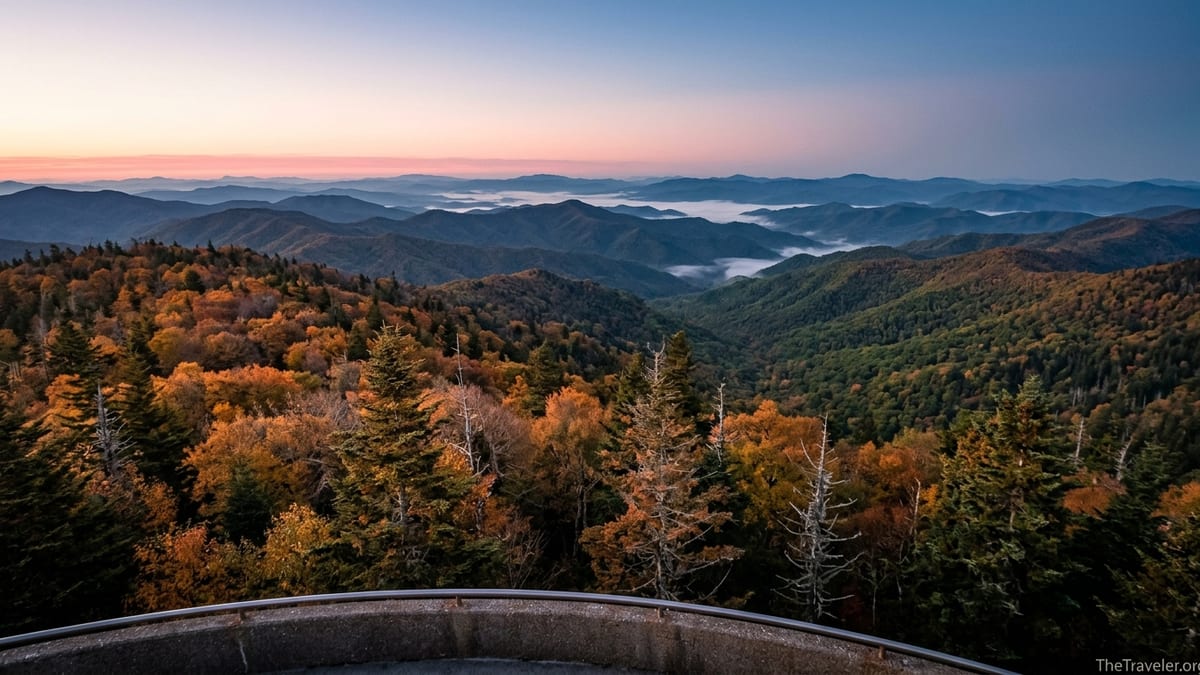
Clingmans Dome, the 6,643-foot high point of Great Smoky Mountains National Park, is one of the most spectacular sunrise and fall color viewpoints in the eastern United States. Timing your visit correctly can mean the difference between an unforgettable panorama of layered ridges glowing in orange and red, and a chilly morning in a complete whiteout. This guide walks through when to visit for sunrise, how fall color timing works at high elevation, and how to stack the odds in favor of clear, crowd-manageable views.
Get the latest updates straight to your inbox!
Understanding Clingmans Dome’s Seasons and Access
Before you plan a sunrise, it helps to understand how access works at Clingmans Dome. The mountain, also known by its Cherokee name Kuwohi, is open year-round to hikers, but the paved access road that most visitors use is not. The National Park Service treats Kuwohi Road (formerly Clingmans Dome Road) as a seasonal secondary road. In the most recent schedules, it typically opens around April 1 and closes around late November each year, with exact dates such as April 1 to November 29 listed for the 2026 season, weather permitting. Outside of that window, the road is gated, so reaching the summit requires a long, winter-style hike rather than a simple pre-dawn drive.
Even during the open season, Kuwohi Road is frequently closed on short notice due to snow, ice or hazardous conditions. At over 6,600 feet, the summit’s climate is dramatically cooler and wetter than nearby Gatlinburg or Cherokee, with temperatures often 10 to 20 degrees Fahrenheit lower than in the valleys and frequent low clouds and fog. A clear afternoon in Pigeon Forge can coincide with rime ice and freezing winds at Clingmans Dome. This variability matters if you are targeting a sunrise with a wide, clear view, because even in fall the road can close for early snow events or freezing rain.
The other key access detail is the half-mile paved trail from the parking area to the concrete observation tower. It is short but very steep, and at sunrise you will be walking it in low light, often in cold wind. Many visitors watch sunrise from the parking lot or the path’s first few hundred yards, which already offer big-sky vistas, but the 360-degree tower typically delivers the broadest fall color views when the weather cooperates. Building a little extra time into your schedule to climb comfortably and adjust clothing at the top will make the experience much more enjoyable.
Because all vehicles stopping in the park must display a paid parking tag, you will also need to factor that into your access plan. Daily, weekly, and annual tags are widely sold at visitor centers like Sugarlands and Oconaluftee, as well as at some kiosks along major roads, and they are checked even in shoulder seasons. Picking up your tag the day before avoids scrambling in the dark on the morning of your sunrise.
Best Months for Sunrise Views and Stable Weather
For the clearest sunrise views, you are trying to balance two competing realities at Clingmans Dome: the high elevation produces frequent fog and low clouds, but it also delivers dramatic clarity when cold, dry air sweeps across the Smokies. In practice, the most reliable stretches for crisp mornings tend to be in late September through October, and again in late October into early November when cooler, drier air masses move in. These periods often follow passing cold fronts, which scrub haze and humidity from the valleys and leave sky conditions particularly transparent.
Summer can certainly produce photogenic sunrises, but it is also the haziest season in the Smokies. Warm, humid air and regional pollution often soften long-distance views, leaving the distant ridges more muted and gray-blue than sharp. Mornings may begin with low clouds filling the coves, which can be beautiful if you like moody sea-of-clouds vistas, but less ideal if your priority is to see ridge after ridge stretching to the horizon. In contrast, the first cool, dry air masses of fall typically arrive in mid to late September, and that change is often visible in much sharper horizons from high viewpoints such as Clingmans Dome.
Early spring, particularly April, also offers clear sunrises with bare-branched views and minimal haze, but the weather is more volatile. You might encounter conditions ranging from frosty, near-freezing windchill to mild, calm air in the 40s and 50s Fahrenheit on back-to-back days. For many travelers focused on fall colors and reasonable odds of good weather, late September through late October hits the sweet spot, combining more stable cool temperatures with the beginning and middle of the foliage show.
If you are scheduling a trip months in advance, plan your core Clingmans Dome sunrise attempts somewhere between the last week of September and about the third week of October. Then, as your travel dates approach, watch regional forecasts from outlets like the National Weather Service for signs of approaching cold fronts. Targeting the morning after a front moves through can significantly increase your chances of those classic crystal-clear, post-frontal skies that make the layers of the Smokies look almost etched in the distance.
Timing Fall Colors at High Elevation
Fall color at Clingmans Dome does not arrive at the same time as in Gatlinburg or Cades Cove. Because the summit sits more than 5,000 vertical feet above nearby towns, it experiences a much earlier color shift. National Park Service resources and regional fall foliage guides consistently note that high elevations above about 4,000 feet tend to see their best color in late September to early October, with lower and mid elevations peaking later, from mid-October into early November. Practical planning guides for the Smokies often list Clingmans Dome, Newfound Gap, and Mount Le Conte as high-elevation locations that typically see their most vibrant foliage in the last week of September and first week or two of October.
In real terms, that means foliage on and just below Clingmans Dome’s summit may start to show strong color by the third week of September, building toward a high-elevation peak sometime between roughly September 25 and October 10 in an average year. The exact timing shifts with temperature patterns and rainfall, but visitors who arrive in early October often report a mix of gold and orange tones on the ridges near the summit, while valleys visible in the distance may still look mostly green. This “two-season” look can be particularly photogenic at sunrise, as the low angle of the sun picks out golden upper slopes above deep green hollows.
Because fall color descends the mountains in waves, you do not need to hit a single perfect weekend to enjoy sunrise color from Clingmans Dome. In late September, you may be looking at early color on the highest ridges and a predominantly green backdrop. In early to mid-October, the immediate surroundings may be near peak while mid-elevation slopes down toward the Oconaluftee and Little Pigeon River valleys are turning. By late October, most color at the very top may be past peak or partially leafless, while rich oranges and reds dominate the middle elevations below you. From the observation tower’s 360-degree platform, you can often see multiple stages of the season in a single sweep.
The key is to match your expectations to your dates. If you want intense color in the trees right around you at the summit, favor late September through the first part of October. If you care more about looking out over vast hillsides painted in orange and red, early to mid-October can be ideal as color spreads across the middle elevations. Travelers who visit in the second half of October may find the summit more wintry, but the long ridge views can still be spectacular with color hanging on in the lower valleys during sunrise.
Choosing the Best Time of Morning for Sunrise
On paper, catching sunrise at Clingmans Dome sounds simple: check the sunrise time for Great Smoky Mountains National Park on your chosen date, arrive a bit early, and walk up. In practice, there are a few subtleties that matter if you want both color and clear views. First, because the parking lot sits just below the summit, you will want to arrive at least 45 to 60 minutes before official sunrise time during peak fall season. This buffer allows 20 to 30 minutes to drive Kuwohi Road from Newfound Gap or the turnoff near the state line, 10 to 20 minutes to park, layer up, and use restrooms if available, and 10 to 20 minutes to climb the steep half-mile to the observation tower without rushing.
Second, some of the most atmospheric light at Clingmans Dome happens in nautical and civil twilight, in the 30 to 45 minutes before the sun actually breaks the horizon. In fall, this is when you often see the “blue hour” glow fading into pink and orange bands above the eastern ridges. Low valley fog may still blanket the hollows, so arriving early enough to watch the whole transition gives you more chances to experience dramatic light even if the exact sunrise is partially obscured by a low cloud deck.
If conditions are marginal or you are uncertain about clouds on the eastern horizon, consider staying at the summit for at least 30 minutes after the posted sunrise time before deciding the morning is a loss. On some days, the sun emerges from behind a cloud bank only after it has risen well above the horizon, creating a delayed but still spectacular burst of warm light over the Smokies. Visitors who leave immediately when they do not see first contact sometimes miss the best part of the show.
Finally, remember that temperature and windchill at sunrise in late September or October can be quite harsh. It may be 45 to 50 degrees in Gatlinburg when you start driving and barely above freezing on the tower. Winds that feel moderate in the parking lot can feel much stronger on the exposed ramp of the observation platform. Wearing layered clothing, a windproof shell, light gloves, and a warm hat, and packing a headlamp for the pre-dawn walk, can transform a shivering wait into an enjoyable hour of watching first light move across the ridges.
Weekday vs Weekend and Crowd Patterns
Clingmans Dome is one of the most popular viewpoints in Great Smoky Mountains National Park, and October is the park’s single busiest month. That combination means crowded afternoons and full parking lots are the norm on sunny fall weekends. Sunrise tends to be less busy than midday, but in peak fall foliage season you should still assume a moderate early-morning crowd, particularly on Saturdays and Sundays around late September and early October.
If your priority is a quiet sunrise experience with plenty of space on the observation tower, plan for a midweek visit. Tuesdays through Thursdays generally see fewer visitors, and the first light of the day is still early enough in late September and early October that casual visitors are less inclined to arrive before dawn. A practical approach for a three or four day trip is to identify at least two weekday mornings within your stay and pencil both in as potential Clingmans Dome sunrise attempts. If one is clouded in, you have a backup.
Parking patterns matter too. On peak weekends, the small lot at the end of Kuwohi Road can begin to fill soon after sunrise, especially if the forecast is dry and leaf color is strong. Arriving in pitch darkness may feel like overkill, but reaching the lot an hour before sunrise almost guarantees a space, gives you time to pick a vantage point, and allows your eyes to adjust as the first color appears in the sky. Photographers who want foreground elements, such as the silhouettes of the spruce-fir forest, often climb to the tower early and then adjust positions as more people arrive.
For travelers staying in nearby gateway towns, it can help to visualize the pre-dawn drive. From Gatlinburg, the route typically follows Newfound Gap Road for roughly an hour to the Clingmans Dome turnoff, depending on traffic and stops. From Cherokee, the drive time is similar. In both cases, factor in reduced speeds in the dark, possible encounters with wildlife on the road, and any extra time you might spend at pullouts if you see stars or the Milky Way. Building that margin into your wake-up time keeps you from speeding on mountain roads to make up for lost minutes.
Strategies for the Clearest Views
At Clingmans Dome, clarity is everything. You can plan around seasonal patterns, but each specific morning is determined by a mix of humidity, temperature, and atmospheric stability. In fall, temperature inversions are common: cool air settles into the valleys overnight while warmer air rides above. This can create seas of low fog in basins such as Cades Cove or the Oconaluftee Valley, while the ridges and summit remain clear and sunlit. From the observation tower, such inversions produce some of the most dramatic scenes visitors experience, with ridgelines rising like islands from a white ocean of mist.
For maximum clarity, consider a few practical weather strategies. First, look for forecasts that mention lower humidity, cooler overnight lows, and post-frontal conditions. After a cold front passes, the air mass behind it is often clean and transparent, with deep blue skies and sharply etched ridges. The day of frontal passage itself may be stormy, but the next morning can be ideal for sunrise at Clingmans Dome. Second, watch valley forecasts in nearby towns. If Gatlinburg is expecting dense fog and little wind with clear skies above, odds increase that clouds will be trapped below you, creating inversion conditions that the observation tower can rise above.
It is also worth thinking about your tolerance for waiting. Sometimes conditions at the parking lot are discouraging. You may step out of your car into thick cloud with visibility of only a few dozen yards, with the tower invisible in the gray. On other days, wind and cloud thickness change rapidly. Seasoned sunrise chasers often hike up anyway and give the mountain at least an hour to change. One real-world pattern locals describe in the Smokies is a “sucker hole” effect in autumn: clouds briefly thin or break in narrow bands as the sun warms the air, creating just enough of an opening for short-lived but unforgettable shafts of light on the ridges. If you leave immediately when you see fog, you may miss these windows.
Finally, remember that clarity is not just about the distant horizon. On some mornings, horizons 30 or 40 miles away may still be hazy, but the near and middle-distance ridges can glow with saturated fall color when the sun angles low through them. In late September and early October, even a modestly clear morning can reward you with richly textured views of gold and orange slopes, especially looking south and east. Going in with flexible expectations and appreciating the conditions you do get often leads to a more satisfying experience than chasing a single imagined “perfect” view.
Building a Sunrise-Centered Fall Itinerary
Because conditions are never guaranteed, the smartest way to experience sunrise and fall colors at Clingmans Dome is to treat it as one highlight among several flexible options rather than as a single all-or-nothing goal. A common strategy for a four-day Smokies trip in late September or early October is to book lodging in Gatlinburg, Pigeon Forge, Bryson City, or Cherokee, then earmark two or three mornings as potential Clingmans Dome sunrise runs. Each afternoon, you adjust the next morning’s plan based on weather forecasts, cloud cover, and how tired your group feels.
On days when the forecast looks promising, you set a pre-dawn alarm, drive Newfound Gap Road and Kuwohi Road, and watch sunrise from the tower. Afterward, you can turn the early start into a full high-elevation day by hiking to Andrews Bald, a grassy bald accessed from the same parking lot. This relatively short but sometimes muddy hike leads to open meadows with additional long-range views that can be stunning when mid-elevation slopes are turning color. On less clear days, or if sunrise at Clingmans Dome is fogged in, you might salvage the morning by driving to lower viewpoints such as Newfound Gap, where you may slip below the cloud deck.
On other mornings, you can trade an early wake-up for sunrise in the valleys, where fog-filled fields in places like Cades Cove or the Oconaluftee River trail create their own kind of magic. Because fall color timing varies by elevation, a weeklong trip often allows you to sample both the high-elevation early color at Clingmans Dome and the later peak color in middle and lower elevations. By being flexible, you reduce the pressure on any one sunrise to deliver everything.
Budget-wise, a sunrise-focused Clingmans Dome visit does not require special tickets or tours. Your core costs are lodging, fuel, and the park’s parking tag. However, if you want more local expertise, booking a regional photography or guiding service that understands Smokies weather can help you choose which morning to target and where to go if the mountain is closed or clouded in. In peak fall season, some Gatlinburg-area outfitters offer early-morning photography outings that include Clingmans Dome or nearby overlooks, which can be helpful for travelers unfamiliar with mountain driving before dawn.
The Takeaway
If you time it right, sunrise at Clingmans Dome during fall can feel like standing on the balcony of the sky while autumn rolls beneath you. The combination of early high-elevation color, sweeping layers of ridges, and frequent morning inversions creates one of the most memorable viewpoints in the Smokies. The tradeoff is that clarity is never guaranteed. Clouds, fog, and sudden road closures are part of the reality of a 6,643-foot summit.
The odds tilt in your favor when you aim for late September through about mid-October, arrive at least 45 to 60 minutes before sunrise, build flexibility into your itinerary, and pay close attention to short-term weather patterns. Treat Clingmans Dome as one key piece of a broader fall Smokies plan rather than an all-or-nothing objective, and you will be more likely to come home with both beautiful photographs and a relaxed sense of having experienced the mountains in their seasonal rhythm.
Whether your morning brings blazing orange light spilling across endless ridges, a subtle pastel glow over a sea of fog, or a quiet, cloud-wrapped walk on the summit path, a carefully planned Clingmans Dome sunrise in fall almost always rewards the effort. The mix of cool air, spruce-fir forest scent, and the slow reveal of color across the landscape makes this high point of Tennessee one of the finest places in the East to greet the day.
FAQ
Q1. When is the best overall time to visit Clingmans Dome for sunrise and fall colors?
The most reliable window for combining sunrise views with strong high-elevation fall color is usually from about the last week of September through the second week of October, with some variation depending on weather each year.
Q2. What time should I arrive before sunrise?
Plan to reach the parking lot 45 to 60 minutes before the posted sunrise time. This allows time to park, layer up, and hike the steep half-mile path to the observation tower without rushing.
Q3. Is Clingmans Dome Road open year-round?
No. Kuwohi Road, which leads to Clingmans Dome, is a seasonal road that typically opens in early April and closes in late November, and it can close temporarily at any time for snow, ice, or hazardous weather.
Q4. How cold is it at sunrise in the fall?
At 6,643 feet, it is usually much colder than in nearby towns. In late September and October, sunrise temperatures at the summit can often be near or below freezing, with wind making it feel colder.
Q5. Do I have to go all the way to the observation tower for a good sunrise view?
No. You can see excellent sunrise views from the parking lot and the first part of the trail, but the observation tower provides the most expansive 360-degree panorama over the surrounding ridges.
Q6. How bad are crowds at sunrise during peak fall season?
Sunrise is less crowded than midday, but during late September and early October weekends there can still be a noticeable crowd. Midweek mornings typically see fewer visitors and provide a calmer experience.
Q7. What if I arrive and it is completely foggy?
Fog is common at this elevation. Many visitors choose to hike to the tower and wait at least 30 to 60 minutes, because clouds sometimes thin or break around and after sunrise, briefly revealing dramatic views.
Q8. Can I see fall colors from Clingmans Dome if I miss the high-elevation peak?
Yes. Even if trees at the summit are past peak, you can usually still see strong color on middle and lower slopes below you through much of October, because fall foliage arrives later at those elevations.
Q9. Do I need a special permit or ticket for sunrise?
You do not need a special sunrise permit, but you must have a valid park parking tag displayed in your vehicle, which can be purchased by the day, week, or year.
Q10. Is sunrise at Clingmans Dome suitable for young children or people with limited mobility?
Many families and visitors with limited mobility enjoy sunrise from the parking lot, where there are still big views. The paved trail to the tower is steep and can be challenging, so it may not be ideal for everyone, especially in cold or windy conditions.