


At 6,643 feet, Kuwohi, still widely known as Clingmans Dome, is the highest peak in Great Smoky Mountains National Park and in Tennessee. On paper it sounds like a serious mountaineering objective. In practice, it is one of the easiest high summits in the entire Southern Appalachians to experience. From a paved access road that leaves you steps from the ridgeline to a short, steep but accessible walkway to the observation tower, the journey to Clingmans Dome looks very different from the rugged, all-day climbs required for other Smokies icons such as Mount Le Conte or Rocky Top. For road‑trippers, families with young kids, and travelers with limited mobility, that difference matters.
Get the latest updates straight to your inbox!
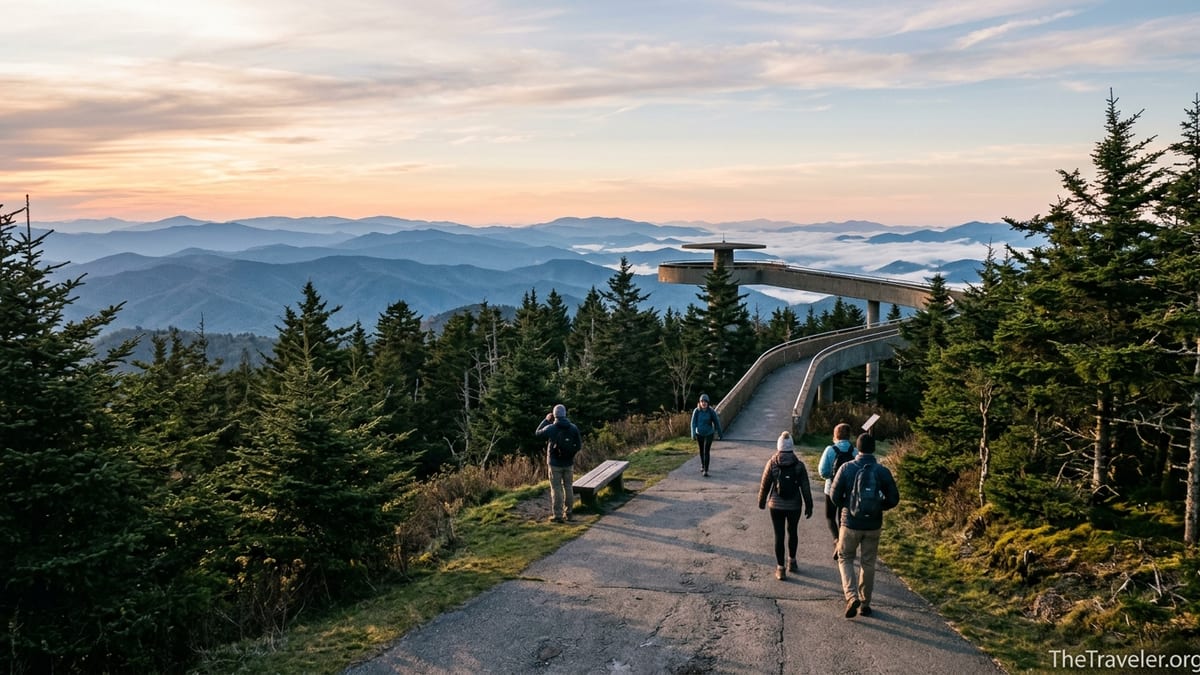
The Highest Peak You Can Almost Drive To
Most major Smokies summits begin with a long forest approach. Clingmans Dome is different. A signed turnoff on Newfound Gap Road, the main spine highway that crosses the park between Gatlinburg, Tennessee, and Cherokee, North Carolina, leads to Kuwohi Road, a paved seven‑mile spur to the Clingmans Dome parking area. The drive itself is scenic but straightforward, suitable for standard passenger cars and small rentals. You do not need a high‑clearance vehicle, and in summer you will see everything from compact sedans to minivans and 30‑foot RVs easing their way up the ridge.
Because the road climbs so high, the trail to the summit is remarkably short. From the large parking lot, the paved Clingmans Dome Trail gains roughly 330 vertical feet in about half a mile one way. Even allowing for frequent photo stops and a slow pace, most visitors reach the concrete observation tower in 20 to 30 minutes. By comparison, a classic climb of Mount Le Conte via Alum Cave Trail covers about 5 miles one way with more than 2,700 feet of elevation gain, often taking 3 to 4 hours for reasonably fit hikers. That contrast is the core of Clingmans Dome’s appeal: you invest a few minutes of uphill walking to stand on the highest peak in the Smokies.
For road‑trip planners, this easy access changes how the summit fits into an itinerary. Instead of devoting a full day to a single peak, travelers frequently pair Clingmans Dome with a drive over Newfound Gap, a stop at Newfound Gap overlook, and perhaps a picnic near Chimneys Picnic Area, creating a satisfying high‑country loop in half a day. It is one of the few places in the eastern United States where you can eat breakfast in downtown Gatlinburg or Cherokee and be standing at nearly 6,700 feet before lunch.
Paved Trail, Short Distance, Big Views
The paved surface of the Clingmans Dome Trail is a major reason it is more approachable than other Smokies summits. While the path is quite steep in places and not technically wheelchair‑accessible end to end, the smooth pavement eliminates the roots, rocks, and mud that can make even short mountain trails treacherous for inexperienced hikers. Visitors in everyday sneakers, older travelers who rely on walking sticks, and parents pushing sturdy strollers for part of the way all share the path on busy days.
The short length also makes the climb easier to fit around weather windows. In summer, the typical pattern is foggy mornings that often burn off by midday. Travelers staying in Pigeon Forge or Gatlinburg routinely watch the webcam feeds or simply step onto their motel balcony to check the cloud ceiling, then decide to make a spontaneous dash to the Dome when the ridge looks clear. Because the round‑trip walk from the parking lot is typically under an hour, visitors can wait for a break in showers rather than committing to a full‑day hike into uncertain weather.
Despite its modest distance, the payoff at the top is expansive. The 45‑foot concrete observation tower rises above the spruce‑fir canopy and offers a full circle of layered ridges in Tennessee and North Carolina. On a clear day, visibility can extend 100 miles or more in soft blue‑gray bands. Families with tight schedules often comment that they could not have justified a strenuous all‑day climb just for a view, but for a one‑hour outing, standing above the clouds feels like an incredible return on effort.
Comparing Clingmans Dome With Other Smokies Summits
To grasp why Clingmans Dome feels easy, it helps to compare it with a few other popular peaks in the park. Mount Le Conte, for example, is the third‑highest summit in the Smokies and one of the most famous. Yet all routes to its 6,593‑foot top are full‑day hikes. The shortest, Alum Cave, still demands about 10 miles round trip. The Boulevard Trail, often used by strong hikers seeking airy ridgeline views, involves linking the Appalachian Trail from Newfound Gap and then following The Boulevard corridor, an outing that many hikers log at roughly 15 to 16 miles total for the day. For families with school‑age children or travelers coming from low elevations, that is simply out of reach.
Rocky Top, on Thunderhead Mountain, is another beloved summit. The popular route from the Anthony Creek or Cades Cove picnic area typically covers 12 to 13 miles round trip and racks up more than 3,600 feet of climbing. Even experienced hikers often finish that day tired, especially in the humidity of a Tennessee July. Meanwhile, peaks such as Charlies Bunion or the Jumpoff, reached via spur paths from the Appalachian Trail, may be slightly shorter but still require several hours of continuous walking and a tolerance for narrow, uneven tread.
In contrast, Clingmans Dome concentrates much of the work into the drive rather than the hike. You gain thousands of vertical feet through the car’s transmission instead of your calves. That does not mean the summit is effortless. The grade feels relentless if you are not used to hills, and many visitors pause on the benches that park staff have placed along the trail. But for the average traveler who might only hike a few miles a year, the difference between a one‑mile paved walk and a 10‑mile mountain trek is enormous.
Because of this, Clingmans Dome is often the only 6,000‑plus‑foot peak that casual Smokies visitors ever experience. Travelers who might feel intimidated by trail names like Alum Cave, Boulevard, or Chimney Tops usually find the straightforward “Clingmans Dome Trail” on the park map and realize that the summit experience is within their ability level and time budget.
Central Location and Simple Logistics
Geography is another reason Clingmans Dome is easier to reach. Newfound Gap Road, the main access corridor that links Gatlinburg and Cherokee, passes within a few miles of the summit. Most visitors to Great Smoky Mountains National Park are already driving this route to cross between Tennessee and North Carolina, or to visit popular overlooks such as Newfound Gap itself. Turning off for Clingmans Dome adds a manageable side trip rather than a dedicated back‑road journey.
Driving times illustrate the convenience. From downtown Gatlinburg, the turnoff to Kuwohi Road is typically about a 30‑ to 40‑minute drive under normal summer traffic. From Cherokee, it can be 45 minutes to an hour. This places the Dome within easy reach of major lodging hubs that line the park’s approaches, including Gatlinburg, Pigeon Forge, Sevierville, and Cherokee, where visitors find everything from budget motels and mid‑range chains to rental cabins that sleep a dozen guests. Travelers can book a cabin in Pigeon Forge with a pool table and hot tub, spend the morning doing outlet shopping, then pivot in the afternoon to a high‑country outing without changing accommodations.
The parking area at Clingmans Dome is also designed for volume. On peak October weekends it does fill, and rangers occasionally close the spur road temporarily until spaces open. But compared with trailheads like Alum Cave, where roadside parking can stretch for half a mile along the highway on busy days, the Dome’s large, purpose‑built lot with vault toilets and informational displays feels relatively orderly. For first‑time visitors who are nervous about mountain driving, the paved, two‑lane road with guardrails and regular pullouts is far less intimidating than narrow gravel access roads sometimes found in more remote corners of the Appalachians.
Even the wayfinding is simple. Brown park signs clearly mark the turnoff, and GPS directions from Gatlinburg or Cherokee generally handle the route accurately. In contrast, travelers aiming for less visited trailheads like Porters Creek, Maddron Bald, or Big Creek frequently describe driving past unsigned junctions, needing to study topographic maps, or losing cell signal and improvising based on paper directions from their motel front desk.
Seasonal Road Access and Weather Considerations
Clingmans Dome’s ease of access is seasonal. Kuwohi Road, the spur to the summit, operates roughly from early April through late November, with exact dates varying by year and snowfall. In winter, the road is closed to vehicles, and reaching the summit would require a long hike or ski from Newfound Gap or other trailheads. Within its open season, however, the drive makes the high point dramatically more reachable than it would otherwise be.
Travelers should understand that high elevation brings rapid weather changes. Even in June, temperatures at the summit can be 10 to 20 degrees Fahrenheit cooler than in Gatlinburg. It is common to leave a sunny campground in shorts and arrive at the parking area stepping into mist, wind, and low 50s. Fortunately, the short hike means you can often simply wait out passing showers in your car, then walk to the top once the clouds thin. Families frequently pack light layers, a small umbrella, and a thermos of coffee or hot chocolate from a Gatlinburg coffee shop to make that wait more pleasant.
By contrast, on longer summit hikes, weather decisions must be made hours in advance. Hikers setting out for Mount Le Conte or Rocky Top need to commit early in the day and are exposed to whatever conditions develop along the trail, with fewer opportunities to retreat quickly to the car. Thunderstorms rolling over the ridgeline can turn exposed sections into serious hazards. On Clingmans Dome, visitors can simply descend the paved walkway if thunder is heard and be back at their vehicle within minutes.
One logistical quirk to keep in mind is that Newfound Gap Road itself occasionally closes for snow, ice, high winds, or storm damage, especially from late fall through early spring. When that happens, it cuts off access both to Clingmans Dome and to high passes like Newfound Gap overlook. Park rangers and regional news outlets usually provide updates early in the day, so winter visitors who hope to catch a rare snowy view from the Dome should check conditions before leaving Gatlinburg or Cherokee.
Suitable for Families and Less Experienced Hikers
Clingmans Dome functions as a gateway summit, giving travelers a sample of high‑elevation scenery without demanding strong hiking skills. Families with young children often use the climb as a first test of hill walking. It is common to see parents setting informal challenges: “Let’s make it to the next bench,” or “We will stop for a snack halfway to the tower.” Because the path is wide and paved, kids can weave a bit without constantly tripping over roots, and there are no drop‑offs immediately beside the trail for most of its length.
For older travelers or those recovering from injuries, the Dome is one of the few high Smokies viewpoints that may be accessible with a cautious, paced approach. The grade can still be too steep for some, and the final spiral ramp to the tower adds additional distance. But visitors who might never attempt the rocky final scrambles of hikes like Charlies Bunion can often manage part of the Clingmans Dome walkway and still enjoy sweeping views from overlooks near the tree line, then decide whether to push on toward the tower.
Because the outing is short, visitors can treat their time on the mountain as an introduction rather than a capstone. Travelers who discover they enjoy the thin, cool air and balsam fragrance on Clingmans Dome frequently return the next day for slightly longer but still manageable hikes such as the Forney Ridge Trail to Andrews Bald, which leaves from the same parking area and offers a 3.6‑mile round trip to a grassy high‑elevation meadow. In this way, Clingmans Dome becomes a launch pad for broader exploration rather than a once‑in‑a‑lifetime summit that leaves hikers exhausted.
Even gear needs are modest. In summer, most visitors are comfortable in regular walking shoes, a light jacket, and a small daypack. You do not need trekking poles, specialized backpacks, or technical rain gear, though they never hurt. By contrast, hikers tackling longer summit routes routinely carry 2 to 3 liters of water per person, trail snacks or lunches, headlamps, paper maps, and in cooler months microspikes for lingering ice on shaded switchbacks.
Planning a Clingmans Dome Visit in a Crowded Park
Great Smoky Mountains National Park has been the most visited national park in the United States in recent years, drawing well over 10 million visitors annually. That popularity means parking, traffic, and crowding are real considerations, especially at marquee viewpoints like Clingmans Dome. To keep the experience pleasant, timing is critical. Many travelers aim to arrive at the parking area before 9 a.m. in summer, or in the late afternoon, to avoid the most intense midday crush.
Early or late visits also come with softer light and a better chance of clear views. Morning sun slanting through the spruce‑fir forest adds depth to the ridges, while late‑day visits can deliver pastel sunsets over Tennessee if clouds cooperate. Some visitors plan their entire Smokies itinerary around a single sunrise or sunset at the Dome, building in a backup day in case fog dominates their first attempt.
Because the Clingmans Dome parking lot fills frequently in October, rangers sometimes manage traffic at the base of Kuwohi Road, allowing vehicles up in waves as spaces open. Travelers should be prepared to be flexible. If you arrive at midday in peak fall color season and find the road temporarily closed to private cars, an alternative is to continue along Newfound Gap Road to explore another high overlook, then loop back later in the day to try again. Many repeat visitors schedule their Dome visit for shoulder seasons in May or early June, when wildflowers are blooming along lower roads but schools are still in session in many states.
For those balancing budgets, the cost of a Clingmans Dome visit remains low relative to certain other mountain experiences. Great Smoky Mountains National Park does not charge an entrance fee, though a modest parking tag is now required for most vehicles that stop for more than a brief period. Compared with gondola tickets in western ski resorts or guided summit tours in some international destinations, the opportunity to stand on a high peak in the Smokies for the cost of fuel, a parking tag, and perhaps a picnic lunch picked up from a grocery store in Gatlinburg is compelling.
The Takeaway
Clingmans Dome occupies a rare niche in mountain travel. It offers the bragging rights of reaching the highest summit in a major national park, with a fraction of the effort usually required to stand on such a lofty perch. A paved spur road climbs most of the vertical, a short but steep walkway handles the rest, and a concrete observation tower delivers big panoramas that rival those from much more demanding routes in the Smokies.
For travelers with limited time, mixed‑ability groups, or only a passing interest in hiking, that combination is ideal. They can sample the cool air, spruce‑fir scent, and layered ridgelines that define the high country, then return to valley‑bottom attractions such as Dollywood, Cherokee cultural sites, or Gatlinburg’s busy parkway in the same day. More committed hikers, meanwhile, can treat a Dome visit as a warm‑up or rest‑day outing between longer adventures to summits like Mount Le Conte or Rocky Top.
Above all, Clingmans Dome demonstrates that in the Great Smoky Mountains, the most memorable views are not reserved only for those with the strongest legs or the lightest packs. With thoughtful planning around weather, timing, and seasonal road openings, almost any visitor who can manage a short uphill walk can stand at the crest of the range and look out across two states of rolling blue ridges.
FAQ
Q1. How long does it take to walk from the parking lot to the top of Clingmans Dome?
Most visitors take 20 to 30 minutes to walk the half‑mile paved trail from the parking area to the observation tower, depending on pace and rest breaks.
Q2. Is the Clingmans Dome trail suitable for small children and older adults?
The trail is short and paved but quite steep. Many families with children and active older adults manage it by going slowly and using benches along the way for rest.
Q3. When is the road to Clingmans Dome open?
The spur road to Clingmans Dome typically opens in early April and closes around late November. Exact dates vary each year based on weather and maintenance needs.
Q4. Do I need special hiking gear to visit Clingmans Dome?
For most summer visits, comfortable walking shoes, a light jacket, and a small daypack with water are sufficient. Longer nearby hikes, like the route to Andrews Bald, may warrant sturdier footwear.
Q5. How does Clingmans Dome compare with Mount Le Conte in difficulty?
Clingmans Dome requires about one mile of walking round trip, while Mount Le Conte hikes typically involve 10 or more miles and several thousand feet of climbing, making Le Conte a full‑day effort.
Q6. Can I visit Clingmans Dome in winter?
In winter, the road to Clingmans Dome is closed to vehicles. Reaching the summit then requires a long hike or ski from other trailheads and is only suitable for experienced, well‑equipped visitors.
Q7. Is Clingmans Dome accessible by public transportation or shuttle?
There is currently no regular public transit or park‑operated shuttle to Clingmans Dome. Most visitors reach the trailhead using private vehicles or rental cars.
Q8. What is the best time of day to avoid crowds at Clingmans Dome?
Early morning before 9 a.m. and late afternoon or early evening typically see fewer crowds than midday, especially during peak summer and fall color seasons.
Q9. Can I combine Clingmans Dome with other nearby hikes in one day?
Yes. Many visitors pair the short walk to the summit with a side trip to Andrews Bald from the same parking area or with scenic stops along Newfound Gap Road on the drive to and from Gatlinburg or Cherokee.
Q10. Do I need a reservation or permit to visit Clingmans Dome?
You do not need a special hiking permit or reservation to visit Clingmans Dome, but a valid parking tag for Great Smoky Mountains National Park is required for most vehicles that stop for more than a brief visit.