


For many travelers, Western Union is the financial safety net that makes a long-haul trip feel possible. Whether you are backpacking across Southeast Asia or visiting family in Latin America, the promise is simple: if something goes wrong, someone at home can wire cash and you can pick it up almost anywhere. In practice, though, using Western Union abroad is more complicated and often more expensive than first-time users expect. A few common missteps can leave you paying far more than necessary, stuck in a foreign city without access to funds, or even caught up in a scam. Understanding those pitfalls before you go is the best way to make Western Union work for you instead of against you.
Get the latest updates straight to your inbox!
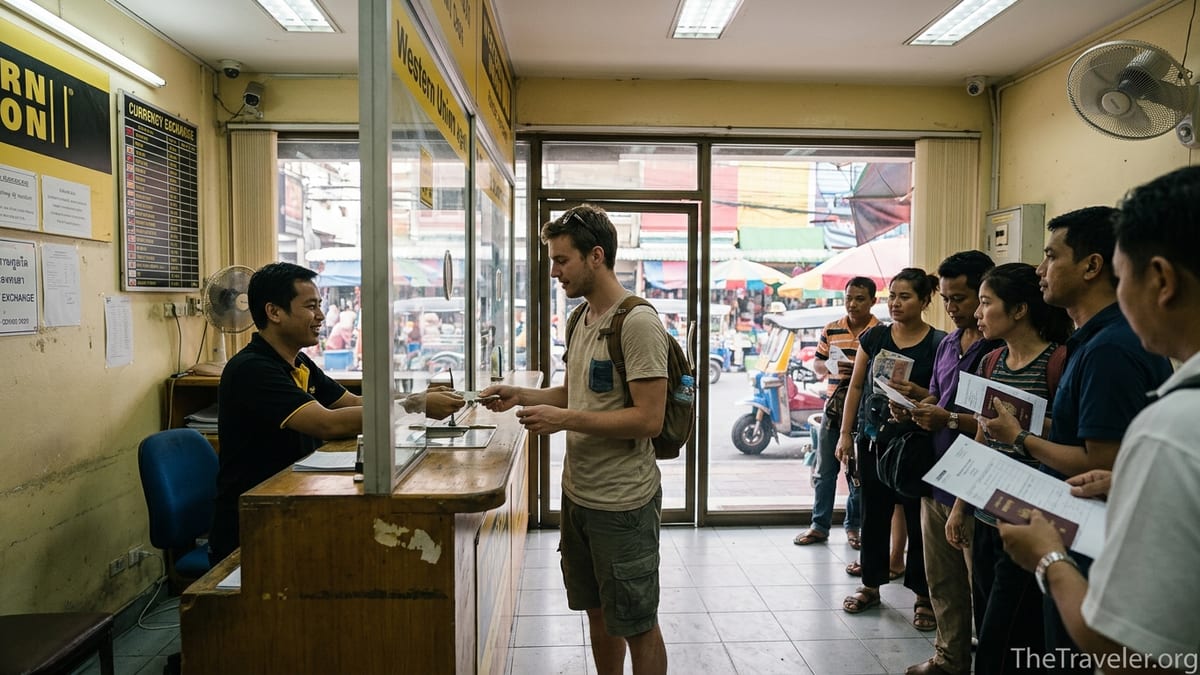
Ignoring How Fees and Exchange Rates Really Work
The single biggest mistake travelers make with Western Union is looking only at the visible transfer fee and ignoring the exchange rate. Western Union, like most money transfer services, usually charges in two ways: a stated fee and an exchange rate markup. Independent comparisons in 2026 show that a typical online transfer might combine a modest flat fee with a 2 to 4 percent margin built into the exchange rate, while cash-funded transfers at an agent counter can carry higher fees and, in some corridors, an even steeper currency margin. A traveler who thinks they are paying “just 5 dollars” to send money abroad can easily discover that the real cost, once the markup is included, is closer to 5 percent of the transfer.
You see this most clearly on common backpacker routes. Consider a US traveler in Mexico City who has a family member send 500 dollars from Chicago for cash pickup in pesos. Western Union might quote a 10 or 15 dollar fee online, but the exchange rate could be several percent worse than the mid-market rate you would see on a financial news site. That can mean the traveler walks away with the equivalent of 15 to 25 dollars less in pesos than expected, on top of the stated fee. Over the course of a few emergency transfers in the same trip, that gap can add up to the price of several hostel nights.
Travelers also overlook how pricing changes by channel. Recent fee comparisons in the United Kingdom, for example, found that Western Union online transfers could cost under 1 pound in fees for small amounts, while in-person cash transfers for the same corridor reached more than 70 pounds, plus the exchange rate margin. A similar pattern appears in North America: funding with a bank account or card through the app is often cheaper than walking into a kiosk at a touristy train station and paying cash. If you assume the price is the same everywhere, you may end up using the most expensive option just because it feels convenient in the moment.
The fix is straightforward but requires a bit of discipline. Before anyone initiates a transfer, use Western Union’s online calculator or app to model different funding and payout options and compare the total cost, not just the fee. Check what your recipient will actually receive in local currency and compare that, at least roughly, to the mid-market rate you can find via a separate currency converter. If the gap feels large, you may be better off moving a bigger one-time amount instead of several smaller transfers, or even exploring whether a debit card withdrawal from an ATM could be cheaper overall.
Walking In Without Proper Identification
Another common mistake is assuming that you can walk into any Western Union agent abroad with nothing more than the tracking number and a smile. In reality, you almost always need valid, unexpired government photo identification to pick up money, and the exact rules vary by country. In many destinations a passport is the safest choice, but some agents will accept a national ID card, residency permit or local driver’s license instead. Compliance rules have tightened in recent years, and in several countries Western Union now requires not only an ID but also proof of address or additional documents once transfers cross certain thresholds or when your activity seems unusual.
Take an American traveler in Berlin as an example. A relative in the United States sends 900 euros for cash pickup. At a central Western Union agent, the clerk may ask for a passport and a second document that shows a German address, such as a rental contract or registration paper. If the traveler is staying in a hostel and has no local address document at all, the agent might refuse to release the money or ask them to find another location that applies a more flexible standard. Similar problems crop up in New Zealand, where quick ID guides specify particular combinations of photo ID and proof of address, such as a foreign passport plus a bank statement or hotel booking printout. Travelers who show up with just a student card or an expired license are often turned away disappointed.
Regulatory rules can also trigger extra verification when you hit certain amounts or limits within a few days. In parts of the European Union, for instance, sending more than about 1,000 euros within a short period may require your identity to be fully verified in the system. That can mean filling out extra forms, uploading documents online, or waiting while the compliance team reviews your account. For a tourist who expected to pick up emergency cash within minutes, an unanticipated verification step can easily stretch into hours or days.
To avoid this, treat identification as seriously as you treat your passport at airport immigration. Always carry your passport when you plan to receive Western Union funds, and keep a digital copy of your itinerary, hotel confirmation and any local registration documents on your phone or printed out. Before a sender initiates a large transfer, call or visit an agent in your destination city and ask exactly what documents are required at that location and for that amount. A five-minute check can prevent the scenario where your money is technically waiting for you but trapped behind a documentation rule you cannot currently meet.
Not Understanding Local Payout Options and Hours
Western Union advertises that it serves hundreds of thousands of agent locations worldwide, but travelers sometimes assume those locations are equivalent. In reality, a Western Union counter in a supermarket on the outskirts of Lisbon operates very differently from a 24-hour kiosk next to Bangkok’s Khao San Road. Each agent has its own operating hours, cash limits, and policies on which payout options are available. Not understanding these local quirks is a frequent source of frustration for travelers trying to retrieve their funds abroad.
Imagine arriving in a midsize town in Morocco on a Sunday afternoon after your wallet has been stolen. A relative wires you 400 dollars for cash pickup, you find a Western Union sign on a nearby street, and then discover that the counter is inside a bank branch that only opens Monday to Friday from 9 to 15. In some countries, agents inside post offices or small banks close early, shut at lunchtime or do not open at all on local holidays. Even within a big capital, one Western Union agent might run out of local currency and limit payouts to small amounts or insist on paying in US dollars instead of the currency you actually need for buses and food.
Travelers also misinterpret the different payout methods. In many countries Western Union now allows transfers to bank accounts or mobile wallets instead of cash. That can be a lifesaver in cities with few safe cash pickup points, but only if you understand how long the delivery will take. Some mobile wallet routes are close to instant, while others can take a business day or more to clear. If you are standing at a hostel desk in Lima needing to pay for your room immediately, choosing bank deposit as the payout option might leave you stuck overnight while the funds settle.
The best habit is to plan around actual agent hours and payout limits instead of assuming every sign works 24 hours a day. Within the Western Union app you can search locations in your destination city and view their opening times and services. Before a transfer is sent, check that at least one reasonably close agent will be open within a realistic time window, and that it offers cash payouts in the currency you need. In countries where mobile wallets are popular, such as Kenya or the Philippines, consider setting up a local wallet account in advance so that family can send directly to it if cash counters are closed when you arrive.
Using Western Union for the Wrong Kind of Payment
Western Union was designed for personal money transfers, not for buying secondhand electronics from strangers online or paying deposits to unknown landlords. Yet travelers under time pressure often reach for Western Union when a seller insists that “it is the fastest way.” That is exactly what many fraudsters rely on. Global scam reports show Western Union used in mystery shopper cons, fake travel apartment rentals, and fraudulent “emergency” requests from supposed friends or relatives. Once cash is collected abroad, it is extremely difficult to reverse the transfer.
Consider a traveler planning a working holiday in Canada who spots a studio apartment in Vancouver on a classified site. The “landlord” says that they are out of the country but will hold the place if the traveler wires 800 Canadian dollars through Western Union and sends a photo of the receipt, promising that a local agent will show them the keys on arrival. In reality, there is no apartment. As soon as the scammer or an accomplice picks up the money, the listing disappears and the traveler lands in Vancouver with no housing and 800 dollars missing from their budget. Similar stories play out with fake tour operators in Istanbul demanding Western Union payments for hot air balloon rides in Cappadocia, or online sellers in Europe offering discounted cameras or concert tickets.
Family emergency scams are another persistent problem. Fraud warnings describe cases where travelers receive a message that appears to be from a sibling or friend, claiming their phone has been lost and they need a cash transfer to pay a hospital bill, fine or urgent transport. The message often instructs them to send money via Western Union to a name they do not recognize or to a foreign city where their loved one would not logically be. In the shock of the moment, people wire funds without independently confirming the story, only to realize later that the message came from a hacked or spoofed account.
As a rule, if someone you do not personally know and trust asks to be paid by Western Union, assume that it is either risky or outright fraudulent. Western Union itself advises that its service should not be used to pay for online purchases, rental deposits, lottery fees, job training or taxes. If a tour company or landlord insists that Western Union is the only acceptable method, walk away and look for a provider that takes a more traceable form of payment such as a credit card. And if you ever receive an emergency money request, call the person on a known phone number or video chat with them before sending anything.
Overlooking Legal and Tax Rules on Remittances
Most travelers think of Western Union transfers as private arrangements between them and their families, but in many countries remittances are increasingly regulated. In the United States, new federal rules taking effect in 2026 introduce a small excise tax on certain outgoing international money transfers funded in cash, money orders or similar instruments. Consumer watchdogs point out that this kind of levy effectively adds to the cost of sending money abroad, especially for people who rely on cash instead of bank accounts. While tourists are not the main target of these rules, they can still feel the impact if family back home funds transfers in cash at a convenience store counter.
For example, if a US resident walks into a grocery store Western Union counter and funds a 500 dollar transfer to a traveler in India entirely with cash, they may pay the standard Western Union fee plus an additional 1 percent remittance tax at the point of sale, depending on how the final regulations are implemented. That would add roughly 5 dollars to a transaction that might already cost around 20 dollars in service fees and exchange rate margin. Over several emergency transfers in the same extended trip, those extra dollars start to matter.
There are also local limits and reporting rules in receiving countries. Some governments cap the amount of foreign currency that can be collected in cash in a single transaction or within a set period, especially by non-residents. Others require identification and reporting when transfers exceed thresholds meant to combat money laundering. A long-term traveler bouncing between countries may inadvertently trigger extra scrutiny by picking up multiple large Western Union transfers in cash over a few weeks. In the worst case, an agent might refuse to release funds until additional questions are answered or documents are produced.
The practical takeaway is not to panic about law and tax jargon but to build awareness into your planning. If your support network at home expects to use Western Union regularly while you are abroad, encourage them to fund transfers from a bank account or debit card rather than large amounts of cash, and to keep amounts sensible rather than pushing up against regulatory limits. If you will be based in one country for several months, ask a local bank or consulate about any caps on foreign cash pickups so that you can structure support transfers in a way that avoids problems at the counter.
Failing to Protect Personal Data and Account Security
Western Union has tightened fraud controls over the years, but criminals keep finding ways to exploit inattentive users. A recurring mistake travelers make is treating Western Union emails, text messages and verification codes casually while on the road. Reports on consumer forums describe people who suddenly receive Western Union one-time passwords or account confirmation codes on their phone even though they never created an account. In some cases, scammers were trying to use that phone number to set up a Western Union profile for money laundering. In others, phishing emails that mimic Western Union branding tried to trick users into entering login details on fake websites.
Travelers who frequently connect to public Wi-Fi networks in hostels, cafes or airports are particularly exposed. Logging into your Western Union account on an unsecured network and then clicking through a link in an unsolicited email can hand a criminal enough information to attempt unauthorized transfers. There have been cases where victims noticed small test transfers sent from their profile to unfamiliar recipients, a tactic scammers use to probe how much money can be extracted from linked bank cards or accounts.
Good security hygiene goes a long way. Never follow links in emails or text messages that claim to be from Western Union, especially if they talk about account suspensions, unexpected transfers or prize winnings. Instead, open the official Western Union app or type the company name directly into your browser and log in that way to check your transfer history. If you receive verification codes for an account you did not create, contact Western Union’s fraud help line and your mobile provider, as this can be a sign that someone is attempting to take over your number or associate it with a fraudulent profile. While traveling, avoid saving your Western Union password in browsers on shared computers and log out of your account after each session.
It is also sensible to treat your money transfer receipts like bank statements. Avoid photographing full receipts that show tracking numbers and sending them via unsecured messaging apps or posting them in group chats. In some scam patterns, a fraudster persuades a victim to send a transfer to a legitimate recipient but then uses a copy of the receipt and fake identification to collect the cash first at a different location. Keeping your transaction details private reduces the chances that someone else can intercept your funds.
Not Comparing Alternatives Before Hitting Send
Western Union has one undeniable strength: in many remote or cash-based economies, it still provides a reliable way to get physical money into a traveler’s hands quickly. That does not mean it is always the smartest choice. A frequent error is defaulting to Western Union without comparing it to other options such as ATM withdrawals with a low-fee debit card, online money transfer specialists, or even carrying a backup prepaid travel card. For certain routes and amounts, those alternatives can be significantly cheaper or easier to manage.
Take a US traveler in Thailand facing an unexpected medical bill of 300 dollars equivalent in baht. One option is to have a family member send a Western Union transfer for cash pickup. Another is to use a debit card from a bank that refunds foreign ATM fees and charges a modest currency spread. Depending on the card and the specific Western Union pricing for that route, withdrawing from an ATM might cost only a few dollars in total, while a cash pickup through Western Union could be two or three times as expensive once all fees and margins are counted. On the other hand, if the traveler has lost their wallet completely and only has their passport and phone, a Western Union cash transfer might be the only realistic option.
Dedicated online money transfer companies have made significant inroads since Western Union first dominated the market. Many of them offer clear mid-market exchange rates with a transparent low fee, especially for bank-to-bank transfers. In cities where your host family or friend has a local bank account and is willing to help, sending money to that account and then having them withdraw cash for you can be both cheaper and safer. Prepaid travel cards, which you load from home before departure, provide another backup for moderate expenses, though they also have fee structures that need to be checked in advance.
The goal is not to replace Western Union entirely but to put it in its proper place within a toolkit. Before your trip, research typical costs for Western Union on your most likely corridors as well as the terms of your bank cards and any alternative remittance services available in your destination region. When an emergency hits, you will be able to make a quick, informed choice instead of reaching for the first logo you recognize.
The Takeaway
Used thoughtfully, Western Union can still be a valuable safety net for travelers, especially in destinations where card acceptance is patchy and bank infrastructure is thin. The problems start when travelers treat it as a simple, uniform product rather than a complex financial service that behaves differently country to country and channel to channel. Ignoring exchange rate markups, walking in without proper identification, failing to check local agent hours and limits, or sending money to strangers for rentals and purchases are the kinds of mistakes that turn Western Union from a lifeline into a liability.
The best protection is preparation. Well before you board a plane, talk with the people who might need to send you money, download the official Western Union app, and experiment with fee calculators and location searches on the routes that matter to you. Make sure your passport and supporting documents are in order and stored safely. Learn the red flags of common scams and decide in advance that you will never use Western Union to pay unknown individuals. And when something does go wrong on the road, pause for a few minutes to compare options instead of blindly following the first suggestion. A bit of foresight will help ensure that if you ever need Western Union abroad, it works exactly as intended: a fast, reliable bridge between home and wherever in the world your travels take you.
FAQ
Q1. Is Western Union safe to use while traveling abroad?
Western Union itself is a regulated company and generally safe when you send money to people you know and follow identification rules. Most problems arise when travelers send money to strangers or respond to scams, or when they neglect basic security precautions like protecting verification codes and using only official apps or agent locations.
Q2. How can I check Western Union fees before sending money?
You can use Western Union’s online calculator or mobile app to see the fee, the exchange rate and the estimated payout amount in the local currency before you pay. It is wise to compare that result with a mid-market rate from an independent currency converter to understand how much you are paying in total, not just the visible service fee.
Q3. What ID do I need to pick up a Western Union transfer overseas?
In most countries you need a valid, unexpired government-issued photo ID such as a passport, national ID card or driver’s license that matches the recipient name on the transfer. Some agents and countries also require proof of address or additional documents for larger amounts, so carrying your passport and a copy of your travel or accommodation details is strongly recommended.
Q4. Can I reverse a Western Union transfer if I realize it is a scam?
If the money has not yet been paid out, the sender may be able to cancel the transfer and request a refund by contacting Western Union immediately. Once the cash has been collected or funds delivered to a bank account or wallet, reversing the transaction is usually impossible, which is why you should never send money to someone you do not know personally.
Q5. Are Western Union fees higher at physical agent locations?
Fees and exchange rates can differ between online, app-based and in-person agent transfers. In many corridors, cash-funded transfers at retail counters cost more than transfers funded from a bank account or card through the app or website, and may use a less favorable exchange rate. Always price out both options before deciding how to send.
Q6. What should I do if a Western Union agent refuses to release my money?
Ask the agent to explain which requirement is not being met, such as missing documents, incorrect recipient name or a compliance review. If you believe everything is in order, contact Western Union customer support using a number from the official site or app. In some cases it may be faster to adjust the transfer details or choose another agent location that can meet your identification situation.
Q7. Is it safe to use Western Union over public Wi-Fi while traveling?
It is safer to avoid logging into financial accounts over unsecured public Wi-Fi networks when possible. If you must use Western Union on public Wi-Fi, connect through a trusted virtual private network, never follow links from unsolicited emails, and always log out afterward. For sensitive changes, such as updating payment methods, wait until you have a secure connection.
Q8. Can I use Western Union to pay for vacation rentals or tours?
It is strongly discouraged. Legitimate rental platforms and tour operators almost always accept traceable methods such as credit cards or reputable payment processors. Requests to pay deposits or full balances by Western Union are a common hallmark of scams, especially for apartments advertised on free classifieds or social media.
Q9. What happens if I lose the Western Union tracking number?
The tracking number is important but not the only way to locate a transfer. The sender can log in to their Western Union account, retrieve the number and share it again. In some cases, agents may be able to search using the recipient’s name and location, but they will still require full identification and cannot release funds if key data does not match the original transfer details.
Q10. How can I minimize the total cost when using Western Union abroad?
Plan ahead by comparing different funding and payout options, sending fewer larger transfers instead of many small ones, and choosing online or app-based transfers when they are cheaper than cash at an agent. Encourage family or friends sending you money to avoid funding transfers with large amounts of cash if extra taxes or fees apply, and always check the exchange rate margin as well as the stated fee.