


For more than a century, Western Union has been the default name people think of when they need to move money across borders. In 2026 it still dominates cash pickups from New York to Nairobi, but travelers now have app-based rivals like Wise, Revolut, and Remitly competing hard on price and convenience. If you are planning a trip and wondering whether Western Union is worth using for your travel money, the answer is nuanced. It can be a lifesaver in some situations, and unnecessarily expensive in others.
Get the latest updates straight to your inbox!
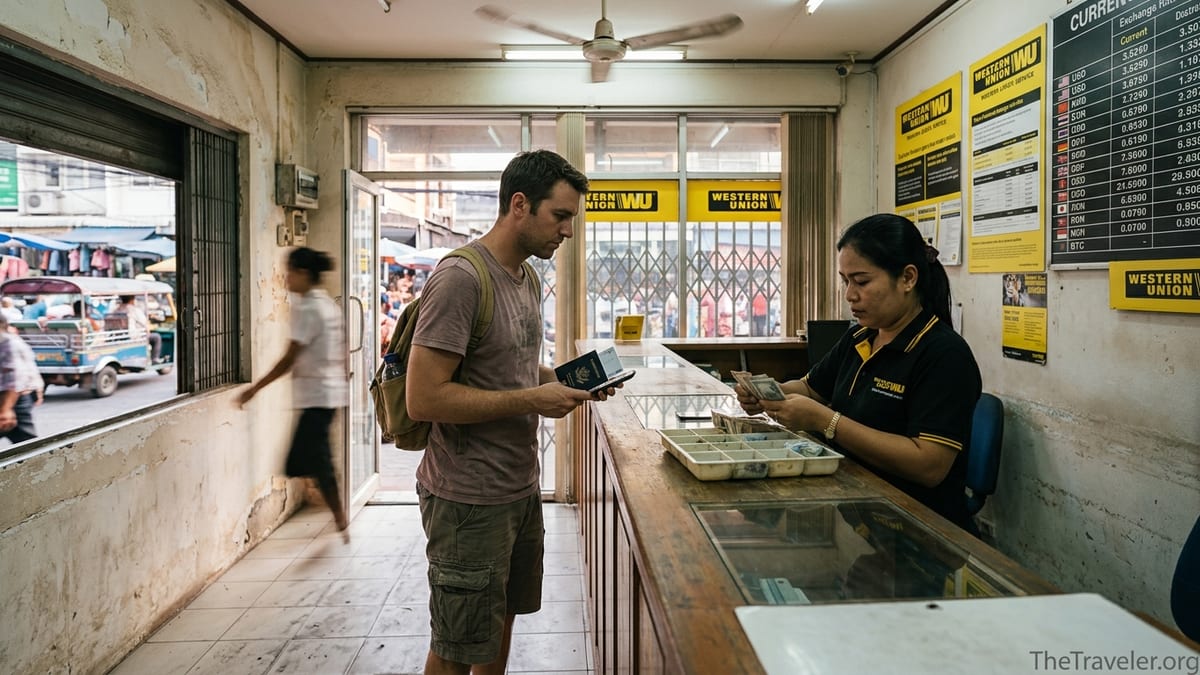
What Western Union Actually Offers Travelers in 2026
Western Union is best thought of as a global cash distribution network rather than a cheap bank alternative. The company lets you send money from the United States to more than 200 countries and territories, with options for cash pickup, bank deposit, mobile wallet, and sometimes even home delivery. For a traveler, that usually translates into one of two use cases: sending yourself cash to pick up on arrival, or having friends or family send you emergency funds while you are overseas.
In practice, this reach matters in destinations where card payments and ATMs are unreliable. For example, a traveler heading from Chicago to rural Guatemala might find that their US debit card only works at a single ATM in Antigua, but Western Union cash pickups are available in dozens of small towns through pharmacies and corner shops. The same story plays out across parts of West Africa, Central Asia, and island destinations where banking infrastructure is thin yet there is at least one Western Union sign in the market square.
Western Union can be accessed in three main ways: at physical agent locations such as supermarkets or check-cashing stores, through the Western Union website, or within the mobile app. Online and app transfers usually offer slightly better fees and exchange rates than walk-in agent transfers, because they are cheaper for the company to process. For a US traveler planning ahead, setting up an online account before departure often leads to better pricing than showing up at an agent counter with cash.
However, all of this flexibility does not automatically mean Western Union is a smart default for everyday travel spending. The key question is not only the visible fee, but how much you lose in the exchange rate compared with alternatives that use the mid-market rate.
Fees and Exchange Rates: The Real Cost for Travelers
Western Union’s pricing has two parts: an upfront transfer fee and a hidden markup in the exchange rate. For US-based transfers in 2026, the upfront fee on a typical international transaction can range from a few dollars to around 15 dollars for common corridors when you pay by bank account or debit card, and can climb higher if you pay with a credit card or choose certain fast delivery options. Some low-fee or even zero-fee promotions exist, but that usually means more of the cost is pushed into the exchange rate instead of the visible fee.
The exchange rate markup is where costs can quietly add up. Independent comparisons in 2025 and 2026 have found that Western Union often prices its exchange rate roughly 2 to 4 percent worse than the mid-market rate on many popular routes, and sometimes more for smaller or less common currencies. In simple terms, if the real mid-market rate is 1 US dollar to 0.90 euros, Western Union might offer around 0.87 to 0.88 euros per dollar. On a 1,000 dollar transfer to Europe, that can mean your recipient gets 20 to 30 euros less than they would with a provider that uses the mid-market rate.
To see how that plays out for travel money, consider a US traveler sending 500 dollars to themselves for pickup in Mexico City using an online Western Union transfer funded by debit card. A typical quote might show a fee in the range of 2 to 5 dollars, which looks reasonable at first glance. But if the peso exchange rate is 3 percent worse than mid-market, that 500 dollars could convert to roughly 250 to 300 pesos less than with a mid-market provider. In effect, the visible fee is only part of what you are paying for the convenience of cash pickup.
By comparison, services like Wise generally charge a transparent percentage-based fee starting under 1 percent and convert at the mid-market rate, which means that for bank deposits and card spending, you often keep more of your money even if the visible fee figure appears higher than Western Union’s. For pure cash pickup where your recipient does not use a bank or card, however, Western Union’s higher rate can sometimes be the cost of reaching places other providers still cannot.
When Western Union Makes Sense on the Road
Despite its relatively high overall cost, Western Union can still be worth using in specific travel scenarios. The first and most compelling is emergency access to money when other options fail. Imagine arriving in Dakar, Senegal, late at night to discover that your US debit card is repeatedly declined at ATMs due to a fraud hold, and your hotel will not accept card payments. A quick call home to a family member in the United States, followed by a Western Union cash transfer funded from their bank account, can have you picking up cash at a local agent the next morning, even if you have no functioning card and no local bank account.
The second scenario is travel in cash-heavy or underbanked regions, particularly if you are moving beyond major cities. In some rural parts of Morocco, for example, independent guesthouses and drivers may prefer cash in Moroccan dirhams, and international ATMs can be scarce or unreliable outside larger towns. A traveler who knows they will be in small villages for several days might use Western Union to send themselves a larger lump sum for pickup in a regional center like Ouarzazate before heading deeper into the countryside, ensuring they have enough cash for guesthouses, food, and transport.
A third, less obvious use case is temporary relocation or long-term stays where local banking is difficult to arrange. Consider a US digital nomad planning a three-month stay in a town in the Philippines where opening a local bank account is not practical. If their landlord insists on cash payments in pesos and local ATMs issue only small amounts per withdrawal, periodic Western Union transfers to themselves could be a workable, if not cheapest, solution. Some travelers choose this route early in their stay and later switch to cheaper bank-based options once they have more stable arrangements.
Finally, Western Union can be a backup channel in countries where sanctions, local regulations, or unstable banking systems make newer fintech services patchy or unavailable. There are corridors where app-based services simply do not operate, or where local banks restrict incoming transfers from particular providers. In those cases, Western Union’s long-established regulatory footprint allows it to function where others cannot, though you should always check updated information for your specific route before traveling.
Situations Where You’re Probably Better Off With Alternatives
For many ordinary leisure trips and city breaks, Western Union is not the most cost-effective way to manage travel money. If you are flying from New York to London or Los Angeles to Paris, withdrawing cash from ATMs using a debit card that has no foreign transaction fees will usually beat Western Union on total cost, especially if your bank reimburses or caps ATM charges. Even factoring in a couple of 3 or 5 dollar ATM fees, you are generally losing far less in hidden margins than you would through a 2 to 4 percent exchange rate markup on each Western Union transfer.
Similarly, online providers that convert at or close to the mid-market rate are typically cheaper for funding bank accounts and cards. A traveler from the United States who pre-loads a multi-currency account with euros or pounds before leaving, then spends directly with a debit card abroad, may pay a transparent fee under 1 percent and get the real market rate. If the same traveler instead uses Western Union to send themselves 1,000 dollars equivalent for cash pickup in Europe, the combination of visible fees and weaker rate might easily cost them 30 to 60 dollars more overall.
Western Union is usually a poor choice for advanced trip planning when you have stable banking and card options. There is little reason, for instance, to send yourself cash via Western Union to pick up on arrival in Tokyo if you hold a debit card from a US online bank that reimburses ATM fees and uses the Visa or Mastercard rate with no extra markup. In that scenario, simple ATM withdrawals or a mid-market multi-currency card are better options in terms of both cost and convenience.
Another situation where Western Union often does not make sense is routine cash support for family members who do have access to bank accounts or mobile wallets in the destination country. Many remittance-focused platforms have lowered prices on those routes, especially to countries such as India, Mexico, and the Philippines. If your recipient can accept bank deposits or mobile wallet top-ups, digital competitors often beat Western Union on total money received over time, even if Western Union initially advertises a low or zero fee.
Real-World Price Examples Travelers Might See
Because Western Union’s fees and rates vary by corridor, time, and payment method, it is impossible to quote universal numbers. But recent comparisons provide a sense of the ranges a traveler might encounter. Independent reviews analyzing hundreds of quotes in early 2026 found that Western Union’s exchange rate on many routes tended to sit a few percentage points below the mid-market rate, while flat fees for common online transfers hovered from a couple of dollars to the mid-teens for typical amounts.
Imagine a US traveler in Miami sending 300 dollars to themselves for cash pickup in Mexico before a road trip through Yucatan. A plausible scenario could involve a transfer fee around 2 to 4 dollars when paying by bank account online, combined with an exchange rate that is about 3 percent worse than mid-market. In peso terms that 3 percent might translate into roughly 150 to 200 pesos lost in the conversion, which is the price of a basic meal or two in a local taqueria. For a one-off emergency, that might be acceptable. For repeat transfers across a month-long trip, those invisible losses add up quickly.
On a larger transfer, say 1,000 dollars from the United States to the euro area for a long stay, a similar pattern can hold. Fees for sending via bank account could be in the single or low double digits, but a 2 to 4 percent rate gap would equate to 20 to 40 euros less received compared to a mid-market provider, on top of the fixed fee. When travelers compare this with alternatives that charge around 0.7 to 1 percent in transparent fees and use mid-market rates, Western Union often comes out notably more expensive, especially for non-urgent transfers going to bank accounts.
It is also worth noting how funding method affects price for travelers. Paying for a Western Union transfer with a credit card is usually the costliest option. Not only can the transfer fee itself be higher, but the card issuer in the United States may treat the payment as a cash advance, adding its own fee and a higher interest rate from day one. Many travelers who discover this after their trip are surprised to see extra charges on their card statement that dwarf the Western Union fee they initially focused on.
Safety, Reliability, and Practical Issues at Pickup
From a security standpoint, Western Union is a regulated money transfer company subject to stringent anti-money-laundering and know-your-customer rules in the United States and most destination countries. For travelers, that translates into robust identity checks, transaction monitoring, and documented compliance processes. While no system is immune to fraud attempts, Western Union’s long history and licensing across multiple markets generally make it a safe channel to move funds, provided you follow basic precautions and only send money to people you trust.
On the ground, however, travelers can run into practical issues at pickup. In popular tourist destinations, it is not uncommon for small agents like pharmacies or corner shops to run out of cash for large transfers early in the day. For example, a traveler trying to collect the equivalent of 1,500 dollars in pesos or baht from a small store at 9 a.m. may be told to return later once the agent has enough cash. In some US cities, staff at supermarkets that handle Western Union have reported limiting single payouts during the first hours after opening because they simply do not have several thousand dollars in the till yet.
Another practical consideration is documentation. When you pick up money abroad, you will typically need a government-issued photo ID that matches the name on the transfer. In the United States, a passport or state-issued ID usually works, while overseas, your passport is almost always required. In certain countries, agents may also request additional details such as your local address or the purpose of funds, especially for larger amounts. Travelers who arrive without the correct ID or with a passport that uses a different spelling from the name on the transfer can find themselves unable to collect cash until the sender corrects the details.
From a timing perspective, Western Union is usually fast, especially for cash pickups funded by debit card or credit card. Many transfers are available within minutes, which is crucial in emergencies. Bank deposits may take longer, sometimes several hours or a business day depending on the country and banking system. For trip planning, it is sensible to assume that cash pickup will be quick but to allow extra time for bank deposits, especially if you are relying on those funds to pay a hotel bill or rental deposit.
How to Minimize Costs if You Do Use Western Union
If Western Union is the right or only choice for your situation, there are still ways to keep the cost as low as possible. The first is to run live comparisons before you send. Western Union’s own price estimator can show you the exact fee and rate before you confirm, and there are independent comparison sites that let you check what other providers would deliver for the same route and amount in real time. Even in a hurry, a 60-second comparison can reveal whether you are giving up 5 or 50 dollars to use Western Union for that transfer.
Second, consider sending fewer, larger transfers instead of frequent small ones. Because Western Union often charges a flat or tiered fee, multiple small transfers can multiply the fee impact. If you know you will need roughly 600 dollars in local currency over a week, sending it as a single transfer could be cheaper than three separate 200 dollar transfers, each with its own fee. That said, do not carry more physical cash than you can safely manage, especially in destinations where theft or loss is a concern.
Third, avoid funding transfers with credit cards unless there is no alternative and you urgently need the money. Whenever possible, pay via bank account or debit card through the app or website, as these options tend to have lower fees and do not trigger credit card cash advance charges. If you must use an in-person agent, ask the clerk to walk you through fee options for paying with cash versus card so you can see the difference before you commit.
Finally, be cautious about promotional offers. Western Union, like several competitors, sometimes markets first-transfer discounts or temporarily improved rates on popular corridors. These can be good deals for a one-off use, but the pricing often reverts after the promotion, and repeat transfers may become significantly more expensive. For longer trips or recurring needs, base your decision on the regular fee and rate structure rather than a one-time introductory offer.
The Takeaway
Western Union remains a powerful tool in a traveler’s money toolkit, but it is no longer the unquestioned default it once was. Its great strength is reach: from small towns in Latin America to remote islands and border regions, Western Union kiosks and agents often appear where bank branches and modern fintech services are thin on the ground. For emergencies, for travel in cash-first regions, and for situations where your recipient cannot easily access a bank or card, that reach can justify the extra cost.
For routine travel spending in well-served destinations, however, Western Union is usually not the cheapest or most convenient choice. A combination of a good no-foreign-transaction-fee debit or credit card, selective ATM withdrawals, and possibly a multi-currency account from a low-cost provider will often beat Western Union both on price and day-to-day ease of use. Before your next trip, it is wise to think of Western Union as a backup or special-purpose option rather than a primary travel money solution.
If you do end up relying on Western Union, you can reduce the sting by paying attention to how you fund transfers, consolidating transactions, and checking live comparisons. Used thoughtfully, it can still save a trip or bail you out of a tight spot. Used unthinkingly for every travel money need, it may quietly drain more of your budget than you expect.
FAQ
Q1. Is Western Union a good way to get travel cash before I leave the United States?
It can work, but it is rarely the cheapest. For common destinations like Canada, Western Europe, or Japan, using a debit card with low or no foreign ATM fees at local ATMs usually costs less overall than sending yourself cash via Western Union, once you factor in both the visible fee and the exchange rate markup.
Q2. How fast can I get money through Western Union if I have an emergency abroad?
For many routes, cash pickup transfers funded by debit card or credit card are available within minutes, which is one of Western Union’s biggest advantages in emergencies. Transfers funded by bank account or sent for bank deposit can take longer, sometimes several hours or up to a business day depending on the banking system in the destination country.
Q3. Are Western Union exchange rates really that much worse than other options?
They can be noticeably worse than providers that use the mid-market rate. Independent comparisons in 2025 and 2026 often find Western Union’s rates around a few percentage points below mid-market on many routes. That may not sound like much on a single transaction, but on larger or repeated transfers it can amount to tens or hundreds of dollars in lost value compared to low-cost alternatives.
Q4. Is it safer to carry Western Union cash pickups than a lot of cash from home?
In many cases, yes. Instead of flying with a large amount of US dollars, some travelers prefer to send money via Western Union and pick up local currency once they arrive. This reduces the risk if your luggage is lost or you are targeted for theft during transit. The trade-off is the higher cost and the need to visit an agent location during opening hours.
Q5. What ID do I need to pick up Western Union money while traveling?
Most of the time you will need a valid government-issued photo ID that matches the name on the transfer. For US travelers abroad, that usually means a passport. Some countries or agents may also ask for additional information such as a local address, phone number, or the purpose of the transfer, especially for larger amounts.
Q6. Can I use Western Union to avoid foreign ATM fees entirely?
Not really. You are swapping ATM fees and card markups for Western Union’s own fees and exchange rate margin. For small, infrequent amounts the difference may not matter much, but for regular travel spending you will typically pay more overall with Western Union than by using a decent travel-friendly bank card and being selective about ATM withdrawals.
Q7. Is Western Union cheaper than my bank for international transfers?
It depends on your bank and the corridor. Some US banks still charge high flat fees for international wires, which can make Western Union look better at first. However, banks may use stronger exchange rates than Western Union. In many cases, modern money transfer apps with transparent pricing beat both traditional banks and Western Union on total cost, particularly when the recipient can receive funds into a bank account.
Q8. Should I use Western Union to pay landlords or long-stay rentals abroad?
It can be a workable stopgap if your landlord insists on cash and you have not yet set up a local banking solution, but it is usually not ideal for ongoing payments. Once you settle in, it is worth exploring cheaper methods such as local bank transfers, low-cost international providers, or card payments if your landlord is willing to accept them.
Q9. What is the biggest mistake travelers make with Western Union?
A common mistake is focusing only on the visible fee while ignoring the exchange rate. Travelers may see a low or zero fee promotion and assume they are getting a bargain, without realizing that a weaker rate can cost them far more than the waived fee. Another mistake is funding transfers with credit cards without understanding that their bank might treat it as a cash advance with extra charges.
Q10. Is Western Union worth keeping as a backup option when I travel?
Yes, for many travelers it is worth knowing how to use Western Union even if you hope never to need it. As long as you recognize it is usually more expensive than your main travel money tools, it can be an invaluable fallback in emergencies, in cash-heavy destinations, or on routes where your cards and modern apps do not work as expected.