


I thought I knew exactly what my Statue of Liberty day would look like: a quick boat ride, a few photos with Lady Liberty, maybe a stroll through the museum, and then back to Manhattan in time for a late lunch. Instead, what stayed with me most was the part I had barely thought about at all: the ferry ride. From the airport-style security tent in Battery Park to the crush of languages on the open deck and the unexpected quiet on the return from Ellis Island, the journey by water reframed the entire experience.
Get the latest updates straight to your inbox!
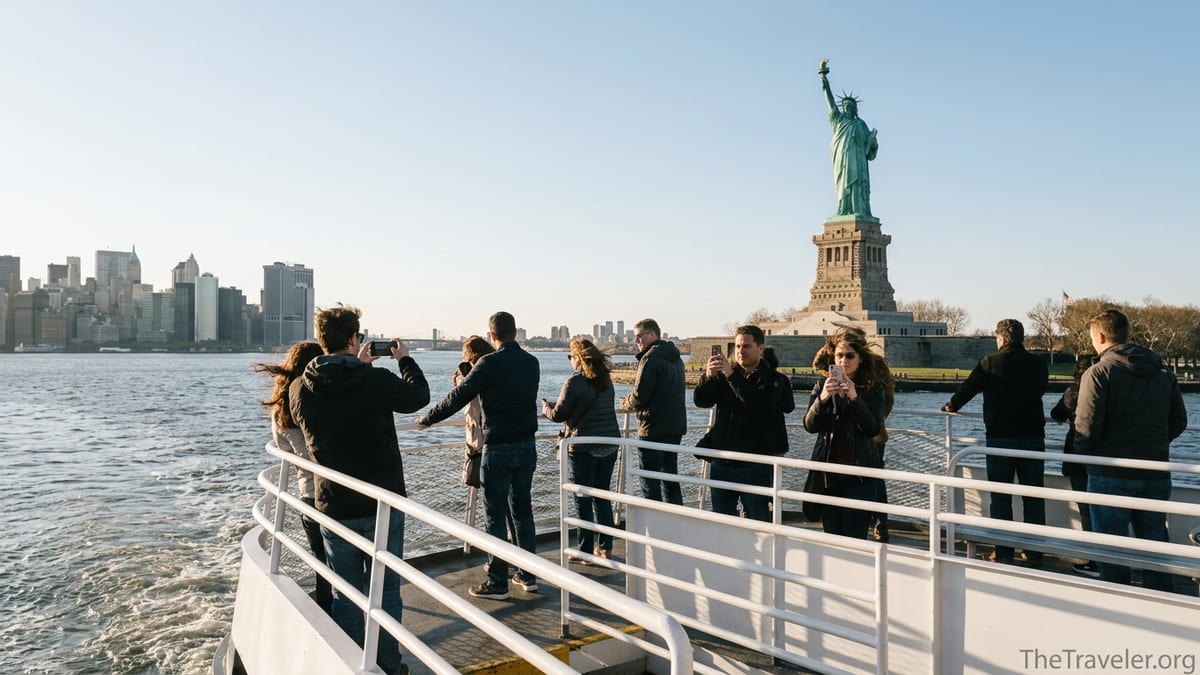
Realizing the Ferry Is Not Just Transport
My day started at the new Statue City Cruises screening facility at The Battery in Lower Manhattan, where all official ferries to Liberty and Ellis Islands now depart. The National Park Service is very clear that Statue City Cruises is the only authorized operator, and that you should buy tickets either online in advance or at the official kiosks in Battery Park or Liberty State Park in New Jersey. Everything about the setup initially felt purely functional: timed entry printed on my ticket, TSA-style metal detectors, and uniformed staff funneling people into snaking lines.
What surprised me first was how much that choreography shaped the mood. The ticket time is not a reserved sailing but the moment you are allowed into security, which means you might wait another 20 to 40 minutes before your boat actually departs, especially on summer weekends or school holidays. Standing in that line, with families juggling strollers and school groups comparing lanyards, I realized I was not just heading to see a monument. I was joining a constantly moving river of visitors from all over the world, all converging on the same small boats.
When the gates finally opened and we walked down toward the gangway, the ferry did not feel like a simple shuttle. It felt like the starting point of the story. The skyline of Lower Manhattan rose behind us, Liberty Island sat in the middle distance, and a ranger’s recorded voice started to play through the speakers once we pulled away from the pier, setting the stage with a mix of history, orientation, and safety tips. The narrative of the day began on the water, not at the base of the statue.
That was the first surprise: the realization that the Statue of Liberty experience officially starts the moment the boat leaves Manhattan, not when you step onto the island.
The First Crossing: Leaving Manhattan Behind
The ride from The Battery to Liberty Island is short, around 15 to 20 minutes, but it feels much longer because there is so much to take in. The open upper deck is where almost everyone wants to be, and for good reason. As the ferry eases away from the dock, the skyscrapers of the Financial District slide into a postcard-perfect panorama behind you. On a clear morning, the glassy sides of One World Trade Center catch the light, and small commuter ferries trace bright wakes across the harbor.
Despite the crowds, there is a sense of collective discovery as people realize that this is one of the best budget-friendly harbor cruises in New York City. A standard reserve ticket, which includes round-trip ferry service and access to Liberty and Ellis Islands, typically costs roughly the price of a modest sit-down lunch in Manhattan. For that, you get essentially three boat rides: Manhattan to Liberty, Liberty to Ellis, and Ellis back to your starting point. Compared with separate sightseeing cruises that charge far more just to circle the harbor, the value of this crossing alone is unexpectedly high.
The commentary on board adds another layer. Over the loudspeakers, a recorded guide explains how Liberty Island sits roughly 1.6 miles southwest of The Battery and just east of Liberty State Park in New Jersey. As the boat turns, you see how the statue is oriented toward the Atlantic, facing southeast, a reminder that she was originally greeting ships arriving from Europe. Children lean against the railings to spot the Verrazzano-Narrows Bridge in the distance; parents quietly point out Ellis Island, low and red-brick, tucked off to the right.
By the time the ferry approaches the Liberty Island dock, the statue that had been a tiny green figure on the horizon has become a towering presence. But it is the transition you feel most sharply: within a quarter of an hour you have gone from the steel canyons of Lower Manhattan to a breezy, open harbor, and that change in perspective does as much to reset your expectations as any museum exhibit.
Which Side of the Boat, and Other Practical Surprises
One of the most practical surprises of the ferry ride is how much your experience depends on where you stand. On the way from Manhattan, the right-hand side of the upper deck delivers the classic sequence: Manhattan sliding away behind you, Governor’s Island off the port side, then the Statue of Liberty slowly growing closer off the starboard rail. This is where you see families subtly jockeying for position, holding spots along the railing as others weave through to take their turn with the skyline.
On the Liberty Island to Ellis Island leg, the vantage point changes. The ferry now skirts behind the statue and cuts across toward the red-roofed immigration complex. Here, the left side of the boat often offers the best views, especially of the statue’s outstretched arm and torch with Manhattan once again as a hazy backdrop. Regulars, including New Yorkers bringing visiting relatives, know this and move with quiet purpose as soon as the gangway drops, angling for those specific spots on deck.
Another surprise lies in the rhythm of boarding and disembarking. Because all visitors pass through metal detectors before boarding, you cannot simply dash back to Manhattan on a whim. Bags are screened, large items and certain sports equipment are not allowed, and anything you buy on the islands must be carried back through the same limited spaces on deck. The result is that the ferry ride becomes a series of structured chapters in your day, each bound by departure times and crowd flow, rather than a hop-on, hop-off shuttle you can use casually.
This structure matters if you are trying to fit the statue into a tight itinerary. A common pattern is to book a morning ferry from Manhattan, spend an hour or so on Liberty Island, then another 60 to 90 minutes at Ellis Island before riding back. In practice, the crowds, security checks, and sheer appeal of standing at the rail to photograph the skyline often stretch that into a three- to four-hour excursion. The ferries themselves, with their queues and views, quietly add at least an hour of experience you will want to savor rather than rush.
Liberty vs New Jersey: Two Very Different Departures
Most first-time visitors default to departing from The Battery in Manhattan, but the New Jersey departure from Liberty State Park offers a very different ferry experience. While Manhattan departures place you in the dense energy of Lower Manhattan almost immediately, Liberty State Park gives you a quieter launch point. The Statue City Cruises dock sits near the historic Central Railroad of New Jersey Terminal, and the approach to the boat involves wide lawns, fewer street vendors, and a calmer security setup than the Manhattan tent during peak season.
On the water, the difference becomes even more pronounced. From New Jersey, the ferry crosses a shorter stretch of harbor, hugging the side of Ellis Island and then swinging out toward Liberty Island. The Manhattan skyline appears diagonally across the water instead of directly behind you, and you gain a stronger sense of how Liberty, Ellis, and Jersey City are all part of the same enclosed upper bay. Local families from New Jersey, day-tripping school groups, and out-of-state visitors mix here, often in smaller numbers than the Manhattan boats, especially early in the morning.
If you are staying in Lower Manhattan, the New York departure will almost always be more convenient, but knowing that the New Jersey route exists can shape how you plan. Some travelers choose to arrive by car, park near Liberty State Park, and use the ferry as a scenic alternative to driving into the city. For them, the ride back in the late afternoon, when the sun softens over the Hudson and the office towers downtown turn golden, is as memorable as any rooftop bar view. It is a reminder that the Statue of Liberty is not just a New York icon but a shared landmark between two states.
Whichever departure you choose, all boats stop at both Liberty Island and Ellis Island, and you can return to your original starting point from either stop. That flexibility turns the ferry itself into a kind of floating bridge between states, museums, and perspectives.
The Emotional Weight of the Ellis Island Leg
The most unexpectedly moving part of the ferry experience for me was the short ride between Liberty Island and Ellis Island. After you have circled Lady Liberty, taken your photos, and perhaps climbed into the pedestal or museum, stepping back onto the boat feels different. The chatter softens slightly, and more people lean on the railings in reflective silence rather than scrambling for selfies.
From this angle, Ellis Island initially appears modest, a low profile of red-brick buildings and green roofs. But as the ferry approaches, the main immigration hall comes into focus, and you start to imagine the packed steamships that once docked here. The recorded narration points out that for millions of newcomers, this short stretch of water was the final threshold before stepping onto American soil. Today, the same water carries school groups clutching worksheets, elderly visitors pointing out imagined landing spots, and descendants of immigrants who made this exact crossing from ship to processing hall.
On my own trip, a group of teenagers from the Midwest crowded the bow, comparing notes on which ancestors had passed through Ellis Island. One boy, clutching a printout from his genealogy research, quietly explained to his friend that his great-grandmother had listed “15 dollars and feather pillow” on her arrival record. Hearing that detail while watching Ellis Island swell in front of us gave the crossing a weight I had not expected.
By the time the boat bumped against the Ellis Island dock, it was clear that the ferry is not just a connector between attractions. It is a moving gallery where contemporary visitors mirror the emotions of those who crossed these waters a century ago, trading fear and uncertainty for anticipation and curiosity.
Returning to the City: A Different Kind of Skyline
The final ferry ride, from Ellis Island back to Manhattan, is where the experience quietly comes full circle. Many guides recommend standing on the left side of the boat for the best views on this leg, and they are right. As the ferry pulls away, Liberty and Ellis shrink behind you, and the towers of Lower Manhattan slowly rise ahead, turning from an abstract silhouette into a familiar city again.
In the late afternoon or early evening, the light can transform this crossing into something almost cinematic, even though nothing about it is staged. Office windows flare with reflected sun, Staten Island ferries carve bright orange arcs across the harbor, and helicopters trace faint paths over Governors Island. Families flip through photos on their phones, marking the transition from “we’re going” to “we’ve been,” while commuters on nearby boats check their messages, barely glancing at the statue they pass every day.
What struck me most was how the ferry ride reframed my sense of distance. Looking back toward Liberty Island from the returning boat, the statue appears smaller again, but it no longer feels remote. The harbor seems less like a barrier and more like an open plaza connecting city, monument, and museum. That shift stays with you when you step off the gangway, pass through the final turnstiles, and spill back into the swirl of Battery Park, where hot dog carts, performers, and street vendors replace the quiet rhythm of engines and waves.
Walking up into Lower Manhattan after that last crossing, I realized that without the boat rides, the Statue of Liberty and Ellis Island would be powerful, but static. It is the act of crossing the harbor that turns them into lived experiences rather than distant icons.
The Takeaway
Before I went, I thought the ferry would be the least interesting part of visiting the Statue of Liberty and Ellis Island, a necessary but forgettable shuttle. Instead, it became the thread tying the whole day together. From the first glimpse of the skyline receding behind the boat to the subtle, reflective quiet of the Ellis Island approach and the golden return to Manhattan, the crossings shaped how I understood the monuments themselves.
The practical details matter: buying tickets only from the official operator, allowing extra time for security, choosing a side of the boat based on the leg of the journey. Yet what lingers longest is not the logistics but the feeling of moving across a harbor that millions of people once crossed in hope, fear, or simple curiosity. The ferry ride puts you, briefly, in their wake.
If you are planning your own visit, do not think of the ferry as a hurdle between you and the statue. Treat it as the heart of the experience. Arrive a little earlier than you think you need to, head for the open deck, and let the harbor tell its story. You may find, as I did, that when you remember your day with Lady Liberty, it is the time you spent on the water that comes most vividly back.
FAQ
Q1. How long does the Statue of Liberty ferry ride take each way?
The ride from Battery Park or Liberty State Park to Liberty Island typically takes about 15 to 20 minutes, depending on conditions and boarding times.
Q2. Which side of the ferry has the best views of the Statue of Liberty?
From Manhattan to Liberty Island, the right side of the upper deck usually offers the best views of both the skyline and the statue as you approach.
Q3. Do I need to reserve a specific ferry departure time?
Your ticket time is for entry into the security screening area, not a specific boat. After screening, you board the next available Statue City Cruises ferry.
Q4. Is the ferry ticket included with pedestal or crown access?
Yes. Pedestal and crown reservations are built on top of the standard ticket, which always includes round-trip ferry service to Liberty and Ellis Islands.
Q5. Can I start in New York and return to New Jersey, or vice versa?
No. You must return to the same side you departed from, either Battery Park in Manhattan or Liberty State Park in New Jersey.
Q6. How early should I arrive before my scheduled time?
Arriving 30 to 45 minutes before your ticketed time is sensible, especially in peak season, to allow for lines at security and boarding.
Q7. Are there restrooms and concessions on the ferry?
Yes. The ferries have basic restrooms and a small snack bar, but most food options are located on Liberty Island, Ellis Island, and in the parks.
Q8. Can I bring luggage or large bags on the Statue of Liberty ferry?
Large luggage and bulky items are not allowed. Bags are screened, and you may be asked to use paid lockers on the islands for certain belongings.
Q9. Is the ferry ride accessible for visitors with mobility challenges?
The boats are designed to be accessible, with ramps and indoor seating, though upper outdoor decks are reached by stairs and may be harder to navigate.
Q10. What happens if the weather is bad on the day of my ferry ride?
Ferries run in most weather, but severe conditions such as high winds or thunderstorms can cause delays or cancellations, announced by the operator on the day.