


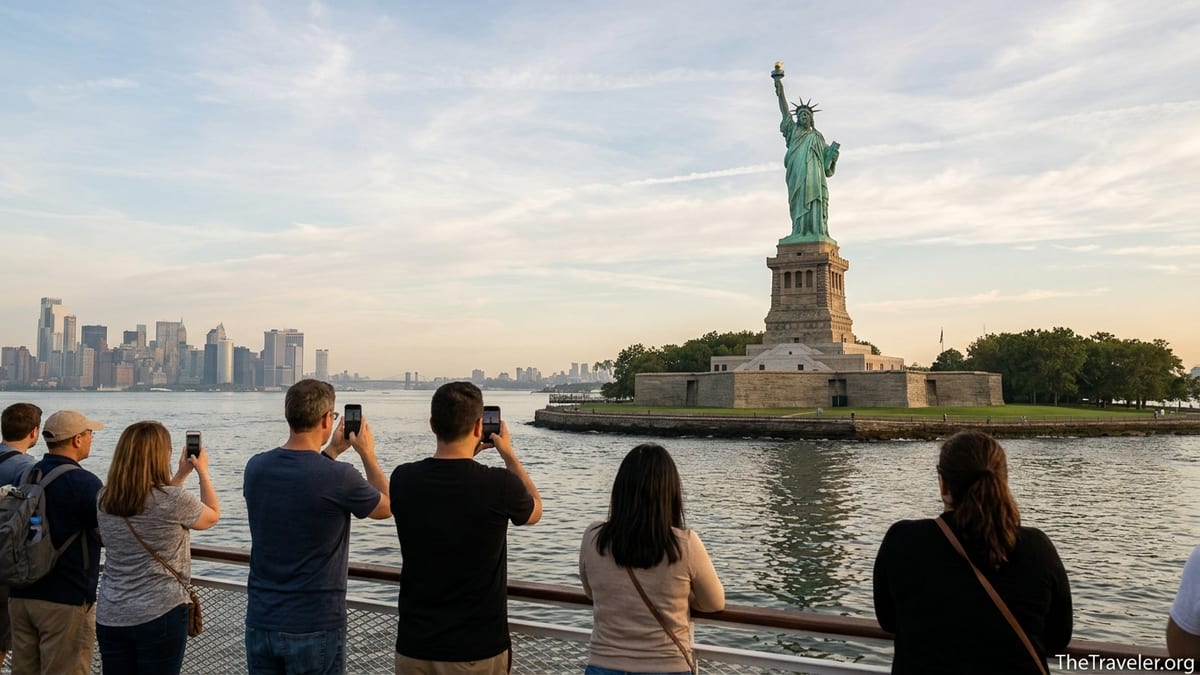
From the deck of a harbor ferry, the Statue of Liberty can look surprisingly small, a pale-green figure standing alone in New York Harbor. It is only when you step onto Liberty Island, pass through security, and stand beneath the folds of her copper robe that the scale and emotional weight of the monument come into focus. This is one landmark that truly feels smaller from afar but infinitely more powerful up close.
Get the latest updates straight to your inbox!
The Optical Illusion of a Global Icon
Many travelers are startled the first time they see the Statue of Liberty from a distance. On a hazy afternoon from Battery Park or the Brooklyn Heights Promenade, the statue can look like a toy figurine planted on a speck of land. Part of this comes down to simple geography: Liberty Island sits several hundred meters out in the water, separated from Manhattan’s high-rise skyline and framed by vast stretches of harbor. Even though the statue is about the height of a 20-story building including the torch, it competes visually with surrounding skyscrapers that easily double or triple that height.
Perspective on the water exaggerates this effect. Board the free Staten Island Ferry from Whitehall Terminal and you will glide within a few hundred yards of the statue, yet it still feels smaller than photographs suggest. The wide expanse of harbor, the container ships heading for New Jersey and the enormous Verrazzano-Narrows Bridge dwarf even major landmarks. First-time visitors often snap photos on their phones and remark that Lady Liberty looks “cute” or “tiny,” not realizing they are looking at one of the largest statues in the world.
Only later, when they zoom into their photos back at the hotel, do they notice details the eye glossed over in real time: the flame of the torch, the stone blocks of the pedestal, the sharp points of the crown. That delayed realization is part of the statue’s paradox. From afar it reads as a symbol. Up close it reveals itself as a piece of architecture and engineering designed to be experienced bodily rather than just visually.
From Harbor Silhouette to Human Encounter
The real transformation happens when you leave the distant silhouette behind and step onto Liberty Island itself. After passing airport-style security at Battery Park or Liberty State Park in New Jersey and riding the official ferry out to the island, you disembark into a surprisingly intimate space. A ring of lawns, trees, and pathways encircles the base of the monument. The Manhattan skyline now becomes the distant backdrop while the statue fills your entire field of vision.
Stand at the base of the pedestal and look straight up. The tablet in Liberty’s left hand is bigger than a person. Each foot alone measures longer than a family car. The calm, slightly turned expression on her face, which looks so gentle on postcards, sits several stories above you. Visitors often fall into a quiet hush here, not because of any formal rule, but because the physical presence of the statue creates its own kind of reverence. Underneath the soaring robes and exposed copper ribs inside the pedestal, the monument feels more like a cathedral than a tourist sight.
The emotional shift is just as dramatic as the visual one. From a moving ferry you might fire off a dozen photos in a few minutes. On the island, you slow down. Travelers lie back on the grass to gaze up at the torch. Parents point out details to their children, explaining the broken chains at her feet or the date of the Declaration of Independence on the tablet. School groups stand quietly while rangers speak about immigration and civil rights. The closer you get, the less you are looking at a small statue and the more you are standing inside a story.
Seeing Liberty From Afar: Ferries, Parks, and City Vistas
There are several ways to experience the “smaller from afar” version of the Statue of Liberty, and each offers a different mood. The classic choice for many budget-conscious travelers is the Staten Island Ferry, which remains free and runs regularly between Lower Manhattan and St. George Terminal on Staten Island. On the 25-minute crossing you pass within a short distance of Liberty Island, close enough for clear photos on a good phone camera but far enough for the monument to sit neatly between water and sky.
Travelers who have only a short layover in New York or do not want to commit half a day to the full visit often choose this ferry as a compromise. They position themselves on the right-hand side of the boat when leaving Manhattan to face the statue and skyline. At sunset, when the copper turns from pale green to muted gold and the office towers of Lower Manhattan start to glow, it is one of the most memorable free experiences in the city.
Other distant vantage points are quieter but equally revealing. From the southern tip of Battery Park, you can sit on a bench with a takeaway coffee and watch the statue as a small, still figure framed by passing ferries. Over in New Jersey, Liberty State Park offers long waterside promenades where joggers and families stroll with the statue on the horizon and the former rail terminal behind them. Seen from these points, the statue reads as part of a vast cityscape, almost modest in scale compared to the megastructures around it.
Crossing the Water: How to Reach Liberty Island
To experience the monument’s full power, you need to leave those distant viewpoints and board the official ferry to Liberty Island. The only authorized operator is the company contracted by the National Park Service, with main departure points from Castle Clinton in Battery Park and from the historic railroad terminal at Liberty State Park. Your ferry ticket typically includes access to both Liberty Island and Ellis Island on the same day, though how much you see depends on timing and what type of access you purchase.
Standard reserve tickets give you the ferry ride and access to the island grounds and museum, which is enough for many visitors who mainly want to walk around the statue, take photos and learn some history. For a deeper encounter, pedestal tickets allow you inside the massive stone base, where museum exhibits and a 360-degree outdoor platform just below the statue’s feet offer expansive harbor views. Crown tickets, which are limited and must be reserved well in advance, take you higher still via a tight double-helix stairway to small windows in the crown.
The practical experience of crossing the harbor also changes how you perceive the monument. From the deck of the official ferry, you approach the statue head-on, watching it grow steadily larger instead of sliding past sideways as on the Staten Island route. Families crowd the bow railings, angling for that moment when Lady Liberty seems to rise straight out of the water. By the time the boat docks alongside Liberty Island, many visitors are surprised to find they must crane their necks sharply to keep the torch in view.
Up Close in the Pedestal and Crown
Inside the pedestal, the statue becomes less like a distant figure and more like a living structure. Exposed iron supports, riveted beams, and walkways reveal the engineering skeleton that holds the copper skin in place. On the lower levels, museum displays show the original torch and early photographs of the construction process, grounding the monument in the gritty reality of nineteenth-century industry and politics. Guests who had previously seen the statue only in photographs often remark that this is the first time it feels like something built by human hands rather than a simple symbol.
Step out onto the pedestal’s outdoor balcony and the harbor spreads around you in every direction. Helicopters buzz past at eye level. Ferries move like toy boats below. Manhattan’s towers compress into a textured wall of glass and steel. From here, the statue’s feet, robe folds, and tablet loom at close range, filling the frame of any photograph you try to take. It is a jarring contrast with the tiny green figure you see from Brooklyn or midtown rooftops, and many visitors find themselves leaning on the railing, taking a few quiet minutes to absorb the size and significance of the structure.
For those with crown tickets and the stamina to climb more than 300 steps, the experience becomes even more intimate. The stairway narrows and twists in a tight spiral up through the statue’s body. You can feel the temperature change and hear your footsteps echo inside the copper shell. At the top, small windows in the crown offer peeks out over the harbor and back toward Manhattan. It is not a grand panorama so much as a deeply personal moment. Knowing that you are literally inside the head of a global emblem changes the memory of every distant view you will see from that day forward.
Emotional Weight: Stories Embedded in Copper and Stone
What makes the Statue of Liberty feel so much more powerful up close is not just the change in physical scale. It is the way the monument gathers human stories. On Liberty Island, you hear snippets of conversations in dozens of languages. A retired couple from the Midwest might be visiting as a bucket-list trip. A New York City teacher might be shepherding a class of ten-year-olds through a lesson on the Bill of Rights. A visitor whose grandparents once arrived at nearby Ellis Island may quietly point across the water and explain how this statue was the first thing their family saw of America.
Inside the museum, personal artifacts and historical photographs give concrete form to the ideals associated with the monument. Rather than an abstract “symbol of freedom,” you see fundraising posters from nineteenth-century France, the immense copper sheets hammered by workers in Paris workshops, and newspaper clippings from the dedication in 1886. The layers of labor and politics become visible. The statue stops being just a background object in the skyline and becomes a product of human effort, compromise, and hope.
Travelers often describe leaving Liberty Island with a different emotional tone than they expected. Some arrive anticipating a simple photo stop and instead find themselves reflecting on migration, identity, or recent global events. Others realize that seeing the statue from hotel windows or rooftop bars later in their trip now triggers memories of being inside it, hearing ranger talks, or simply watching families pose arm-in-arm under the patinaed folds of the robe. The distant view acquires weight because it is tied to a physical experience.
Planning Your Visit: Turning a Distant Icon Into a Personal Memory
To make the most of the contrast between distance and closeness, it helps to plan deliberately. One popular approach is to start with a free or low-commitment distant view, then upgrade to the full experience once you feel the pull to see more. For example, you might ride the Staten Island Ferry in the evening of your arrival day, taking in the skyline and the statue from the water without worrying about tickets. Then, if the sight moves you, you can book a pedestal or crown ticket for a later morning when you have more time.
Families with limited patience for lines sometimes choose to depart from Liberty State Park in New Jersey, where the surroundings are less hectic and parking is more straightforward than in Lower Manhattan. Others look for early morning ferry times, which tend to be less crowded and often come with softer light on the harbor. Whatever your logistics, it is smart to treat a Liberty Island visit as a half-day commitment rather than squeezing it between other attractions.
Small practical choices also shape how powerful the experience feels. Wearing comfortable shoes makes the climb to the pedestal or crown more manageable. Bringing a light jacket matters because the harbor wind can be chilly even on sunny days. Packing minimal belongings speeds you through security and lockers at the monument entrance. These details may sound mundane, but they are what allow you to focus your attention on the monument itself instead of on tired legs or cumbersome bags.
The Takeaway
Viewed from afar, the Statue of Liberty can surprise travelers by seeming modest, even small, against the immense backdrop of New York Harbor and the city skyline. It is easy to treat it as just another silhouette among bridges, towers, and cranes. Yet the moment you step onto Liberty Island, walk beneath the robe, and feel the scale of the copper and stone around you, the monument reveals a different side: part architectural marvel, part living archive of human stories.
The most rewarding way to experience this icon is to embrace both perspectives. Let the distant view from a ferry or park bench introduce you to the shape and setting of the statue. Then, when you are ready, cross the water and meet it at full scale, where history, engineering, and emotion converge. Long after your trip, photographs from rooftops or river walks will not just show a small green figure in the distance. They will remind you of the day you stood beneath that figure and felt its quiet, unexpected power.
FAQ
Q1. Is it worth going to Liberty Island if I have already seen the Statue of Liberty from the Staten Island Ferry?
Yes. The Staten Island Ferry gives a good distant view and photos, but visiting Liberty Island lets you experience the statue’s true scale, museum exhibits, and the powerful atmosphere beneath the monument.
Q2. How much time should I plan for a visit to the Statue of Liberty and Ellis Island?
Most visitors should plan at least four to six hours for the combined trip, including ferry rides, security lines, and time exploring Liberty Island and Ellis Island at a relaxed pace.
Q3. What is the difference between a reserve ticket, a pedestal ticket, and a crown ticket?
A standard reserve ticket covers the ferry and island grounds. A pedestal ticket adds access inside the base and its viewing platform. A crown ticket, which is limited and must be booked well in advance, includes everything plus the climb into the statue’s crown.
Q4. Do I need to book Statue of Liberty tickets in advance?
Advance booking is strongly recommended, especially for pedestal and crown access. Crown tickets in particular can sell out weeks or even months ahead during busy seasons.
Q5. Can I visit the Statue of Liberty without paying for a ticket?
You can see the statue for free from places like Battery Park, the Brooklyn waterfront, or the Staten Island Ferry. However, stepping onto Liberty Island or entering the monument itself requires a paid ferry ticket.
Q6. Is the climb to the crown very difficult?
The climb is steep and involves narrow stairways with many steps. Healthy visitors usually manage it, but anyone with serious heart, breathing, mobility, or vertigo issues may find it too strenuous and may prefer to stop at the pedestal.
Q7. Where are the best places to photograph the Statue of Liberty from a distance?
Popular spots include the Staten Island Ferry, the southern edge of Battery Park, parts of the Brooklyn Heights Promenade, and the waterfront walks in Liberty State Park in New Jersey.
Q8. What should I wear and bring for a Statue of Liberty visit?
Wear comfortable walking shoes and bring weather-appropriate layers because it can be windy on the harbor. Pack light, as you will pass through security, and avoid large bags or prohibited items to move more easily.
Q9. Can I start my trip from New York and return to New Jersey, or vice versa?
No. You must return to the same departure point where your ferry trip began, whether that is Battery Park in Manhattan or Liberty State Park in New Jersey.
Q10. Is visiting the Statue of Liberty suitable for children?
Yes. Children generally enjoy the boat ride, open lawns, and dramatic views. Very young children may find the crown climb tiring, but exploring the island and pedestal is family friendly and educational.