


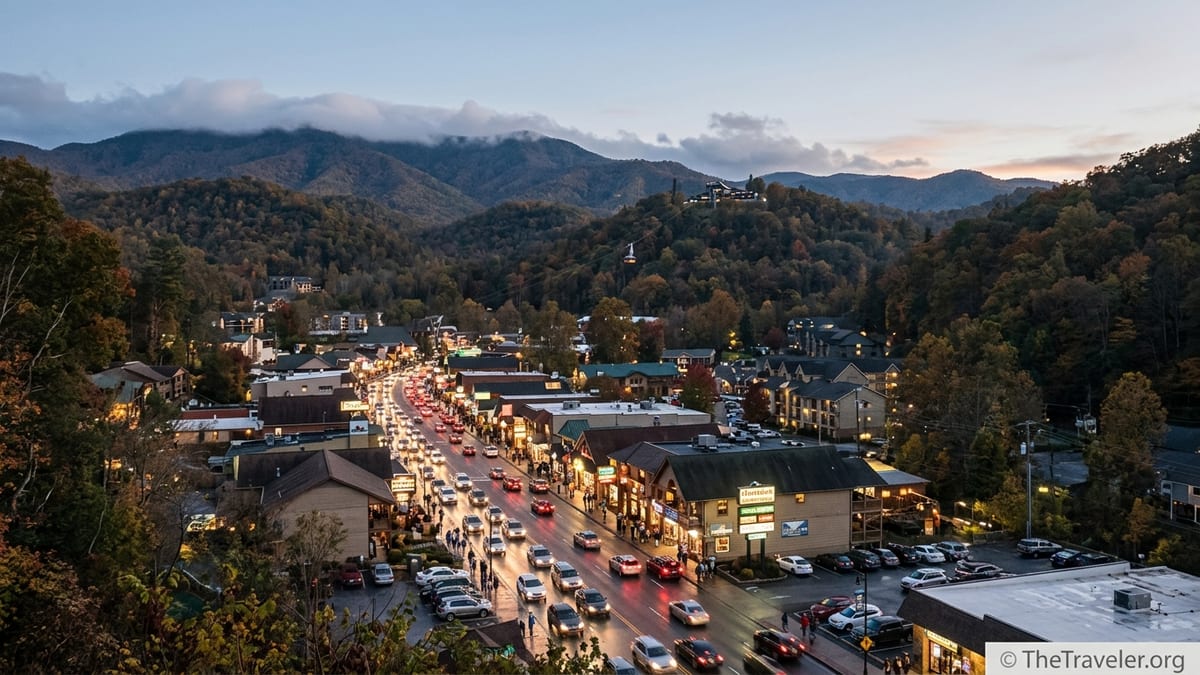
For millions of travelers, the Great Smoky Mountains begin not with a quiet trailhead or a misty ridge, but on the busy sidewalks of Gatlinburg, Tennessee. This compact mountain town, cupped by ridgelines on three sides and opening directly into Great Smoky Mountains National Park, has become the best-known launchpad for exploring the most visited national park in the United States. Understanding how Gatlinburg claimed that role means looking at its geography, history, roads, and the sheer density of cabins, attractions, and restaurants that now orbit the park’s Tennessee entrance.
Get the latest updates straight to your inbox!
From Isolated Cove To National Park Doorstep
Long before souvenir shops and pancake houses lined the Parkway, Gatlinburg was a remote settlement known as White Oak Flats, named for the white oaks that once dominated this river bottom along the West Prong of the Little Pigeon River. In the early 1800s, families like the Ogles carved small farms out of the cove. Reaching this corner of Appalachia meant following rugged wagon roads from Sevierville and over steep gaps; there was no sense of it being a “gateway” to anything, only a valley hemmed in by high ridges and dense forests.
The transformation began when large logging companies pressed into the Southern Appalachians around the turn of the 20th century. By 1900, sawmills were operating in and around what would become Gatlinburg, and simple boarding houses appeared to accommodate loggers, inspectors, and visiting executives. Those early visitors discovered something the locals already knew: the cool air, steep hollows, and smoky blue ridges had a magnetic pull. Even before a national park was formally proposed, word spread through travel magazines and rail posters that eastern Tennessee’s “Smokies” offered alpine scenery without a cross-country train ride.
The national-park movement accelerated Gatlinburg’s shift from working town to resort. As conservationists, local boosters, and state leaders lobbied for a Great Smoky Mountains park in the 1920s and 1930s, Gatlinburg’s proximity to high ground and scenic gaps mattered. The corridor that would become Newfound Gap Road climbed straight out of town to the crest of the Smokies, a route that allowed touring motorists to drive from a lodge in Gatlinburg to the 5,000-foot heights of Newfound Gap in under an hour. When Great Smoky Mountains National Park was officially established in 1934 and dedicated in 1940, Gatlinburg was already positioned as its Tennessee front door.
Unlike some Western gateway towns that grew up at a distance from park boundaries, Gatlinburg effectively touches the park. Sugarlands Visitor Center, one of the main ranger stations and trail hubs, sits just a few minutes’ drive from the main strip. Today, the city’s own tourism office describes Gatlinburg as the “gateway community for Great Smoky Mountains National Park,” noting multiple park entrances right in town and its role as a base for millions of annual park visitors. That physical closeness means a family can finish breakfast on the Parkway and realistically be on the Laurel Falls or Chimney Tops trail within half an hour.
The Power Of Location In A Crowded National Park
Gatlinburg’s rise as the Smokies gateway is not just about charm or marketing; it is about being in the right place for the way modern travelers move. Great Smoky Mountains National Park lies within a day’s drive for a large share of the U.S. population, and many of those visitors funnel toward the easiest, most obvious entries. On the Tennessee side, that is the Gatlinburg corridor, where the Parkway narrows, the mountains close in, and the park boundary sits practically at the town line.
Official visitor-use surveys conducted in the 2020s show how dominant Gatlinburg remains in trip planning. In recent park studies, a clear majority of respondents who visited Great Smoky Mountains National Park also reported spending time in Gatlinburg, often pairing a few days of hiking with evenings on the strip. Travelers routinely book three to five nights in town, using it as a hub to reach marquee park sights like Clingmans Dome, Alum Cave, and Roaring Fork Motor Nature Trail, all accessible on half- or full-day outings from downtown hotels and cabin developments just up the hillsides.
The town’s walkable main drag also shapes visitor behavior. Unlike more dispersed communities such as Townsend or Bryson City, Gatlinburg concentrates restaurants, attractions, and lodging in a tight corridor. A couple staying at a mid-range chain hotel near traffic light No. 6 can stroll to dinner at a local steakhouse, ride the aerial tram to a mountaintop ski and amusement area, pick up trail snacks at a general store, and still be back in their room without ever moving the car. That convenience makes Gatlinburg feel like a full-service resort that just happens to back up against a national park boundary.
Crucially, Gatlinburg also sits at a crossroads between park experiences. To the south and east, Newfound Gap Road climbs past the Chimneys Picnic Area, Alum Cave trailhead, and the turnoff to Clingmans Dome. To the north and west, the one-way Roaring Fork loop begins near town and loops through historic farmsteads and streamside forests. A short drive north puts visitors on the Gatlinburg Spur connecting to Pigeon Forge and the larger regional highway grid, while to the northeast the low gap at Greenbrier leads to quieter trailheads and picnic spots. From a single overnight base in Gatlinburg, a first-time visitor can sample an impressive range of Smokies scenery without long repositioning drives.
Roads, The Spur, And The Funnel Effect
Road building cemented Gatlinburg’s gateway status as much as scenery did. The Great Smoky Mountains Parkway, a major four-lane corridor, carries drivers from Interstate-style highways around Knoxville through Sevierville and the entertainment strip of Pigeon Forge. From there, the Gatlinburg Spur, a scenic four-mile stretch hugging the Little Pigeon River, funnels traffic directly into town and, ultimately, toward the park entrance. National Park Service data emphasize that this Spur is one of the most heavily used access routes into the Smokies, handling many millions of vehicle entries each year.
The result is a physical funnel. Visitors leaving Dollywood in Pigeon Forge or outlet malls in Sevierville who want a taste of the “real mountains” naturally follow the signed route for Great Smoky Mountains National Park. That road does not terminate at a remote ranger station; it dead-ends in Gatlinburg’s traffic lights and neon. For a family with limited time, the easiest option is to book a motel room in town, park once, and rely on a short drive to reach Sugarlands Visitor Center or the first major scenic overlooks along Newfound Gap Road.
Even park infrastructure acknowledges this funnel effect. The Gatlinburg Bypass, a 3.6-mile road built to route traffic around the congested downtown, exists primarily to maintain reasonable access between the Pigeon Forge area and the main park entrances when the strip clogs with cars. Travelers who simply want to reach trailheads or the North Carolina side of the park without stopping in town often use this bypass, but its very existence underlines how deeply intertwined Gatlinburg and the park’s primary access routes have become.
On summer weekends and October foliage peaks, the road network can feel like both a strength and a liability. Long lines of vehicles move slowly along the Spur, and parking lots at Sugarlands or popular trailheads may fill before mid-morning. Savvy visitors adapt by timing their movements: leaving Gatlinburg for trailheads at sunrise, returning to town for a midday rest and lunch, then heading back out for sunset overlooks at Newfound Gap or quiet evening walks along the river. For better or worse, those rhythms revolve around a town that functions as both bottleneck and base camp.
Built-Up Fun: From Quiet Village To Neon Gateway
Location alone does not explain why Gatlinburg, rather than quieter neighbors like Townsend or Cherokee, became the Smokies gateway town everyone recognizes. Over the decades, local business owners doubled down on entertainment, building an all-ages resort strip that feels every bit as central to many trips as the park itself. That layering of attractions atop natural access turned Gatlinburg from a simple staging ground into a destination in its own right.
Early tourism here centered on small motor courts, craft shops, and trout streams. By the late 1960s, the skyline had changed. The Gatlinburg Space Needle rose above downtown, offering 360-degree views of town and mountains, signaling that this was a place meant to be looked at, photographed, and experienced as an attraction. Ripley-branded museums, haunted adventures, mini-golf courses curling up steep hillsides, and glass elevators climbing the facades of high-rise hotels followed. Walking the strip today means passing arcades, moonshine tasting rooms, themed mirror mazes, and chairlifts that float visitors to scenic overlooks and mountaintop adventure parks.
For many travelers, especially families, that built environment is part of the draw. A couple from Ohio might spend a Saturday hiking to Grotto Falls, then reward kids with an evening at an aquarium that anchors one end of the strip. A multi-generational group renting a cabin on Ski Mountain Road can split their days, with some members booking guided fly-fishing on park streams while others browse craft galleries on the Great Smoky Arts & Crafts Community loop just outside town. Gatlinburg’s promise is that a trip can mix serious outdoor time with arcade tokens and funnel cakes, all within a few miles.
The density of lodging reinforces this gateway role. Visitors can choose from budget-friendly motels directly on the Parkway, creekside inns near the edge of town, or large cabins managed by regional rental companies perched on ridges with views into the park. In off-peak seasons, it is not unusual to find weekday hotel rates under one hundred dollars per night for no-frills rooms walking distance from downtown, while winter cabin specials may make multi-bedroom chalets competitive for groups. That breadth of options makes Gatlinburg an easy default choice for first-timers planning a Smokies trip months in advance.
Gatlinburg has also worked to define itself as more than a strip of attractions. Year-round special events, from spring wildflower pilgrimages that tie directly into park natural history to holiday lighting displays that fill the valley with decorations, keep shoulder seasons busy. This event calendar means that even visitors who have already checked off the classic park viewpoints may return to town to experience it in a different season, reinforcing Gatlinburg’s status as the Smokies gateway they know best.
Economy, Identity, And The Gateway Label
Economically, Gatlinburg fits the profile of what planners call a “gateway community” for public lands. The vast majority of local jobs and tax revenue derive from tourism and tourism-supporting industries: hotels and vacation rentals, restaurants, retail, attractions, and tour services. When Great Smoky Mountains National Park reports that visitors spend billions of dollars each year in surrounding counties, Gatlinburg is one of the most visible recipients. Everything from the shuttle driver ferrying guests up to Ober Mountain, to the breakfast cook at a diner near traffic light No. 3, to the clerk at a backcountry outfitter depends on the steady flow of park-bound visitors.
The town has leaned into that identity. Local initiatives with names like the Gatlinburg Gateway Foundation have focused on improving how the community interfaces with the park, from beautification projects along key entry corridors to sustainability campaigns encouraging businesses to cut energy use and protect air quality. City branding often uses phrases such as “mountain getaway to the Great Smoky Mountains,” directly tying any visit to Gatlinburg to an imagined parallel visit into the park, even when many travelers spend most of their time inside town limits.
That gateway status is not merely informal. State-level recognition has increasingly highlighted Gatlinburg as the symbolic doorstep to the Smokies. Legislative resolutions and promotional campaigns in Tennessee refer to the city as the “Gateway to the Smokies,” acknowledging both its historic relationship to the park and its ongoing role as the most tourist-oriented entry point. While neighboring communities such as Pigeon Forge, Townsend, Cherokee, Bryson City, and Sevierville also welcome park visitors and market themselves as alternatives, Gatlinburg’s name is the one that typically appears first in national travel features, television weather reports about fall color, and social media hashtags about Smokies vacations.
This prominence shapes visitor expectations. Many first-timers assume that “seeing the Smokies” means “staying in Gatlinburg,” much as travelers to Yellowstone think in terms of West Yellowstone, or visitors to Acadia picture Bar Harbor. That mental shorthand reinforces a feedback loop: more visitors choose Gatlinburg because it is the place they have heard of, businesses expand to meet that demand, and the town’s association with the park grows stronger. Even travelers who ultimately decide to base in a quieter town often drive through Gatlinburg at least once, whether to access a particular trailhead or to see what all the fuss is about.
Balancing Crowds, Authenticity, And The Mountains Next Door
Gatlinburg’s success as a gateway comes with trade-offs that seasoned Smokies visitors know well. On peak summer weekends and holiday periods, sidewalks can feel shoulder-to-shoulder, and traffic along the Parkway and Spur slows to a crawl. Some longtime fans of the region lament how a once-quiet mountain town has filled with national-chain attractions, flashing signs, and political souvenir shops, arguing that the strip no longer reflects the older Appalachian character found in nearby hollows and on back roads.
At the same time, Gatlinburg remains the easiest base for travelers who want both comfort and proximity to trailheads. A couple arriving on a Friday evening can park at a downtown hotel, walk to dinner, and still be at the Sugarlands Visitor Center parking lot by 7 a.m. the next morning with only a ten-minute drive. Parents with small children appreciate that they can retreat to a pool, playground, or air-conditioned arcade after a hot day exploring kid-friendly stops like Cataract Falls or the Noah “Bud” Ogle Cabin trail. For mobility-limited visitors, scenic drives such as the Roaring Fork Motor Nature Trail or the lower reaches of Newfound Gap Road provide access to mountain vistas without demanding long hikes.
Finding the gateway town that fits your style often means understanding what Gatlinburg is and is not. Travelers seeking nightlife, themed attractions, and a festival-like atmosphere after dark usually thrive here. Those hoping for starry skies and quiet streets may prefer a rental cabin on the outskirts of town, a room in Townsend on the “Peaceful Side of the Smokies,” or lodging in Cherokee or Bryson City on the North Carolina side, driving through Gatlinburg only when a particular trail or scenic drive on the Tennessee side is on the agenda. In all cases, though, Gatlinburg’s infrastructure and services remain part of the broader Smokies experience, whether you embrace the full neon-bathed strip or simply stock up on groceries and fuel before disappearing into higher elevations.
Practical strategies can help visitors enjoy both town and park on their own terms. Booking weekday stays outside of school holidays often yields lower nightly rates and thinner crowds. Arriving at popular trailheads near Gatlinburg at sunrise, then returning to town by late morning, allows travelers to enjoy quieter woodland hours and still indulge in brunch at a pancake house before midday rush. Using the Gatlinburg Bypass or timing drives along the Spur for early or late in the day can reduce traffic frustrations, especially during fall leaf season when day-trippers pour in from across the region.
The Takeaway
Gatlinburg did not become the Smokies’ best-known gateway town by accident. Its evolution from isolated farm settlement to logging hub to national-park resort followed the contours of geography, road building, and economic opportunity. Being pressed up against the boundary of America’s most visited national park, with major highways feeding its narrow valley and trailheads radiating outward into steep hollows, meant that once the Smokies gained national fame, Gatlinburg was almost destined to sit at center stage.
What makes Gatlinburg unique among gateway towns is the intensity of that role. It is not simply a place to pick up gas and groceries before disappearing into the backcountry. For many visitors, the bright lights of the strip, glass-walled observation towers, aerial trams, aquariums, and craft galleries form a parallel vacation alongside the national park itself. Some travelers love that mix of wilderness by day and carnival energy by night; others look for quieter bases and treat Gatlinburg as a drive-through necessity. Either way, it remains the name most travelers associate with Great Smoky Mountains National Park.
For prospective visitors, understanding how and why Gatlinburg became this iconic gateway can help shape a better trip. If you want easy access to marquee Tennessee-side trails, a wide range of lodging at different price points, and the security of knowing that outfitters, restaurants, and pharmacies are just minutes away, Gatlinburg is hard to beat. If your ideal Smokies experience involves hearing only rushing water and bird calls after dark, you might base elsewhere and visit Gatlinburg selectively. The mountains that drew settlers, loggers, conservationists, and vacationers here still tower above town, indifferent to neon; how you use this gateway is ultimately up to you.
FAQ
Q1. Why is Gatlinburg called the gateway to the Smokies?
Gatlinburg sits directly against the boundary of Great Smoky Mountains National Park, with major park entrances, visitor centers, and popular trailheads just a short drive from its downtown strip. Its dense cluster of lodging, restaurants, and attractions makes it the most visible and frequently used base for park visitors, which is why both tourism officials and travelers commonly refer to it as the gateway to the Smokies.
Q2. Is Gatlinburg the closest town to Great Smoky Mountains National Park?
Gatlinburg is one of several towns that touch or sit very close to the park boundary, but it is the best known on the Tennessee side. Sugarlands Visitor Center and the start of Newfound Gap Road toward Clingmans Dome lie only a few minutes from downtown, which gives it especially easy access compared with many other communities.
Q3. How does Gatlinburg compare to Pigeon Forge as a base for visiting the park?
Pigeon Forge offers a broader spread of large attractions and family entertainment, including major theme parks, and sits a few miles farther from the park boundary. Gatlinburg is more compact and pressed directly against the mountains, so reaching popular trailheads and viewpoints from town is generally quicker. Many visitors split time between the two, staying in one but driving through the other for specific activities.
Q4. Can I enjoy Great Smoky Mountains National Park without dealing with Gatlinburg’s crowds?
Yes. Travelers who prefer quieter experiences often base in Townsend, Cherokee, Bryson City, or in rental cabins on less busy roads. They may use bypass routes to avoid downtown Gatlinburg when heading to trailheads. However, even these visitors often pass through or near Gatlinburg at least once, because key Tennessee-side roads and services converge there.
Q5. What types of lodging are available in Gatlinburg for park visitors?
Gatlinburg offers everything from budget motels on the Parkway and mid-range chain hotels with pools to boutique creekside inns and large cabin rentals in surrounding hills. This variety lets visitors choose simple rooms within easy walking distance of the strip or more secluded rentals that trade convenience for privacy and views.
Q6. Is Gatlinburg a good choice for first-time visitors to the Smokies?
For many first-time visitors, Gatlinburg is an excellent choice because it simplifies logistics. You can arrive by car, park at a hotel, walk to meals and attractions, and reach major park trailheads and overlooks with short, well-marked drives. The abundance of outfitters, visitor information, and guided services also makes planning easier for those unfamiliar with mountain travel.
Q7. When is the best time of year to stay in Gatlinburg for park access?
Spring and fall are especially popular because of wildflowers and changing leaves, so they can be busy and require reservations well in advance. Winter and non-holiday weekdays often bring lower room rates and thinner crowds, though some high-elevation roads may close in bad weather. Summer offers long daylight hours but also heavier traffic, so early starts are helpful.
Q8. How can I avoid traffic when staying in Gatlinburg?
You can minimize traffic frustrations by arriving and departing town outside peak weekend and holiday times, using the Gatlinburg Bypass when appropriate, and planning park outings early in the morning or later in the afternoon. Parking once at your lodging and relying on walking for in-town dining and attractions also helps, since most congestion is on the main strip and Spur.
Q9. Are there authentic Appalachian cultural experiences in Gatlinburg, or is it all touristy?
While the strip is heavily commercial, Gatlinburg still offers genuine regional experiences. Visitors can explore the Great Smoky Arts & Crafts Community for locally made pottery and woodwork, attend seasonal bluegrass performances, and visit nearby historic sites like farmsteads on Roaring Fork Motor Nature Trail. Seeking out smaller galleries and long-established eateries helps balance the more obvious tourist attractions.
Q10. If I stay outside Gatlinburg, should I still plan to visit the town?
Many travelers based in quieter communities still schedule a half-day or evening in Gatlinburg to ride an aerial tram, visit the aquarium, or simply walk the strip and decide for themselves how they feel about the atmosphere. Even a short visit can be useful for stocking up on groceries or outdoor gear before returning to a more tranquil base elsewhere around the Smokies.