


Everyone recognizes the Statue of Liberty long before they ever set foot in New York Harbor. It appears in films, news footage, postcards, even emojis. Yet again and again, travelers step off the ferry and say some version of the same thing: “I had no idea it would feel like this.” Visiting Liberty Island is not just a photo stop. It is a layered, physical, sometimes unexpectedly emotional experience that rarely matches the mental picture people bring with them.
Get the latest updates straight to your inbox!
The First Shock: Scale, Setting, and Sound
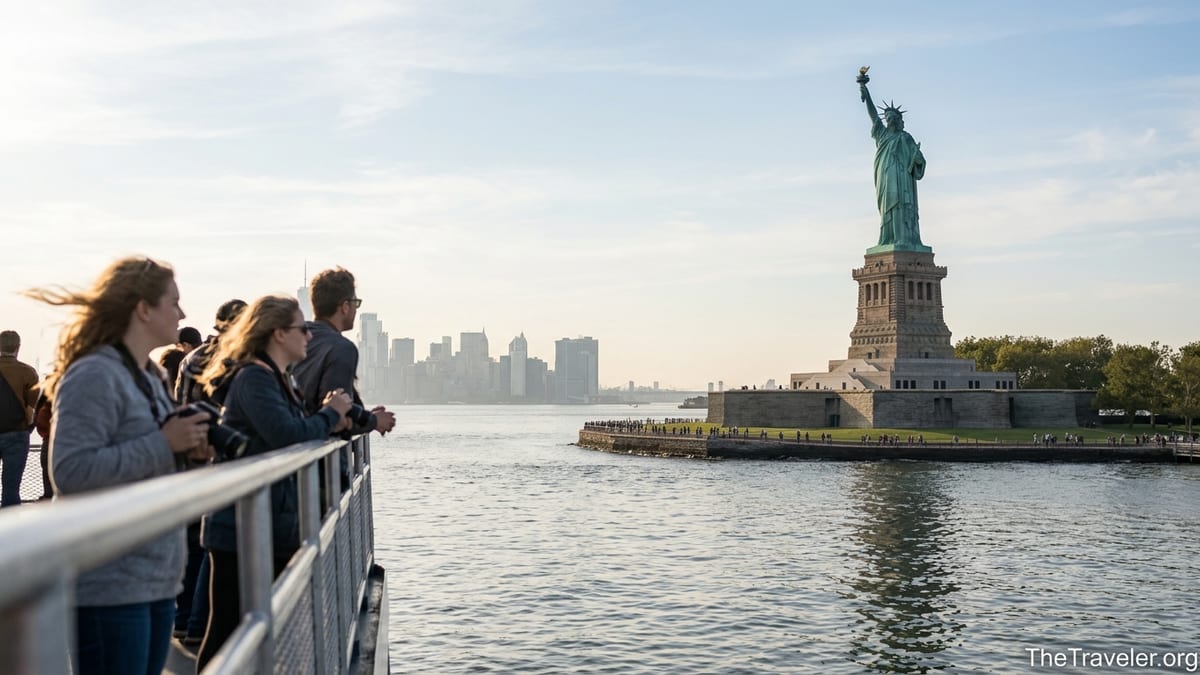
From Manhattan’s Battery Park or New Jersey’s Liberty State Park, the Statue of Liberty can look almost delicate against the skyline. Many visitors expect something roughly skyscraper-sized standing right off Lower Manhattan. In reality, Liberty Island sits alone in the harbor, and as the ferry approaches, the statue slowly swells from a green silhouette into a towering, copper-skinned figure. At 305 feet from the ground to the tip of the torch, it is not the tallest monument in the world, but because the statue stands on its own island, surrounded by open water, the sense of scale lands differently than people expect.
On the ferry deck, you can actually hear reactions change. People who were chatting loudly in line often fall quiet as they realize how wide the pedestal is and how finely detailed the folds in Liberty’s robe appear. The crown’s windows, which look like simple dots from Manhattan, suddenly resolve into a row of distinct openings you could easily stand beside. Travelers who have seen the statue only in photos often say it feels less like an icon and more like a personified presence once they are level with her feet.
The sensory details also surprise people. Out on the harbor, the wind can be brisk even on a warm June afternoon. The sound is a constant mix of gulls, ferry horns, and multilingual conversations. When sea spray hits the air on choppy days, cameras fog up and hair whips sideways. It is not the static, postcard-perfect view many imagined, but a living, noisy, working harbor that frames the monument in motion.
Even the backdrop feels different from the Instagram shots. From Liberty Island, Lower Manhattan’s towers rise directly behind the statue, while to one side you see Brooklyn and, farther off, Staten Island. Standing along the promenade near the flagpole, you can pivot and see New Jersey’s waterfront on one horizon and the Verrazzano-Narrows Bridge on another. Many visitors do not anticipate that the island offers a 360-degree panorama of the region, not just a single, straight-on view of the statue herself.
Getting There: What People Don’t Realize About Ferries and Security
Another recurring surprise is how structured the visit is. You cannot simply walk up to the base of the statue whenever you like. Every visit begins with a timed ferry ticket, departing either from The Battery in Manhattan or from Liberty State Park in New Jersey. Those tickets include access to both Liberty Island and Ellis Island, and the boats run on a loop through the day, but lines can be long and boarding often starts about 10 minutes before the scheduled departure time, which catches some travelers off-guard.
Many people also underestimate the security process. Before you ever board the ferry, you pass through airport-style screening: metal detectors, x-ray machines, bag checks. You remove belts, empty pockets, and run backpacks through the scanner. On busy summer weekends and during school holidays, travelers posting in online forums commonly report waiting 30 to 60 minutes for this first screening, even with pre-purchased tickets, especially at Battery Park where crowds are heaviest.
The surprises continue on the islands themselves. If you have pedestal or crown tickets, you must pass through a second, more restrictive security checkpoint at the base of the statue. Large backpacks, tripods, and certain personal items are not allowed inside the monument. Lockers are available nearby for a small fee, and many visitors only discover this at the last minute, hurriedly reshuffling gear while trying to keep a timed reservation.
Finally, there is the timing. If all you did was ride the ferry from Manhattan to Liberty Island, stay on the boat, and come back, travelers report that it takes close to an hour round-trip. Once you factor in security lines, exploring the Statue of Liberty Museum, walking the perimeter of the island, then optionally continuing on to Ellis Island, a realistic visit often runs four to five hours, not the quick two-hour stop many imagine when they first sketch their New York itinerary.
Inside the Monument: Narrow Stairs, Timed Tickets, and Real Constraints
Perhaps the biggest mismatch between expectation and reality appears when travelers step inside the monument. Many people assume you can simply walk into the statue with a general admission ticket. In practice, your ticket type controls how far you can go: a standard ferry ticket gives you Liberty Island and the museums, a pedestal ticket lets you access the fort-level observation deck around the base, and a crown ticket admits you into the very small space inside Liberty’s head.
Crown tickets are particularly eye-opening. According to the National Park Service, access is limited by a strict timed-reservation system that caps the number of daily visitors to ensure safety inside the narrow stairways and the confined crown platform. These tickets are released months in advance and frequently sell out, especially from late spring through early fall. The NPS also notes that children must meet a minimum height requirement to climb to the crown, something families often do not discover until they are already planning their day.
The physical experience inside the statue confounds expectations too. From the pedestal to the crown, there is no elevator. Instead, you climb a tight spiral staircase: around 160 steps from the pedestal interior to the top, and more than 300 in total from the lobby. The ceiling is low, the steps are narrow, and the air can feel warm even on chilly days. Visitors with heart or respiratory issues, vertigo, claustrophobia, or fear of heights are strongly discouraged from attempting the climb. Many fit travelers describe pausing on the platforms simply to catch their breath and let faster climbers pass.
Once you reach the crown, the actual space is far smaller than most people imagine. Only a handful of visitors fit comfortably at a time. You look out through those familiar windows across the harbor, but you are standing in a tight arc barely wider than a hallway. Park rangers usually limit how long you can stay, both for comfort and crowd flow, so the entire crown experience may last 10 to 15 minutes. What lingers, according to many travelers, is not the duration but the sensation of standing inside a global symbol, close enough to see the rivets in her copper skin and the internal iron framework supporting her weight.
Beyond the Icon: Liberty Island, the Museum, and Unexpected Emotion
Before they arrive, many visitors think of Liberty Island merely as a platform for the statue. In person, it feels more like a compact park and open-air gallery. Paved paths loop around manicured lawns, shaded by trees that offer respite from the summer sun. The perimeter walkway functions almost like a moving balcony over New York Harbor. Travelers frequently spend longer here than expected, stopping at the best angles for photographs of the statue against the skyline, or simply leaning on the railings to watch container ships and commuter ferries move across the water.
The Statue of Liberty Museum, which all ferry ticket holders can access, also reshapes expectations. People often assume a small, old-fashioned exhibit. Instead, they find a modern, three-part experience that begins with a multi-screen presentation about the statue’s history and symbolism, then moves through rooms filled with historic photographs, engineering models, and artifacts that trace the monument’s construction and ongoing conservation. One of the most striking moments is seeing the original, 19th-century torch displayed indoors, taller than many visitors and glowing softly behind protective glass.
For many travelers, the emotional impact of the museum is a surprise. Exhibits highlight how the statue’s meaning evolved, from a Franco-American commemorative gift to a broader emblem of liberty and immigration. Personal stories of people who arrived through nearby Ellis Island or who saw the statue from troop ships during wartime often catch visitors unexpectedly. It is common to see people wiping away tears in front of interactive displays where modern immigrants share what the statue meant to them when they first approached New York Harbor.
Outside, subtle details deepen the experience. On the island’s lawns, you may notice families picnicking with bagels picked up in Lower Manhattan, school groups gathering around their teachers, or solo travelers sitting on benches sketching the statue. It feels less like an isolated monument and more like a shared civic space, where visitors from many countries briefly overlap under the shadow of the same symbol.
Ellis Island and the Wider Story Most People Miss
Another surprise: your Statue of Liberty ferry ticket almost always includes Ellis Island, and many visitors underestimate how compelling it is. The boats run a triangle route between Manhattan or New Jersey, Liberty Island, and Ellis Island. Travelers who attempt to “fit in” Ellis Island quickly, perhaps in an hour before another commitment, often regret not allowing more time. The main building of the Ellis Island National Museum of Immigration is large and densely packed with exhibits.
Inside, the restored Great Hall, where millions of immigrants once queued for inspection, is a powerful counterpoint to the Statue of Liberty across the water. People who thought they were indifferent to history routinely describe the experience as haunting or unexpectedly personal. Display cases hold battered suitcases, family photographs, ship manifests, and letters that make the journey feel immediate and human-scale. Touchscreen stations let some visitors search for relatives whose names passed through the island on the way to new lives in the United States.
Connecting the two sites changes how visitors see the statue. After walking the echoing halls of Ellis Island, looking back across the harbor at Liberty often feels different than it did on the way out from Manhattan. Instead of a distant emblem, many travelers now see it as the first landmark millions of people focused on after days or weeks at sea, hoping that the light under her raised arm meant a new beginning. What started as a simple sightseeing trip frequently becomes an exploration of family history, migration, and belonging.
Because Ellis Island can absorb hours of attention, timing becomes important. Afternoon crown reservations, for example, usually limit your ability to do Ellis Island in depth on the same day. Families often split their visit into a long morning at the Statue of Liberty and Ellis Island, then a quieter evening back in the city, leaving themselves mentally and physically space to absorb what they have seen.
Practical Surprises: Weather, Comfort, Crowds, and Costs
On a practical level, people are often surprised by how much the weather shapes their experience. The harbor is more exposed than city streets, so in April or November, it can feel several degrees colder out on the water than it does in Midtown. In July and August, the combination of sun reflecting off the water, waiting in exposed lines, and climbing inside the statue can feel draining. Many experienced travelers recommend lightweight layers, a hat, and sunscreen regardless of season. Even on cloudy days, the reflected light can be intense on the decks and promenades.
Comfort choices also matter more than people expect. There can be significant walking: from subway or light rail stations to the embarkation points, around Liberty Island’s perimeter, up museum stairs, and possibly up or down hundreds of internal steps. Supportive walking shoes are far better than fashion sneakers or sandals. For those with mobility concerns, ferries and museum spaces provide ramps and elevators, and you can enjoy the island and pedestal-level views without attempting the crown’s spiral staircase.
Crowds are another aspect visitors tend to underestimate. On peak days in summer, thousands of people pass through each embarkation point. Morning ferries often feel the busiest from Manhattan, while late morning and midday can create congestion at security. Families sometimes assume they can buy tickets the same day, only to discover that pedestal or crown access has sold out. The National Park Service strongly encourages advance purchase, especially for any ticket type that includes entry inside the monument.
As for costs, the official round-trip ferry ticket price for adults has been in the mid-twenties in U.S. dollars in recent seasons, with lower prices for children and seniors. Crown tickets add a small supplemental fee. The islands themselves do not require an additional entrance charge, and museums are included. Extra expenses arise from locker rentals at the base of the statue, food at cafes on the islands, and any guided tours you might book in advance. Travelers exchanging stories online often warn against unofficial street sellers near Battery Park who attempt to sell alternative boat rides that do not actually land on Liberty or Ellis Islands.
The Takeaway
For most travelers, the biggest surprise about the Statue of Liberty is that the visit feels nothing like a quick photo stop. The monument that seemed so familiar from movies and skylines turns out to be a physically demanding, logistically structured, and emotionally layered experience. The ferry ride reveals the working harbor, the internal climb exposes the engineering and effort hidden inside the copper skin, and the museum and Ellis Island together deepen the statue’s meaning far beyond a postcard image.
Planning ahead for timed tickets, leaving ample time for security and exploration, and respecting the physical demands of climbing make the day smoother. More importantly, arriving with a willingness to linger rather than rush can transform the visit. In the end, what surprises people most is not just the statue’s size or the narrow crown staircase, but the way a monument they thought they knew pulls them into a larger story about migration, hope, and the evolving idea of liberty itself.
FAQ
Q1. Do I need a ticket just to see the Statue of Liberty up close?
Yes. To set foot on Liberty Island and see the statue up close, you must buy an official timed ferry ticket that includes access to the island.
Q2. What is the difference between general, pedestal, and crown tickets?
General tickets include the ferry, Liberty Island, and both museums. Pedestal tickets add access to the fort-level observation deck, while crown tickets allow a timed climb to the small viewing area inside the statue’s head.
Q3. How far in advance should I book crown tickets?
Crown tickets are limited and often sell out months ahead, especially in spring and summer, so it is wise to book as soon as you know your travel dates.
Q4. Is the climb to the crown very difficult?
It can be strenuous. You climb narrow spiral stairs in a confined space, and there is no elevator from the pedestal to the crown, so visitors should be reasonably fit and comfortable with heights.
Q5. Can I visit Ellis Island on the same ticket?
Yes. The standard ferry ticket covers both Liberty Island and Ellis Island, and you can visit them in either order, time and energy permitting.
Q6. How much time should I plan for the whole visit?
Allow at least four to five hours for security, ferry rides, Liberty Island, and Ellis Island, and more if you have a crown reservation or like to linger in museums.
Q7. What should I wear and bring for a comfortable visit?
Wear sturdy walking shoes and layered clothing, bring sunscreen and a hat for sun, and carry only essential items, since large bags and some objects are not allowed inside the monument.
Q8. Are there food and restrooms on the islands?
Yes. Both Liberty and Ellis Islands have restrooms and cafes, though many visitors also bring snacks or light picnics, especially when traveling with children.
Q9. Is the Statue of Liberty visit accessible for visitors with limited mobility?
Ferries, island paths, and museum spaces provide accessible routes and elevators, though the internal stairways to the pedestal’s upper levels and the crown are not wheelchair accessible.
Q10. How can I avoid ticket scams near Battery Park?
Ignore street sellers and only purchase tickets directly from the official provider or ticket offices at the departure points, where staff are clearly identified and signage is prominent.