


Flight delays and cancellations are no longer just a travel annoyance. Under European and other passenger-rights rules, they can entitle you to hundreds of euros in compensation. That promise has helped fuel the rise of services like Refund.me, which offer to fight the airline on your behalf in exchange for a share of whatever you recover. But how successful is Refund.me in practice, and is it really the smartest way to claim what you are owed?
Get the latest updates straight to your inbox!
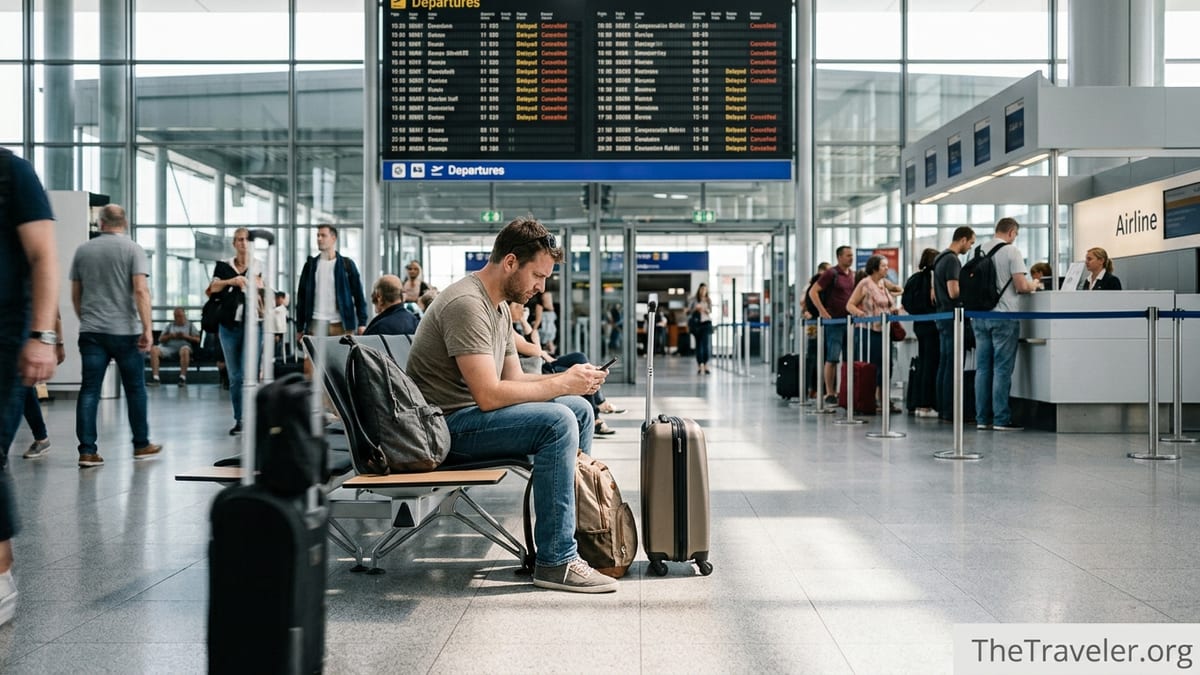
What Refund.me Actually Does for Air Travelers
Refund.me is a Germany-based legal-tech service that specializes in enforcing air passenger compensation, primarily under European Union Regulation 261/2004. That regulation gives travelers on many flights to, from, or within the EU potential cash compensation, typically around 250 to 600 euros depending on distance and delay, when flights are heavily delayed, cancelled, or overbooked and the disruption is not due to extraordinary circumstances such as severe weather or air traffic control strikes. Refund.me positions itself as the intermediary that understands the rules, argues with the airline, and if needed escalates to legal action so passengers do not have to.
In practical terms, a traveler whose Madrid to Berlin flight arrives more than three hours late might go to Refund.me’s website, enter their flight number and date, and let the company’s eligibility engine estimate whether compensation is likely. If the case looks promising, Refund.me will invite the traveler to upload documents such as boarding passes, booking confirmations, and identity details. From there, Refund.me contacts the airline, sends formal letters of claim, and pursues negotiations or court proceedings where local partners are available.
Refund.me works on a contingency basis. Instead of charging an upfront fee, it takes a percentage of any money recovered as its commission, plus in some cases an additional legal or handling fee. While specific fee tables can change, services of this type commonly charge somewhere around 25 to 35 percent of the recovered compensation. That means if a family of four is owed 400 euros each after a cancelled Paris to Rome flight, a successful claim might generate 1,600 euros in compensation, of which several hundred euros would go to Refund.me and the rest to the travelers.
This model is appealing to many passengers who feel overwhelmed by legal jargon or have been repeatedly brushed off by airline customer service agents. For travelers who do not have the time, patience, or language skills to draft formal complaints and follow up, outsourcing the headache to a specialist can sound like a small price to pay.
How Refund.me’s Success Rate Is Presented Versus Reality
Refund.me, like many flight-compensation services, has historically highlighted very high win rates in its marketing, sometimes pointing to figures approaching or exceeding the 90 percent range for cases it decides to take on. Legal-tech reports and academic work discussing the broader claims industry cite similarly high success numbers for selected cases among some providers. On the surface, that suggests a near-guaranteed path to money if Refund.me accepts your claim.
The reality is more nuanced. First, those figures usually refer to the percentage of accepted cases that eventually end in some form of settlement or judgment, not the percentage of all inquiries. Refund.me screens out weak or borderline claims, especially those likely to be caught by airline defenses such as bad weather, air-traffic restrictions, or very short delays. If ten travelers enter their details on the site, Refund.me might only accept five of them as clients, and the success rate is then measured on that smaller pool.
Second, a “successful” claim from the company’s perspective does not always mean a fast or straightforward experience for the passenger. There are many real-world examples of travelers who receive their money after months of silence, as well as others who are told that a case turned out to be weaker than first thought when the airline produced additional evidence. For instance, a traveler from Barcelona to London might be told at first that the delay looks compensable, only for the airline later to produce documents showing an unexpected runway closure unrelated to the carrier, which can dash the claim.
Finally, success rates do not factor in traveler expectations about timing and communication. A claim that takes twelve to eighteen months, with minimal updates, can technically be part of a high success percentage yet feel like a failure in terms of service quality. In other words, Refund.me’s legal success rate on processed cases may be relatively strong, but the overall user experience, from first click to final payout, is much more mixed.
What Recent Traveler Reviews Reveal About Performance
To understand Refund.me today, it is useful to look at fresh, publicly available customer reviews rather than relying only on older marketing claims. Across major review platforms, Refund.me’s ratings in 2025 and 2026 show a visibly mixed picture, with both highly satisfied passengers and deeply frustrated ones posting detailed accounts of their experience.
On the positive side, there are travelers who say Refund.me obtained compensation they never would have managed to secure alone. For example, a family from Italy reported that their long delay on a flight from Rome to Amsterdam had been brushed off twice by the airline, but after submitting the case to Refund.me they received several hundred euros per person. Similar success stories often come from passengers in non-EU countries such as India or Canada who flew into Europe on European or European-bound carriers and were unfamiliar with the compensation rules until they discovered the service.
Negative reviews, however, are significant. Some users complain of long periods of silence after submitting documents, saying that they heard nothing for months and had to repeatedly chase updates. Others describe situations where Refund.me declared their claim unviable only after extended delays, leaving them feeling they had lost time they could have spent following up directly with the airline. A handful of travelers report confusion over the final payout amount, saying that after fees and other deductions the money they received was lower than they had expected from the headline compensation rules.
When read in aggregate, these reviews suggest that Refund.me is neither a pure scam nor a flawless “set and forget” solution. The service can and does win cases that meet the right legal conditions, but travelers should approach it with realistic expectations about timelines, communication, and the share of any payout that will go to fees.
When Using Refund.me Makes Practical Sense
Despite the trade-offs, there are clear scenarios where turning to Refund.me can be a rational choice. One common example is the long-haul traveler whose trip touches multiple jurisdictions and airlines. Consider a passenger flying from New York to Lisbon via Madrid on a European airline, whose connecting flight is cancelled overnight due to a technical fault. They are rebooked the next day and arrive in Portugal more than twelve hours late. Under EU rules, they may be entitled to substantial compensation, but the claim route might be unclear: Should they approach the operating carrier, the codeshare partner, or the booking site? For someone without the time to study regulations, using a claims specialist can take away the guesswork.
Another typical use case involves language or procedural barriers. A traveler living in Canada might have trouble communicating with a small regional carrier in Eastern Europe or interpreting letters from an overseas law office. Refund.me, which works with local partners in multiple countries, can help close that gap by handling correspondence and legal filings in the appropriate jurisdiction and language. In such cases, travelers often view the company’s percentage fee as a fair trade for not having to navigate unfamiliar systems.
Refund.me can also be attractive for travelers who are psychologically exhausted after a particularly bad disruption. For instance, imagine a family with young children stranded overnight due to an overbooked London to Athens flight, forced to arrange hotels and meals out of pocket. Once they are finally home, the prospect of arguing with the airline’s customer relations department for months may be overwhelming. By handing the paperwork to Refund.me, they convert an open-ended hassle into a simple trade: a smaller payout, but with someone else doing the persistent work.
In all of these situations, the key factor is opportunity cost. If you are unlikely to pursue the claim yourself, or if the stress of doing so would be disproportionate to the extra money you might save in fees, then using Refund.me can still leave you financially and emotionally better off compared with doing nothing.
When You May Be Better Off Claiming Directly
There are equally clear circumstances where travelers may be better served going directly to the airline or relevant regulator instead of using Refund.me. The first is when the case is straightforward, well documented, and falls squarely within widely recognized rules. For example, if your intra-EU flight from Paris to Frankfurt arrived more than three hours late due to a confirmed technical issue, and you have boarding passes and written confirmation from the airline about the cause, many EU carriers provide online claim forms that are relatively simple to complete.
In such routine cases, travelers with some time and patience can often secure the standard compensation amount without sacrificing a large share as a commission. For a solo traveler who stands to receive 400 euros, claiming directly could mean keeping that full amount rather than parting with a third or more in fees. The same logic applies to large family claims: if four passengers would jointly receive 1,600 euros, handling the paperwork yourself can keep hundreds of euros in your travel budget instead of sending it to an intermediary.
Another reason to proceed independently is control over the process. When you claim directly, you decide how aggressively to escalate, whether to accept partial settlements such as vouchers, and how frequently to follow up. With Refund.me, you effectively hand those decisions to a third party whose priorities include efficient case management and fee recovery. Some travelers later regret delegating that control, especially if they would have been willing to push harder or wait longer for a better offer than the one negotiated on their behalf.
Finally, some airlines and national enforcement bodies have become more responsive in recent years, particularly after waves of disruption highlighted passenger rights. Travelers who make polite but firm use of written complaints, social media channels, and if necessary national ombudsman schemes sometimes report faster outcomes than those who went through an intermediary. If you are comfortable writing a clear, factual letter and following up every few weeks, you may find that the “do it yourself” route keeps more money in your pocket without costing too much extra effort.
Comparing Refund.me With Other Claim Services
Refund.me operates in a crowded marketplace of flight-compensation specialists, including well-known names such as AirHelp, Flightright, EUclaim, and various regional players. Each has its own fee structures, geographic strengths, and reputational profile, but they broadly share the same model: evaluate a claim’s eligibility, accept cases that look profitable to pursue, and charge a percentage of any payout.
Compared with some of these competitors, Refund.me has historically emphasized its technology-driven approach, including an “Advanced Business Logic” system designed to quickly check flights against court decisions and regulations. That can be a genuine advantage for borderline or complex cases, since subtle differences in route, aircraft rotation, or prior case law can make or break a claim. For instance, two flights delayed out of the same airport on the same day may be treated differently depending on whether the underlying issue was a specific mechanical fault or a broader air-traffic restriction.
However, reputation also matters. Some rival services receive consistently stronger customer ratings, while others are criticized for high fees or aggressive marketing. Travelers comparing Refund.me with alternatives should look beyond headline success claims and ask concrete questions: How clear are the terms and fee structures? How often does the provider send updates? What happens if the airline sends the money to the service but the passenger disputes the final amount received?
In real life, many seasoned travelers take a layered approach. They might first submit a claim directly to the airline and wait for a clear written refusal. Only then, if the airline remains uncooperative and the potential compensation is substantial, do they consider turning to Refund.me or another specialist as a second line of attack. That approach preserves a chance of receiving full compensation while keeping a professional option in reserve if the airline digs in its heels.
How to Maximize Your Chances of a Payout With or Without Refund.me
Regardless of whether you use Refund.me, there are concrete steps travelers can take to improve the odds of actually receiving compensation. The most important is good documentation. Always keep boarding passes, booking confirmations, and receipts for hotels and meals during disruptions. Take photographs of departure boards showing delays and consider noting the explanations given at the airport. These details can help confirm the cause and length of a disruption when airlines later argue about what happened.
Timing also matters. Many jurisdictions place strict deadlines on compensation claims, sometimes as short as one or two years from the date of the disrupted flight, depending on local law. If you plan to use Refund.me, initiate the process as soon as you are back online after your trip rather than waiting months. If you prefer to claim directly, submit your complaint to the airline as soon as you have gathered your documents, and keep copies of what you send.
When dealing with Refund.me specifically, clarity at the outset can prevent misunderstandings later. Before signing any agreement, review the fee structure carefully, including any court or success fees that might be added if the case goes to litigation. Ask how you will be updated, how long typical cases take on routes similar to yours, and whether you can withdraw your claim if you decide to pursue it independently instead. Travelers who ask these questions upfront are less likely to be surprised when the first update arrives months later or when the final payout amount is calculated.
Finally, be realistic about what “success” means in your situation. Even when the law appears to be on your side, airlines may raise defenses that are difficult for non-lawyers to evaluate, such as arguing that a specific technical fault was unforeseeable. Refund.me may decide not to risk court costs on a borderline case, or a judge may interpret the law differently from how online summaries suggest. Treat any potential compensation as a welcome bonus, not a guaranteed part of your travel budget, and you will be less disappointed if outcomes fall short of expectations.
The Takeaway
The truth about Refund.me is more complex than a scam-or-savior narrative. The company sits in the middle ground: a genuine legal-tech service that has helped many travelers secure compensation they struggled to claim alone, but also a business that screens cases for profitability, charges substantial fees, and sometimes leaves customers frustrated with slow communication or confusing outcomes.
If you are a traveler facing a modest, clear-cut delay on a familiar airline, you will often be better off filing a claim directly and keeping any payout in full. If your case is cross-border, legally intricate, or simply more stress than you want to handle, using Refund.me can still be a rational choice, especially when the alternative is abandoning the claim entirely. As with many travel decisions, the smartest move is not to rely on slogans or star ratings but to weigh your own time, patience, and risk tolerance against the likely size of any compensation.
Ultimately, services like Refund.me exist because airlines and regulators have not yet made passenger rights as simple and automatic as they could be. Until the day your compensation arrives as reliably as your boarding pass, companies that turn legal complexity into a one-click service will continue to attract travelers. Go in with your eyes open, understand how success rates are calculated, and decide whether handing over part of your payout is a price you are willing to pay for less hassle on your next disrupted journey.
FAQ
Q1. Is Refund.me a legitimate company or a scam?
Refund.me is a real legal-tech company based in Germany that focuses on air passenger compensation. It operates on a contingency-fee model and has handled claims against many airlines, but traveler experiences vary widely, from smooth payouts to long delays and poor communication, so it is best viewed as a legitimate but imperfect service rather than a simple scam or a guaranteed solution.
Q2. What kind of flights and problems can Refund.me help with?
Refund.me mainly helps with flights affected by long delays, cancellations, overbooking, or missed connections that fall under European-style passenger-rights rules, especially EU Regulation 261/2004. It tends to be most useful when flights touch the EU or other jurisdictions with similar legislation, though it also works with cases involving certain routes in countries such as India, Canada, Ukraine, and Turkey where specific compensation rules apply.
Q3. How much does Refund.me charge if my claim is successful?
Refund.me does not usually charge an upfront fee but instead takes a percentage of any compensation recovered, often in the general range typical of claims services, which can be around a third of the payout once all costs are included. Exact percentages and any additional legal or handling fees can change over time, so travelers should always read the current fee schedule carefully before agreeing to proceed.
Q4. How long does it typically take to receive money through Refund.me?
The timeline for a Refund.me claim can vary from a few months for straightforward cases that airlines do not contest heavily to more than a year if the case is disputed, requires extra documentation, or goes through court proceedings. Many negative reviews focus on slow progress and long periods without updates, so travelers should be prepared for a potentially lengthy process rather than expecting a quick turnaround.
Q5. Can I still claim directly from the airline if I use Refund.me?
Once you sign an agreement with Refund.me and it opens a case on your behalf, you normally authorize the company to handle the claim, which can limit your ability to negotiate directly with the airline on the same issue. If you prefer to keep the option of self-representation open, you should clarify with Refund.me in writing before signing whether and how you can withdraw, and what happens if you or the airline initiates separate contact during the process.
Q6. What documents do I need to start a claim with Refund.me?
To begin, Refund.me typically asks for your booking confirmation, boarding passes if available, and identification details such as your full name and contact information, along with the date, route, and flight number. Additional documents, such as written explanations from the airline, hotel or meal receipts, and photos of airport departure boards, can strengthen your case and help the company argue more effectively for compensation.
Q7. Is Refund.me’s success rate really as high as advertised?
Refund.me and similar services often quote high success rates, but these figures generally apply only to cases the company chooses to accept after screening, not to every inquiry. They also treat a case as successful when some form of settlement or judgment is reached, regardless of how long it took or whether the passenger felt the final amount and communication matched expectations, so travelers should treat headline percentages as marketing indicators rather than guarantees.
Q8. When is it smarter to claim compensation yourself instead of using Refund.me?
You may be better off claiming directly from the airline when your case is straightforward, clearly covered by compensation rules, and supported by good documentation, such as a long delay due to a confirmed technical issue on an EU airline. In these situations, submitting a complaint via the airline’s own channels and, if necessary, a national enforcement body can allow you to keep the full compensation amount without paying a commission to an intermediary.
Q9. Does using Refund.me affect the amount of compensation I am legally entitled to?
The underlying legal entitlement, such as 250 to 600 euros under EU Regulation 261/2004, does not change whether you use Refund.me or claim directly, but what you actually receive in your bank account will be reduced by Refund.me’s fees if the case is successful. In other words, the service does not alter the law but effectively trades part of your payout for expertise and effort.
Q10. What should I watch out for before signing up with Refund.me?
Before committing, review Refund.me’s current terms and fee structure, including any extra charges if the case goes to court or involves additional partners, and ask how often you will receive updates and how long typical cases take. Make sure you are comfortable with giving the company authority to negotiate with the airline on your behalf and understand what happens if the airline pays Refund.me directly, so there are no surprises about timing, communication, or the final amount you receive.