


From the Staten Island Ferry or the windows of a landing jet, the Statue of Liberty looks timeless, almost inevitable, as if she has always stood watch over New York Harbor. Yet the real story behind “Liberty Enlightening the World” is far more complicated and fascinating than many visitors expect. Born in the turmoil of 19th century French politics, shaped by debates over slavery and immigration, financed by thousands of small donations, and rebuilt to survive Atlantic storms, this global icon carries layers of meaning that reward any traveler willing to look a little closer.
Get the latest updates straight to your inbox!
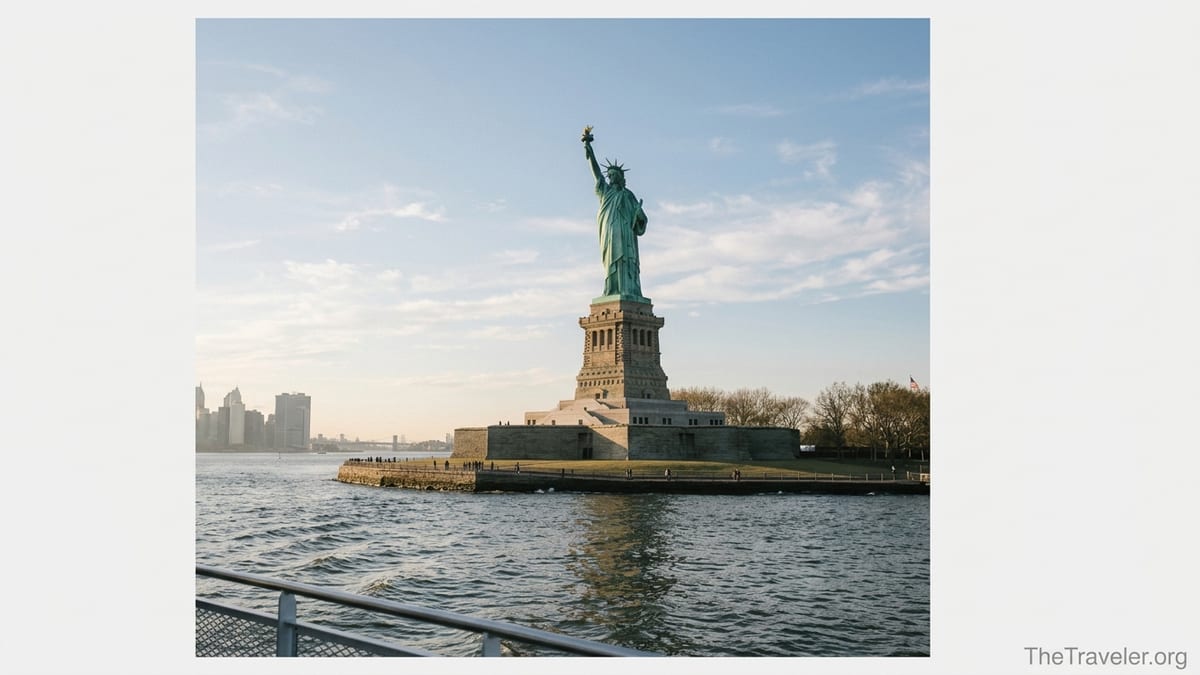
A Radical Idea Born in 19th Century France
The Statue of Liberty’s story begins not in New York, but in Paris in 1865, just as the American Civil War was ending. French legal scholar and abolitionist Édouard de Laboulaye proposed a bold idea: a monumental statue celebrating the United States’ survival as a democratic republic and the abolition of slavery. He imagined it as a joint project that would strengthen ties between France and the United States, and quietly criticize France’s own lack of political freedoms at the time.
To bring the vision to life, Laboulaye turned to a young sculptor, Frédéric Auguste Bartholdi. Bartholdi had already experimented with colossal statuary and was drawn to the concept of a figure holding a beacon of light. The project that would become the Statue of Liberty was, from the beginning, more than a decorative gift. It was a carefully calibrated political statement that spoke to liberty, republican ideals, and the fragile nature of democracy on both sides of the Atlantic.
Travelers who visit the Statue of Liberty Museum on Liberty Island today can see early sketches, maquettes, and letters from this formative period. These exhibits help frame the monument not just as a symbol of America, but as a product of a very French conversation about freedom, empire, and modernity.
Even the statue’s full, original name hints at that ambition. Officially titled “Liberty Enlightening the World,” it was meant to shine beyond the United States, casting its symbolic light toward Europe and beyond.
From Suez Dreams to New York Harbor
One of the most surprising chapters in the statue’s story unfolds far from the United States. Before Bartholdi settled on New York Harbor, he explored the idea of a colossal lighthouse at the entrance to the Suez Canal, celebrating Egyptian modernization. Elements of that unrealized project, especially the robed female figure raising a torch, clearly echo in the final Statue of Liberty design, revealing how global his thinking was.
When the Suez concept failed to gain funding, Bartholdi refocused on Laboulaye’s American plan. In 1871, he sailed to the United States, scouting possible sites. Sailing into New York for the first time, he noticed Bedloe’s Island, a low patch of land near the main shipping channel. Every ship entering the harbor passed close by, making it a perfect stage for a monument meant to greet the world.
Today, travelers retrace that moment every time they approach Liberty Island by ferry from Battery Park in Manhattan or Liberty State Park in New Jersey. As the boat swings around the island, it mirrors the route of 19th century transatlantic steamers, and it is easy to imagine Bartholdi seeing that same rocky outcrop and picturing a monumental figure rising from its center.
The choice of site would prove inspired. When the statue was finally dedicated in 1886, it instantly became part of the arrival ritual for immigrants entering New York Harbor, long before nearby Ellis Island became the country’s busiest federal immigration station.
Engineering a Colossus: From Paris Workshop to New York Dock
Turning Bartholdi’s vision into a 151-foot copper-clad figure required cutting-edge engineering. The sculptor enlisted French engineer Gustave Eiffel, who would later become famous for the Eiffel Tower, to design an internal iron framework that could support the thin copper shell while flexing in the wind. Eiffel’s solution was to suspend copper plates from an iron pylon using a secondary skeletal structure, allowing the outer skin to move slightly without cracking.
In Paris, artisans began work in the 1870s. They hammered thin copper sheets over gigantic wooden molds to shape Liberty’s drapery, face, and crown. Visitors to Paris at the time could buy tickets to see the work in progress in a workshop in the city’s 17th arrondissement. For a period, the completed head and raised torch were even exhibited separately during the 1878 World’s Fair, drawing crowds who climbed into the torch for a view over the Seine. Those fragments served as both technical tests and savvy fundraising tools.
By 1884, the statue was fully assembled in Paris, towering above the surrounding rooftops. It was then disassembled into hundreds of pieces and packed into wooden crates for the Atlantic journey. When travelers enter the Liberty Island museum today, a large-scale model and archival photographs show this temporary Paris skyline, making it clear that the statue’s first life was emphatically French as well as American.
Once the pedestal was ready in New York, a crew of mostly immigrant workers began reassembling the statue in 1886. They worked high above the harbor without the safety gear expected on modern construction sites, bolting the iron framework together and riveting the copper plates in place. Contemporary visitors can get a sense of that dizzying height by climbing to the crown, where narrow, 162-step stairways wind up inside the structure, revealing glimpses of Eiffel’s latticework as you go.
The Crowdfunded Gift: How Ordinary People Paid for Liberty
The popular story of the statue describes it as a simple gift from France to the United States. The reality is messier and more relatable. France was responsible for financing the statue itself, while the United States agreed to fund the pedestal and site. Both countries struggled to raise the needed money, and progress often stalled for years at a time.
In France, a committee organized lotteries, charity events, and public subscriptions. Schoolchildren sent in coins, and fundraisers sold souvenir medallions and miniature statues. Collectors today sometimes find these 19th century bronze miniatures in Paris antiques markets, a tangible reminder that the monument was financed one small donation at a time.
The American side faced even sharper delays. By the mid-1880s the statue was finished and waiting in crates in Paris, but the pedestal in New York was not fully funded. It took an aggressive campaign by newspaper publisher Joseph Pulitzer to turn things around. Through the pages of his New York World, he appealed directly to ordinary readers, promising to print the name of every donor, no matter how small the amount. Thousands of people across the United States responded with donations as low as a single dollar or even a few cents.
Standing today on the pedestal’s viewing gallery, visitors often focus on the skyline views of Lower Manhattan and the Verrazzano-Narrows Bridge. Yet the stone beneath their feet is also a monument to one of the earliest truly mass crowdfunding efforts, long before the word existed. The idea that a global symbol of liberty was built on the modest savings of workers, shopkeepers, and children helps explain why so many people feel a personal connection to it even now.
Symbolism in Copper: Chains, Tablets, and a Changing Color
Most visitors arrive at Liberty Island knowing the statue as a green copper figure crowned with seven rays, but every piece of the design was carefully chosen, and some of its most telling details are easy to miss. The robed woman represents Libertas, the Roman goddess of liberty. In her left arm, she cradles a tablet inscribed with the date “July 4, 1776” in Roman numerals, tying the statue to the Declaration of Independence. On her head, a crown of seven spikes suggests both rays of sunlight and the seven continents and seas.
At the statue’s feet lie broken chains and shackles, partially hidden by folds of drapery. These details, which visitors can see more clearly in close-up photographs displayed in the on-site museum, refer directly to the end of slavery in the United States. They echo Laboulaye’s abolitionist politics and the statue’s origins in post-Civil War debates, adding a layer of meaning that can be easy to overlook from a ferry deck or a distant boardwalk in Brooklyn Bridge Park.
Another surprise is that the statue was not always the familiar sea-green color travelers see today. When it was dedicated in 1886, the copper surface was closer to a dull brown, similar to a shiny new penny. Over the next two to three decades, exposure to salt air and pollution created a natural patina, slowly transforming the surface into the blue-green hue now associated with Lady Liberty. Engineers and historians have since concluded that the patina actually protects the underlying metal, and when a full restoration took place in the 1980s, conservators worked carefully to preserve it rather than strip it away.
Visitors can experience this material story up close inside the Statue of Liberty Museum, which displays a section of the original copper skin and samples of patinated metal. Comparing these fragments to the gleaming copper replica of the original torch, now sheltered inside the museum, gives a vivid, tactile sense of how 19th century engineering has weathered 140 years of Atlantic storms.
From Beacon of Immigrants to World Heritage Icon
By the late 19th and early 20th centuries, the Statue of Liberty had become inseparable from the immigrant experience. Steamships from Europe passed close to Liberty Island, and for many arrivals the statue was the first glimpse of the United States. After Ellis Island opened in 1892 just a short distance away, the two sites formed a powerful symbolic gateway. Accounts in family letters and oral histories often describe the emotional impact of seeing Liberty’s raised torch after days or weeks at sea.
The poem most associated with the statue, Emma Lazarus’s “The New Colossus,” was originally written in 1883 to help raise funds for the pedestal. Only later, after the poem’s text was placed on a plaque inside the pedestal, did its lines become central to the public meaning of the monument. Travelers who take the ranger-led tours today frequently hear excerpts recited aloud, connecting the physical structure outside with the words that shaped its interpretation as a welcoming “Mother of Exiles.”
Over time, the monument’s meaning continued to evolve. During the World Wars, it appeared on recruitment posters and war bond campaigns. In the Civil Rights era, activists invoked Liberty’s image when demanding that the country live up to its professed ideals. In 1924 the statue was declared a national monument, and in 1984 it was inscribed as a UNESCO World Heritage Site, recognized not only as an American landmark but as a global symbol of freedom.
For modern travelers, this layered symbolism is on display in subtle ways. A foggy morning ferry ride from Manhattan, when the outline of the statue emerges gradually from low cloud, can feel almost cinematic. On bright afternoons, Liberty Island’s lawns fill with families from across the world, many posing for photos mirroring the torch-bearing pose. The monument is at once a tourist attraction, a memorial to past struggles, and a living part of ongoing debates about migration and democracy.
Planning Your Visit: Where to See the Story Come Alive
Understanding the story behind the Statue of Liberty can change how you plan your time in New York City. Most visitors book a combined ticket that includes both Liberty Island and Ellis Island, departing from Battery Park in Lower Manhattan or Liberty State Park in New Jersey. Ferries typically run throughout the day, with early morning departures offering cooler temperatures and fewer crowds during the busiest months of May through September.
Access to Liberty Island is included in the base ferry ticket, but crown and pedestal access require timed reservations that often sell out weeks in advance during peak travel seasons. The pedestal platform offers sweeping views of New York Harbor, while the climb to the crown provides a rare close-up look at Eiffel’s internal framework and the copper ribs supporting the statue’s face. Travelers who are claustrophobic or have mobility challenges may prefer the pedestal or island grounds, where interpretive signs and audio tours tell much of the story without the narrow staircases.
Inside the Statue of Liberty Museum, which opened in 2019, visitors can explore immersive exhibits about the statue’s creation and its changing meanings. One gallery presents an enormous model of Liberty’s face, while another projects archival images from the Paris workshop. The museum also houses the original torch, replaced in the 1980s after decades of weather damage. Seeing this delicate, gilded piece up close, with its glass panes and intricate framework, helps travelers appreciate the technical challenges of keeping a gigantic metal beacon lit safely above a busy shipping channel.
After Liberty Island, a stop at Ellis Island adds important context. The main immigration building, now the Ellis Island National Museum of Immigration, includes ship manifests, photographs, and personal artifacts from the millions who passed through between 1892 and 1954. Standing in the cavernous Registry Room, with Liberty Island visible through tall arched windows, connects the statue’s lofty symbolism with the very real journeys and inspections that shaped countless lives.
The Takeaway
What makes the Statue of Liberty so compelling for travelers today is not just its skyline silhouette, but the surprising depth of its backstory. It is a monument conceived in French political salons, refined in a Paris workshop, crowdfunded by small donations, engineered by one of the 19th century’s greatest builders, and reinterpreted by generations of immigrants, activists, and tourists.
To see Liberty only as a postcard backdrop is to miss the debates over slavery that influenced its design, the financial struggles that nearly derailed it, and the engineering innovations that still hold it aloft. Spending a few extra hours in the statue’s museum, reading the words of Emma Lazarus, or simply watching ferries trace the same harbor routes that 19th century steamers once followed, reveals how many stories have been folded into this one copper figure.
For anyone planning a trip to New York, understanding these layers can turn a routine photo stop into one of the most meaningful experiences of your visit. The statue remains, as its creators intended, a beacon: not of perfection accomplished, but of liberty as an ongoing, unfinished project.
FAQ
Q1. Why was the Statue of Liberty created in the first place?
The statue was conceived in France after the American Civil War as a celebration of the United States’ survival as a democracy, the end of slavery, and the long friendship between France and the United States.
Q2. Who actually designed and built the Statue of Liberty?
The sculptor was Frédéric Auguste Bartholdi, and the internal iron framework was engineered by Gustave Eiffel and his team, the same engineer later known for the Eiffel Tower in Paris.
Q3. Was the Statue of Liberty really a gift from France?
Yes, but not in the simple sense many imagine. The statue itself was financed largely in France, while the pedestal was funded in the United States through thousands of small public donations, making it a joint effort.
Q4. Why is the Statue of Liberty green instead of copper-colored?
The statue’s skin is made of copper, which originally looked brown. Over several decades, exposure to sea air created a natural green patina that now protects the metal beneath.
Q5. What do the chains at the Statue of Liberty’s feet represent?
The broken chains and shackles, partly hidden by her robes, symbolize the end of oppression and slavery, reflecting the abolitionist views that shaped the statue’s early conception.
Q6. Can visitors still go up into the crown of the Statue of Liberty?
Yes, but access is limited and requires advance reservations. The climb involves narrow stairways and more than 160 steps, so it is best suited to visitors comfortable with heights and tight spaces.
Q7. What is the best way to see the Statue of Liberty on a short visit to New York?
The most direct option is to book the official ferry from Battery Park or Liberty State Park, which includes access to Liberty Island. Travelers short on time sometimes opt for a public ferry past the harbor for views from the water.
Q8. How is the Statue of Liberty connected to Ellis Island?
Liberty Island and Ellis Island sit close together in New York Harbor. Ships bringing immigrants passed the statue before docking at Ellis Island, so many arrivals saw it as their first visual symbol of the United States.
Q9. What is inside the Statue of Liberty Museum?
The museum features historical artifacts, including the original torch, models and sketches of early designs, multimedia exhibits about construction and symbolism, and panoramic views of the statue and harbor.
Q10. Why is the Statue of Liberty considered a World Heritage Site?
UNESCO recognizes the statue as a World Heritage Site because of its outstanding universal value as a global symbol of liberty, democracy, and the aspirations of people seeking a better life.