


Carnival Cruise Line has quietly reshaped what a vacation at sea can look like. On its newest and most thoughtfully designed ships, days no longer revolve only around a main pool and buffet. Instead, they unfold across purpose-built neighborhoods, resort-style retreats, and immersive dining and entertainment areas that feel more like a modern land-based resort than a traditional cruise ship. If you are deciding which ship to book for your next getaway, a handful of Carnival vessels clearly stand out for delivering that full “floating resort” experience.
What Makes a Carnival Ship Feel Like a Floating Resort
Walk onto one of Carnival’s newest Excel-class ships and the change is immediate. The atrium is no longer just an open lobby. On Mardi Gras and Carnival Jubilee, the Grand Central space rises three decks high, wrapped in floor-to-ceiling windows that look straight out to sea, with a bar, coffee spot, and flexible stage that hosts everything from live bands to aerial performances throughout the day. It sets a tone that feels much closer to a lifestyle resort lobby than a transport vessel.
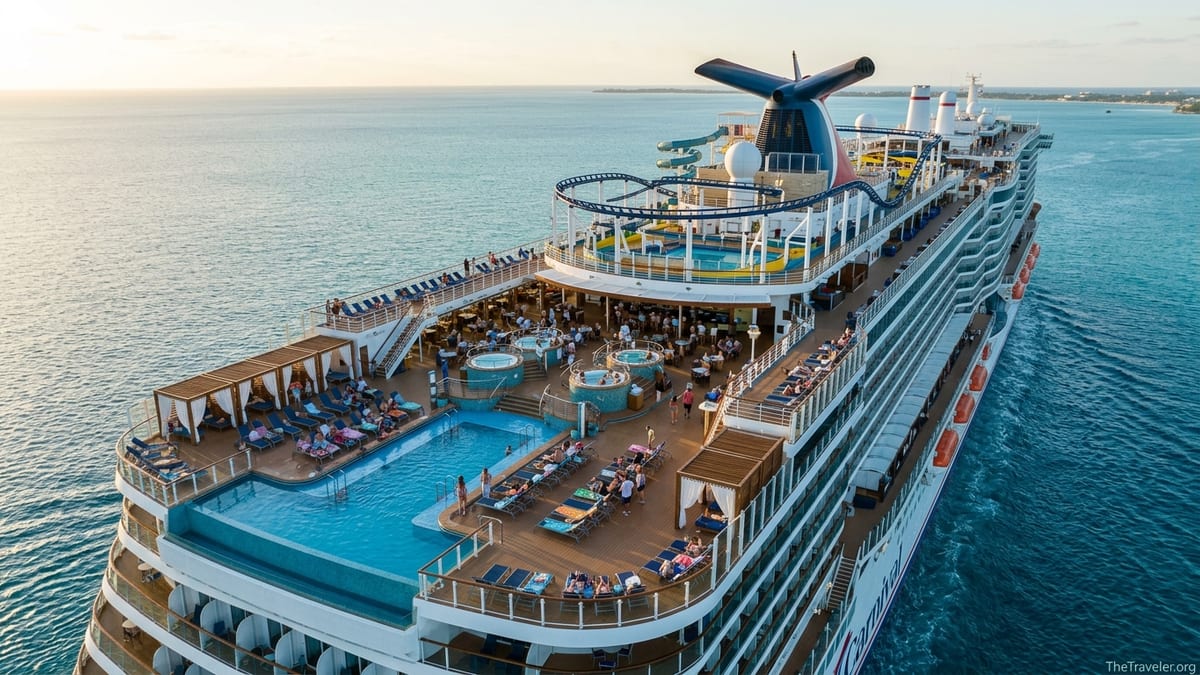
Instead of one or two generic pool areas, these ships divide public spaces into themed “zones” that anchor your day. You might wander from the Summer Landing retreat, with its aft infinity pool and Smokehouse Brewhouse, to the Ultimate Playground, where a water park and the BOLT roller coaster arc above the top decks. That ability to change the mood simply by moving a few steps is a hallmark of modern destination resorts, now carried out at sea.
Accommodation has evolved in a similar way. Traditional inside and ocean-view cabins still exist, but on ships like Mardi Gras the experience shifts dramatically when you book into a dedicated enclave such as the Havana staterooms or Family Harbor. These areas bundle room categories with exclusive lounges, semi-private decks, and tailored perks, mirroring club-level floors at large resort hotels. At the highest level, Carnival Excel Suites add benefits like complimentary access to Loft 19, an elevated retreat with cabanas and a dedicated bar and pool.
Carnival has also invested heavily in its private destinations, which function as an extension of the shipboard resort. A day at Half Moon Cay or Celebration Key can feel like a seamless continuation of your onboard routine: cabanas, beach clubs, family splash zones, and quiet coves are laid out in zones in much the same way as the ship. The result is a cruise experience where you can settle into a resort rhythm and rarely feel like a passing visitor.
Carnival Mardi Gras: The Blueprint for a Floating Resort
Mardi Gras, which debuted in 2020 as Carnival’s first Excel-class ship, was the line’s boldest step toward a true floating resort. Instead of the traditional deck-by-deck layout, it is divided into six themed zones. Grand Central acts as the multi-level heart of the ship. The French Quarter channels New Orleans with venues like Emeril’s Bistro 1396 and jazz-inflected bars. La Piazza nods to Italy with family-style dining and a café-like atmosphere. Summer Landing, Lido, and the Ultimate Playground each serve a different style of vacation day, from lazy pool time to adrenaline-filled slides and rope courses.
In practice, this zoning makes Mardi Gras feel much larger and more varied than its already impressive size suggests. A sea day might start with coffee and people-watching in Grand Central, followed by a long lunch at Big Chicken near the Beach Pool on Lido, an afternoon in a whirlpool overlooking the wake at Summer Landing, and sunset cocktails at a bar tucked into the French Quarter. You are not revisiting the same main pool or lounge repeatedly but moving between micro-environments that could easily belong to different resorts.
Dining supports that resort-like feeling. In addition to the main dining rooms and buffet, Mardi Gras features a roster of complimentary and surcharge venues that approximate a small restaurant district. Guests can choose from quick-service favorites like Guy’s Burger Joint and BlueIguana Cantina, a Chibang! venue combining Mexican and Chinese menus, and specialty options such as Fahrenheit 555 steakhouse. Reserving a table at a different spot each evening can feel similar to planning dinners at an all-inclusive resort with several signature restaurants.
Stateroom design also contributes to the overall impression. Guests who book Havana cabins gain exclusive daytime access to a dedicated aft deck with its own pool and bar, often far more tranquil than the main pool area. Family Harbor staterooms cluster around a lounge serving breakfast and snacks, stocked with games and movies ideal for families who want a central hangout. At the top end, Excel Suites unlock Loft 19, a private retreat of cushioned loungers and cabanas, giving suite guests a level of space and privacy more typically associated with land-based luxury hotels.
Carnival Celebration and Carnival Jubilee: Refining the Resort Concept
Carnival Celebration and Carnival Jubilee build directly on the Mardi Gras template while adding their own twists. Celebration, which began sailing from Miami in late 2022, swaps Mardi Gras’s French Quarter zone for The Gateway and 820 Biscayne. The Gateway plays with the romance of travel, with venues like the Golden Jubilee bar celebrating Carnival’s history, while 820 Biscayne pays homage to Miami with décor, eateries, and bars that feel like a slice of the city brought onboard.
Carnival Jubilee, which homeports in Galveston, continues the six-zone layout and introduces new Texas-inspired design touches. Its Grand Central atrium serves as a hub for live performances, while other zones mix established favorites such as Summer Landing and the Ultimate Playground with refreshed bars and eateries. The effect is of a familiar upscale resort brand that repeats its most popular features while tailoring each property to its location and audience.
On both ships, BOLT, the roller coaster that first appeared on Mardi Gras, anchors the top-deck Ultimate Playground. Guests strap into electric two-person “motorbikes” and can control their speed as they race along a track suspended high above the ocean. It is a headline-grabbing attraction, but it is also emblematic of the broader shift in mindset: these ships are designed to be destinations guests will choose specifically for their amenities, not simply as a means of reaching Caribbean ports.
The resort analogy becomes even stronger when you compare these ships’ suite experiences to what you might find at an upscale land resort. Excel-category suites deliver priority boarding, concierge-style support, and complimentary access to Loft 19, a dedicated retreat space with its own pool, bar, and cabanas that can be reserved for a full day. Guests who might ordinarily book a beachfront suite at a resort in Cancun or Punta Cana instead find a similar level of seclusion on a ship that also offers nightly production shows, comedy clubs, and casino gaming just a short walk away.
Carnival Venezia and Carnival Firenze: Fun Italian Style as a Themed Resort
While not part of the Excel class, Carnival Venezia and Carnival Firenze represent another strand of the floating resort idea. Originally built for Costa Cruises and later integrated into Carnival’s fleet, these “Fun Italian Style” ships sail primarily from U.S. homeports but retain a strong Italian design theme. Public spaces are inspired by Venice and Florence, with piazza-like atriums, ornate décor, and bars and cafés that could be mistaken for Italian city squares at a glance.
For guests, that coherent theme helps the ship feel like a boutique resort with a distinct identity. On Carnival Venezia, for instance, you might spend an evening sipping an Aperol spritz in a space designed to evoke a Venetian square, then dine at a trattoria-style venue and end the night in a theater styled after an Italian opera house. The sense of place is more specific than on many older mainstream ships, and it creates the impression of staying at an Italian-themed resort rather than simply a generic Caribbean cruise vessel.
Daily life aboard these ships aligns with the rest of the Carnival fleet in terms of activities and dining, but the setting changes the overall mood. American-style favorites such as Guy’s Burger Joint sit alongside Italian-accented café counters and bars, and entertainment schedules often lean into the theme with Italian music nights and events. For travelers who enjoy staying at themed resorts in Orlando or Las Vegas, Carnival Venezia and Firenze provide a similar sense of immersion while still delivering traditional Caribbean or Mexican Riviera itineraries.
Importantly, these ships also reflect Carnival’s shift toward more thoughtfully planned outdoor spaces. Their lido decks and aft pool areas incorporate multiple small zones with bars, whirlpools, and shaded seating, encouraging guests to linger and move about rather than crowding a single main pool. Over a weeklong sailing, that variety helps them feel like resorts where you keep “discovering” new corners instead of circling the same limited set of venues.
Private Destinations That Extend the Resort Experience
No resort-style cruise experience is complete without the beach, and Carnival has steadily expanded and refined its portfolio of private and exclusive destinations in the Bahamas and Caribbean. Half Moon Cay in the Bahamas remains a favorite for many repeat guests, with a broad crescent of white sand, clear turquoise water, and a low-rise layout of bars, food stations, and shaded seating that blends into the natural setting. It feels like a relaxed island-side extension of the ship, with familiar Carnival food and beverage options served in a more rustic, barefoot setting.
More recently, the line has begun welcoming guests to Celebration Key, a new purpose-built destination on the island of Grand Bahama. Designed expressly for Carnival Cruise Line, Celebration Key is laid out in distinct areas, including a welcome plaza, a family-focused lagoon with splash zones and slides, an adults-oriented lagoon with swim-up bars, a shopping district, and a more exclusive beach club called Pearl Cove. The zoning mirrors the Excel ships’ neighborhood concept, reinforcing the sensation that you have simply moved from one part of a resort to another rather than disembarking to a separate port.
For guests arriving on ships such as Carnival Celebration or Carnival Jubilee, a day at Celebration Key can feel like the continuation of a carefully choreographed resort stay. Families might head straight for the Starfish Lagoon area, where shallow water, play structures, and family-friendly dining options make it easy to settle in for the day. Adults seeking quiet can book loungers or a cabana at Pearl Cove, gaining access to a more serene beachfront, an elevated restaurant, and full-service bars without the bustle of the main public beach.
Carnival’s other exclusive ports, including Amber Cove in the Dominican Republic and the long-standing Half Moon Cay, round out that resort-focused strategy. Amber Cove delivers a large pool complex with a swim-up bar and hillside cabanas overlooking the water, while Half Moon Cay emphasizes soft sand, calm seas, and water sports such as kayaking, horseback riding along the surf, or simply renting a clamshell lounger for the day. In each case, the design encourages guests to treat the destination as another wing of their floating resort, complete with familiar service and branding.
Choosing the Right “Floating Resort” Ship for Your Travel Style
Deciding which Carnival ship will feel most like your ideal resort starts with considering how you like to spend time on vacation. If you gravitate toward big, buzzy properties with multiple restaurants, elaborate pool complexes, and a full slate of activities from sunrise to late night, the Excel-class trio of Mardi Gras, Carnival Celebration, and Carnival Jubilee is likely the best match. Their six-zone layouts, top-deck BOLT roller coaster, and wide variety of bars, lounges, and eateries make them well suited to travelers who dislike repetition and want the option to change the vibe of their day with a short stroll.
Within that group, choose based on homeport and theming. Mardi Gras often sails from Port Canaveral, making it a convenient option for pairing with a Central Florida trip. Carnival Celebration, based in Miami, has a strong sense of connection to the city, particularly in its 820 Biscayne zone, which might appeal if you like the feel of Miami’s waterfront neighborhoods. Carnival Jubilee, sailing from Galveston, naturally draws many guests from Texas and surrounding states and nods to that regional identity in its décor and onboard atmosphere.
If you prefer a more compact ship with a strong theme, Carnival Venezia and Carnival Firenze offer a different kind of floating resort experience. They do not have roller coasters or as many separate zones, but their Italian styling and “Fun Italian Style” programming create a sense of staying at a mid-size themed resort where the ambiance is as much a part of the appeal as the activities themselves. These ships can be a good fit for travelers who enjoy resort-style relaxation and dining but do not necessarily need the latest headline attractions.
Regardless of ship, pay close attention to stateroom categories if you want your experience to feel especially resort-like. On Excel-class ships, splurging on a Havana or Excel Suite can transform your days by giving access to semi-private pools, lounges, and sundecks that are quieter and more refined than the main public areas. That upgrade can be the difference between a cruise that simply feels like a busy holiday and one that more closely resembles a week at a high-end beach resort.
How to Plan and Budget for a Resort-Style Carnival Cruise
Planning a Carnival cruise on one of these floating resort-style ships involves some of the same decisions as booking an all-inclusive property, along with a few cruise-specific considerations. First, look at itineraries that feature at least one of Carnival’s private or exclusive destinations, such as Half Moon Cay, Celebration Key, or Amber Cove. These ports amplify the resort feel by providing controlled environments where most guests spend the entire day using facilities run by Carnival or its partners, rather than dispersing into a city.
Budgeting realistically is also important. While cruise fares often include more than a standard hotel room rate, many of the elements that make these ships feel like resorts, such as specialty dining, spa treatments, and certain attractions or cabanas, carry extra charges. On a typical weeklong voyage, it is common for guests to add several hundred dollars per person in onboard spending for drinks, specialty meals, shore excursions, and gratuities, depending on habits. Families booking cabanas at Celebration Key’s Pearl Cove or reserving a Loft 19 cabana on sea days should plan ahead to secure preferred dates and to understand the added cost.
At the same time, these ships offer many included activities and venues that approximate resort amenities without additional fees. Pools, water slides, kids’ clubs, most theater shows, comedy performances, and standard dining venues are built into the fare. Travelers who prioritize included options can still enjoy a resort-like vacation, especially if they take advantage of included venues such as Guy’s Burger Joint, BlueIguana Cantina, and complimentary entertainment in Grand Central or the main theater.
Finally, think about how you want each day to unfold. Some travelers will want to pre-book dining times, shows, and shore excursions as soon as reservations open, treating the cruise like a tightly planned week at a popular resort during peak season. Others may prefer to treat the ship like a spontaneous playground, wandering between zones until they find a bar with open seats, a trivia game about to start, or a nearly empty whirlpool facing the sunset. Both approaches can work well on these ships; the key is to align your expectations and planning style with the ship’s range of options.
The Takeaway
Carnival’s newest and most distinctive ships have moved well beyond the classic image of a simple pool deck and buffet at sea. Vessels like Mardi Gras, Carnival Celebration, and Carnival Jubilee function as all-in-one destinations, with carefully planned neighborhoods, varied dining, and resort-style lounges and retreats that keep many guests happily onboard even when the ship is in port. Carnival Venezia and Carnival Firenze add another dimension, demonstrating how a strong overarching theme can make a ship feel like a cohesive, character-rich resort.
When paired with private destinations such as Half Moon Cay, Amber Cove, and Celebration Key, these ships deliver a continuity of experience that feels very much like checking into a Caribbean resort complex that simply happens to change scenery every night. Choosing the right ship, cabin category, and itinerary allows you to tailor that floating resort to your own travel style, whether that means chasing the latest attractions, savoring themed spaces, or retreating to exclusive decks and beach clubs.
For travelers who enjoy the convenience and variety of modern beach resorts but still crave the novelty of waking up somewhere new, Carnival’s resort-style ships offer a compelling alternative. They condense the best parts of a high-energy resort stay into a single, mobile property, giving you the freedom to do as much or as little as you like while the ocean drifts quietly by outside.
FAQ
Q1. Which Carnival ships feel most like full-scale floating resorts?
Carnival’s Excel-class trio Mardi Gras, Carnival Celebration, and Carnival Jubilee most closely resemble modern floating resorts, thanks to their themed zones, wide dining choices, and top-deck attractions. Carnival Venezia and Carnival Firenze also deliver a strong resort feel through their immersive Italian theming and thoughtfully designed public spaces.
Q2. How do Carnival’s Excel-class ships differ from older vessels?
Excel-class ships are larger, divided into distinct neighborhoods, and feature headline attractions such as the BOLT roller coaster, expansive water parks, and purpose-built retreat areas like Loft 19. Older ships are more traditional in layout, with fewer separate zones and generally smaller, less varied pool and lounge complexes.
Q3. Are resort-style features like Loft 19 and Havana areas included in the fare?
Access to certain spaces is linked to the stateroom you book. Guests in Carnival Excel Suites receive complimentary access to Loft 19, while Havana staterooms come with entry to the Havana pool area during the day. Other experiences, such as renting a Loft 19 cabana or booking spa services, carry additional charges.
Q4. Which Carnival private destinations best complement these floating resort ships?
Half Moon Cay in the Bahamas, Amber Cove in the Dominican Republic, and Celebration Key on Grand Bahama Island all extend the resort experience ashore. Each offers curated beaches, pools, bars, and cabanas that function like an offshoot of the ship, with Celebration Key in particular designed around multiple themed areas similar to the Excel ships’ zones.
Q5. Do I need to book specialty dining to enjoy a resort-style Carnival cruise?
No. While specialty restaurants add variety and can be memorable highlights, the main dining rooms, buffets, and included venues such as Guy’s Burger Joint and BlueIguana Cantina provide a wide range of meals at no extra charge. Guests who plan carefully can enjoy a resort-like experience relying mostly on included options, supplementing with a few paid dinners if desired.
Q6. Are these larger resort-style ships a good fit for first-time cruisers?
They can be excellent for first-timers who enjoy busy, amenity-rich resorts on land and want many activity options. However, travelers who prefer quieter, more intimate ships may find the scale and energy of Excel-class vessels overwhelming. In that case, a mid-size ship like Carnival Venezia or Firenze, or an older Carnival ship on a shorter itinerary, may be a better starting point.
Q7. How far in advance should I book popular features like cabanas or BOLT?
Availability varies, but cabanas at areas such as Loft 19 or Celebration Key’s Pearl Cove, as well as time slots for high-demand attractions, often sell out well before sailing. It is wise to secure these extras as soon as reservations open in your online cruise planner if they are a priority for your trip.
Q8. Will I feel crowded on these big resort-style ships?
At peak times, popular areas such as the main pools and buffet can be busy, similar to large land-based resorts. However, the zone-based layout, multiple pools, and numerous bars and lounges help spread guests out. Choosing off-peak times for meals, shows, and pool visits, or booking access to more exclusive areas, can significantly reduce the sense of crowding.
Q9. Are these Carnival ships suitable for travelers without children?
Yes. While Carnival is family-friendly, Excel-class ships and others like Venezia include adults-focused spaces such as Serenity retreats, cocktail bars, specialty restaurants, and, in some cases, adults-only areas at private destinations. Couples and adult groups who avoid peak school holiday periods often find plenty of quiet corners and adult-oriented entertainment.
Q10. How should I compare a Carnival resort-style ship to an all-inclusive resort on land?
Think of the ship as a moving all-inclusive light. Your fare includes accommodation, most meals, entertainment, and many activities, similar to a resort, but some amenities and drinks cost extra. In return, you gain the ability to visit multiple islands in one trip, enjoy sea days with extensive onboard programming, and experience private destinations that extend the resort atmosphere ashore.