


More news on this day
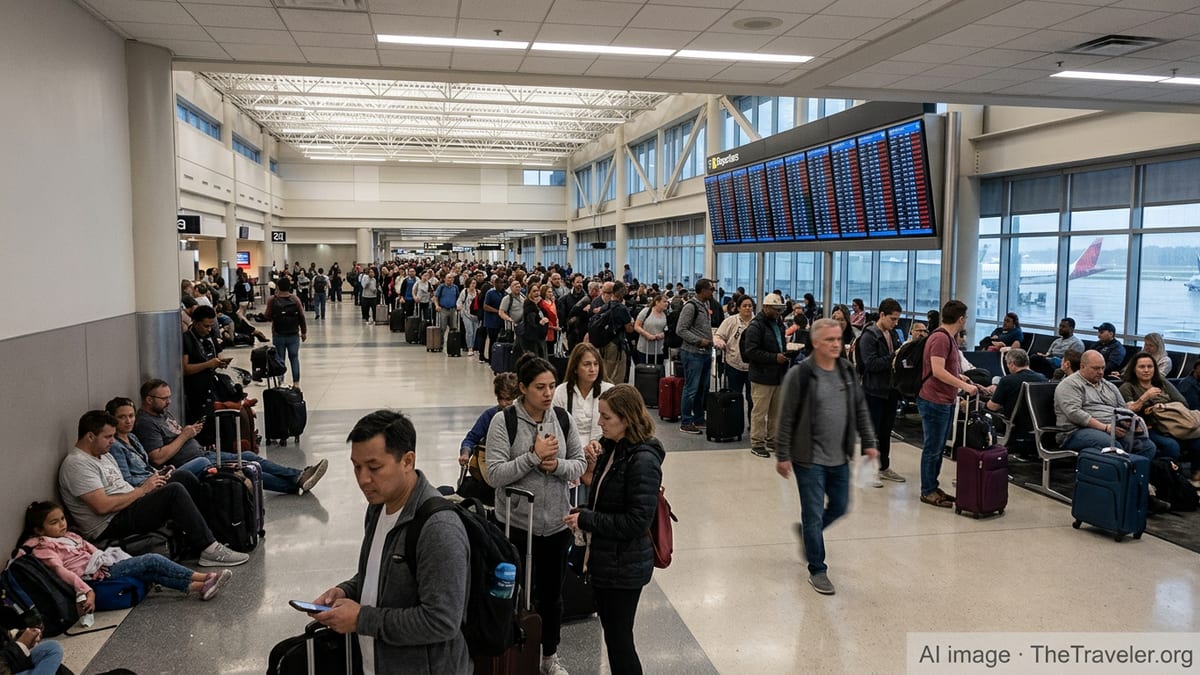
Travelers staring at cloudless blue skies are often baffled when departure boards fill with delays attributed to “weather.” On clear days, the real causes usually lie far beyond the window view, in the upper atmosphere, at a distant hub airport, or inside the complex systems that keep the air traffic network moving.
Get the latest news straight to your inbox!
Invisible Weather Above the Wing
Published information from aviation agencies shows that what passengers see at the gate is only a fraction of the weather the system must manage. Airliners cruise at altitudes where conditions can differ sharply from those on the ground, with jet stream shifts, high altitude turbulence, and fast-building storm cells reshaping routes even when departure and arrival airports appear calm.
Federal aviation data indicate that weather remains the single largest driver of delays in the United States, responsible for a majority of system wide disruptions over recent years. However, much of that weather is convective activity and turbulence along en route corridors that never appears on a local phone forecast. When large storm complexes erupt over the central United States, for example, aircraft may be forced into long detours that strain already crowded airways.
To prevent conflict in the skies, traffic managers sometimes slow departures from faraway airports that feed into affected routes. The result is a delayed flight on a perfectly sunny apron because the airspace hundreds of miles away has reached its safe capacity. To the traveler, the explanation may still be summarized as “weather,” even though the storm is out of sight.
Researchers have also begun exploring how “space weather,” including solar flares that disturb radio communication and satellite navigation, can influence flight timings. Academic studies suggest that intense solar activity can lead to measurable departure delays when crews and controllers take extra precautions with communication and routing, again without any visible change in local weather.
Ground Stops, Capacity Limits and a Fragile Flow
Beyond storms, the rules that govern how many aircraft can safely move through each segment of airspace or use a runway at once play a central role in delays on clear days. When demand outstrips that capacity, authorities can issue ground delay programs or ground stops that halt or meter departures headed to an affected airport or region, even if those departure airports are enjoying ideal flying weather.
Reference material from the Federal Aviation Administration describes ground stops as temporary measures that hold flights at their origin to manage hazards such as thunderstorms, equipment outages, or sudden congestion. Historical advisories show that these restrictions have also been used when key radar or automation systems malfunction, and when staffing levels in busy control facilities leave too few controllers to safely handle normal traffic volumes.
Industry guidance to travelers notes that capacity can fall even on bright days for reasons such as strong crosswinds or changes in runway configuration. When fewer runways are available for takeoff and landing due to wind direction, construction, or maintenance, the number of flights that can be handled each hour shrinks. To keep the system stable, flights waiting to depart from other cities may be held back, and local passengers experience unexplained delays under clear skies.
Because aircraft and crews are scheduled in tight rotations, one capacity related slowdown at a busy hub can ripple through the day’s schedule. A morning ground delay program in one region often translates into afternoon and evening disruptions elsewhere, long after the original constraint has eased and even where the weather is benign.
Staffing Strains and Aging Technology
Public reports over the past several years have pointed to persistent staffing challenges at some air traffic control facilities. Congressional hearing records and oversight documents describe facilities operating with fewer certified controllers than planned, prompting calls for accelerated hiring and training to recover from years of attrition.
While official statistics attribute the vast majority of delays to weather, volume, or runway capacity, lawmakers and analysts have questioned how often staffing limitations quietly shape those categories. Testimony and advisory data show examples where staffing “triggers” contributed to ground stops or required traffic reductions on otherwise clear days, forcing flights to wait at their gates until the flow could be managed safely.
The technology that underpins the national airspace system has also come under scrutiny. A high profile outage in a key flight planning system in 2023 briefly halted departures nationwide and prompted an independent review of aging infrastructure. Subsequent U.S. Government Accountability Office work highlighted more than a dozen critical air traffic control systems in need of modernization to reduce the risk of similar disruptions.
When radar units, automation platforms, or communication links require maintenance or experience intermittent faults, traffic managers may proactively reduce arrival and departure rates even if weather is excellent. To the passenger, this can feel like a mysterious, sunny day delay, but from the system’s perspective it is a safety margin built around fragile or constrained equipment.
How One Clear Day Delay Can Spiral Into Many
Transportation statistics show that a large share of late departures are tied to “late arriving aircraft,” a category that reflects the cascading nature of delays. Once one flight falls behind, the aircraft and crew arrive late for the next leg, which then departs behind schedule even if conditions at both airports are perfect.
Analyses of network wide disruptions illustrate how quickly these cascades can spread. A storm over a major hub in the morning can trigger reroutes and holding patterns that slow dozens of arrivals. Those aircraft, arriving late, then push back departures across multiple airlines and routes, turning a weather event in one region into a day long delay pattern for passengers elsewhere who never see a cloud.
Crowded airports and tight turn times can magnify the impact. Guidance from transportation agencies notes that delays typically grow over the course of the day as small disruptions accumulate. Afternoon and evening flights are therefore more exposed to the residual effects of earlier problems, which helps explain why a late day departure may be held on a sunny tarmac for reasons rooted in a long resolved issue thousands of kilometers away.
Once a certain threshold of disruption is reached, operational recovery becomes more complex. Crews may reach duty time limits, aircraft may miss maintenance windows, and available gate space can become scarce. At that point, even when the weather everywhere along the route network is stable, the system can keep generating delays as planners work through the backlog of aircraft, crew, and gate assignments.
What Travelers Can Realistically Do
Consumer information from the U.S. Department of Transportation advises that while travelers cannot control the complex causes of delays, they can make strategic choices to reduce their exposure. Early morning departures are often recommended, because they are less affected by the buildup of knock on delays that typically grows later in the day.
Choosing itineraries that avoid chronically congested hubs or tight connections can also help. Flights that route through less busy airports, even if slightly longer on paper, may have a better chance of operating close to schedule when the system is under stress from distant weather, staffing constraints, or equipment maintenance.
Regulators emphasize that refund and compensation policies depend on the cause of a delay and the laws of the country where the ticket is sold. In the United States, airlines are generally not required to compensate passengers for delays attributed to weather or air traffic control constraints, though they may offer rebooking options or goodwill gestures in some cases.
For passengers watching the sun shine outside the terminal windows while their plans unravel, understanding these behind the scenes forces does not erase the frustration. It does, however, reveal why clear skies are no guarantee of an on time departure in a system that must balance safety, capacity, and aging infrastructure across thousands of daily flights.