


More news on this day
A three-hour suspension of air traffic at Eindhoven Airport on June 22 disrupted dozens of passenger flights, after a technical fault forced one of the Netherlands’ busiest regional gateways to halt all takeoffs and landings.
Get the latest news straight to your inbox!
Technical fault brings runway operations to a standstill
Flight movements at Eindhoven Airport were interrupted early on Saturday afternoon after a technical malfunction affected systems essential for safe aircraft handling. Publicly available information indicates that both arrivals and departures were halted for roughly three hours, effectively placing a ground stop on passenger operations.
Local aviation outlets describe a complete cessation of traffic, with no commercial flights able to use the single runway during the outage. The disruption reportedly began shortly after midday, just as weekend leisure traffic was building, creating a backlog of aircraft and passengers across the compact terminal.
Initial reports suggest that the incident was linked to critical airport infrastructure rather than broader Dutch airspace management. As a result, the effects were concentrated at Eindhoven, contrasting with earlier European disruptions this summer that have been tied to air traffic control issues or strike action in neighboring countries.
Dozens of flights delayed or diverted
The three-hour halt translated into significant delays for travelers heading to and from popular holiday destinations across Europe and North Africa. According to Dutch media coverage, dozens of flights were either delayed on the ground at Eindhoven, held at origin airports, or diverted to alternative gateways while the technical teams worked to restore normal operations.
Several inbound services were reported to have diverted to other airports during the shutdown period, adding extra hours to journeys for passengers who then required onward ground transportation. Outbound flights, including low-cost services to Mediterranean beaches and city-break hubs, faced rolling departure times once the runway reopened as airlines attempted to recover disrupted schedules.
For some travelers, the disruption meant missed connections, revised hotel check-in plans and rebooked transfers. Airline customer-service channels and airport information desks experienced heavy demand throughout the afternoon, as passengers sought updates on revised departure and arrival times.
Operations gradually resume after three-hour pause
Traffic at Eindhoven Airport began to restart later in the afternoon as the underlying fault was brought under control and key systems returned to service. Published updates show that the airport shifted into a phased recovery mode, clearing aircraft from holding positions and bringing delayed departures to the runway in close sequence.
While flight operations resumed, knock-on effects continued into the early evening. Aircraft and crew rosters needed to be adjusted, and turnaround times shortened where possible, as airlines sought to operate as many scheduled sectors as feasible before night restrictions came into play.
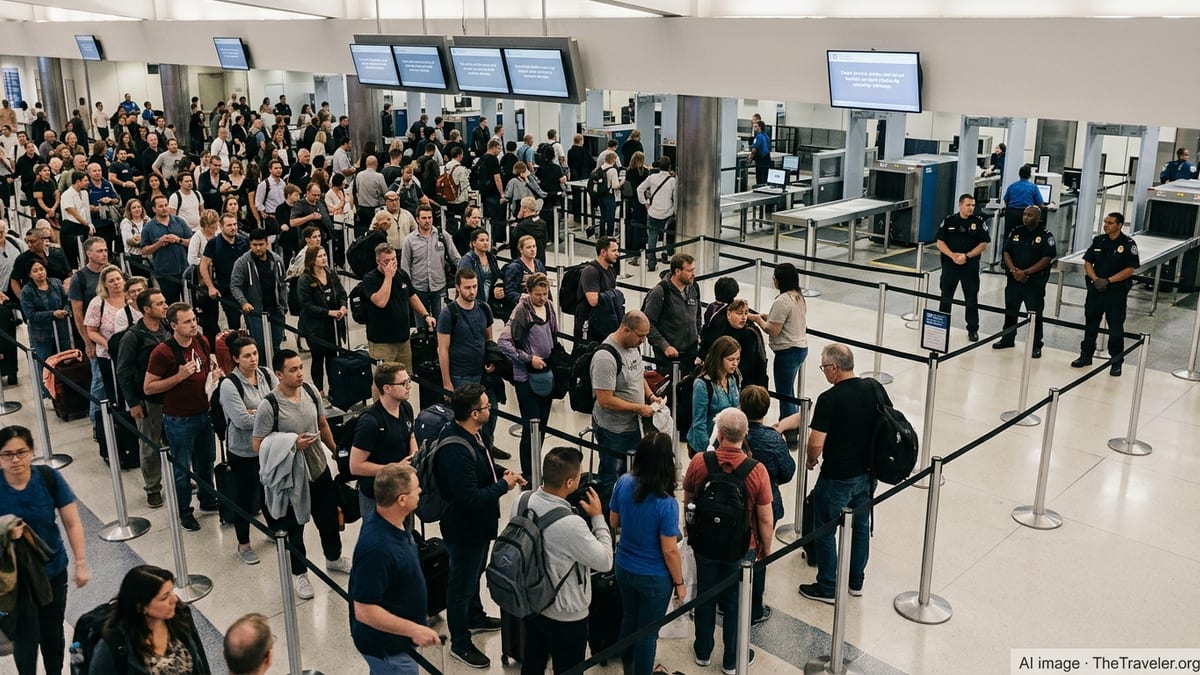
Ground handling staff and security checkpoints also faced pressure as delayed passengers converged on the terminal during a compressed period. Observers noted that, although queues lengthened at peak moments, operations remained broadly orderly as travelers waited for updated boarding information.
Video footage highlights impact inside terminal and on apron
Video shared on social and local media platforms captured the unfolding disruption inside the terminal and on the airport apron. Footage from the departures hall showed long lines forming at airline service counters and self-service kiosks, with passengers tracking mobile apps and overhead displays for new departure times.
Additional clips circulating online appeared to show aircraft parked on remote stands and near the terminal as the ground stop continued, with service vehicles largely stationary and jet bridges idle. The relative lack of movement provided a rare stillness at a facility that typically handles dense waves of low-cost and charter flights throughout the day.
The video material, while fragmentary, underscored the scale of the disruption for a regional airport of Eindhoven’s size. For many travelers, the images served as a real-time snapshot of a suddenly frozen operation, in contrast to the normally rapid turnaround rhythms associated with short-haul European flying.
Broader context of a fragile European summer travel season
The incident at Eindhoven Airport adds to a growing list of early-summer disruptions affecting European air travel. In recent weeks, passengers across the continent have faced delays and cancellations linked to air traffic control glitches, localized staff shortages, and industrial action at major hubs.
Although Saturday’s event was contained to Eindhoven and resolved within hours, it illustrates how a single technical fault can reverberate through tightly timed schedules, particularly at airports dominated by short-haul point-to-point traffic. With aircraft often performing several rotations per day, even a short interruption can displace crews and aircraft for the remainder of the schedule.
Travel industry commentators note that passengers flying in the peak summer period should expect occasional disruption, and advise allowing extra time for connections, monitoring flight status closely, and being prepared for itinerary changes at short notice. For Eindhoven and other mid-sized European airports, the challenge in the coming weeks will be to maintain resilience as demand reaches its seasonal high point.