


Copa Airlines has turned Panama City’s Tocumen International Airport into one of Latin America’s most efficient connection hubs, but the first time you land here it can still feel confusing. Two terminals, internal shuttles, unclear immigration rules and tight banks of connections all raise the same questions: Will I make my flight? Do I need to pick up my bag? And when do I ever go through Panamanian immigration? This guide walks you step by step through real Copa-style layovers at Tocumen so you know exactly what to expect and how much time you really need.
Get the latest updates straight to your inbox!
Understanding Tocumen and the Copa hub model
Tocumen International Airport serves Panama City but functions primarily as Copa Airlines’ “Hub of the Americas,” designed around fast international-to-international connections across North, Central and South America and the Caribbean. Most Copa itineraries route through Panama for under two hours, with passengers never formally entering the country. That hub design changes how security, immigration and baggage work compared with point-to-point airports such as Miami or Los Angeles.
Copa builds its timetable into “banks” of arriving and departing flights. For example, an early afternoon bank might see a flight from Los Angeles arrive around 5:30 p.m. and ones to Lima, Quito and Bogotá depart between 6:30 p.m. and 7:15 p.m. In practical terms, that means hundreds of passengers are doing the same style of connection you are, often with similar connection times, and the airport is set up to move them quickly between gates rather than out through customs.
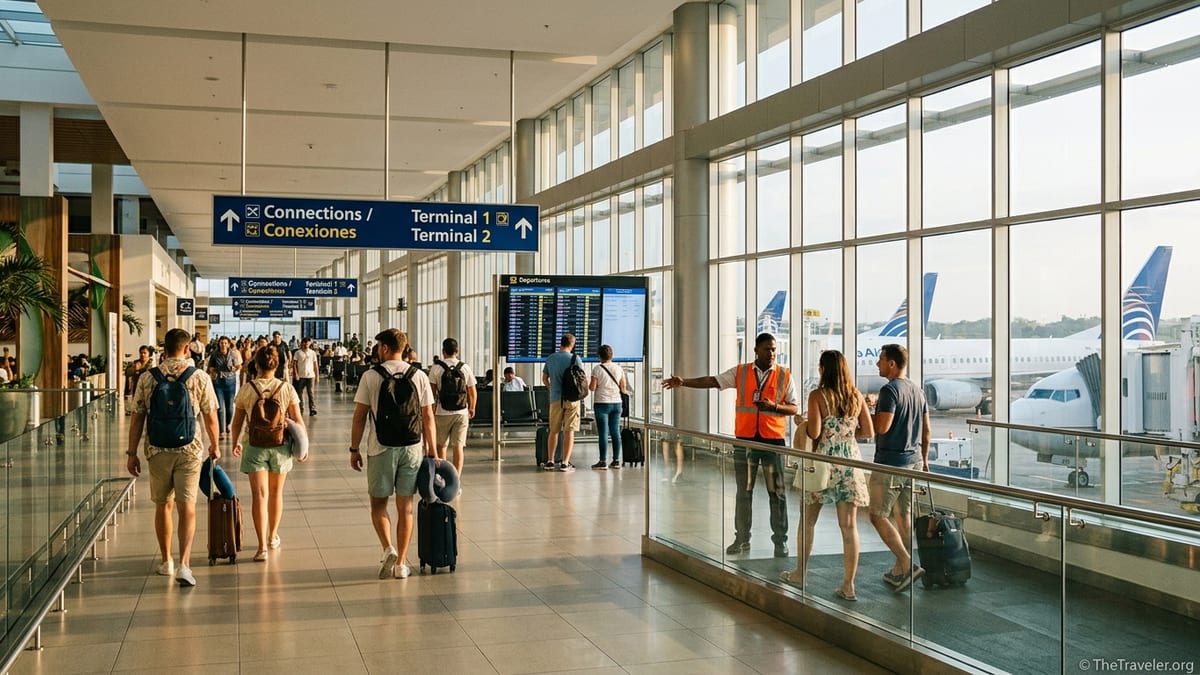
Because Tocumen is so connection-heavy, the airport experience here is different from a big European hub. You will not see long passport queues for transfer passengers heading between, say, Santiago and Toronto. Instead, you walk off one plane, follow signs for “Connections,” clear a single security checkpoint, then walk directly to your next gate. The entire process for a straightforward Copa-to-Copa international connection often takes 15 to 30 minutes in normal conditions.
Two key impacts of this hub model matter for planning your layover: you usually do not see your checked bag in Panama, and you usually do not go through immigration unless you are entering Panama or changing to certain other airlines or domestic flights. Keeping that in mind makes the rest of the process easier to follow.
Terminals T1 vs T2: layout, walking routes and shuttles
Tocumen has two main international terminals. Terminal 1 is the older building; Terminal 2 is the newer complex where a large share of Copa flights now arrive and depart. The two terminals sit roughly parallel to each other and are physically connected airside by corridors and, at times, by an internal shuttle for passengers who must move between distant gates. The design goal is that you can remain within the secure international zone throughout a Copa connection, even if you change terminals.
In practice, many Copa itineraries will keep you entirely within Terminal 2, especially long-haul flights to and from North America and larger South American cities. For example, a flight from New York to Panama might arrive at a gate in T2’s 200-series, with your onward flight to Guayaquil also departing from a neighboring 200-series gate. In that scenario, your “terminal transfer” is nothing more than a short walk down the concourse and perhaps a level change via escalator.
If you do need to move between T1 and T2, the main airside walking route is on an upper level, signposted in Spanish and English. Typical walking time end-to-end is roughly 10 to 15 minutes at a normal pace, though tight connections and crowding can make it feel longer at peak banks. Travelers coming off a flight from Bogotá in T1 and connecting to Orlando in T2, for instance, might walk briskly along this connector corridor and still be at their new gate within 20 to 25 minutes including a quick restroom stop.
For passengers with mobility issues or very far-apart gates, airport staff can request the internal interterminal shuttle, which runs airside between gates near the 100s in T1 and the 200s in T2. The shuttle is free, but you should budget extra time because it is less frequent than the walking option. If you know you have a short layover and significant mobility limitations, it is worth alerting Copa in advance so wheelchair or golf-cart style assistance can be set up for your connection.
International-to-international transfers on Copa: step by step
Most readers using Tocumen will be doing an international-to-international connection entirely on Copa, for example Los Angeles to Panama to Buenos Aires, or Toronto to Panama to Cartagena. The process is standardized and usually smooth. Once your inbound flight parks at the gate, you deplane into the concourse and immediately see overhead signs for “Connections” or “Connecting flights” alongside standard exit signage.
Instead of walking toward baggage claim or passport control, follow the “Connections” signage. You will be funneled with other transfer passengers toward a central security checkpoint inside the international zone. There is no immigration control here for pure transit passengers. You keep your boarding pass for your onward flight, and in many cases Copa will have already issued both boarding passes at your original departure airport. If you do not yet have your second boarding pass, transfer desks are positioned near the connection flows so you can get a reprint before or after re-clearing security.
At the transit security checkpoint, your carry-on items go through an x-ray machine while you walk through a metal detector or scanner, just as at normal departure security. Liquids rules apply, so a large water bottle purchased before your first flight will likely need to be emptied or discarded unless your connecting security lane is specifically signed as allowing duty free liquids in sealed bags. Once through security, you are back in the departure-level concourse with departure boards showing all outgoing flights and gates.
A realistic example: a traveler flying from Chicago to Lima with Copa has a 1 hour 10 minute layover in Panama, all tickets on the same reservation. The inbound Chicago flight arrives on time to T2. It takes 5 minutes to deplane, 5 to 10 minutes to walk to transit security, another 5 to 10 minutes to clear that checkpoint, and 5 minutes to walk to the Lima gate. That still leaves 30 minutes before boarding starts, enough time to use restrooms, refill a water bottle post-security and perhaps grab a quick snack from a café near the gate.
Bags, immigration and when you actually enter Panama
For standard Copa international connections at Tocumen, your checked baggage is tagged at your origin airport to your final destination and remains in the system throughout your layover in Panama. You do not collect it, you do not take it through customs, and you do not recheck it in Panama. This applies whether you are flying, for example, from Montreal to Bogotá or from Cancun to São Paulo, as long as the entire trip is on a single Copa ticket with compatible partners.
Immigration is similarly bypassed on same-day international-to-international connections. You do not receive a Panamanian entry stamp and technically never enter Panama as long as you remain in the secure international area and your layover is within the allowed transit time window, commonly up to about 12 hours for many nationalities. If your flights are on one ticket and your onward boarding pass is confirmed, airport staff treat you as a transit passenger rather than an arriving visitor.
You will go through immigration and customs in Panama in a few specific scenarios. One is when Panama is your final destination: for instance, a Copa flight from São Paulo arriving in the evening with no onward segment. In this case you follow “Arrivals,” clear passport control, collect your bags from the carousel and pass through customs. Another scenario is when you are connecting to domestic flights inside Panama, such as onward service to David or Bocas del Toro. Often this requires exiting the international area, collecting checked baggage and checking in again at the domestic terminal section, then clearing security and immigration on the way back out to the international zone for your next departure.
You might also face immigration requirements if you have a very long layover or are on separate tickets where your bag cannot be checked through. A traveler who books Bogotá to Panama on Copa and a separate ticket from Panama to San José on a different airline, for example, may be forced to enter Panama, pick up bags, check in again and then re-clear exit immigration and security. In those cases you should confirm if you need a transit visa or regular visitor visa based on your nationality and whether Panamanian authorities require passengers with long overnight layovers to leave the international zone.
Realistic connection times and what Copa sells
Copa and its partners sometimes sell very tight connections in Panama, particularly between flights that are part of the same scheduled bank. Minimum connection times for Copa-to-Copa international transfers can be as low as around 45 to 60 minutes, and passengers regularly report making connections in that range without difficulty when flights are on time and gates are reasonably close together. However, that does not mean such times feel comfortable, especially if you are unfamiliar with the airport or traveling with children.
For reasonably stress-free Copa-to-Copa connections where both flights are international and within the same terminal, a layover of 75 to 90 minutes tends to feel comfortable for most travelers. That gives you buffer time for a slightly delayed arrival, a slower-moving transit security line, or a gate change to the far end of the concourse. For example, a traveler flying Los Angeles to Panama to Quito with a 1 hour 20 minute layover would generally have time to walk the length of several gates, clear security, use a restroom and still board in a normal zone call.
When your itinerary involves a change between T1 and T2, it is wise to add at least 20 to 30 minutes of extra connection time beyond the basic minimum. A Bogotá to Panama (arriving T1) then Panama to Montreal (departing T2) routing with a 1 hour layover may be technically valid and occasionally successful, but any delay on the inbound leg or crowding at the transit security checkpoint could make it tight. If you have the option to choose a 2 hour layover instead of a 1 hour one with a terminal change, the extra time is generally worth it for peace of mind.
Remember that if you buy a through ticket entirely with Copa or a partner, the airline is responsible for rebooking you if an officially sold connection is missed due to delays. Travelers on a multi-city trip sometimes purposely choose the shortest available connection because it costs less or gets them to their destination earlier. Others prefer a 3 to 4 hour layover so they can have a sit-down meal in the terminal, use a Copa club lounge if eligible, or browse duty free at leisure without worrying about a rush to the gate.
Terminal transfers, security nuances and special cases
While Tocumen’s standard flow keeps international transfer passengers away from immigration, there are a few nuances that catch travelers by surprise. One is the possibility of encountering a second security check at or near your departure gate, especially for flights to the United States or certain other destinations. This is similar to additional screening areas you might see before boarding US-bound flights in airports like Mexico City or Bogotá. You may be asked to remove electronics again or have your carry-on searched, so do not wait until the last boarding call to present yourself at the gate.
Another nuance is how separate tickets are treated. Suppose you book a flight from San José, Costa Rica to Panama on Copa and, separately, a ticket from Panama to Miami on the same airline because the separate purchase was significantly cheaper. Even though both flights are flown by Copa, the system might not automatically tag your checked bag through to Miami. In that scenario, you may need to collect your bag in Panama, exit to the public area, check in again, and then clear departure immigration and security. That turns what looks like a normal 90-minute connection into an unrealistic sprint, so you would want at least 3 to 4 hours and to check in advance with Copa about through-checking rules on separate tickets.
Travelers using Tocumen as a deliberate stopover, rather than a pure connection, have a different experience again. Copa has periodically promoted a stopover program that allows eligible passengers to stay in Panama for a limited number of days at no extra airfare cost. In that case you are not considered a transit passenger: you enter Panama through immigration, collect your bags, spend one or more nights in the city, and then return to the airport to depart as a normal originating passenger. For those itineraries, you should think of Tocumen the way you would think of any other origin or destination airport, with normal arrival and departure formalities.
There are also passengers who simply want to leave the airport during a long daytime layover without booking an official stopover. For instance, someone flying Buenos Aires to Panama to Los Angeles with a 10-hour daytime layover might wish to visit Panama City briefly. Whether this is allowed depends on your nationality, visa status and any current government rules. If you are allowed to enter Panama visa-free, you can usually clear immigration, have your bag stored or checked through as appropriate, and then return to the airport a few hours before your onward flight to clear exit immigration and security.
Planning your layover experience: food, comfort and timing
For connections of 60 to 90 minutes, there is generally only time to focus on movement and essentials: find your gate, clear transit security, use restrooms and perhaps grab a quick sandwich or coffee from one of the cafés that line the concourses. The international areas in both terminals have typical airport fare such as fast-food counters, grab-and-go kiosks and small bars serving snacks and drinks. Prices are similar to other international airports, with simple meals often in the 10 to 20 US dollar range and bottled drinks a few dollars apiece.
On layovers of 2 to 4 hours, you can expect a more relaxed experience. Many travelers choose to sit near charging points, especially close to their departure gate, and use the airport’s Wi-Fi to catch up on messages. Families with children often gravitate toward quieter seating zones or open spaces near the ends of the concourses where kids can walk around without blocking traffic. With this length of layover, you have time to browse duty free perfume or electronics shops and still return to the gate before boarding starts.
If you have access to airline lounges through business-class tickets, Copa’s loyalty program or Star Alliance status, a longer layover is more pleasant. Lounges typically offer comfortable seating, light hot and cold food, alcoholic and non-alcoholic drinks, good Wi-Fi and quieter spaces to rest. Travelers on an overnight itinerary, such as Los Angeles to Panama to Montevideo with a long evening layover, often choose to shower or nap in a lounge if facilities are available, especially after a red-eye from North America.
For overnight or very long layovers without lounge access, consider basic comfort items in your carry-on: a light jacket or sweatshirt for cool terminal air conditioning, an inflatable pillow and any medicine or toiletries you might need. It is also sensible to pack a change of clothes in your hand luggage on long-haul itineraries in case your checked bag is delayed and you must continue without it. While Copa connections in Panama generally work smoothly, being prepared for irregular operations will always make your journey less stressful.
The Takeaway
Tocumen International Airport is built around Copa’s connecting model and generally delivers fast, straightforward international-to-international transfers. On a typical Copa itinerary, you will not see your checked bag in Panama, you will not go through Panamanian immigration, and your entire layover will consist of walking off one aircraft, passing through a central security checkpoint and walking to your next gate. For most same-airline connections within the same terminal, 60 to 90 minutes is usually workable, while itineraries requiring a terminal change or involving separate tickets deserve at least 2 to 3 hours.
Understanding your specific situation is key. If you are on one ticket, staying on Copa, and your layover is under about 6 hours, you can treat Tocumen as a simple connection point and follow “Connections” signs without overthinking it. If you are changing airlines, planning a domestic hop inside Panama, or hoping to leave the airport during a long daytime layover, then immigration, customs and visa rules begin to matter and you should check them in advance for your nationality.
Travelers who arrive prepared to walk briskly, keep documents handy and follow airport signage generally find Tocumen one of the easier major hubs in the Americas. With realistic expectations about timing, terminals, security and baggage, a Copa layover in Panama can feel like a smooth midpoint in your journey rather than a stressful mystery between flights.
FAQ
Q1. Do I need to collect my checked bag during a Copa connection in Panama?
In most standard Copa international-to-international connections on a single ticket, your checked bag is tagged to your final destination and you do not collect it in Panama. You simply follow the “Connections” route, clear transit security and continue to your next gate.
Q2. Will I go through immigration if I am only transiting Tocumen?
If you remain in the international transit area, have a confirmed onward flight and your layover is within the typical transit window, you usually do not pass through Panamanian immigration or receive an entry stamp. You do go through immigration if Panama is your final destination, if you must exit to recheck bags on a separate ticket, or if you choose to leave the airport during a long layover.
Q3. Is 1 hour enough time to connect on Copa at Tocumen?
It can be, especially for Copa-to-Copa international connections within the same terminal when flights are on time. Many passengers successfully make 60-minute connections. However, for a more comfortable experience and a buffer against minor delays, 75 to 90 minutes is a safer target.
Q4. How much extra time should I allow if I must change between Terminal 1 and Terminal 2?
Allow at least 20 to 30 minutes extra beyond the basic minimum connection time if your itinerary involves T1 and T2. Walking end-to-end can take 10 to 15 minutes, and you may still need to clear the transit security checkpoint and navigate crowds at peak connection banks.
Q5. Can I leave the airport during a long layover in Panama?
Leaving the airport is possible for many nationalities, especially those that are visa-free visitors to Panama, but it turns your connection into a regular arrival and later departure. You must clear immigration, possibly collect bags, then return at least a couple of hours before your next flight to clear exit immigration and security. Always check visa rules for your passport before planning to leave the airport.
Q6. What happens if my inbound Copa flight is late and I miss my connection?
If both flights are on a single Copa or partner ticket and the connection was sold as valid, the airline is generally responsible for rebooking you on the next available flight. Approach a Copa service desk or the transfer counter in the transit area for assistance, and keep any documentation of delays in case of later claims.
Q7. Do I need a transit visa for a layover at Tocumen?
Many nationalities can transit airside at Tocumen for a limited number of hours without a visa, as long as they remain in the international zone and have a confirmed onward ticket. However, requirements vary by nationality and can change, so you should verify the latest rules for your passport and itinerary before you travel.
Q8. How does transferring on separate tickets affect my layover?
On separate tickets, your bags might not be checked through to your final destination, even if both flights are with Copa. That could require exiting into arrivals, collecting luggage, rechecking it and then re-clearing immigration and security. In such cases you should allow several hours rather than a tight connection and confirm baggage policies with the airline in advance.
Q9. Are there lounges or quiet places to rest during a Copa layover in Panama?
Yes. Eligible passengers can access airline and partner lounges that offer seating, food, drinks, Wi-Fi and in some cases showers. For those without lounge access, quieter seating is often available toward the ends of the concourses, away from central shopping and dining areas, although it may still be busy at peak connection times.
Q10. What should I do first when landing in Panama on a connection?
As soon as you deplane, follow the signs for “Connections,” check the departure boards to confirm your next gate and note whether you need to change terminals. Proceed promptly to the transit security checkpoint before stopping for food or shopping, so that you are already on the departure side and close to your gate in case of any last-minute changes or boarding announcements.