


Tokyo and Seoul are two of Asia’s great winter cities, with neon skylines, late-night food, and easy access to ski slopes. Yet the experience on the ground in December, January, or February can feel very different. From cold snaps and snowfall to flight prices and holiday closures, the details matter when you are choosing where to spend a precious winter vacation.
Get the latest updates straight to your inbox!
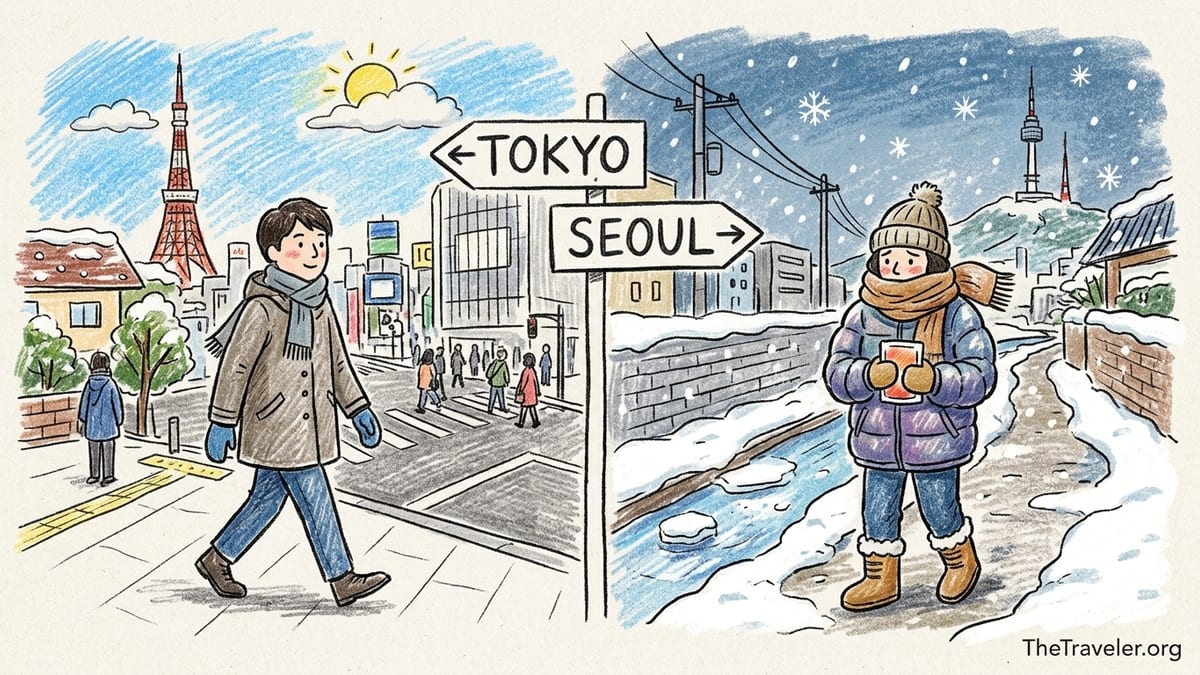
Winter Weather: Crisp in Tokyo, Bitter in Seoul
Both cities have four distinct seasons, but winter feels noticeably harsher in Seoul. Long-term climate normals from national meteorological data sets put central Tokyo’s average highs around 12 degrees Celsius in December and just under 10 degrees in January, with nighttime lows roughly between 1 and 4 degrees. Days are often bright and dry, and snow in the city is occasional. It usually falls a few times a season and often melts quickly, so you might see flurries at Shibuya Crossing rather than deep snowdrifts.
Seoul, by contrast, slides into a much colder continental pattern. Average January highs hover close to 2 degrees Celsius and lows dip to around minus 5 or below, with cold waves sometimes pushing temperatures into the negative teens. Humidity is relatively low in winter and precipitation is limited, but around two dozen days of snow are recorded in a typical year. That means a higher chance of waking up to frozen pavements along the Cheonggyecheon Stream or snow-dusted views from Namsan Seoul Tower.
For travelers, this temperature gap is practical, not just academic. In Tokyo, a medium-weight winter coat, scarf, and a light sweater often suffice for daytime sightseeing, with gloves needed at night. In Seoul, packing a heavier down jacket, thermal base layers, lined boots, and heat packs sold at convenience stores makes the difference between enjoying an evening in Hongdae and ducking indoors every ten minutes. If you strongly dislike deep cold, Tokyo will generally feel more comfortable for walking-heavy itineraries.
Snow seekers should think beyond city centers. From Tokyo, bullet trains put you into the ski resorts of Nagano or Niigata, while from Seoul express buses reach Gangwon-do resorts such as Vivaldi Park or High1. The key distinction is that in Seoul you are more likely to encounter freezing conditions even on a simple stroll to dinner, whereas in Tokyo serious snow usually awaits you a couple of hours outside the city.
Getting There and Around: Flights, Airports and Transit
From North America and Europe, both capitals are well served in winter. Recent fare-tracking data for late 2026 shows typical round-trip economy prices from Los Angeles to Tokyo clustering around the mid-700 to low-800 US dollar range in the cheapest winter months, with some sales dipping lower on select dates. Los Angeles to Seoul in the same period tends to come in slightly higher, with many monitored round trips around the high-700s to above 900 dollars depending on the exact departure month and airline, although competitive nonstop fares from Korean and US carriers can undercut those levels during promotions.
In practical terms, winter is often one of the better-value times to fly to both cities outside Christmas and New Year. Searching for seven- to ten-night itineraries that depart in mid-January usually yields some of the lowest prices of the season. Flexible travelers who can depart midweek and are willing to take a one-stop route via Vancouver, Seattle, or a Pacific hub such as Honolulu or Taipei may save an additional hundred dollars or more, especially to Tokyo where there are numerous connecting options.
On arrival, local transit is a strength for both cities even in cold weather. Tokyo’s two main airports, Haneda and Narita, connect to the city center by dedicated rail services and limousine buses. The Tokyo Monorail and Keikyu Line from Haneda, and the Narita Express and Keisei Skyliner from Narita, all run frequent services through winter, and snow-related disruptions around Tokyo are rare. In Seoul, most international flights land at Incheon International Airport, linked to the city by the Airport Railroad Express and all-stop trains, plus long-distance buses that fan out into various neighborhoods.
Within the cities, extensive metro networks remain the most efficient way to get around during winter. Tokyo’s subway and JR lines provide dense coverage from Asakusa and Ueno down to Shinjuku and Shibuya, while Seoul Metro stitches together districts such as Myeongdong, Gangnam, and Hongdae. Transit cards like Suica or PASMO in Tokyo and T-money in Seoul let you tap in and out on trains and buses, minimizing time spent queuing in the cold. In sub-zero Seoul, this convenience is particularly helpful when you are ducking between underground shopping arcades and heated trains.
Accommodation Costs: What You Can Expect to Pay
Hotel prices in both Tokyo and Seoul respond strongly to demand spikes around local holidays. In Tokyo, late December and the New Year period see significant price jumps, especially between around 29 December and 3 January when many Japanese travelers take domestic trips and some attractions close. A business hotel room that might cost the equivalent of 90 to 130 US dollars per night in early December or late January can climb well above 150 dollars in central areas like Shinjuku or Ginza during these dates, with upscale international chains charging much more.
Seoul has its own peaks, including Christmas, New Year, and the Lunar New Year holidays, which usually fall between late January and mid-February. Around that time, central areas such as Myeongdong, Jongno, and Gangnam often see nightly rates for mid-range hotels move from roughly 70 to 110 dollars in quieter winter weeks to above 130 dollars during the festival window. Guesthouses and hanok stays in Bukchon and Ikseon-dong can book out early as domestic families and inbound tourists compete for limited rooms.
Outside those peak periods, Seoul often edges out Tokyo on value for money in mid-range and budget categories. It is common to find clean, modern rooms in central Seoul in the 70 to 100 dollar range in January or early February, including breakfast in many cases. In Tokyo, comparable comfort in similar locations might sit closer to 100 to 140 dollars. However, capsule hotels and compact business hotels in Tokyo still provide sub-100 dollar options, especially around less touristy districts on the Yamanote Line or in business-heavy suburbs.
Booking early matters in both cities. For a one-week winter trip, securing accommodation two to three months ahead tends to lock in lower rates, particularly if you want specific neighborhoods such as Shibuya in Tokyo or Hongdae in Seoul. Free-cancellation rates are worth considering given the possibility of winter storms affecting flights, even if snow rarely shuts down the cities themselves.
Daily Budget: Food, Transport and Everyday Costs
Day-to-day spending feels slightly cheaper in Seoul, especially once you factor in generous portion sizes. For meals, a basic but hearty Korean lunch near a university area might cost the equivalent of 7 to 10 dollars for a steaming bowl of kimchi jjigae or sundubu-jjigae with rice and unlimited side dishes. In Tokyo, a comparable casual meal, such as a bowl of ramen in a neighborhood shop, often runs around 8 to 12 dollars, though standing noodle bars and chain outlets can push costs lower.
Street and market snacking further amplifies the difference. In Seoul’s winter night markets, such as those in Myeongdong and near Dongdaemun, you commonly see cups of tteokbokki or fish cake skewers priced at only a few dollars each, making it easy to graze your way through dinner. Tokyo’s winter treats, from taiyaki near temples to convenience-store oden, are also affordable, but cumulative costs can climb more quickly if you mix in frequent café stops and limited-edition seasonal desserts.
Public transit is relatively inexpensive in both cities, though individual journeys tend to cost slightly less in Seoul. A typical short metro ride, such as one or two stops between central districts, often lands under 1.50 dollars in Seoul and closer to 1.50 to 2 dollars in Tokyo depending on distance. Day passes and prepaid cards can trim those costs if you plan to string together multiple neighborhoods in a single day. Taxis, meanwhile, are more expensive in Tokyo, making late-night returns substantially pricier than in Seoul for comparable distances.
Attraction fees are broadly similar for marquee sights. In Tokyo, entry to observation decks like Tokyo Skytree or Tokyo Tower can cost the equivalent of 15 to 30 dollars depending on height and package, whereas in Seoul a ticket to Lotte World Tower’s observation deck also falls in the roughly 20 to 30 dollar range. Museum entry for national museums and art institutions in both cities often sits below 15 dollars, with some public museums charging only a small fee or being free on certain days. In practical budgeting terms, most travelers who enjoy mid-range dining, metro transport, and a couple of paid attractions per day will find their daily non-accommodation spending slightly lower in Seoul than in Tokyo, but not by a dramatic margin.
Seasonal Activities: What Winter Actually Feels Like
In Tokyo, winter brings clear views and a calm, almost orderly atmosphere. December illuminations transform districts like Marunouchi, Roppongi, and Shibuya with extensive light displays, often running from late November through Christmas or into early January. Strolling Omotesando in the crisp evening air with a hot milk tea from a convenience store is a quintessential seasonal experience. Late January and February mark the beginning of plum blossom season in parks such as Yushima Tenjin and Ueno Park, adding a subtle hint of spring even while you are still wrapped in a scarf.
Seoul’s winter feels more intense, but also cozier. Frozen air makes the steam from street-food stalls visually dramatic, and popular winter snacks such as hotteok, roasted sweet potatoes, and fish-shaped bungeoppang pastries become part of the sightseeing experience in areas like Insadong and Namdaemun Market. Outdoor skating rinks appear in central Seoul, including seasonal ice rinks near city hall squares, giving visitors a chance to skate with local office workers and families as rush hour swirls around them.
Both cities also offer easy winter day trips. From Tokyo, common winter excursions include visiting Nikko’s shrines in the cold, clear air or soaking in hot-spring towns like Hakone and Kusatsu, where rising steam contrasts with snowy hillsides. Trains make these trips manageable even as the days grow short. From Seoul, you can reach ski resorts in Gangwon-do in a couple of hours by shuttle bus, combining a few days of city cafés and shopping with on-slope time. Snow-themed festivals in towns like Hwacheon and Taebaek often schedule ice-fishing, snow sculptures, and sledding in January, giving visitors distinctively Korean winter memories that differ from urban sightseeing.
Indoor activities take on extra importance when temperatures plunge. Tokyo excels in its range of small specialty museums, design exhibitions, and department-store food halls where you can duck in for an hour whenever your fingers start to go numb. Seoul counters with heated underground shopping complexes, themed cafés from board-game lounges to animal cafés, and multi-story entertainment buildings that cluster karaoke rooms, arcades, and cinemas under one roof. The main difference lies in how often you will want these refuges: in Seoul, multi-hour indoor stretches can feel essential on very cold days, while in Tokyo they are more a pleasant optional break.
Festivals, Holidays and Seasonal Crowds
Winter scheduling revolves heavily around holidays. In Tokyo, the New Year period is culturally significant, and many smaller shops, family-run restaurants, and attractions close for several days, often between around 29 December and 4 January. Major chain stores and large sightseeing sites tend to remain open or close only on the first or second of January, but travelers who arrive on 31 December expecting full normal service can be surprised to find shutters down in quieter neighborhoods. On the positive side, early January brings the chance to see traditional New Year visits at major shrines like Meiji Jingu and Sensoji, which can be crowded but atmospheric.
Seoul also observes the Western New Year, but the bigger impact on travel often comes from Lunar New Year, which usually falls between late January and mid-February. During this multi-day holiday, many residents leave the capital to visit family, and some small businesses in the city close. At the same time, major palaces and tourist attractions often remain open with special holiday programs, and the city can feel simultaneously quieter and more festive. Accommodation near palaces and central shopping streets can still be in high demand as domestic tourists from other regions take short breaks in the capital.
Winter festivals add to the atmosphere in both destinations. Tokyo’s illuminations, early-spring plum blossom events, and occasional winter food fairs in city parks give travelers a gentle, aesthetic experience. Meanwhile, Seoul’s lantern displays, ice-fishing festivals in nearby provinces, and seasonal markets provide more rugged, outdoorsy options that make use of the genuine cold. When planning, check current-year calendars for specific festival dates and any crowd control measures; organizers sometimes adjust schedules based on weather or public-health considerations.
For crowd-averse travelers, mid-January to early February outside major holidays is often an excellent window for both cities. Attractions like Tokyo’s major art museums or Seoul’s palaces and modern art venues see lower footfall, and you are more likely to find same-day tickets and restaurant tables. The trade-off is shorter daylight hours, particularly noticeable for those hoping to fit multiple outdoor sights into a single day.
Food, Nightlife and Winter Atmosphere
Winter menus in both cities lean toward comfort and warmth. In Tokyo, seasonal hotpot dishes such as nabe and oden appear prominently in izakayas and convenience stores. It is easy to build a dinner of simmered daikon, egg, and fish cakes from a steaming oden counter in a 7-Eleven or Lawson before grabbing a seat in a small bar in Golden Gai. Limited-time winter drinks in major coffee chains and department-store basement food halls further add to the sense of seasonality.
Seoul’s cold pushes you naturally toward spicy and communal dishes. Sharing a large pot of budae jjigae or a tabletop Korean barbecue session in a side-street restaurant of Mapo or Gangnam becomes both a meal and a way to thaw out. Many restaurants serve complimentary hot barley tea, and heated floor seating in traditional-style venues provides a distinctive local comfort. For dessert, winter specials such as warm red-bean porridge and street-side hotteok filled with brown sugar and nuts are both affordable and memorable.
Nightlife continues through winter in both capitals, but feels slightly different in each. Tokyo’s nightlife sprawls across Shinjuku, Shibuya, Roppongi, and smaller pockets like Shimokitazawa, with many venues indoors and smoke-free. The chill outside is rarely so severe that a short walk between bars or live houses feels punishing. Seoul’s nightlife hubs in Hongdae and Itaewon can be very lively even in sub-zero temperatures, with patrons huddling around outdoor heaters before moving into packed clubs, so layering is crucial if you plan to stay out past midnight.
For early sleepers, both cities offer plenty of quiet winter evenings wandering past lit-up storefronts and convenience stores. Tokyo’s slightly milder conditions favor leisurely neighborhood strolls, whether in residential Nakameguro or along the Sumida River. In Seoul, icy pavements and sharp winds sometimes shorten these walks, but the reward of ducking into a warm, brightly lit café or dessert shop at the end of your route can feel particularly satisfying.
Which City Is Better for You This Winter?
The better winter destination depends largely on your tolerance for cold, your budget priorities, and what you want from a city break. Tokyo suits travelers who prefer moderate winter conditions, value hyper-efficient transport, and enjoy mixing major sights with quieter neighborhood explorations. Its winter lacks dramatic snowfall in the city but offers clear views, refined illuminations, and straightforward side trips to hot springs and ski slopes without the need to battle extreme urban weather.
Seoul is ideal if you embrace real cold and want a trip where food, nightlife, and winter-specific activities play a central role. The city’s lower everyday costs, from metro fares to street food, can stretch a budget further, and the possibility of actual snow in the city gives a distinctly seasonal feel. Easy access to ski resorts and ice festivals adds experiences that are hard to replicate in milder capitals.
If you are planning your first trip to East Asia in winter and feel unsure about coping with sub-zero days, Tokyo is often the safer starting point. You can still take a day or overnight trip to a snowy region while spending most of your time in manageable cold. If you have traveled in winters in places like Chicago, Toronto, or Northern Europe and enjoyed it, Seoul’s bracing air, spicy stews, and late-night energy may feel like an invigorating upgrade.
Whichever city you choose, packing thoughtfully and checking current-year holiday dates and flight deals will matter more than the last decimal point on a temperature chart. With the right layers and realistic expectations, both Tokyo and Seoul reward winter travelers with sharp light, rich food, and a different side of East Asia than the one most visitors see in cherry blossom season.