


More news on this day
Preliminary work by Canada’s transportation safety investigators is focusing on potential track deficiencies and inspection practices after a Canadian National Railway freight train derailed in Repentigny, Quebec, disrupting a major corridor northeast of Montreal at the height of the summer travel season.
Get the latest news straight to your inbox!
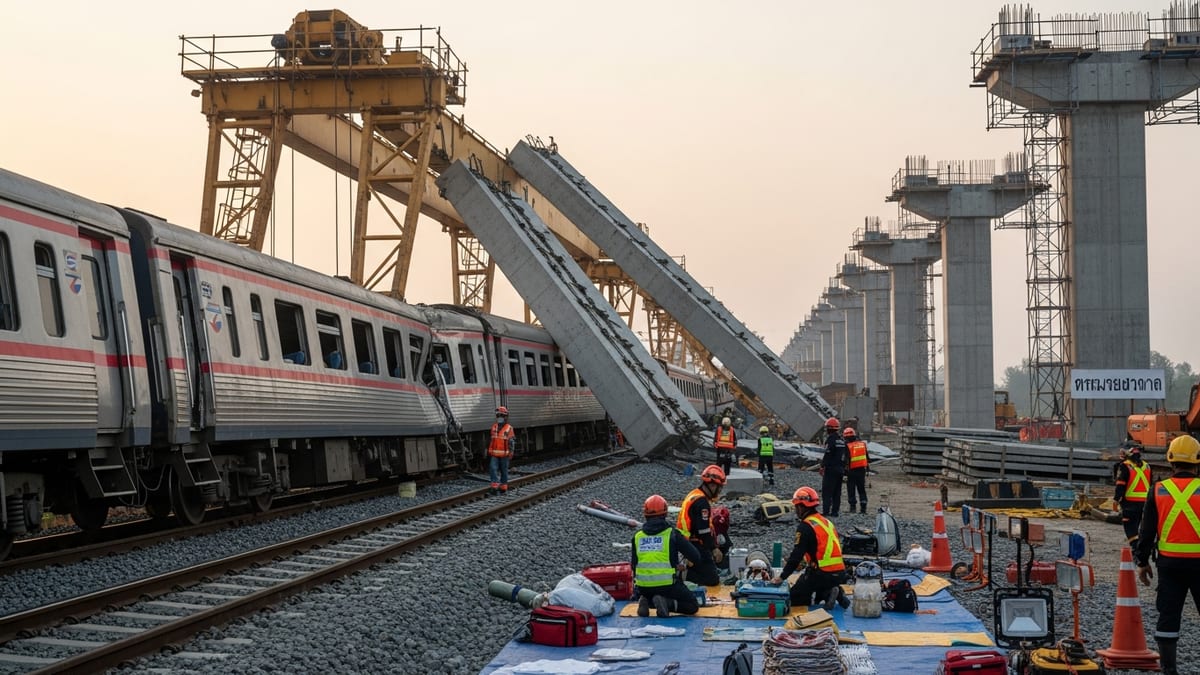
Derailment on busy Joliette Subdivision raises alarms
Public information from the Transportation Safety Board of Canada indicates that on July 5, 2026, a southbound CN freight train operating on the Joliette Subdivision derailed near mile 120.7 in Repentigny, sending dozens of cars off the main line in a densely populated sector. Local reports describe 49 cars derailing in various positions, blocking both tracks and prompting a large emergency response, although there were no reported injuries or fires.
The derailment occurred close to arterial streets and residential areas in the Le Gardeur sector, a part of Repentigny where the rail corridor threads between housing, local businesses, and road crossings frequently used by commuters. Initial municipal statements noted that the train was not believed to be carrying dangerous goods, yet the scale of the wreck and its location heightened public concern about freight operations on this heavily used stretch east of Montreal.
Travel through the region was immediately disrupted, with both rail and road closures as damaged rolling stock and torn-up track blocked crossings and adjacent streets. For leisure travelers and daily commuters who rely on regional roads paralleling the line, detours and congestion added to summer weekend traffic delays, underscoring how a single mainline disruption can ripple through local mobility.
Early summaries on the Transportation Safety Board’s rail investigation page show that the Repentigny occurrence has been opened as a main-track derailment involving a mixed freight, with a full field investigation under way. While the final report will take time, the board’s initial emphasis on the state of the infrastructure is already shaping the public debate over how CN maintains and oversees this corridor.
Focus on track condition and inspection “deficiencies”
Although the precise mechanical cause of the Repentigny derailment has not yet been released, publicly available guidance from the Transportation Safety Board describes how investigators typically zero in on track geometry, rail wear, and previous maintenance history when early signs point toward infrastructure factors. In other main-track derailment reports, the board has cited defects such as rail breaks, inadequate superelevation on curves, and long-standing surface irregularities as critical contributors.
Recent TSB material dealing with other CN derailments highlights several recurring themes that are now informing scrutiny of the Repentigny line. Past reports have pointed to gaps in track inspection regimes, including limitations in how visual inspections and automated measurement cars identify problems like internal rail flaws or corrosion concealed at crossings. In those cases, the board has referred to such gaps as safety deficiencies, recommending more rigorous monitoring and risk-based maintenance planning.
Against that backdrop, local concern in Repentigny has focused on whether similar weaknesses may exist on the Joliette Subdivision, particularly given the freight volume moving through the area. Public notices from CN acknowledge that track repairs and reconstruction are under way at the derailment site, while temporary operating restrictions remain in place. The speed reductions imposed by Transport Canada, reportedly to around 15 kilometres per hour through the affected zone, further underline that authorities are treating the condition of the line as a central factor pending detailed findings.
For travelers, the emphasis on track-related deficiencies carries implications that go beyond this single incident. The Joliette Subdivision forms part of a broader freight network feeding the Montreal region, and disruptions can cascade into timetable changes, re-routings, and congestion on other lines used by intercity and regional passenger services. As investigators probe the Repentigny track, the outcome may influence inspection standards in other corridors that support both freight and passenger trains.
Patterns from earlier CN derailment investigations
The Repentigny case is emerging at a time when the Transportation Safety Board has been publishing a series of detailed reports on other CN derailments, several of which flag track and infrastructure issues as key safety concerns. A recent main-track derailment investigation near Paris, Ontario, for example, describes how combinations of localized defects, rail wear, and maintenance decisions can increase the risk of a train leaving the rails under normal operating speeds.
In older yet still influential investigations, the board has drawn attention to specific gaps in the national Track Safety Rules, particularly around how corrosion or hidden cracking is identified at crossings and in high-stress locations. In one case involving a broken rail at a public grade crossing, the TSB noted that existing rules did not explicitly address how to assess and mitigate corrosion of the rail web where road salt and trapped moisture make inspection difficult. Those findings led to rail safety advisories urging railways and regulators to refine their monitoring practices.
Other CN investigations have linked derailments to a mix of operational and infrastructure factors, including train handling on marginal track, the use of dynamic braking on grades where geometry is already tight, and the positioning of heavy cars in a train consist. While the specific configuration at Repentigny has not been detailed publicly, these precedents show how track deficiencies can interact with train makeup and speed, a combination that can be particularly unforgiving at mainline speeds through urban areas.
For the traveling public, these patterns help explain why investigators and local officials are emphasizing the word “deficiencies” rather than treating Repentigny as an isolated mishap. The concern is that the factors present on this stretch of the Joliette Subdivision could mirror systemic issues that, if left unaddressed, might appear elsewhere on the national freight network.
Community pressure for slower trains and stronger oversight
The visible impact of the derailment in Repentigny has energized local calls for tighter control over train speeds and more robust oversight of CN’s infrastructure. The city has publicly asked for a temporary reduction in line speed on its territory, arguing that until the causes of the derailment are fully understood and corrective work is completed, slower trains represent a prudent safeguard for residents living close to the tracks.
That position aligns with Transport Canada’s announcement of temporary speed restrictions through the derailment zone, which cut permissible speeds far below the usual limit for the Joliette Subdivision. While these measures have helped reassure many residents, they also illustrate the tension between safety-driven slow orders and the imperative to keep freight moving efficiently through a critical corridor serving the Montreal region and points beyond.
Travelers passing through the area by road have experienced that tension firsthand. Longer gate-down times at crossings, lingering work equipment, and more frequent inspection runs can all contribute to travel delays, particularly at peak commuting hours. At the same time, the sight of trains creeping past the derailment site serves as a daily reminder that the line remains under scrutiny and that the community is watching closely how CN and federal agencies respond.
Advocacy groups following rail safety in Quebec are using Repentigny as a case study in the need for transparent reporting on infrastructure condition and follow-through on TSB recommendations. From a travel perspective, those calls are ultimately about predictability: regular, well-maintained operations are less likely to produce sudden disruptions that upend itineraries and increase risk for those who live, work, or vacation along the rail corridor.
Implications for future rail travel in the Montreal region
As the Repentigny investigation progresses, the emerging focus on track deficiencies is likely to influence how both freight and passenger services operate in and around Montreal. Should the Transportation Safety Board ultimately confirm specific infrastructure shortcomings, its recommendations could include changes to inspection frequency, use of specialized rail-flaw detection technologies, or revised standards for track geometry in busy suburban corridors.
Such changes would have a direct bearing on the reliability of rail travel options that share or intersect with CN lines, from intercity services linking Montreal with Quebec City and Ontario to regional commuter routes feeding the metropolitan area. Rail remains a critical component of Canada’s low-carbon transport strategy, and confidence in its safety record is essential if travelers are to continue choosing trains over private vehicles for medium-distance trips.
In the near term, travelers planning journeys through the Montreal region may encounter schedule adjustments, construction-related slow zones, and occasional rerouting as CN completes repairs and potential upgrades tied to the Repentigny derailment. While inconvenient, those disruptions form part of the broader effort to address the deficiencies that investigators are now probing.
Longer term, the Repentigny incident may serve as a catalyst for renewed investment in track infrastructure and more proactive risk management on key corridors. For residents and visitors alike, a safer, more resilient rail network translates into more predictable journeys, fewer sudden closures, and greater confidence that trains passing through communities are running on track infrastructure that meets the highest modern standards.