

More news on this day
A commuter rail collision on Friday afternoon near Bedford, north of London, left a train driver dead and dozens of passengers injured, according to published coverage, in one of the most serious rail incidents to affect services into the British capital in recent years.
Get the latest news straight to your inbox!
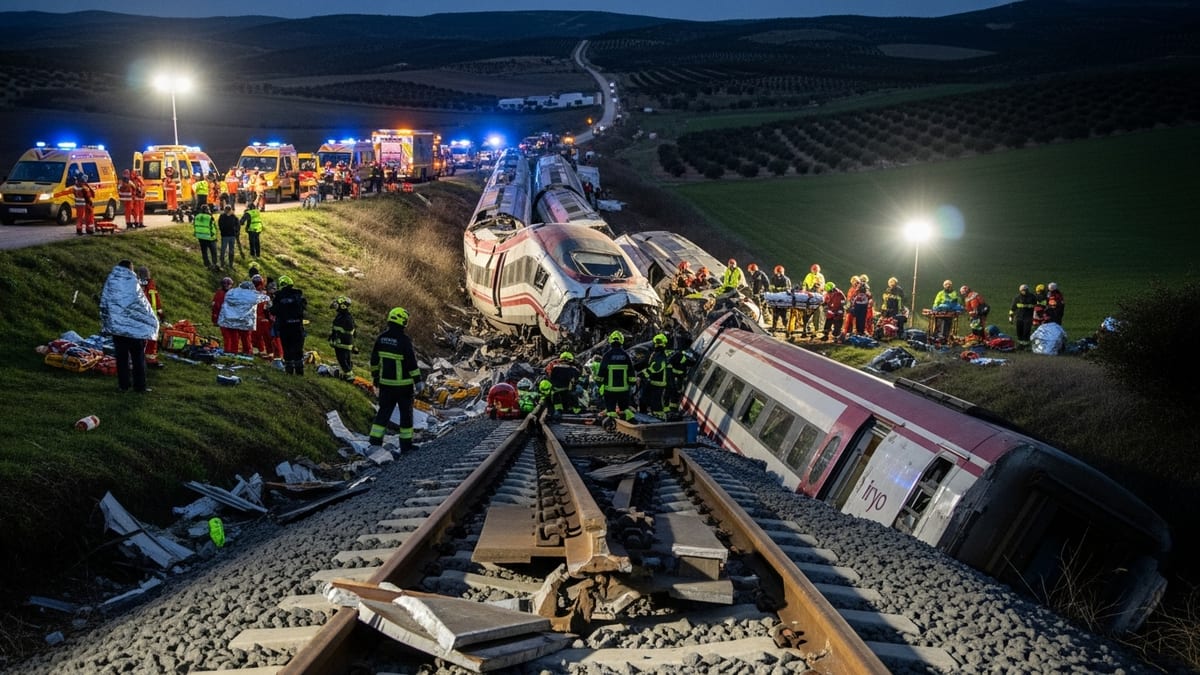
Collision on busy London commuter route
Reports indicate that two southbound East Midlands Railway services bound for London St Pancras collided on the approach to Bedford in the early evening peak, at around 5:15 p.m. local time on June 19. Both trains were operating on one of the key north–south corridors feeding commuters into London, a route that carries thousands of passengers each weekday.
Initial accounts from rail tracking data and media coverage suggest that one train ran into the rear of another on the same line, resulting in a violent impact strong enough to crush the leading cab of the rear train and distort several carriages. Photographs from the scene show both trains upright but badly damaged at the point of impact, with debris scattered along the ballast and beside the tracks.
Emergency services classified the incident as a major event and deployed extensive resources, including fire crews, specialist rescue teams, paramedics and an air ambulance. Images shared publicly show passengers being treated on a roadway running parallel to the line, with a long line of ambulances and emergency vehicles positioned along the embankment.
The collision occurred on a stretch of railway between Luton and Bedford, a heavily used section of the Midland Main Line that connects communities across the East Midlands with central London. The location, south of Bedford, meant that disruption rapidly rippled through the evening timetable for both regional and long-distance services.
Casualty figures highlight severity of impact
Publicly available information from medical and police updates compiled by news outlets indicates that the driver of one of the trains died at the scene. Rail industry reporting identifies the victim as the driver of the train that collided with the service ahead, underscoring the vulnerability of cab crews even in relatively low-speed impacts.
Ambulance service updates cited in multiple reports state that 11 people sustained very serious injuries, 22 were seriously injured and 56 suffered minor injuries, creating a total casualty figure approaching 90 passengers and crew. Many of the injured were transported to regional hospitals in Bedfordshire and surrounding counties for further treatment and assessment.
Passengers described being thrown forward without warning as the train braked sharply at the moment of impact. Some accounts speak of broken limbs, head wounds and passengers temporarily unable to move in badly distorted carriages. Others reported smoke in coaches immediately after the collision and a brief period of confusion before staff and fellow travelers began helping people to evacuate.
Despite the dramatic scene and the large number of injuries, observers note that both trains remained upright and on the track, which likely prevented an even higher casualty toll. The structural integrity of the rolling stock, combined with the absence of a high-speed derailment, appears to have been a significant factor in limiting fatalities to a single confirmed death.
Major disruption across East Midlands Railway network
The crash brought one of Britain’s main north–south commuter arteries to a standstill at the height of the evening rush. East Midlands Railway announced that all services to and from London St Pancras on the affected route were suspended for the rest of Friday, with passengers advised to delay travel or seek alternative routes via other main lines.
Real-time journey planners showed significant cancellations and diversions on services linking London with Nottingham, Derby, Sheffield and Corby. Some long-distance trains were terminated short of the capital, while others were rerouted where possible to avoid the blocked section. Knock-on disruption was expected to continue into Saturday as engineers assessed damage to track, signaling equipment and overhead power infrastructure.
Passengers already on trains elsewhere on the network faced extended journey times and crowding, with carriages on unaffected routes reportedly busier than usual. For many regular commuters, the collision revived memories of past disruption on the rail network and raised immediate practical concerns about the reliability of weekday travel into central London.
Travel information services warned that replacement road transport would be limited, given the scale of the closure and the number of passengers affected. Those planning weekend leisure journeys or airport transfers via St Pancras were urged by transport operators and broadcasters to check schedules carefully before setting out.
Investigations focus on signalling, braking and train spacing
With rescue operations now largely complete, attention is turning to how two modern passenger trains came to collide on a busy main line fitted with contemporary safety systems. Rail safety specialists interviewed in broadcast and print coverage have pointed to a range of possible factors, including signalling issues, driver reaction times, braking performance and line speed at the time of the impact.
Modern British main lines are typically equipped with multiple layers of protection, including trackside signals, in-cab indications and automatic systems designed to reduce the risk of a train passing a signal at danger or approaching another train at unsafe speed. Early analysis in the media suggests that investigators will examine whether any element of this safety net failed, whether human error played a role, or whether a combination of low adhesion, technical malfunction or communications issues contributed to the crash.
Specialist teams from the national rail infrastructure manager and the government’s independent accident investigation body are expected to carry out detailed inspections of the damaged trains, onboard data recorders and trackside equipment. Past investigations into rear-end collisions on Britain’s railways have typically included exhaustive analysis of braking curves, signal aspects, train positioning data and driver workload in the minutes leading up to impact.
While it is too early for firm conclusions, transport commentators are already noting parallels and contrasts with previous UK and European commuter rail crashes where low speeds nonetheless produced serious injuries in packed rush-hour trains. Any eventual recommendations are likely to examine whether additional technology, revised operating rules or changes to rolling stock design could further reduce the risk of similar incidents.
Questions for commuters and the wider rail industry
The Bedford collision has quickly become a national talking point, not only because of the human cost but also due to its timing on a heavily used commuter corridor. For regular rail users, the incident raises renewed questions about crowding, emergency procedures and how information is relayed to passengers during and after a major disruption.
Reports from the scene describe a mix of orderly evacuation and moments of confusion, with some passengers initially unsure whether to remain on board, move through damaged carriages or self-evacuate to the trackside. Travel commentators suggest that investigators may look closely at how instructions were communicated to passengers and how well emergency signage and lighting functioned in the moments following the crash.
For the rail industry, the collision adds pressure to demonstrate that a network carrying rising numbers of passengers can maintain and improve safety standards even as infrastructure and rolling stock are stretched by capacity demands. Publicly available analysis following previous accidents has often highlighted the need for sustained investment in signalling upgrades, staff training and rolling stock renewal, particularly on intensively used commuter lines into major cities.
In the coming weeks, the Bedford crash is expected to feature prominently in public debate about transport funding, regional connectivity and passenger safety. As formal investigations get under way, many travelers along the London to East Midlands corridor will be watching closely for assurances that lessons are learned from an incident that has shaken confidence on one of the country’s busiest routes.