


Florence’s historic center is compact, but its two great squares offer very different experiences. Many visitors arrive with just a day or two in the city and a simple question: if you have limited time, should you focus on Piazza della Signoria or Piazza del Duomo? The answer depends less on which is “better” and more on what kind of visit you want, how you handle crowds, and how deep you want to go into Florence’s art and history.
Get the latest updates straight to your inbox!
The Character of Each Square: First Impressions Matter
Walk into Piazza del Duomo and your eye is immediately pulled upward. The white, pink, and green marble of the Cathedral of Santa Maria del Fiore, Giotto’s slender bell tower, and Brunelleschi’s massive brick dome dominate the skyline. The space feels almost theatrical, framed by souvenir shops, gelato bars, and a constant churn of group tours. At peak hours in high season, it can feel more like an open-air corridor than a relaxed square, with guided groups following raised umbrellas and audio headsets clustered at every corner.
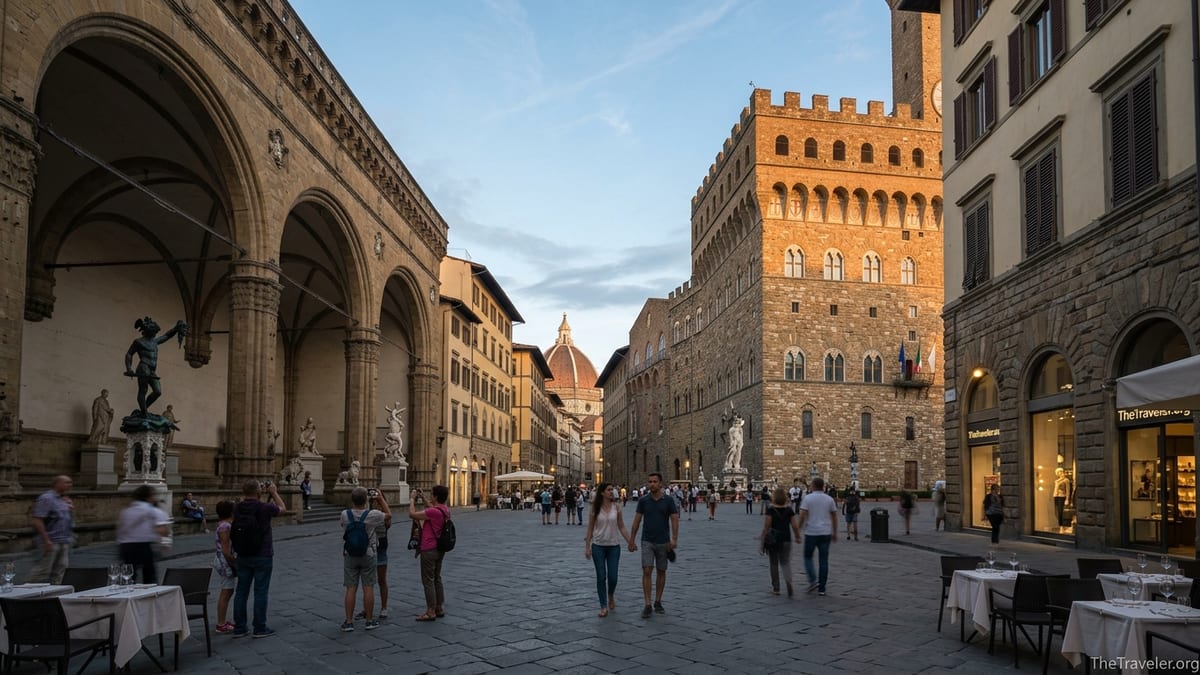
Piazza della Signoria, a five to seven minute walk along Via dei Calzaiuoli from the Duomo, has a different personality. Here, the fortress-like Palazzo Vecchio anchors one side of the square, the open-air Loggia dei Lanzi forms an outdoor sculpture gallery on another, and the Uffizi colonnade opens like a stone canyon toward the Arno. The space is busier in the evening, with café terraces, buskers, and couples taking photos with the replica of Michelangelo’s David in front of Palazzo Vecchio, but it still feels more like an urban living room than a funnel for tour groups.
If you want jaw-dropping architecture and that postcard “I’m in Florence” moment within seconds of leaving the train station, Piazza del Duomo delivers. If you prefer a square you can linger in, where you can actually sit, sip, and absorb Renaissance Florence at street level, Piazza della Signoria will likely feel more comfortable.
Art & Architecture: Where the Icons Live
For architecture lovers, Piazza del Duomo is hard to beat. The cathedral complex includes the Duomo itself, Giotto’s bell tower, the Baptistery of San Giovanni, the cathedral museum and the archaeological remains of the earlier church of Santa Reparata. The mosaic-covered Baptistery ceiling and the massive bronze doors, the marble patterning of the cathedral facade, and Brunelleschi’s dome are touchstones in the history of European art and engineering. Recent ticketing changes mean that, from 2025 onward, visitors choose passes such as the Brunelleschi, Giotto, or Ghiberti options to access specific parts of the complex, with timed entries especially for the dome climb.
Piazza della Signoria is where Florence’s civic art lives outdoors. In front of Palazzo Vecchio, you find powerful political symbols in stone: the copy of Michelangelo’s David standing as a guardian of the republic, Bandinelli’s muscular Hercules and Cacus, and the fountain of Neptune rising from a ring of bronze figures. Under the Loggia dei Lanzi, completely free to visit, stand masterpieces like Cellini’s Perseus with the Head of Medusa and Giambologna’s Rape of the Sabine Women. Here, sculptures that would be behind ropes in most cities are just a few steps from your table at a café.
Serious art travelers will note that Piazza della Signoria also serves as the gateway to the Uffizi Gallery, one of the world’s great collections of Renaissance painting, which sits between the square and the Arno. That proximity alone makes it the better home base if your Florence visit revolves around seeing Botticelli’s Birth of Venus or works by Leonardo and Caravaggio.
Time, Tickets, and Practical Logistics
If your schedule is tight, how you spend time in each square matters. Piazza del Duomo’s central buildings are ticketed, time-controlled attractions. To climb Brunelleschi’s dome, for example, you must reserve a specific entry slot with the appropriate pass, and those slots in busy months can sell out days in advance. Lines to enter the cathedral for free worship visits can snake around the square, with some travelers reporting waits of one to two hours in peak season. The cathedral museum behind the Duomo, which many visitors overlook, is calmer and often becomes a highlight because it houses the original Baptistery doors and sculptures removed from the facade.
By contrast, Piazza della Signoria is largely a no-ticket zone. The square itself, the Loggia dei Lanzi, and the views of Palazzo Vecchio’s exterior are all free and open at all hours. If you want to go inside Palazzo Vecchio as a museum, or climb its tower, you will need a ticket and to respect opening hours, but you can easily enjoy the essence of the square without any prior booking. The Uffizi, a few steps away, does require advance reservations in high season, but your experience of the piazza itself is not bound to a time slot.
For a traveler with just an afternoon, this difference is crucial. Spending a morning trying to coordinate a dome climb, bell tower ascent, and Baptistery visit can leave you rushed and stressed if you only have one day in Florence. Conversely, you can wander into Piazza della Signoria at golden hour, enjoy the sculpture, and perhaps tour Palazzo Vecchio without the same degree of planning, then walk to the river for sunset over Ponte Vecchio.
Crowds, Atmosphere, and When to Visit Each Square
Crowding patterns should influence which piazza you emphasize. Piazza del Duomo is busiest during mid-morning and mid-afternoon, roughly 9:30 a.m. to 4:00 p.m., when tour buses arrive and day-trippers pass through on Florence-in-a-day itineraries. Even in the shoulder seasons, you can expect dense crowds near the cathedral’s main doors, aggressive selfie-stick vendors, and guides shouting to keep groups together. If you are sensitive to noise and jostling, the atmosphere can feel overwhelming, especially for families with small children or older travelers.
Piazza della Signoria also attracts plenty of visitors, but the flow is more dispersed throughout the day. Early morning, around 8:00 or 9:00 a.m., you will encounter office workers cutting through the square and cleaners hosing down the stone, with only a handful of photographers taking advantage of the empty space in front of Palazzo Vecchio. By lunchtime, the café terraces fill, but the square rarely feels as compressed as the narrow passages around the Duomo. Evening is the most atmospheric time, when Palazzo Vecchio and the statues under the Loggia are lit, street musicians play near the Uffizi colonnade, and locals meet under the equestrian statue of Cosimo I.
If you dislike crowds but still want to experience Piazza del Duomo, the best strategy is to go very early or fairly late. Seeing the facade and dome just after sunrise, or walking around the square after 9:30 p.m. when day-trippers have left, gives you space to appreciate the architecture. Then spend the midday and early afternoon in or around Piazza della Signoria, where you can always step into a side street or into the Uffizi courtyard to escape the busiest corners.
Budget & Value: What You Actually Spend
Costs in both squares are higher than in residential neighborhoods, but they play out differently. Around Piazza del Duomo, you will find a dense band of souvenir shops selling magnets, miniatures of the dome, and “I Love Firenze” shirts, along with cafés that advertise “Duomo view” surcharges. A basic espresso at a stand-up bar nearby might run 1.50 to 2 euros if you drink at the counter, but sitting at a table on the square can easily double that. Gelato near the Duomo tends to be among the most expensive in Florence, and some places still scoop from brightly colored, piled-high tubs that suggest more artificial ingredients and less quality.
Around Piazza della Signoria, prices for seated drinks on the square are also high, especially for a spritz, wine, or cocktail with direct views of Palazzo Vecchio or the Loggia. Expect to pay several euros more than you would at a neighborhood bar a few streets away. However, the value equation here is different: you are paying extra for a front-row seat to masterpieces of Renaissance sculpture, and you might linger longer. If you want to manage your budget, you can order a relatively inexpensive espresso at the bar in a side-street café just off the square, then carry a takeaway gelato back to one of the quieter corners of the piazza to enjoy the view for free.
In terms of ticketed experiences, the Duomo complex can add significantly to your costs if multiple family members want to climb the dome or bell tower and visit the museum. Florence’s major passes for the complex bundle several elements over 48 to 72 hours, so a couple or family of four can see their total quickly rise. Piazza della Signoria itself is cheaper to experience; you can spend hours among sculptures, photograph Palazzo Vecchio, and soak up the ambiance without spending anything beyond perhaps a coffee or wine if you choose to sit at a terrace.
What Kind of Traveler You Are: Matching Piazza to Personality
If this is your first time in Italy and you have always dreamed of standing under Brunelleschi’s dome or seeing the Duomo’s facade in person, skipping Piazza del Duomo would feel like skipping the Eiffel Tower in Paris. Architecture lovers, photographers drawn to grand facades, and visitors eager to climb towers for panoramic city views will naturally gravitate toward this square. Travelers who enjoy structured, “checklist” sightseeing, and who do not mind booking time slots and following a tight schedule, will appreciate how much the Duomo complex offers in one compact area.
Piazza della Signoria speaks more to travelers interested in atmosphere, civic history, and open-air art. Solo travelers, couples on slower itineraries, and repeat visitors often find themselves returning to this square in the evening to watch the light slide down Palazzo Vecchio’s battlements. If you love sculpture, enjoy people-watching while nursing a single drink for an hour, or like the idea of dropping into an art museum like the Uffizi between strolls along the river, this piazza is a natural base.
Families with children might also find Piazza della Signoria easier to manage. Children can move a bit more freely on the wide stone pavement, you can point out dramatic statues without queueing or shushing, and there are plenty of quick escape routes down side streets if anyone gets overstimulated. On the other hand, teens fascinated by engineering or architecture might be inspired by a dome or bell tower climb at the Duomo, making that square more meaningful for them.
Suggested Itineraries: How to Use Each Square in a Short Visit
For a first-time visitor with one full day in Florence, one practical approach is to divide your time by mood. Start at Piazza del Duomo early, say around 8:00 a.m., to see the cathedral’s exterior in softer light and before the big tour groups arrive. If you have a timed entry for the dome or bell tower, schedule it in the morning, then reward yourself afterward with a coffee at a nearby bar where locals still stand at the counter. A quick walk around the Baptistery and a short visit to the cathedral museum can complete the “Duomo block” before lunch.
After a midday break on a quieter street, walk down Via dei Calzaiuoli toward Piazza della Signoria for the afternoon. Spend time among the sculptures in the Loggia dei Lanzi, step into Palazzo Vecchio to see the grand council hall and frescoes, then either tour the Uffizi or simply walk under its colonnade toward the river. As the sun lowers, the stone of Palazzo Vecchio glows warm and buskers begin to play; this is an ideal moment to sit with a gelato from a reputable gelateria on a nearby side street rather than directly on the square.
If you have two or three days in Florence, consider choosing one piazza as your morning anchor and the other as your evening haunt. For example, use Piazza del Duomo as your base on the day you explore the cathedral complex and nearby streets, but spend both nights returning to Piazza della Signoria for dinner, a twilight stroll to Ponte Vecchio, or simply to watch the statues change character under artificial light. In this way, you do not have to choose one over the other, but you match each to the time of day when it works best.
The Takeaway
Choosing between Piazza della Signoria and Piazza del Duomo is less about ranking them and more about aligning them with your time, budget, and travel style. Piazza del Duomo offers the most concentrated hit of monumental architecture: the cathedral, the dome, the Baptistery, and the bell tower rise in a dense cluster that defines Florence’s skyline. It rewards travelers ready to plan ahead with timed tickets and who do not mind moving through crowds for the chance to climb to unforgettable city views.
Piazza della Signoria, by contrast, offers Florence at street level: political history carved into stone, world-class sculpture under open skies, and the living rhythm of a civic square that still doubles as a meeting point for residents. It is easier to enjoy spontaneously and at minimal cost, and it pairs naturally with a visit to the Uffizi and a walk along the Arno.
For most travelers, the best answer is not “either/or” but “how much time in each.” Give Piazza del Duomo a structured morning or afternoon focused on the cathedral complex, then reserve your unhurried moments for Piazza della Signoria, where you can sit, watch, and feel Florence breathe. If you truly have time for only one, choose Piazza del Duomo for spectacle and engineering marvels, or Piazza della Signoria for atmosphere, sculpture, and a slower, more lived-in sense of the city.
FAQ
Q1. If I only have a few hours in Florence, should I prioritize Piazza della Signoria or Piazza del Duomo?
If this is your first visit and you have always wanted to see Florence’s cathedral and dome, prioritize Piazza del Duomo, even if crowds are heavy. If you prefer a more relaxed atmosphere, open-air sculpture, and easier photo opportunities without constant jostling, Piazza della Signoria may give you a more enjoyable short visit.
Q2. Can I visit both piazzas comfortably in one day?
Yes. The two squares are only a short walk apart, and many visitors move between them several times a day. A common pattern is to visit Piazza del Duomo in the early morning when it is slightly quieter, then head down Via dei Calzaiuoli to Piazza della Signoria for the afternoon and evening when the light on Palazzo Vecchio and the sculptures is particularly beautiful.
Q3. Which square is better for travelers on a tight budget?
Piazza della Signoria generally offers more value for money. The square, the Loggia dei Lanzi, and the statues around Palazzo Vecchio are all free to enjoy, and you can appreciate much of the area without buying any tickets. Around Piazza del Duomo, the main experiences that go beyond simply looking at the exterior, such as climbing the dome or bell tower and visiting the museum, require paid passes.
Q4. Is one piazza better for families with children?
Families often find Piazza della Signoria easier to manage. The open space, outdoor sculptures, and possibility of taking breaks without being locked into timed tickets make it less stressful with children. That said, a dome or bell tower climb from Piazza del Duomo can be a memorable challenge for older kids and teens who enjoy climbing stairs and viewpoints.
Q5. Which piazza is closer to the Uffizi Gallery?
Piazza della Signoria sits right beside the Uffizi. One edge of the square opens directly into the Uffizi colonnade, and the gallery’s main entrances are just a short walk away. If your main goal is to visit the Uffizi Gallery, staying near or planning to spend time around Piazza della Signoria is the most convenient option.
Q6. Are there quieter times of day to visit Piazza del Duomo?
Yes. Piazza del Duomo is usually quieter very early in the morning and later in the evening after most day-trippers have left. Visiting around sunrise allows you to see the facade in soft light with fewer crowds, while an evening stroll after dinner lets you appreciate the illuminated dome and cathedral without the midday congestion.
Q7. Do I need to book tickets in advance for attractions around these squares?
For Piazza del Duomo, it is strongly recommended to book tickets in advance for the dome climb, bell tower, and related museum visits, especially in high season, because timed slots can sell out. Around Piazza della Signoria, the square and Loggia dei Lanzi are free and require no booking, but you should reserve ahead for the Uffizi Gallery and, in busy periods, for certain Palazzo Vecchio tours or tower climbs.
Q8. Which square is better for photography?
Both are photogenic, but in different ways. Piazza del Duomo offers dramatic vertical shots of the dome, facade, and bell tower, but you will often have to work around crowds and tour groups. Piazza della Signoria offers more flexibility for composing photos of statues, Palazzo Vecchio, and street life, especially in the early morning or at sunset when the light is warm and the stone glows.
Q9. Can I find reasonably priced food and drink near these piazzas?
Prices directly on the squares tend to be higher, especially at tables with prominent views. To keep costs reasonable, look for cafés and trattorias on side streets a few minutes’ walk away, where you are more likely to find normal local prices for espresso, sandwiches, and simple Tuscan dishes. You can then return to either piazza for a stroll or to enjoy a gelato you picked up elsewhere.
Q10. Which piazza should I choose for an evening stroll or a romantic moment?
Both can be romantic, but Piazza della Signoria usually offers a more relaxed evening atmosphere. The statues are beautifully lit, musicians sometimes play near the Uffizi colonnade, and from the square it is an easy walk to the Arno for views of Ponte Vecchio. Piazza del Duomo is striking at night too, especially when the dome is illuminated, but it can feel busier and less intimate than the more enclosed, sculpture-filled space of Piazza della Signoria.