


More news on this day
Shenzhen Bao’an International Airport is undergoing one of its most turbulent days of the year, with hundreds of delays and cancellations rippling across the densely connected Greater Bay Area and crippling mobility for business and leisure travelers alike.
Get the latest news straight to your inbox!
Storms and Airspace Bottlenecks Trigger Over 380 Disruptions
Publicly available aviation data for June 14 indicates that a powerful combination of heavy rain, low cloud and tight airspace controls has produced widespread disruption across China’s southern aviation corridor. Aggregated operational metrics show more than 2,300 delayed flights and over 200 cancellations nationwide, with the Pearl River Delta standing out as one of the hardest-hit regions.
Within this grid, Shenzhen Bao’an International Airport is among the most severely affected facilities. Data compiled from real-time tracking dashboards and industry reporting points to roughly 295 delayed flights and 18 outright cancellations at Shenzhen alone, a total of around 313 individual disruptions. When knock-on effects to turnarounds and missed connections are considered, analysts estimate that the tally of affected movements tied to Shenzhen and its immediate feeder routes climbs toward the 386 mark often cited in industry coverage.
Neighboring Guangzhou Baiyun International Airport has recorded even higher delay counts, underlining how a localized band of bad weather and saturated airspace can paralyze multiple hubs simultaneously. With Guangzhou logging close to 380 delays and nearly 30 cancellations, the two airports have, in effect, created a bottleneck at the heart of the Greater Bay Area’s domestic and international air network.
The situation is exacerbated by the structure of China’s airspace, where large portions remain reserved for military use and civilian corridors are comparatively narrow. Aviation commentators note that when convective storms form along these corridors, air-traffic flow control measures quickly force extensive rerouting, holding patterns and ground stops, translating into rolling disruption across several major hubs at once.
Greater Bay Area Connectivity Severely Strained
The cascading impact of delays at Shenzhen Bao’an is magnified by the sheer density of the Greater Bay Area, which links Shenzhen, Guangzhou, Hong Kong, Macau and a ring of manufacturing cities into a single megaregion. Before the pandemic, the area was already one of the busiest aviation markets in Asia, and traffic volumes have been steadily recovering, intensifying the pressure when operations falter.
Shenzhen Bao’an functions as a key hub for carriers such as China Southern Airlines, Shenzhen Airlines and SF Airlines, and serves as a focus city for Hainan Airlines. The airport handled more than 52 million passengers in 2023, according to publicly available statistics, making it one of mainland China’s top four airports by passenger throughput. Under normal conditions, that scale supports extensive domestic reach and growing long-haul connectivity; on a day of severe disruption, it amplifies the chaos.
Travelers across the Greater Bay Area often treat Shenzhen, Guangzhou, Hong Kong International Airport and Macau’s airport as an interconnected system, shifting between them by high-speed rail, metro and cross-border buses to find the best itineraries or fares. On a day like June 14, the usual safety valve of “airport shopping” is largely unavailable, because parallel delays at Guangzhou and congested cross-border links leave passengers with few alternatives.
Reports from route-analysis platforms also show that regional network adjustments, including reductions and suspensions on some international routes by Greater Bay-based airlines, have tightened spare capacity across the region this summer. When a high-impact weather event hits, there is less slack in the system to absorb stranded passengers, making rebooking significantly more difficult.
Passenger Experience: Long Queues, Missed Connections and Scant Information
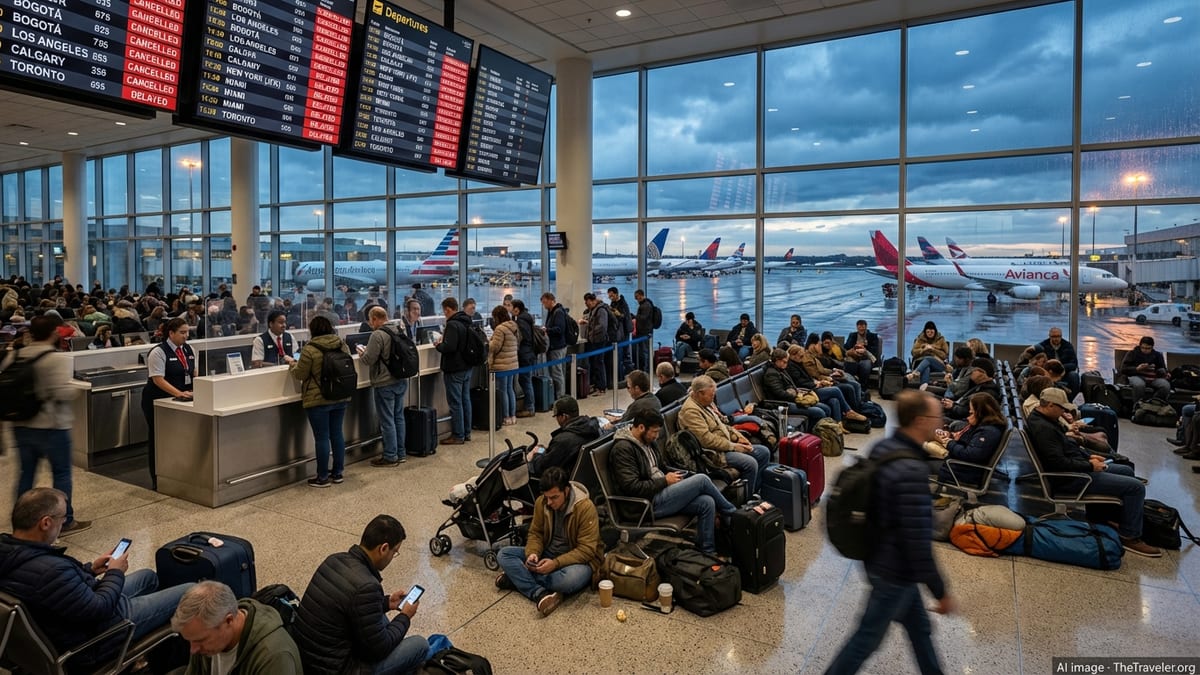
For travelers on the ground at Shenzhen Bao’an, today’s disruption is translating into extended waits at check-in and security, congested boarding gates and crowded airside seating areas. With average departure delays for Shenzhen departures recently reported at over an hour on other bad-weather days this month, many passengers are facing multi-hour waits and, in some cases, overnight stays.
Domestic itineraries built around tight connections are especially fragile in this environment. With flights arriving late from inland hubs and northern cities, onward services from Shenzhen into Southeast Asia and other parts of China are missing their scheduled departure windows, leading to missed connections and last-minute rebookings. Families traveling at the start of summer holidays and business travelers shuttling between factory zones and financial centers are among those most heavily affected.
Publicly available commentary on social platforms and travel forums highlights inconsistent communication as a recurring frustration. While most major airlines are updating flight status information through apps and airport displays, rolling schedule changes and shifting slot allocations mean that departure times can change multiple times within a few hours. Some travelers report confusion over whether delays are primarily due to storms over the Pearl River Delta, congestion along key inland corridors, or broader air-traffic flow control measures.
Airport guidance generally urges passengers to arrive early, monitor official flight-status channels frequently and remain prepared for rapid gate or time changes. Travel advisories circulating online also recommend that travelers keep basic essentials such as medication, chargers and a change of clothes in carry-on bags, given the heightened risk of unexpected overnight stays when disruption indices are high.
Network Effects Reach Far Beyond Southern China
The problems at Shenzhen and Guangzhou are extending well beyond southern China’s skies. Because Shenzhen Bao’an is embedded in a wider national and international network, delays there can ripple outward to distant destinations, from Northeast Asia and Central China to long-haul points in Europe, the Middle East and Africa.
Real-time schedules show that Shenzhen remains linked to a growing roster of intercontinental destinations, including planned services to Johannesburg and established routes to major hubs elsewhere in Asia. When departure waves from Shenzhen are heavily delayed or partially canceled, aircraft and crew are left out of position for subsequent legs, producing fresh knock-on delays in cities far removed from the original storm system.
These network effects are not unique to China. In recent days, airports in other regions, such as New York’s John F. Kennedy International Airport, have also experienced concentrated periods of cancellations and triple-digit delay counts, with repercussions across dozens of onward destinations. Aviation analysts point out that today’s events in the Greater Bay Area fit a broader global pattern in which tightly optimized airline schedules leave limited resilience when severe weather coincides with tight airspace or staffing constraints.
For multinational firms that rely on frequent travel into the Greater Bay Area’s technology and manufacturing corridor, today’s chaos serves as a reminder of the operational risk attached to aviation-dependent supply chains. Some corporate travel managers are already encouraging staff to build in additional buffer days for critical factory visits or product launches scheduled during the summer thunderstorm season.
What Travelers Should Do Next
With conditions still fluid across the Pearl River Delta’s airports, travel experts advise that anyone scheduled to fly into or out of Shenzhen Bao’an over the next 24 to 48 hours should assume the potential for significant disruption. Checking flight status repeatedly on the day of travel, rather than relying on the original ticket confirmation, is emerging as a basic precaution.
Passengers already holding tickets are encouraged by widely shared guidance to contact their airlines digitally rather than relying solely on airport counters, which are often overwhelmed during mass disruption events. Many carriers are waiving change fees or offering flexible rebooking windows for flights touching the most affected airports, although specific policies vary by airline and fare class.
Travelers who have not yet begun their journeys may wish to consider alternative routings that avoid the most constrained windows or, where feasible, shift to rail links between Greater Bay Area cities for shorter segments. However, the density of today’s disruption means that options are limited, and industry observers caution that even flights that appear to be operating on time can be vulnerable to sudden air-traffic restrictions.
With the summer storm season still in its early phases, aviation watchers expect that Shenzhen Bao’an and its neighboring hubs will face further stress tests in the coming weeks. How quickly airlines and airport operators can restore normal operations after today’s disruption, and how effectively they communicate with passengers, will shape traveler confidence as one of Asia’s busiest air regions heads into its peak travel period.