


More news on this day
Europe’s aviation network has been hit by a fresh wave of severe disruption, with data from flight-tracking platforms and network managers indicating that at least 1,424 flights have been delayed across the continent as air traffic congestion, storms and staffing constraints collide at key hubs.
Get the latest news straight to your inbox!
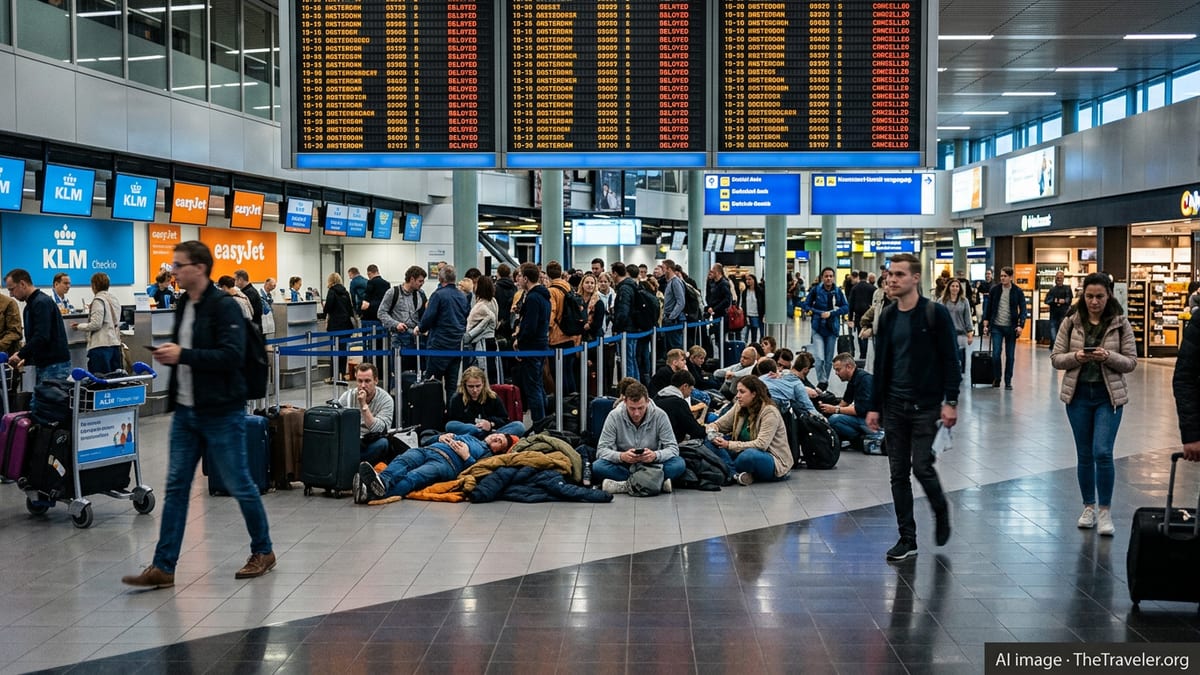
Major Hubs Buckle Under Congestion Pressure
Flight data compiled from multiple tracking services and network performance briefings points to a sharp spike in delays concentrated at Europe’s busiest hubs, including Frankfurt, Munich, Zurich, Barcelona and Athens. Disruption has been building through early June, but over the past 24 to 48 hours it has tipped into full-scale gridlock for many passengers, with delay numbers running far ahead of typical early-summer patterns.
Recent disruption in Germany illustrates the scale of the problem. Earlier this month, severe thunderstorms over Frankfurt, Munich, Berlin and Hamburg pushed more than 400 flights into delay status in a single day, with knock-on effects lasting well into the next operating cycle. That storm system effectively primed the network for further instability, leaving airlines with tight aircraft rotations and crews out of position as new waves of traffic moved into already constrained airspace.
Zurich, one of Europe’s key premium transfer hubs, has now joined the list of pressure points. Publicly available aviation data for June 14 shows a sudden deterioration in on-time performance at Zurich Airport, with a handful of cancellations but a much larger number of delayed departures and arrivals rippling across Swiss, Helvetic and KLM services. Even modest numbers of cancellations at such a tightly scheduled hub can cascade quickly, pushing up total delay counts across the network.
When these localized shocks are layered onto an already busy early-summer timetable, the result is a complex web of missed connections and late arrivals that can strand passengers far from the original point of disruption. The current tally of 1,424 delayed flights reflects not only weather impacts but also the cumulative effect of previous days’ congestion, as aircraft and crew rotations struggle to recover.
Air Traffic Management and Staffing Strains
Beyond headline storms and individual airport problems, structural stresses inside Europe’s air traffic management system are playing a significant role in the latest wave of delays. Recent network performance briefings from the continent’s central air traffic coordination body show that air traffic flow management restrictions have been affecting tens of thousands of flights each week, with around one in six services experiencing some form of regulated delay.
Greece and parts of southern Europe have been particular hotspots, with en‑route capacity constraints and staffing challenges at key control centers contributing disproportionately to the network’s delay minutes. These constraints can force airlines to accept longer routings, reduced flow rates into busy sectors or holding patterns near major hubs, each of which adds incremental minutes to flight times and pushes more arrivals into already congested peak periods.
Barcelona and Athens control centers have repeatedly appeared among the highest generators of en‑route delay minutes in recent technical reports. As traffic levels climb toward or beyond 2019 levels on certain days, even small shortfalls in controller availability or sector capacity can have outsized effects, especially when combined with convective weather that forces traffic to be rerouted around storm cells.
For passengers, these underlying airspace issues are largely invisible, but their impact is felt in the form of missed slots, extended taxi times and last‑minute gate changes. The latest surge to 1,424 delayed flights is consistent with a pattern in which network-wide air traffic management constraints amplify the disruption caused by local weather or airport incidents.
Knock-On Effects for Intra-European and Long-Haul Routes
The current congestion is affecting both short‑haul intra‑European services and long‑haul flights to and from the continent. Many of the delayed services are feeder flights that connect regional cities to larger hubs such as Frankfurt, Munich, Zurich, Amsterdam and Paris, where passengers transfer onto transcontinental routes. When those feeders run late, airlines are often forced to hold onward departures to protect connections or rebook large numbers of travelers when minimum connection times are breached.
Long-haul operations are particularly vulnerable because widebody aircraft perform complex rotations, often linking multiple continents in a single duty sequence. A delay of one or two hours on a European departure can echo through subsequent legs to North America, Asia or Africa, turning an isolated problem into a multi-day schedule imbalance. Publicly accessible flight boards at several major European airports on June 14 showed clusters of long-haul departures pushed back well beyond their scheduled times, in some cases by more than 90 minutes.
The disruption is not limited to departures from Europe. Delayed transatlantic and intercontinental arrivals can arrive late into crowded morning or evening peaks, where runway and gate capacity are already heavily utilized. As those flights queue for landing and parking positions, short‑haul turnarounds are squeezed, generating additional late departures that feed back into the network statistics. This dynamic helps explain how the continent has reached a cumulative total of more than 1,400 delayed services in such a short window.
Rail, coach and ferry operators are beginning to feel secondary impacts as passengers seek alternatives to disrupted itineraries. While some travelers are able to switch to high‑speed rail for journeys such as Paris to Amsterdam or Frankfurt to Brussels, capacity on these modes is finite, and last‑minute surges can quickly exhaust available seats, particularly at weekends.
Passenger Experience and Rights Under EU Rules
For travelers caught in the latest wave of disruption, the immediate experience is one of long queues, crowded terminals and uncertain departure times. Social media posts and consumer reports from across Europe over the past week describe passengers waiting hours for rebooking assistance, particularly at transfer hubs where missed connections have left them in unfamiliar airports late at night.
Under EU Regulation 261/2004, passengers departing from EU airports or flying with EU carriers may have specific rights to care and, in some circumstances, financial compensation when flights are heavily delayed or canceled. Eligibility depends on multiple factors, including the length of the delay on arrival, the distance of the flight and whether the disruption is attributable to the airline or to extraordinary circumstances such as severe weather or air traffic control strikes.
Specialist passenger-rights organizations note that summer is typically the busiest period for claims, and the current spike in delays is likely to generate another surge in inquiries. However, travelers often face a complex and time‑consuming process in asserting these rights, particularly when journeys involve multiple carriers or non‑EU segments. Many passengers opt instead for direct negotiations with airlines or rely on travel insurance policies, which may offer additional coverage for missed connections, overnight accommodation and incidental expenses.
Airports and airlines have been encouraging travelers to monitor digital channels and apps for real‑time information, but the rapid pace of operational changes can make it difficult for systems to keep up. In several recent disruption events, gate displays, mobile apps and email notifications have shown conflicting messages, complicating passengers’ efforts to make timely decisions about rebooking or alternative transport.
Outlook for the Coming Days
Looking ahead, network performance data suggests that Europe’s air traffic system is likely to remain fragile through the coming days, with further localized disruption possible if additional storm systems or unplanned capacity constraints emerge. Traffic volumes are edging upward as schools in multiple countries move into summer holidays, increasing the load on both airports and air traffic control centers.
Airlines are attempting to stabilize schedules by adding recovery time into turnarounds, adjusting departure banks and, in some cases, trimming frequencies on marginal routes to create more operational slack. These measures can help contain the spread of disruption but may also reduce flexibility for last‑minute rebookings when irregular operations occur.
For travelers, the latest episode of 1,424 delayed flights serves as an early warning about the volatility of Europe’s peak‑season air travel environment in 2026. Industry data and recent events underline that even on days without headline-grabbing storms or strikes, a combination of dense traffic, tight schedules and constrained airspace can quickly push the system beyond its limits, with widespread consequences for itineraries across the continent.
Analysts tracking aviation performance note that without significant improvements in airspace modernization, staffing resilience and ground-handling capacity, similar episodes of large-scale delay are likely to recur throughout the summer. For now, passengers face a travel landscape in which extra time, flexible plans and clear awareness of rights are increasingly essential parts of any European itinerary.