


More news on this day
Flight schedules across the Middle East have been thrown into disarray after missile attacks on Riyadh’s King Khalid International Airport killed three people this week, forcing airlines to cancel services, divert aircraft and warn travelers to brace for extended disruption.
Get the latest news straight to your inbox!
Deadly attack on key Saudi hub disrupts regional skies
Publicly available statements from Saudi Arabia’s General Authority of Civil Aviation and international media reports indicate that King Khalid International Airport in Riyadh was struck on Thursday, 8 October 2026, in a pair of attacks that hit airport facilities and a Saudia aircraft on the ground. The incident followed earlier strikes on Abha International Airport in the country’s southwest, which were reported on 6 October.
According to published coverage drawing on aviation authority figures, three Saudi citizens were killed in the Riyadh incident, while dozens of people were injured in the series of airport attacks that began earlier in the week. The fatalities reportedly include at least one commercial airline pilot. The strikes have been described in multiple analyses as the deadliest airport attacks inside the kingdom since the latest phase of the regional conflict escalated.
Reports from regional outlets and international travel publications note that the incident at Riyadh triggered an immediate wave of disruptions: aircraft already inbound were rerouted, departures were held at gates and air traffic control imposed temporary restrictions while damage assessments and security checks were carried out. Flight-tracking platforms showed sharp spikes in delays and cancellations at Riyadh, with knock-on effects at other Gulf and Levant hubs.
The attacks come against the backdrop of a broader Iran-linked conflict that has already affected airports in Kuwait, the United Arab Emirates and elsewhere in the Gulf over recent months. Analysts say the latest strike on Riyadh has heightened concerns that Saudi Arabia’s main international gateway, traditionally a key east–west transit point, could be periodically pushed offline by renewed missile or drone activity.
Airlines suspend Riyadh routes and widen detours
In the hours after the explosions at King Khalid International Airport, several international airlines announced temporary suspensions of services to the Saudi capital. Publicly available statements and news reports indicate that carriers including Lufthansa Group airlines and Air India have paused flights to Riyadh for at least several days, citing security assessments and operational uncertainty.
Regional analysis of flight data compiled on 9 and 10 October points to a sharp reduction in traffic at Riyadh, with some aviation trackers estimating that roughly one third to two fifths of scheduled departures were cancelled in the immediate aftermath of the attack. Industry-focused outlets report that more than one hundred flights linked to Riyadh were either cancelled outright or experienced significant delays as airlines adjusted crewing, insurance and routing plans.
The disruption is not confined to Riyadh. Travel trade coverage and route-mapping data show that some airlines have increased their use of alternative hubs in Jeddah, Dammam, Doha and Dubai to keep long-haul connections running while avoiding the most affected airspace. Others have added fuel stops or lengthened routings to skirt higher-risk corridors near Yemen and parts of the Red Sea, adding time and complexity to journeys between Europe, Asia and Africa.
Aviation analysts note that every schedule change creates a cascading effect: aircraft and crew may be left in the wrong place, connecting passengers miss onward flights, and ground handling systems become congested as thousands of travelers attempt to rebook at once. Given that Gulf and wider Middle Eastern hubs handle a significant share of global transfer traffic, even a single airport outage can reverberate widely.
Travel advisories tighten as embassies flag higher risk
Government travel advisories have shifted quickly in response to the attacks. Security consultancies summarizing official notices report that on 8 and 9 October several countries, including the United Kingdom, expanded advice against all but essential travel to parts of Saudi Arabia, naming Riyadh and southern provinces such as Asir, Jazan and Najran among the areas of heightened concern.
Earlier alerts issued by foreign ministries and embassies across the region had already warned of the possibility of airspace closures and short-notice flight cancellations as missile and drone activity increased. The latest guidance, updated after the strike on King Khalid International Airport, stresses that further attacks on airports or aviation infrastructure cannot be ruled out and that flight operations may be disrupted with little warning.
Travel risk bulletins compiled on 9 October highlight that several Gulf and Levant states, including Saudi Arabia, Kuwait, Qatar and the United Arab Emirates, currently sit at “reconsider travel” tiers within some national advisory systems. These ratings do not amount to outright bans, but they can influence corporate travel policies, insurance coverage and airline decisions about restoring suspended routes.
Specialists in duty-of-care and corporate security note that companies sending staff to the region are increasingly requiring pre-approval for itineraries that pass through Riyadh or other higher-risk hubs. Some organizations are temporarily routing essential travel through airports perceived as less exposed to direct attacks, even when that adds cost or time to a journey.
What passengers are experiencing on the ground
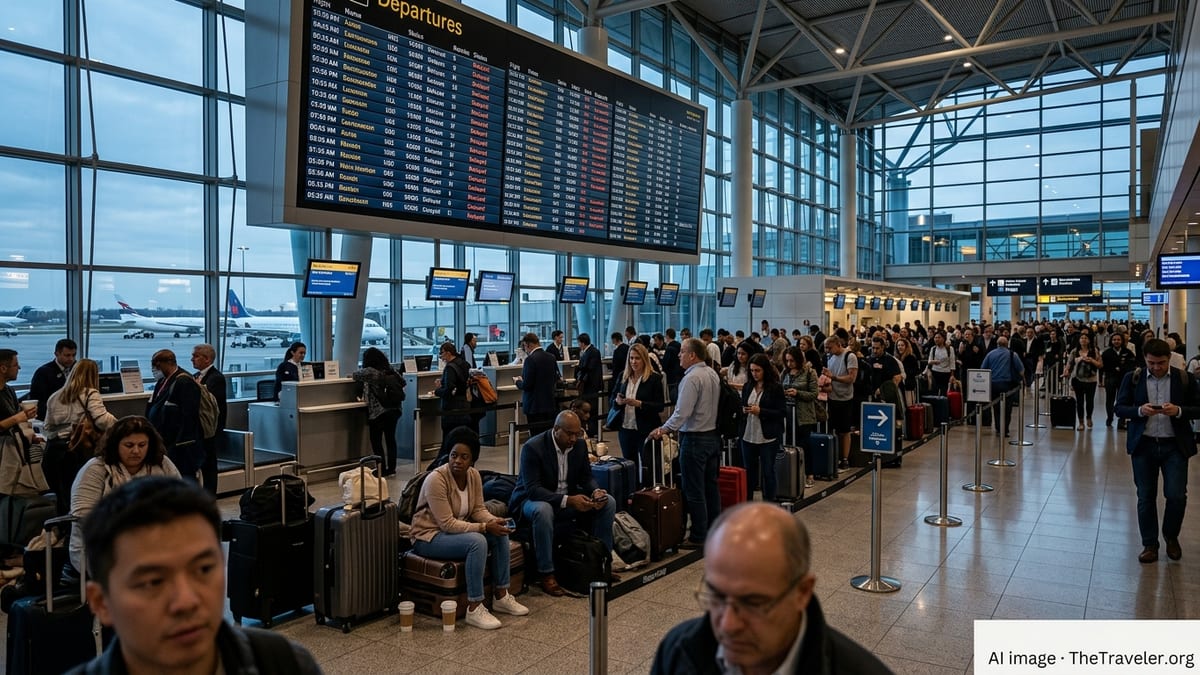
For individual travelers, the most visible impact has been at check-in desks and departure boards. Travel industry reports and eyewitness accounts collated by aviation blogs describe packed terminals, long queues at airline counters and information screens filled with delayed or cancelled flights at Riyadh, Jeddah and other key airports in recent days.
Data from flight-tracking and independent aviation monitoring services suggests that hundreds of flights across the wider region have been delayed by more than an hour since the Riyadh strike, with knock-on congestion as aircraft wait for new clearances or are repositioned. In some cases, passengers have been held on aircraft at gates while security sweeps are completed, adding to overall journey times.
Reports from travel advisors indicate that rebooking options are becoming more limited on popular routes, particularly between Europe and South or Southeast Asia, where many itineraries normally rely on one-stop connections through Gulf hubs. With certain routes to Riyadh suspended and capacity constrained elsewhere, some travelers are being offered indirect routings via Istanbul, Cairo or European capitals, or are being shifted to later dates when seats are available.
Accommodation costs are also emerging as a pain point. As delays stretch into overnight stays, hotel rooms near major airports are filling quickly and rates have risen. Some airlines are providing vouchers where required by local regulations or carrier policy, but in many cases, particularly for tickets bought through third-party agents or on the lowest fare classes, travelers are being told to claim costs from travel insurance providers.
How to plan Middle East itineraries in the current climate
Travel experts and risk consultancies advising corporate and leisure clients on Middle East itineraries in October 2026 emphasize preparation and flexibility. They recommend that passengers build in longer connection times when itineraries involve hubs such as Riyadh, Jeddah, Dubai or Doha, since last-minute airspace restrictions or ground holds can quickly erode standard layovers.
Publicly available guidance from security and travel risk firms also encourages travelers to monitor both airline notifications and official government advisories up to the time of departure. Because airlines are frequently updating route networks and schedules, information published even a few days earlier may no longer be accurate, and some carriers are allowing free rebooking away from affected airports within defined travel windows.
For those who must transit Saudi Arabia, analysts suggest considering alternative domestic links such as high-speed rail or internal flights via less congested airports if connections through Riyadh are cancelled. However, they stress that these options can also be affected by broader security measures and that conditions may change at short notice.
Insurance specialists quoted in industry reports underline the importance of checking policy wording carefully. Many standard travel insurance products contain exclusions or limited benefits for disruption linked to armed conflict or terrorism. Where coverage is unclear, travelers may wish to seek products that explicitly address trip interruption and additional expenses related to security incidents.
With the situation around Riyadh’s King Khalid International Airport still fluid as of 10 October, the consistent message from airlines, risk advisers and official travel notices is that further disruption across Middle Eastern air corridors remains possible. Travelers are being urged, through publicly accessible advisories, to remain flexible, stay informed in real time and be prepared for changes to even well-established routes.