


Tucked into the far north of New South Wales, the Tweed region has quietly transformed from a sleepy coastal pocket into one of Australia’s most talked‑about beach and hinterland escapes. Recent Expedia data highlights The Tweed as a trending destination with around 35% year‑on‑year growth in demand, putting towns like Kingscliff on the radar for travellers who once defaulted to the Gold Coast or Byron Bay. For visitors, that surge translates into more places to stay, better food and tour options, and a growing choice between classic surf breaks and rainforest retreats, all within easy reach of Gold Coast Airport.
Get the latest updates straight to your inbox!
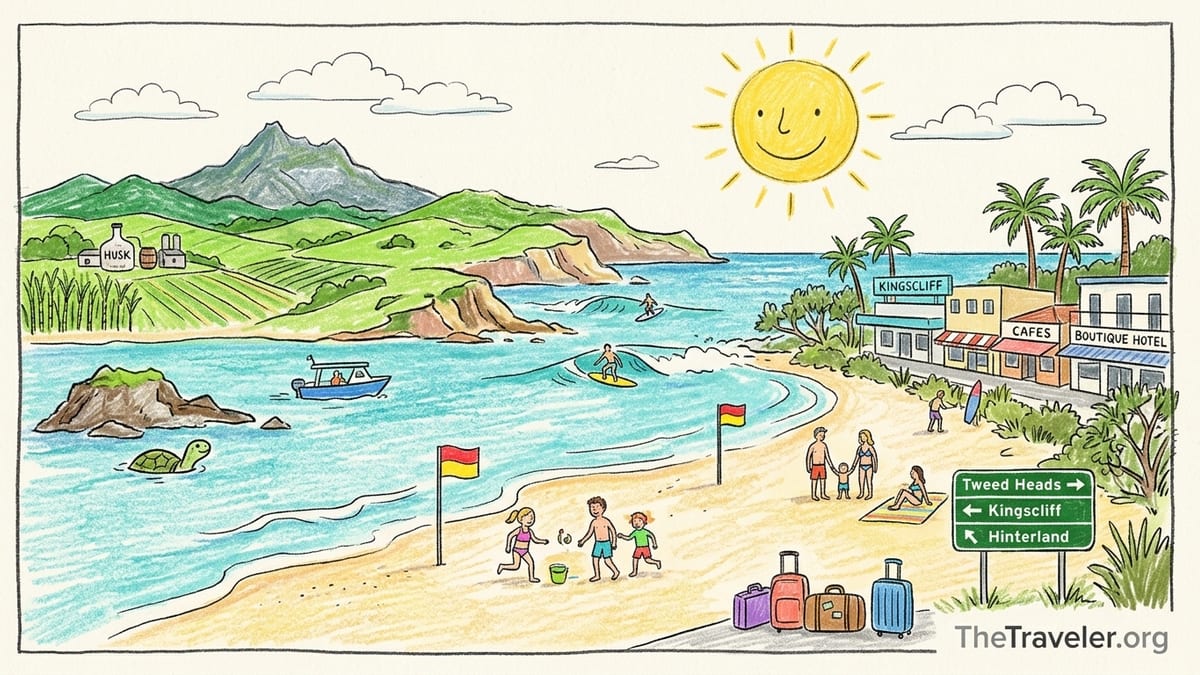
Why The Tweed Is Suddenly On Every Shortlist
The Tweed sits just south of the Queensland border, anchored by Tweed Heads on the river mouth and a run of coastal towns including Kingscliff, Casuarina and Cabarita Beach, then stretching inland to Murwillumbah and the caldera country around Wollumbin Mount Warning. Destination NSW includes it in the broader North Coast tourism region, which recorded solid visitor growth in the year ending June 2026, reflecting strong demand for coastal getaways outside the capital cities. Travellers who once stopped at Coolangatta or sped straight to Byron Bay are now building Tweed stays into their itineraries as a stand‑alone escape.
Expedia’s recent Unpack travel trends reporting, highlighted by international outlets covering where to travel in 2027, singles out The Tweed as a rising coastal destination with demand up by roughly 35%. At the same time, Expedia’s Australian summer outlook lists nearby Tweed Heads and Kingscliff among the country’s top trending regional beach towns by demand growth, sitting alongside long‑time favourites on the Gold Coast. That combination of broader regional growth and specific surges for Tweed towns is reshaping how accommodation operators, tour companies and local councils plan for the next few seasons.
On the ground, Tweed Shire Council reports that tourism contributes around 1 billion Australian dollars annually to the local economy in the 2023–24 period. That visitor spend supports everything from surf clubs and river cruise operators to farm‑to‑table restaurants and arts venues. It also underpins investment into coastal protection and visitor facilities such as upgraded foreshore paths, new bike links and expanded visitor information services in towns like Kingscliff and Murwillumbah.
For travellers, the practical impact is easy to see. Booking platforms now show a wider range of stays than even a few years ago, from beachfront holiday parks under 200 Australian dollars per night in low season to luxury villas near Kingscliff and Cabarita that can reach 600 to 900 dollars per night over peak summer. River tours and hinterland day trips that once ran a few days a week now often operate daily in high season, and restaurants that focused on locals have pivoted to tasting menus and longer opening hours to cater to visitors arriving from the Gold Coast and interstate.
Kingscliff: Surf Town Turned Laid‑Back Hub
Kingscliff, around 13 kilometres south of Tweed Heads, has become the relaxed heart of the Tweed Coast. Long known for its caravan park and low‑rise holiday flats, it has steadily added boutique hotels, polished cafes and destination restaurants, including long‑running fine‑dining spots that showcase local seafood and Northern Rivers produce. On a summer weekend the main strip fills with Brisbane and Sydney plates, families carrying beach umbrellas and couples heading for long lunches overlooking the ocean.
The main draw remains Kingscliff Beach, a broad stretch of sand popular with swimmers and surfers. Tweed Shire Council manages a network of patrolled beaches along this coast and works with local surf life saving clubs to roster lifeguards across key stretches in season. Visitors will notice visible signage about rips and flagged swimming zones, particularly near the central Kingscliff area where erosion has been an ongoing management challenge. Families who prefer gentler water often cross the road to the Cudgen Creek estuary, where sandbanks create shallow swimming spots ideal for young children and paddleboarders at mid to high tide.
For daily life, Kingscliff feels compact and walkable. A shared oceanfront path, sometimes referred to as an oceanway, links the historic centre to newer residential communities along the Tweed Coast, making it possible to cycle from holiday apartments near town to newer developments and south towards Casuarina on relatively flat terrain. Accommodation choices range from self‑contained apartments above the main street, where off‑peak nightly rates can sit around 220 to 280 Australian dollars, to multi‑bedroom holiday homes in nearby Salt Village catering to extended families and groups of friends.
Practical services have grown with demand. The Kingscliff Visitor Information Centre, signposted near the foreshore, provides maps, tide times, up‑to‑date information on surf patrols and advice on everything from whale‑watching seasons to local markets. Travellers booking last‑minute tours or trying to piece together a hinterland itinerary often drop in for help arranging river cruises, fishing charters or transfers to walking trails further inland.
Beaches From Tweed Heads To Cabarita
The Tweed coastline offers a series of distinct beach experiences within a short drive. Near the border, Duranbah Beach, on the southern side of the Tweed River mouth, is famed among surfers for its punchy beach breaks and regular competitions. It is close enough to the Gold Coast that many day‑trippers simply cross the river for a less crowded line‑up. Slightly to the south, the beaches that run past Fingal Head towards Kingscliff provide a more open, exposed feel, with rolling shore breaks that appeal to experienced swimmers comfortable with waves and rips.
Through Kingscliff itself, foreshore works and erosion management have changed the beach profile in recent years, with council updates noting slow natural sand recovery on some southern stretches. Visitors will find temporary signage and, in some sections, rock protection or fenced dunes designed to stabilise the shoreline. Rather than a drawback, this can be a prompt to explore other nearby options. Casuarina and Cabarita Beach, 10 to 15 minutes by car south of Kingscliff, often offer wider, less impacted swathes of sand, backed by coastal vegetation and a mix of holiday apartments and architect‑designed homes.
Swimming between the red and yellow flags is a constant message along this coast, and the presence of four local surf life saving clubs within Tweed Shire helps maintain a network of patrolled areas during the warmer months. Families frequently choose the patrolled section of Kingscliff Beach near the surf club in summer school holidays, while surfers spread out to the points and bank formations at Cabarita and further south. Board hire outlets in Kingscliff and Casuarina generally charge around 30 to 45 Australian dollars for a half‑day surfboard rental, with softboards recommended for beginners.
For those drawn to quieter water, the Tweed River and Cudgen Creek provide sheltered alternatives. Stand‑up paddleboard hire near the Kingscliff bridge typically starts around 25 to 35 Australian dollars for an hour, with guided eco‑tours sometimes including sunrise or sunset sessions that focus on birdlife and the mangrove environment. It is common to see pods of dolphins in the river mouth near Tweed Heads, while rays and turtles can often be spotted in the clearer creek waters on still mornings.
Outdoor Adventures: From Cook Island To Wollumbin
Beyond simply sitting on the sand, the Tweed is emerging as an outdoor playground for travellers keen on soft adventure. Offshore from Fingal Head and Kingscliff lies Cook Island Aquatic Reserve, a small island surrounded by reef that attracts green and loggerhead turtles, diverse fish life and, in winter, migrating whales. Local operators based around Kingscliff and Tweed Heads run snorkelling and diving trips, with half‑day snorkel tours often priced in the ballpark of 150 to 190 Australian dollars per adult, including equipment and boat transfers. Conditions depend on swell and wind, so it is worth building some flexibility into an itinerary.
On land, the Tweed hinterland rises quickly from the coast into a dramatic volcanic caldera, with Wollumbin Mount Warning as the central peak and a series of national parks forming part of the Gondwana Rainforests World Heritage listing. Access arrangements have changed in recent years in consultation with traditional owners, and the summit track of Wollumbin has been closed to protect cultural and environmental values. However, surrounding national parks still offer a network of walking tracks, waterfalls and lookouts that can be visited with local guides or self‑guided using official maps sourced from visitor information centres.
Travellers often combine a coastal base in Kingscliff with a day trip looping through the hinterland. A typical route might follow the Tweed Valley Way to Murwillumbah for coffee and a visit to the Tweed Regional Gallery and Margaret Olley Art Centre, then continue to villages such as Uki or Tyalgum for short forest walks and local produce, before returning via charming cane‑field backroads. Guided full‑day tours from the Tweed Coast that include transport, short walks and a gallery or farm visit generally sit around 160 to 220 Australian dollars per person, depending on group size and inclusions.
Closer to the coast, lagoon and creek systems offer low‑impact options. Kayak tours on Cudgen Creek, often run by local watersports companies, highlight mangroves, birdlife and occasional stingrays gliding along the sandy bottom. Half‑day kayak tours typically cost around 90 to 120 Australian dollars, with family discounts common. Operators may also offer combination packages that pair paddleboarding with snorkelling near Cook Island or whale‑watching in season, appealing to visitors who want to fit several water experiences into a single day without driving long distances.
Food, Drink And The Tweed’s Emerging Culinary Scene
The Tweed’s visitor economy increasingly leans on its food and drink credentials. Fertile volcanic soils and a subtropical climate support sugarcane, avocados, bananas and a growing number of small‑scale producers. Many of these supply a cluster of farm‑to‑plate restaurants on the coast, particularly around Kingscliff and Casuarina, and in the hinterland near Tumbulgum and Duranbah. For visitors, that means menus rich with local seafood, macadamias and seasonal fruit, paired with craft spirits and regional wines.
One of the most distinctive examples is Husk Farm Distillery, set amid cane fields near Tumbulgum. Recognised in international travel coverage for its paddock‑to‑bottle approach, Husk produces Australia’s first agricole‑style rum made from fresh sugarcane juice, as well as the widely known Ink Gin. Visitors can book tasting experiences that typically cost around 30 to 40 Australian dollars per person, including guided tastings and time on the lawn with views to Wollumbin. Families and non‑drinkers are catered for with food trucks, mocktails and spacious outdoor seating, and many travellers now plan half‑day outings there from Kingscliff or the Gold Coast.
In Kingscliff itself, dining options span casual fish‑and‑chip shops near the beach to highly regarded hatted restaurants that focus on line‑caught fish and Northern Rivers produce. Dinner mains at mid‑range venues usually sit around 30 to 45 Australian dollars, with degustation menus at top‑tier establishments edging higher, especially on weekend evenings. Cafes along Marine Parade serve relaxed breakfasts from about 18 to 25 Australian dollars for dishes such as avocado toast with local feta or house‑smoked salmon, and coffee culture rivals anything in the nearby cities.
Markets and roadside stalls supplement the sit‑down options. Weekly or fortnightly farmers’ markets around Kingscliff, Murwillumbah and Tweed Heads showcase local fruit, artisan bread, cheeses and small‑batch condiments. For self‑catering travellers staying in holiday rentals, stocking up at these markets can be a cost‑effective alternative to dining out for every meal, while also offering a more direct connection to the region’s producers. Many stalls provide samples, making it easy to taste before buying and talk directly with growers about growing seasons and varietals.
Getting To The Tweed And Access From The Gold Coast
One of the Tweed’s biggest advantages is its proximity to the Gold Coast. Gold Coast Airport, situated at Coolangatta on the Queensland–New South Wales border, effectively serves as the main gateway for both regions. Domestic flights from Sydney and Melbourne often price competitively, with advance sale one‑way fares sometimes dipping under 120 Australian dollars outside peak holidays, while major carriers and low‑cost airlines link the airport to other capitals and New Zealand. For international visitors, connecting via Sydney, Brisbane or Auckland is common.
From the airport, Kingscliff is roughly a 15 to 20 minute drive, depending on traffic, via the Pacific Motorway and Tweed Coast Road. Car hire desks at the terminal are well placed for travellers planning to explore both beaches and hinterland, with daily rental rates in low season often starting under 80 Australian dollars for compact vehicles booked ahead. Rideshare and taxi services also operate at the airport; a metered taxi trip to central Kingscliff can fall in the range of 45 to 70 Australian dollars, depending on time of day, toll routes and seasonal surcharges.
Public transport options are more limited but improving. Translink buses connect the airport and Tweed Heads to the Gold Coast light rail at Broadbeach South, making it possible to stay in Tweed and visit Surfers Paradise or Broadbeach for day trips without a car. However, for visitors focused on beach‑hopping along the Tweed Coast or reaching trailheads and farm venues inland, a hire car remains the most flexible option. Many accommodation providers in Kingscliff and Casuarina offer free parking, and driving distances between key sights are relatively short.
For travellers coming from Brisbane by road, the drive to Kingscliff takes about 90 minutes in light traffic, following the M1 south. Some choose to base themselves on the Gold Coast, where the domestic overnight visitor economy was valued at more than 5.4 billion Australian dollars in the year ending June 2026, then take day trips to Tweed beaches and hinterland villages. Others reverse the pattern, staying in Kingscliff or Murwillumbah for a quieter pace and venturing north to theme parks or shopping centres on the Gold Coast as occasional outings.
Planning Your Stay: Seasons, Pricing And Practical Tips
The Tweed’s subtropical climate makes it a year‑round destination. According to official visitor information, average summer daytime temperatures sit around 30 degrees Celsius, with winter days closer to 20 degrees and nights sometimes dipping to about 10. February is often the wettest month, coinciding with the peak of the wet season. As a result, some visitors prefer to target the shoulder seasons of late spring and early autumn, when water temperatures remain warm but humidity and rainfall are more moderate.
Visitor seasons tend to align with Australian school holidays and public holiday periods. Regional tourism authorities describe April to September, excluding school holidays, as low season for much of the North Coast, with October to December and February to March acting as shoulder months and late December to late January forming the high season peak. In practice, that means a beachfront holiday park cabin in Kingscliff that might cost 160 to 220 Australian dollars per night in May can easily climb above 300 dollars in the Christmas–New Year window, while minimum stays of three to seven nights often apply.
Given the high demand reflected in Expedia’s growth figures for the Tweed and Kingscliff, booking ahead is increasingly important, particularly for December and January stays and long weekends around Easter. Travellers looking for better value might consider mid‑week visits in shoulder season, when both accommodation rates and crowd levels tend to ease. Inland options such as cottages around Uki or farm stays near Tumbulgum can also represent good value compared with absolute beachfront properties, while still keeping travel times to Kingscliff’s cafes and beaches under 40 minutes.
Safety and logistics also deserve attention. Parts of the Tweed have experienced flooding in recent years, and local authorities and communities are accustomed to monitoring river levels and road closures. Before heading into the hinterland, especially in the summer wet season, it is sensible to check council updates and local news for any warnings. On the coast, paying attention to lifeguard advice and beach signage is vital, particularly on days of heavy swell or strong currents. Travel insurance that covers weather‑related disruptions can be a wise addition, especially for trips planned in the heart of the storm season.
How To Make The Most Of The Expedia‑Fuelled Boom
The surge in interest captured in Expedia’s data has concrete implications for how visitors experience the Tweed. Increased demand typically leads to broader accommodation and tour offerings but can also compress availability at the most desirable times. For example, snorkel trips to Cook Island or weekend tables at well‑known Kingscliff restaurants now book out earlier than they once did, particularly when overlapping with interstate school holidays or major events on the Gold Coast.
One strategy is to treat the Tweed as a flexible base rather than only a beach break. With Gold Coast Airport so close, travellers can arrive on a Friday, spend Saturday in Kingscliff and on the river, devote Sunday to the hinterland and still fit in a Gold Coast attraction or outlet shopping run on Monday before an evening flight. By diversifying activities across coast, river and hinterland, visitors avoid concentrating all their plans into a handful of peak‑hour beach windows and reduce the frustration that can come when surf conditions do not cooperate.
Another approach is to pair the Tweed with neighbouring regions on a longer road trip. Drivers coming from Sydney often follow the Legendary Pacific Coast route, stopping at Port Macquarie, Coffs Harbour and Yamba before finishing in the Tweed. Others link the Tweed with Byron Bay and Ballina to create a loop that balances buzzy nightlife with quieter village stays. In all cases, the Tweed’s role as a bridge between New South Wales’ north coast and the Gold Coast’s urban strip makes it a natural final or first stop, particularly for those chasing both waves and waterfalls.
The key, in light of Expedia’s reported 35% bump in demand and the region’s broader visitor economy growth, is to plan early without over‑scheduling. Build in backup days for water activities in case of wind or swell, book cornerstone experiences such as snorkelling, distillery tours or gallery visits ahead of time, and allow space for spontaneous discoveries, from roadside fruit stalls in the cane country to impromptu swims in creek pools. Travelling this way, visitors tap into the Tweed’s rising profile while still enjoying the unhurried charm that first drew people here long before the data flagged it as a trend.
Conclusion: A Region Balancing Growth And Quiet Charm
The Tweed stands at an interesting point in its tourism story. Expedia’s data and national visitor statistics confirm that more people than ever are choosing this pocket of northern New South Wales, drawn by its mix of surf beaches, river life and ancient rainforest landscapes. Kingscliff, once simply a holiday park town, now plays the role of relaxed coastal hub, linking visitors to both the Pacific and the fertile hinterland. Gold Coast Airport’s proximity lowers barriers to entry, turning the Tweed into an easy long‑weekend choice for travellers from across Australia and New Zealand.
At the same time, much of what makes the Tweed appealing lies in experiences that remain low‑key and grounded: an early‑morning paddle on a glassy creek, afternoon light on Wollumbin’s silhouette, a meal built around local prawns and cane‑field rum or a quiet walk through gallery spaces that tell the region’s stories. The challenge for the coming years will be balancing that character with the pressures and opportunities of rapid visitor growth.
For now, travellers who arrive with a little planning, a flexible mindset and respect for local communities will find a region that rewards unhurried exploration. Whether you come via the Gold Coast for a weekend in Kingscliff or carve out a week to roam from beaches to hinterland, the Tweed’s new visibility on travel trend lists simply confirms what many locals and repeat visitors already know: this is one of Australia’s most rewarding coastal‑and‑country escapes.