


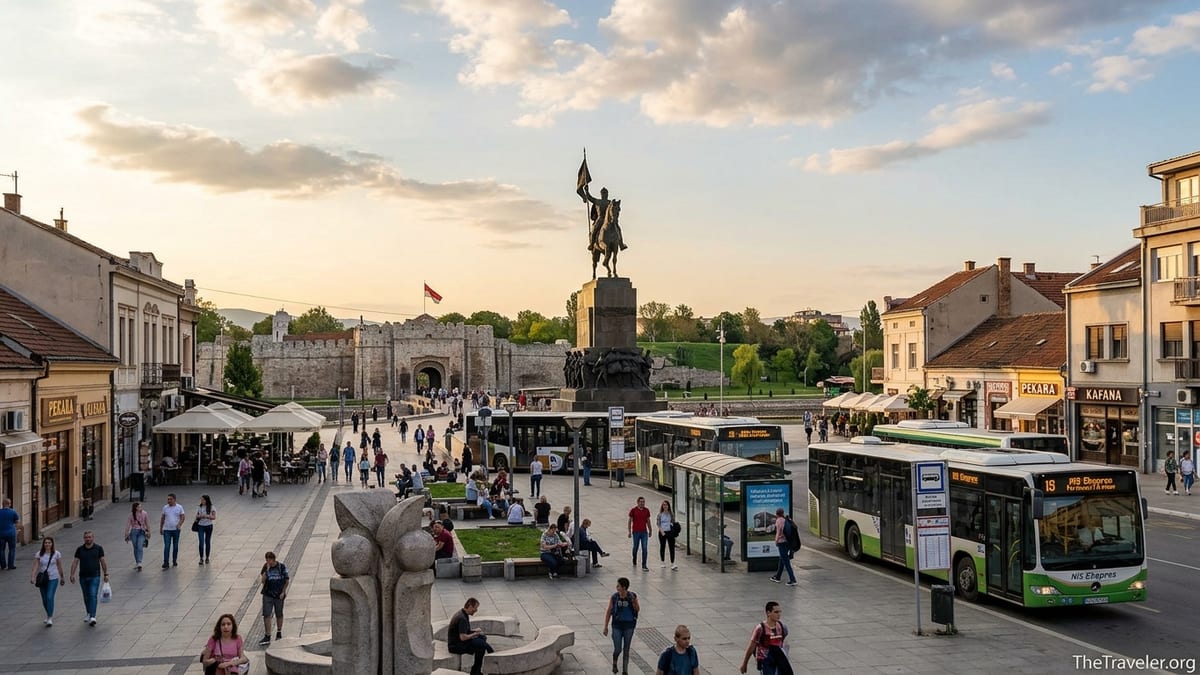
Niš is not a polished resort or a blockbuster capital. It is a working southern Serbian city where Roman emperors were born, Ottoman rule left stark traces, and the twentieth century carved deep scars. For travelers moving between Belgrade, Sofia, Skopje or Thessaloniki, Niš deserves at least an overnight pause: trains and buses cross here, grilled meat smoke drifts over the Nišava River in the evenings, and serious historic sites like Skull Tower and the Red Cross Concentration Camp Memorial lie close enough to reach in a short taxi ride.
Get the latest updates straight to your inbox!
Why Niš Is Worth a Stop on a Balkan Route
Geographically, Niš sits on one of Europe’s classic north–south corridors. The modern road and rail line largely follow the Roman Via Militaris, linking Belgrade to Sofia and further to Istanbul, and south toward Skopje and Greece. This makes Niš a natural break in overland trips between central Europe and the Aegean or between Bulgaria and the rest of Serbia. You are rarely detouring far from your main route to spend a night here.
Historically, the city carries more weight than its relaxed, slightly rough-around-the-edges appearance suggests. Niš was the birthplace of Constantine the Great and lay on the frontier between empires for centuries. The Ottoman period left fortifications and, most chillingly, Skull Tower, a physical reminder of the 1809 Battle of Čegar and the cost of Serbian resistance. In the twentieth century, the city’s Red Cross district saw one of the first Nazi concentration camps outside Germany. Today, those layers coexist with student bars, family bakeries and a compact center that is easy to explore on foot.
Travelers should come with calibrated expectations. Niš has no sweeping old town like Dubrovnik and no riverfront skyline like Budapest. Many streets are plain, some buildings are shabby, and tourist infrastructure is modest. But that is partly the appeal. You will share burek counters with local commuters, stroll river paths largely used by residents, and visit museums that feel civic rather than commercial. For visitors interested in Balkan history, Ottoman heritage, or the everyday feel of a mid-size Serbian city, Niš rewards a focused two-day stay.
Budget is another point in Niš’s favor. Compared with Belgrade, prices for accommodation and food are generally lower, especially outside peak summer weekends. A grilled meat platter for two in a local kafana, with salads and non-alcoholic drinks, can realistically stay in the range of 1,800 to 2,700 Serbian dinars, and burek with yogurt for breakfast often comes in well under 400 dinars per person. Those figures make Niš an attractive base for budget-conscious travelers or anyone padding out an Interrail or bus itinerary through the Balkans.
Getting to Niš by Bus, Train or Car
Intercity buses remain the most flexible way to reach Niš. On the key Belgrade–Niš corridor, multiple operators such as Niš Ekspres and Kavim Jedinstvo run services throughout the day. Timetables checked for November 2026 show scheduled journey times typically between about 3 hours 10 minutes and 3 hours 50 minutes for the roughly 235–240 kilometer route, depending on intermediate stops. Tickets bought at the station counters or via domestic booking platforms start around 1,600 to 2,200 dinars one way in standard seating. Travellers report that buses are often close to on-time outside heavy holiday traffic, though Friday evenings and summer Saturdays can bring delays.
From Sofia, cross-border buses are usually more practical than the limited train options. Direct buses between Sofia and Niš are advertised with scheduled journey times around 2.5 to 3.5 hours for about 170 kilometers, but recent traveler reports note that actual times vary widely because of border checks at Kalotina–Gradina. Waiting at the border can add 30 minutes to several hours in peak summer, while outside holidays the ride may be close to the timetable. Similar patterns hold for some services from Skopje or Thessaloniki that use Niš as a connection point toward Belgrade or northern Serbia.
Rail travel into Niš is improving slowly but still requires some patience. According to late-2026 summaries of Serbian Railways timetables, there are direct Regio services between Belgrade Center (Beograd centar) and Niš, plus at least one faster InterRegio train each way within the timetable valid from mid-December 2025 to mid-December 2026. These schedules quote journey times broadly in the 3.5 to 4.5 hour range, sometimes slightly shorter for the faster trains. However, recent rail users consistently describe minor delays as common and emphasize that on-time arrivals are a pleasant surprise rather than a guarantee. On the plus side, train tickets are usually cheaper than buses on the same route, which can matter if you are traveling as a couple or group.
For drivers, Niš is linked to Belgrade and Skopje by the A1 motorway and to Sofia by main road routes through Pirot. The A1 is a tolled, divided highway for much of its length. Tolls between Belgrade and Niš for a car are in the ballpark of 1,000 to 1,200 dinars one way, depending on the precise entry and exit points. Parking in Niš itself is a mix of metered street zones and paid lots; prices centrally are often in the order of 60 to 100 dinars per hour. Many visitors without local language skills prefer to park once near their accommodation and explore the center on foot or by short taxi rides, given traffic congestion in the core during weekday peaks.
Arriving in Niš: Stations, Airport and Local Transport
Niš Bus Station sits close to the city center, which is a major convenience compared with some other Balkan hubs. Official and local visitor documents describe the main bus terminal as centrally located, with easy access into the core by foot or city bus. In practice, most travelers with moderate luggage can walk to King Milan Square in around 10 to 15 minutes along busy but straightforward streets. If you prefer to ride, several city bus lines run past or near the terminal toward the center, and single tickets bought from the driver reportedly cost around 80 to 120 dinars.
The railway station is less central. Located on Dimitrije Tucovića Street on the western edge of town, it connects Niš with Belgrade, Dimitrovgrad toward Sofia, Skopje and Prahovo on various regional and long-distance lines. Walking from the station to King Milan Square can take 20 to 30 minutes on uneven pavements, so many visitors choose a taxi at arrival, especially after dark or with heavy bags. Licensed city taxis waiting outside the station typically run on a meter, and recent conference travel guides mentioning Niš list reputable companies such as EKO taxi, Lift and Prvi Taxi. A short ride from the station to the main square or the fortress usually falls in the approximate range of 300 to 600 dinars, depending on traffic and exact address.
Niš Constantine the Great Airport lies about 6 kilometers from the city center. Passengers arriving on low cost carriers from destinations like Vienna, Dortmund or seasonal routes in Greece and Western Europe have two main options into town. A local city bus currently links the airport with the main bus station and central areas; recent fare examples from travelers place the ticket at about 80 dinars when bought on board. Journey time into town is often 15 to 25 minutes, depending on traffic. For a quicker and more comfortable transfer, airport users report using official taxis such as Prvi Taxi Niš, recognizable by green and white cars and roof signs, paying roughly the equivalent of a few hundred dinars for the ride to central hotels. It is sensible to avoid unmarked drivers and to confirm that the meter is running.
Within Niš, city buses cover most districts, but the central zone is compact enough that you can walk between the bus station, King Milan Square, the riverfront and Niš Fortress in a few minutes. For outlying sights such as Skull Tower or the Čegar Monument, a short bus or taxi ride is more convenient than walking long distances along busy roads. As in many Balkan cities, taxi numbers are printed on car doors, and phone dispatch is common, but hotel receptions and cafés are usually happy to call a cab for visitors who do not speak Serbian.
Exploring Central Niš on Foot: Fortress, River and Old Streets
Niš is ideal for a structured walking day that ties together Ottoman and modern landmarks. Start at King Milan Square, the main plaza framed by modern shops and a large monument to King Milan Obrenović. From here, pedestrianized Obrenovićeva Street runs south, lined with cafés and mid-range stores. It may not be architecturally spectacular, but it gives a sense of everyday life and is a convenient axis: most central hotels, banks and phone shops cluster around this stretch.
From the square it is a short walk north to the Nišava River and the stone bridge leading to Niš Fortress. The fortress is one of the largest Ottoman fortifications in the Balkans still standing in largely recognizable form. Entry to the grounds is free, and many locals use it as a park rather than a museum. Inside the walls you will find remains of Ottoman-era structures, sections of the former armory, small artisan workshops and open spaces used for summer festivals. It is easy to spend an hour or two wandering tree-lined paths, climbing earth mounds for river views, or seeking shade on hot days. Some inner buildings operate as occasional exhibition spaces or cafés, so specific opening times vary, but the main gates stay open throughout the day.
After exploring the fortress, follow the Nišava embankment downstream. On pleasant days, residents stroll or sit on benches overlooking the water, and informal play areas dot the path. This riverside stretch offers a relaxed contrast to heavier historical sites later in the day, and it is especially atmospheric around sunset when grills begin to smoke at nearby restaurants. Continue along the south bank back toward King Milan Square, then angle into Kazandžijsko Sokače, a short but characterful cobbled lane sometimes called the old bohemian quarter. Once a street of coppersmiths, it now houses cafés, bars and a few traditional-style restaurants under low-tiled roofs.
Kazandžijsko Sokače can feel touristy in high summer but remains popular with locals. Prices for meals here are a touch higher than in purely residential districts, yet still reasonable by regional standards. Expect to find classic grilled meats, salads like šopska and urnebes, and draft beer. Some establishments feature live music on weekend evenings, while afternoons are quieter. The immediate vicinity includes side streets with older low-rise houses and small courtyards that hint at prewar Niš, though modern buildings dominate much of the center. Surfaces here and around the fortress include cobblestones and broken paving, so travelers with mobility challenges should allow extra time and consider sturdy footwear.
Skull Tower, Čegar and the Red Cross Camp: Confronting Difficult History
Skull Tower (Ćele Kula) is Niš’s most sobering Ottoman-era monument. After the 1809 Battle of Čegar, where Serbian rebels fought Ottoman forces near Niš, the Ottomans reportedly built a tower embedded with hundreds of the rebels’ skulls as a warning. Over time many skulls were removed or decayed, and as of 2026 about 58 skulls remain in place, now enclosed within a chapel. The site is administered by the National Museum Niš, and visitors view the tower from a walkway inside the protective building.
Practically, Skull Tower stands a few kilometers east of the center on Bulevar Zorana Đinđića. You can reach it by city bus heading toward that district or by taxi in roughly 10 minutes from King Milan Square, depending on traffic. Taxi fares for this distance are often similar to a cross-town ride, in the hundreds rather than thousands of dinars. Admission is modest, with recent museum-related sources indicating a ticket price around 300 dinars for adults in late 2026, but visitors should check for the latest prices on arrival. Opening hours generally follow a seasonal pattern, with longer days in summer (roughly April to November) and shorter hours in winter, and the site is commonly closed on Mondays.
The Čegar Monument lies on a hill outside town near the original battlefield. It commemorates the same 1809 fighting, with a large statue and landscaped surroundings. Reaching Čegar without a car requires more planning than a visit to Skull Tower. There is a railway stop named for Čegar and some local bus routes toward the area, but travelers often find it easier to arrange a taxi there and back, especially outside summer daylight hours. The monument itself is in open air and can be visited without an entrance ticket, but there may not be visitor services on site beyond basic information boards, and shade is limited. Combining Čegar with Skull Tower in a half-day outing provides context for the story behind the tower’s construction.
Twentieth century history is most visible at the Red Cross Concentration Camp Memorial Museum, located in the Crveni Krst (Red Cross) district north of the center. Established by Nazi Germany in 1941, the camp held Jews, Serbs, Roma and political prisoners, and was the site of executions and deportations. Today the preserved buildings house exhibits about life in the camp, resistance, and the fate of those imprisoned there. Access conditions have evolved in recent years; some parts of the complex have been subject to restoration and changing opening policies. Before visiting, it is advisable to confirm at the Niš Tourist Information Center or via local tourist materials whether the museum is open that day and if any sections remain closed.
When visiting these sites, sensitivity is essential. Photography rules may restrict images of human remains or certain exhibits, and staff often appreciate visitors who approach the spaces quietly. Unlike some larger memorials in western Europe, English-language explanation panels in Niš can be limited or uneven, so bringing background reading or a reliable guidebook helps. These experiences can be emotionally heavy. Many travelers choose to follow a morning visit to the Red Cross camp or Skull Tower with lighter afternoon activities such as river walks or café time, rather than stacking several intense sites back to back.
Mediana Archaeological Site and Changing Access
The Mediana archaeological site, on the outskirts of Niš, preserves parts of a late Roman imperial residence complex, associated with Constantine the Great and other emperors who used Niš as a base. Excavations have revealed mosaics, villa remains and storage facilities that underscore how strategically and economically important the city was in late antiquity. Mediana is potentially one of the most significant Roman sites in Serbia, bridging the story between ancient Naissus and later Byzantine and Slavic periods.
However, access has been irregular for several years. Sections of Mediana have undergone conservation and the site has experienced multiple closures and partial reopenings. Some seasons, visitors have been limited to viewing parts of the complex from walkways or only during guided tours, while other times the site has been entirely closed for restoration or infrastructure works. As of late 2026, publicly available information still points to ongoing works and at least some restrictions on ordinary drop-in visits.
Given this uncertainty, travelers should avoid building Mediana as the core of a tightly timed itinerary. Instead, consider it an optional excursion if current information confirms it is open during your stay. Check with the Niš Tourist Information Center near King Milan Square, your accommodation, or recent printed leaflets in the city. If Mediana is accessible, plan around a half-day including transit, with bus or taxi rides to the site adding to walking time on exposed ground. If it remains closed, you can redirect that time to the fortress, an extra museum visit in the center, or a slower food-focused afternoon.
Even if you cannot enter the archaeological area, contextualizing Niš’s Roman past enriches walks around the modern city. Remember that the flat corridors you travel by bus or train mirror the older Via Militaris, and that the Emperors’ Route promoted by Serbian tourism bodies places Niš among other imperial cities in the region. Local museums occasionally host temporary exhibitions of Roman finds in central venues, so it is worth asking at the National Museum Niš about any current displays if Mediana itself is unavailable.
Eating in Niš: Burek, Grilled Meats and Local Bakeries
The food scene in Niš is robust, filling and relatively affordable. Breakfast often starts at one of the many bakeries scattered around King Milan Square and Obrenovićeva Street. Burek, the layered pastry filled with cheese, meat or spinach, is sold by weight or by slice. A practical example: a generous portion of cheese burek with a small carton or cup of yogurt will frequently total in the range of 250 to 350 dinars, depending on bakery and portion size. Many locals eat standing at counters or take their food to the riverside benches.
For lunch and dinner, grilled dishes are the star. Pljeskavica (a seasoned ground meat patty), ćevapi (small grilled minced meat sausages) and mixed meat platters dominate menus at traditional restaurants and grill houses. In and around Kazandžijsko Sokače and the streets leading toward the fortress, you will find several establishments serving these classics alongside salads like šopska (tomato, cucumber, cheese) and sides such as kajmak or roasted peppers. A single pljeskavica in bread from a simple grill stand can run in the ballpark of 300 to 500 dinars, while a sit-down mixed grill plate with garnishes might start around 900 to 1,400 dinars.
Portions in southern Serbia are substantial. A couple can often share one large mixed grill and a couple of salads and leave satisfied. In that case, adding non-alcoholic drinks or a draft beer each, the bill for two can realistically end up between roughly 2,000 and 3,000 dinars at a mid-range place near the center. More upmarket restaurants along the river may be slightly higher, but Niš still feels good value compared with many western European destinations. Vegetarian options exist but are limited; salads, grilled vegetables, and cheese-based dishes form the backbone of meat-free meals, so strict vegans should plan ahead.
Cafés are plentiful and social. Espresso-based coffees in central Niš often cost in the range of 120 to 220 dinars, with slightly higher prices for elaborate drinks in the most fashionable spots. Traditional kafanas in side streets and residential neighborhoods offer slower-paced dining, live music on some evenings, and menus featuring stews and oven dishes alongside grills. Exploring one or two different food settings over your two days will show you both contemporary and more old-fashioned faces of Niš’s culinary culture.
Two Days in Niš, Plus an Optional Third
A balanced two-day itinerary in Niš blends historical depth with time to enjoy the riverfront and food. On Day One, focus on the central area. Arrive by bus or train around midday and check into accommodation near King Milan Square or the fortress. After lunch at a nearby grill or bakery, spend the afternoon exploring Niš Fortress, crossing its various bastions and shaded paths. Continue with a gentle walk along the Nišava embankment, then loop into Kazandžijsko Sokače for coffee or an early dinner. In the evening, stroll through the pedestrian zone and watch how locals use the main square as a living room, before returning to your hotel.
Day Two can center on heavier history. Start with a taxi or bus to Skull Tower soon after opening time, before crowds arrive and while the indoor space is cooler in summer. Spend time reading the available panels and absorbing the context of the 1809 Battle of Čegar. Depending on transport and your interest in military history, continue to the Čegar Monument by pre-arranged taxi for views over the surrounding countryside and to connect the landscape to the story told at Skull Tower. Return to town for lunch, perhaps trying a different style of restaurant on the opposite side of the river.
In the afternoon, head to the Red Cross Concentration Camp Memorial Museum, after confirming opening hours that day. Allocate at least an hour on site, more if you wish to read details carefully. When you emerge, you may appreciate some time in a quiet café instead of additional intense sightseeing. If Mediana is verifiably open, you could swap it in for Čegar or the Red Cross camp depending on your priorities. Evening can be left loosely structured for another walk through the fortress or along the river, or for a longer, shared meal at a kafana with live music.
For an optional third day, consider Niška Banja, a historic spa town just southeast of Niš, accessible by local bus or taxi. The area has a tradition of thermal springs and early twentieth century resort architecture, though some facilities show their age. You can spend a few hours walking among old villas, sitting in shaded parks and sampling spa treatments if they are operating during your visit. Alternatively, nature-minded travelers might look into light hiking or countryside visits in hills around Niš, arranged through local guides or with a rental car. These excursions are better treated as relaxed add-ons than as headline attractions unless you have a specific interest in spa culture or rural Serbia.
Where to Stay, Safety, Accessibility and Budgets
Most visitors will find it simplest to stay within a short walk of King Milan Square or the fortress. This area balances walkability, access to buses and taxis, and evening atmosphere. Accommodation options range from budget guesthouses and private rooms to mid-range business hotels and a handful of boutique properties in renovated buildings. As of late 2026, centrally located double rooms in simple but well-reviewed hotels often price around the equivalent of 4,000 to 7,000 dinars per night, depending on season and booking channel, while better equipped boutique stays and international chains charge more. Cheaper hostel-style beds exist further from the core or on upper floors of old buildings, though their facilities and accessibility vary.
The fortress-adjacent side of the river offers quieter streets and ready access to green space, which suits travelers who prioritize morning runs, evening walks or a softer soundscape. Staying closer to the bus station can make arrival and departure easier but is generally less charming, with more traffic and fewer purely leisure-oriented venues. Because Niš is compact, even accommodation slightly outside the absolute center typically sits within 15 to 20 minutes’ walk of key sights, or a short taxi ride costing hundreds of dinars rather than thousands.
Regarding safety, Niš does not feature prominently in international security advisories as a high-risk destination. Official foreign ministry guidance from countries such as the United States or European Union members tends to frame Serbia overall as a place where standard urban precautions are sufficient. In practical terms, that means watching your belongings in crowded buses and markets, avoiding obviously intoxicated groups late at night, and using licensed taxis rather than unmarked cars. Violent crime against tourists is rare, though petty theft can happen in busy areas, as in most cities. Political demonstrations or football-related gatherings occasionally occur; steering clear of highly charged crowds and checking local news during sensitive dates is prudent.
Accessibility in Niš can be challenging, particularly around historical sites. The fortress has large open spaces and some wide paths, but surfaces include cobblestones, packed earth and broken paving stones. Steep, unprotected drops appear on some ramparts. Skull Tower’s chapel involves steps, and the Čegar Monument area is hilly. The Red Cross memorial grounds mix outdoor yards with indoor rooms accessed by steps and narrow doors. Sidewalks in the city often feature uneven edges, sudden curbs, or parked cars. Travelers with mobility impairments may wish to arrange private transport between sites and to visit with companions who can assist with obstacles. In summer, high temperatures in southern Serbia intensify these difficulties; daytime temperatures can surpass 30 degrees Celsius in July and August, so early morning and late afternoon sightseeing, plus hats and water, are important.
Budget-wise, Niš is friendly to both solo travelers and couples. A solo visitor staying in a modest central hotel might reasonably plan for a daily budget in the region of 7,000 to 11,000 dinars, broken down as approximately 4,000 to 6,000 for accommodation, 1,200 to 2,000 for meals if eating in local bakeries and mid-range restaurants, 300 to 800 for city buses and taxis, and 500 to 1,000 for museum tickets and small extras. A couple sharing a double room and eating similar meals could expect daily shared costs somewhere around 10,000 to 16,000 dinars, with accommodation not doubling because it is shared. Intercity transport will add one-off amounts: for example, two bus tickets between Belgrade and Niš at current guide prices might total roughly 3,500 to 4,500 dinars combined, while train travel could be somewhat cheaper if schedules match your plans.
Is Niš Worth an Overnight Stop, and for Whom
For history-focused travelers, Niš strongly merits at least one night and ideally two. The combination of late Roman heritage, stark Ottoman-era reminders at Skull Tower and Čegar, and twentieth century atrocities at the Red Cross camp provides a compact overview of how this region straddled empires and ideologies. Being able to see these places without rushing to catch an immediate onward connection allows time for reflection. If Mediana is accessible during your visit, the case for staying longer becomes even stronger.
Budget visitors, including Interrail users and long-distance bus travelers, will also find Niš appealing as a rest point between longer segments. Accommodation and food remain good value compared with many capitals, and transport connections in multiple directions keep onward planning flexible. The city is small enough that you can accomplish a great deal on foot, saving on local transit, and free attractions like Niš Fortress and the riverside paths fill in gaps between ticketed sights.
Travelers whose primary interest is nightlife, shopping or beach-style relaxation might view Niš more as a daytime excursion than a base. While student bars and bohemian cafés exist, the city’s evening energy is lower-key than Belgrade’s or Skopje’s. If your schedule is extremely tight and you are not drawn to historical memorials, it may make sense to pass through Niš with just a short food break near the station. However, for many visitors moving through the Balkans, carving out an overnight stay in Niš adds texture to the journey and introduces a southern Serbian perspective that is easy to overlook when staying only in capitals.
In deciding whether Niš fits into your route, weigh your interest in the specific sites described, the time you have between major cities, and the realities of current transport timetables. If an afternoon bus from Belgrade sets you up for an early morning at Skull Tower and a thoughtful walk through the fortress, then a modest hotel near King Milan Square and two evenings of grilled dinners by the Nišava can be a memorable, grounded pause on a longer Balkan trip.