


More news on this day
Rail travel north of London faced major disruption on Friday after two passenger trains collided in the Bedford area, leading to line closures, injuries among passengers and a large emergency response along one of England’s busiest intercity corridors.
Get the latest news straight to your inbox!
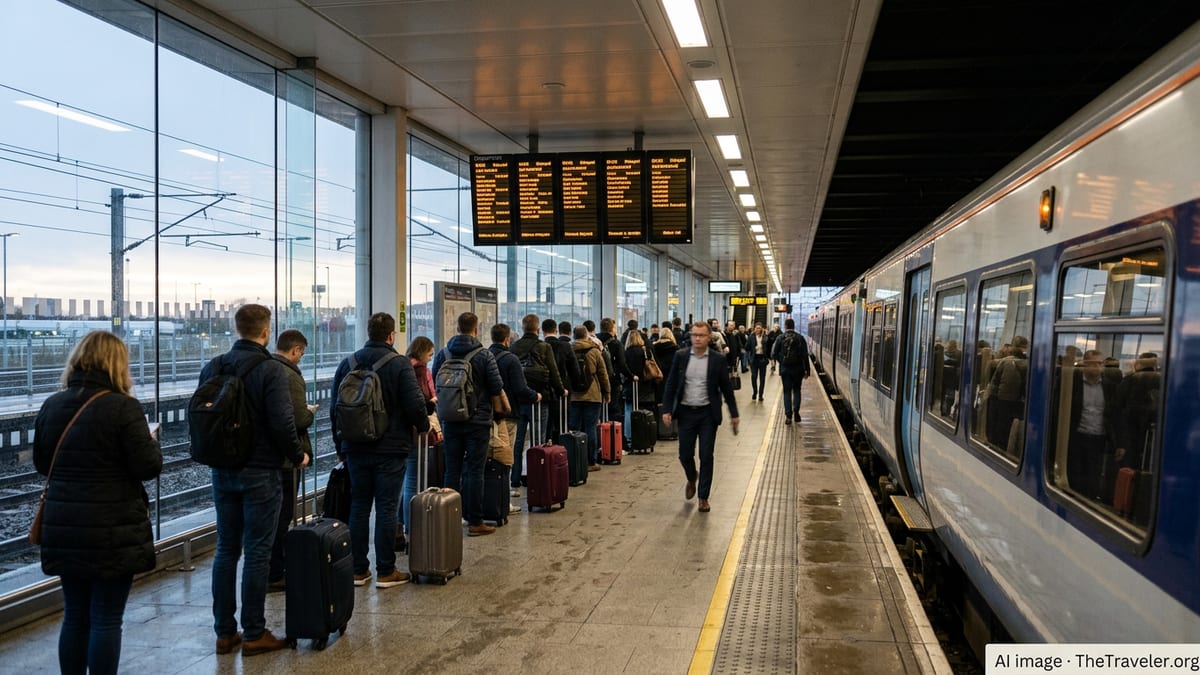
Collision on busy corridor north of London
Initial reports indicate that the incident occurred on Friday evening, 19 June, on tracks south of Bedford, a key junction on the Midland Main Line linking London St Pancras with towns and cities in the East Midlands. Passenger services using the route were brought to an immediate standstill as emergency teams reached the scene.
According to published coverage, the collision involved two passenger services operating in the same direction. Early accounts from the scene suggest that one of the trains was either stationary or moving slowly when it was struck from behind by another service, leading to visible damage at the front of one train and at the rear of the other.
Images circulating on news outlets and social media show two modern intercity units with crumpled ends, surrounded by emergency vehicles. The trains appear to have remained upright and on the rails, but debris and damage at the impact point underline the force of the collision even at what is believed to have been relatively low speed.
Public information released so far does not confirm any fatalities, though multiple injuries have been reported. Local hospital services were placed on alert to receive a significant number of casualties, reflecting concerns about the volume of passengers on the evening services.
Emergency response and passenger injuries
Publicly available information shows that emergency services, including ambulances, fire crews and police, were deployed in large numbers to the crash site within minutes of the first reports. Air ambulances were also seen in the area, indicating preparations for the possible transfer of seriously injured passengers.
Coverage in UK media describes passengers leaving the trains with visible injuries such as head wounds and suspected fractures. Witness accounts published by broadcasters and newspapers refer to a sudden impact that threw standing passengers forward, consistent with a rear-end collision where one train stops abruptly while the other is still in motion.
Operational reports suggest that the collision triggered an automatic shutdown of train movements through the affected section, while power to the overhead lines was cut as a safety measure. Rescue teams then worked along the trackside to assess injuries, move people to safety and establish access routes across fields and railway land.
Specialist rail incident units were sent to stabilise the damaged vehicles and check for any risk from fuel, electrification equipment or damaged infrastructure. Once all passengers were evacuated, crews began the slower task of securing the scene for investigators and planning how to remove the trains.
Severe disruption to East Midlands and commuter services
The crash immediately closed the main northbound and southbound tracks in the Bedford area, effectively severing a primary artery between London and destinations such as Luton, Wellingborough, Kettering and further into the East Midlands. Train operators warned of extensive cancellations and diversions that were expected to last into the night and potentially into the weekend.
Information posted by operators indicates that tickets are being accepted on alternative routes where possible, including other main lines into London, as rail companies work to move stranded travellers. Passengers are being advised to check live departure boards before setting out and to expect significantly longer journey times.
The incident is particularly disruptive for leisure and commuter traffic at the start of the weekend, with the affected route carrying a mixture of intercity, regional and local services. Even after limited services resume, capacity is likely to remain constrained while speed restrictions, single-line working or partial closures remain in force at the crash site.
Travel industry observers note that the collision highlights the vulnerability of key rail links when an incident occurs close to a major junction. With few easy diversionary paths of similar speed and capacity in the immediate area, major delays can quickly spread well beyond the immediate stretch of line.
Early focus on signalling, speed and train protection
While the precise chain of events has not yet been established, published commentary from rail specialists suggests that investigators are likely to focus on signalling performance, train protection systems and the relative speeds of the two services. In modern UK mainline operations, strict rules and layered safety systems are designed to prevent two trains occupying the same section of track.
Publicly available background material on recent near-miss and collision investigations in the UK indicates that issues such as signals passed at danger, equipment failures or incorrect traffic management can all form part of the inquiry when rear-end collisions occur. Analysts emphasise that it is too early to attribute specific causes in the Bedford case, and that formal investigations typically take months.
Attention is also expected to fall on how the design of the rolling stock performed in the crash. Newer intercity trains are built to absorb impact energy and protect passenger space, and early images of the Bedford collision show substantial deformation at the cab and coupling ends but largely intact passenger saloons.
Depending on the outcome of the investigation, the incident could prompt further scrutiny of timetable pressures, signalling headways and infrastructure capacity on one of the country’s busiest north–south rail corridors, particularly around known bottlenecks in the Bedford area.
Passenger support and next steps for travellers
Rail operators have indicated through public channels that affected passengers will be able to use their tickets on alternative services and may be entitled to compensation for delays. Travellers are being urged to retain tickets and booking confirmations and to submit claims once disruption details are fully published.
For those due to travel through Bedford and surrounding stations over the coming days, journey planners are expected to show adjusted timetables as recovery work progresses. Passengers planning airport transfers or time-sensitive connections are being advised to allow additional contingency or to consider alternative modes such as coach services where practical.
Tourism and business travellers using the London to East Midlands route face particular uncertainty while the duration of the closure remains unclear. Industry commentators note that once the damaged trains are removed, engineers will still need to examine and, if necessary, repair track, overhead line and signalling equipment before normal speeds can be restored.
As information continues to emerge, the Bedford collision is likely to be viewed in an international context alongside other recent rail incidents in Europe, prompting renewed discussion about network resilience, emergency preparedness and the balance between high-frequency timetables and operational margins of safety.