


More news on this day
Two passenger trains have collided near Bedford in Bedfordshire, injuring multiple people and causing major disruption on one of Britain’s busiest intercity rail corridors between London and the East Midlands.
Get the latest news straight to your inbox!
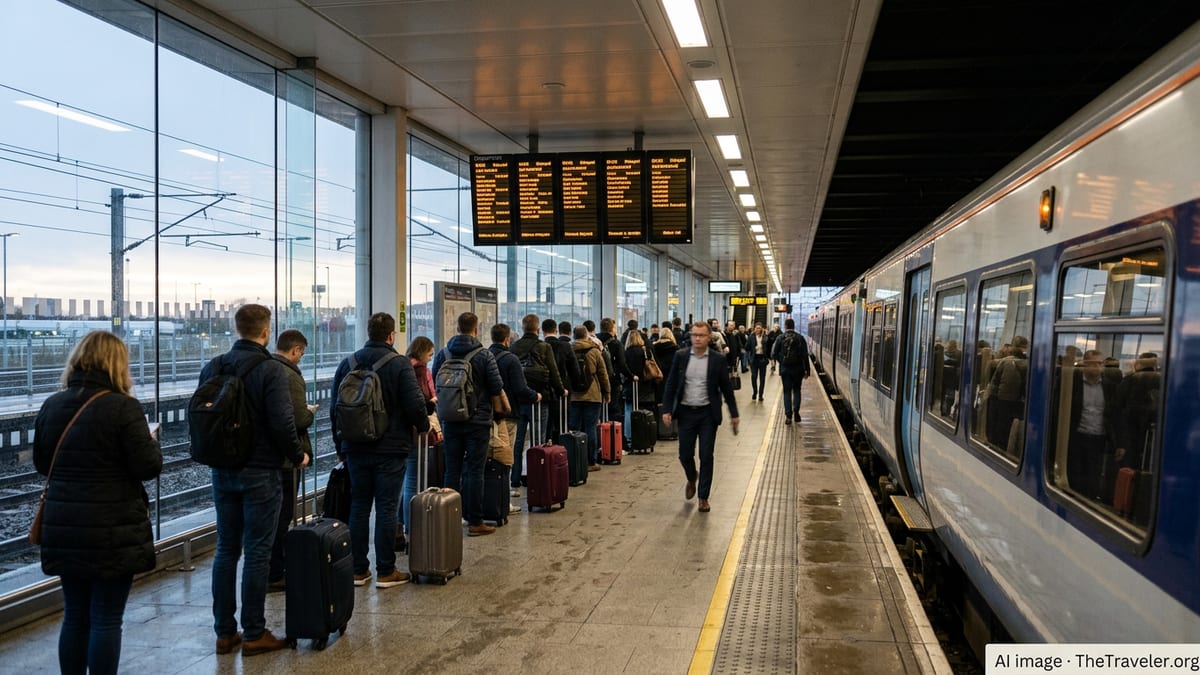
Collision on Key Line Serving London, Luton and the Midlands
Initial reports indicate the crash took place on the evening of 19 June 2026 on the main line south of Bedford, in the corridor linking London St Pancras with Leicester, Nottingham and Sheffield. Publicly available information suggests a Luton Airport Express service was involved along with an East Midlands Railway intercity train, both traveling on northbound routes.
Images and video shared on social media show one train with visible damage and at least one carriage off the tracks, with passengers standing or seated in adjacent fields after being evacuated. The line runs through a largely rural stretch at this point, bordered by farmland and the A421 road, which allowed road ambulances and other vehicles to access the scene.
According to early descriptions from passengers and rail commentators, one train is believed to have been stationary or moving slowly when the following service collided with its rear, suggesting a high-speed impact but not a full head-on collision. The precise sequence of events has not yet been formally confirmed, and specialist rail investigators are expected to examine on-board data recorders and signalling logs.
The crash occurred at a peak travel time for commuters and leisure travelers, including people heading to and from Luton Airport. The line is one of the principal north–south rail arteries in England, carrying both airport shuttles and long-distance intercity services.
Large Emergency Response and Early Injury Reports
Publicly available flight-tracking data and on-the-ground accounts indicate that multiple air ambulance helicopters were dispatched to the area, alongside local ambulance crews, police and fire services. Several helicopters were seen circling and landing near the crash site, a sign that emergency planners were preparing for the possibility of serious trauma cases.
Passenger accounts posted online describe people being treated for cuts, bruises and suspected fractures, with some individuals reportedly “covered in blood” after being thrown inside carriages. At the time of writing there have been unconfirmed mentions of more serious injuries and at least one possible fatality, but official casualty figures have not yet been published in the public domain.
Photos from the scene show paramedics working beside the tracks and along a nearby embankment, while evacuated passengers wait in fields and on access roads. Temporary triage points appear to have been established close to the railway to allow rapid assessment and stabilisation of the injured before transport to hospitals in the wider Bedfordshire and north London area.
As is standard in major transport incidents, a formal major incident plan appears to have been activated, bringing together multiple emergency agencies under a coordinated command structure. That structure typically manages everything from casualty care and scene safety to traffic control on nearby roads and welfare arrangements for uninjured passengers.
Severe Rail Disruption Between London and the East Midlands
Service updates issued by East Midlands Railway and other operators report that all lines through the affected section between London St Pancras and Bedford were initially blocked following the collision. Trains between London and key cities including Leicester, Nottingham, Sheffield and Corby faced cancellations, diversions and significant delays.
Some long-distance services were reported to be turning back short of the incident, with passengers asked to use alternative routes via other main lines where available. Those already on trains north or south of Bedford described extended waits in the countryside as signallers halted traffic to keep the wider network safe.
Rail industry channels have advised passengers to check live journey planners and operator updates before attempting to travel on the Midland Main Line this evening and into Saturday. Disruption on this route often has knock-on effects for connecting services in the East Midlands and Yorkshire, as well as for local Thameslink routes that share parts of the infrastructure near London.
The collision is also affecting access to Luton Airport, where the dedicated Luton Airport Express services form a key part of the airport’s ground transport links. Travellers heading to or from the airport are being warned that journeys may take considerably longer and may require replacement buses or alternative rail routes.
Early Focus on Signalling and Train Protection Systems
Specialist rail accident investigators are expected to focus on how two trains came to be in the same signalling section at the same time on a heavily monitored main line. Early, unverified discussion among railway observers points to a possible issue involving the Automatic Warning System or associated train protection equipment, although it is too early for any firm conclusions.
On modern British main lines, multiple layers of protection are designed to prevent a moving train from approaching too closely to a stationary one ahead, including fixed signals, in-cab warnings and automatic brake applications if a signal is passed at danger. A rear-end collision of this kind typically suggests either a technical failure, a procedural breakdown, or some combination of both.
The Rail Accident Investigation Branch, which conducts independent safety inquiries after serious rail incidents, routinely deploys inspectors to scenes within hours. Their work generally includes collecting physical evidence from the track and rolling stock, securing digital data from on-board recorders and control centres, and interviewing key staff such as drivers and signallers. A preliminary report is usually published within weeks, followed by a detailed final report that may take many months.
Until that process is complete, most rail experts are urging against speculation about individual blame. Instead, attention is likely to focus on whether any systemic vulnerabilities in signalling, maintenance procedures or operational rules may have contributed, and what temporary precautions might be needed elsewhere on the network.
Passengers Describe Sudden Impact and Night of Travel Chaos
Accounts shared publicly by passengers on board the affected trains describe a sudden, forceful jolt followed by darkness and the sound of objects crashing within carriages. Some report luggage flying from racks and people being thrown from their seats, with lights flickering or going out before emergency lighting came on.
Several passengers say they used emergency hammers to break internal glass panels, while others waited for staff to unlock doors once it was safe to step down to the track. Social media images show people walking in line along the ballast and sleepers, guided towards safe collection points away from the railway.
For many travelers on the wider network, the first awareness of a serious incident came through repeated on-board announcements about a line blockage near Bedford, followed by advice that trains would not be moving “for some time.” As the scale of the disruption became clearer, rail operators began to relax ticket restrictions and advise passengers to delay non-essential journeys.
With demand for taxis, buses and hotels likely to spike in the region on Friday night, some stranded passengers have turned to online forums to share offers of spare car seats and local accommodation. Others have expressed concern and sympathy for those directly involved in the crash, noting that had the collision occurred at even higher speeds or on a curve, the outcome could have been far more severe.