


More news on this day
A rush-hour collision between two southbound passenger trains near Bedford, north of London, has killed at least one person and left dozens more with serious injuries, according to early reports from British rail operators and emergency services.
Get the latest news straight to your inbox!
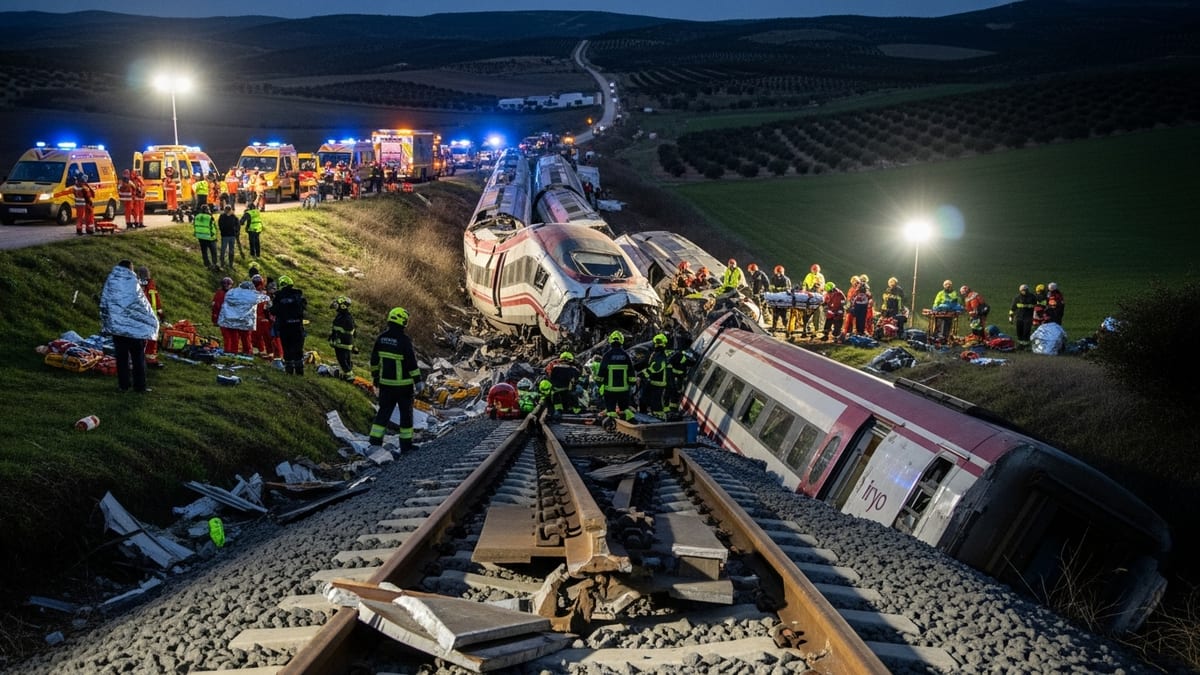
Rush-hour crash on busy route into London
The collision occurred on Friday evening on a key commuter corridor serving London St Pancras station, disrupting services at one of the capital’s main gateways. Publicly available tracking data indicates that both trains were traveling southbound when they made contact on the approach to Bedford, a regional hub on the Midland Main Line.
Reports describe a violent impact that threw passengers forward in their seats, shattering windows and damaging carriages near the front of the trains. Images circulated by national media show twisted metal, debris on the trackside and rail cars at awkward angles but still largely upright.
Coverage from outlets including the Associated Press and British broadcasters indicates that at least one train driver was killed in the crash. Medical teams on site have reported a significant number of patients with broken limbs, head wounds and other trauma consistent with a high-speed collision.
Emergency responders declared a major incident as resources from multiple agencies converged on the site, which lies alongside a local road and open fields north of London. A triage area was set up near the tracks so that the most seriously injured could be stabilized before being transported to hospitals in the region.
Casualty toll and scale of emergency response
According to figures shared by regional ambulance services and rail operators, more than 80 people are believed to have been treated for injuries of varying severity. Early tallies indicate that over 10 individuals have very serious injuries, with more than 20 others classed as seriously hurt and several dozen treated for minor wounds such as cuts, bruises and shock.
Air ambulances, specialist hazardous incident teams and multiple road ambulances responded to the scene within minutes of the first alerts. Fire and rescue crews used ladders and cutting equipment to help passengers down from carriages where doors were jammed or elevated above the ground.
Witness accounts gathered by British media describe scenes of confusion as passengers searched for exits through smoke and dust. Some described helping fellow travelers with visible fractures or heavy bleeding before professional medical help reached their carriage. Many passengers, wrapped in foil blankets, were later shown waiting by the roadside as emergency crews moved stretchered casualties to nearby hospitals.
Local hospitals in Bedfordshire and surrounding counties activated emergency protocols to manage the sudden influx of trauma cases. Public reports indicate that intensive care units received several patients with life-threatening injuries, while other departments treated a larger number for less severe but still significant trauma.
Impact on rail services and regional travel
The collision involved two services operated by East Midlands Railway: one train traveling from Corby to London St Pancras and another from Nottingham bound for the same London terminus. The stretch of track where the incident occurred is a vital artery for commuters and long-distance travelers linking the East Midlands with the capital.
Following the crash, the operator announced the suspension of all services to and from St Pancras on the affected route for the remainder of Friday. Trains were halted or diverted at stations well north of the collision site while engineers and investigators secured the area and assessed damage to the infrastructure.
Passengers attempting to travel between London and destinations such as Nottingham, Derby, Leicester and Corby faced widespread delays and cancellations. Replacement road transport options were limited in the immediate aftermath, with rail passengers advised through public statements and travel alerts to postpone non-essential journeys or seek alternative routes on other main lines into London.
Rail analysts note that disruption to this corridor can ripple across the broader network, as trains and crew are displaced from their normal schedules. Operators have warned that services may remain heavily disrupted into the weekend while rolling stock is recovered, track and signalling equipment are inspected, and safety checks are completed.
Early focus on safety systems and investigation
Specialist teams from Britain’s rail accident investigators and safety regulators are expected to examine the scene, vehicle data recorders and signalling logs to understand how two southbound trains came into conflict on the same stretch of track. Publicly available information suggests that both services were operating on a modern, signalled main line that typically incorporates multiple layers of protection designed to prevent collisions.
Investigators are likely to explore whether any technical malfunction, communication breakdown or human error contributed to the incident. Analysis typically includes a detailed reconstruction of train movements, a review of maintenance records for rolling stock and infrastructure, and checks on the performance of braking and signalling systems in the moments before impact.
Rail unions have already expressed concern about the toll on both staff and passengers, highlighting the driver’s death and the number of on-board crew among the injured. They have also called for a thorough review of safety procedures and workload pressures on a network that carries millions of passengers each day.
Experts interviewed across British media outlets point out that, despite the country’s strong overall rail safety record, the combination of dense traffic, aging infrastructure in some areas and growing passenger volumes means that incidents can have serious consequences when multiple risk factors align.
Rail safety under renewed public scrutiny
For travelers, the crash north of London has revived memories of earlier rail accidents in the United Kingdom and elsewhere in Europe that prompted waves of safety reforms. In recent years, investment in modern signalling systems and train protection technology has been promoted as a key reason serious collisions have become relatively rare on busy main lines.
Travel commentators note that the scale of Friday’s casualty figures will likely intensify debate over how quickly upgraded safety systems are being rolled out, particularly on routes that combine high speeds with heavy commuter and intercity traffic. Questions are already being raised in public discussion forums about the resilience of current safeguards when trains are running at or near capacity during peak hours.
For passengers planning trips in the coming days, rail operators are urging people to check the latest service updates before setting out, to allow extra time for journeys, and to be prepared for diversions through alternative London terminals where possible. Travel advisors recommend that visitors with flexible itineraries consider adjusting their schedules to avoid the most heavily affected periods while the investigation and recovery work continue.
As the full picture of what happened near Bedford emerges, the incident is expected to shape operational priorities and public expectations across the UK rail network, with particular scrutiny on how quickly lessons are translated into practical safety and contingency measures on busy intercity routes.