


More news on this day
The United States has tightened its travel warnings for four East African states, raising its advisory levels for Kenya and reiterating severe restrictions for Ethiopia, Somalia and South Sudan as security conditions, crime and health risks continue to unsettle foreign travel across the region.
Get the latest news straight to your inbox!
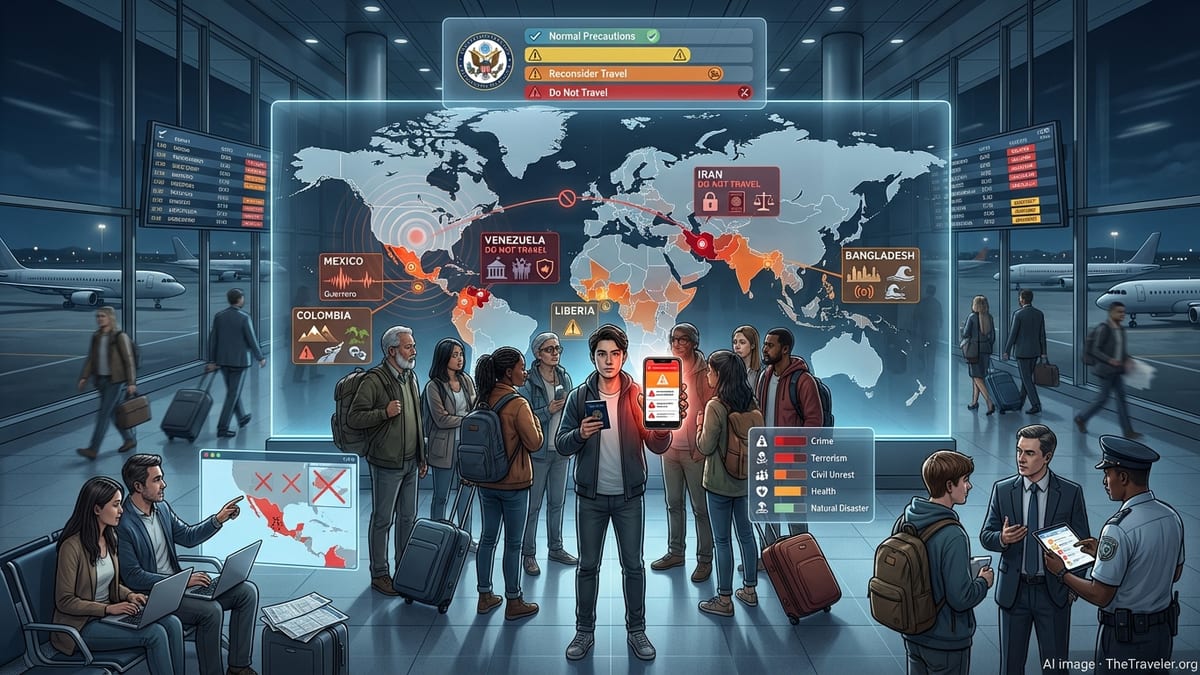
Higher-Risk Ratings Across Key East African Gateways
Publicly available information from the U.S. Department of State shows that four East African countries now sit in the two highest advisory tiers, signaling elevated risk for U.S. travelers. Somalia and South Sudan are currently placed at Level 4, labelled “Do Not Travel,” while Ethiopia and Kenya are both at Level 3, “Reconsider Travel,” following recent changes and restatements of guidance in 2025 and 2026.
The advisory for Kenya was updated in October 2026, asking travelers to reconsider journeys due to a combination of security and safety concerns. The notice highlights risks related to crime, terrorism, civil unrest, kidnapping, health issues and road safety. The Kenya rating represents a step up from earlier, more moderate guidance and aligns the country with Ethiopia in the same Level 3 category.
Ethiopia’s overall advisory was raised to Level 3 in late August 2026. The change reflects persistent instability in several regions, including ongoing tensions, armed conflict and local unrest. While some major cities retain relatively higher levels of routine travel, large parts of the country are flagged for volatility, localized violence and restrictions on movement that can shift with little warning.
Somalia and South Sudan remain among the most heavily restricted destinations in the world for U.S. citizens. Their Level 4 categorization points to serious concerns that range from terrorism and violent crime to civil conflict, weak state control and limited access to medical or consular assistance. Recent reference materials summarizing U.S. guidance continue to list both states in the top-risk bracket.
Why the Advisories Have Been Tightened
Across all four countries, the latest American advisories emphasize overlapping patterns of risk, including terrorism, organized and opportunistic crime, sporadic armed clashes and strained health and emergency infrastructure. Analysts and public reports on regional security describe East Africa as a theater where long-running insurgencies and emerging extremist cells intersect with political instability and economic pressures.
Somalia continues to experience attacks and threats linked to militant groups. Public summaries of U.S. travel guidance point to bombings, assassinations and complex assaults that have periodically targeted government sites, public spaces and international interests. In this context, travel outside tightly controlled zones is described as highly hazardous, with very limited support options in the event of an incident.
South Sudan’s Level 4 status reflects a different blend of risks. Accounts from international observers and regional monitoring bodies describe sporadic fighting between armed factions, banditry on key roads and recurring tensions in urban and rural areas. Combined with under-resourced hospitals and sporadic fuel and supply shortages, these conditions increase the chance that even routine travel disruptions can quickly become emergencies.
In Ethiopia and Kenya, the latest Level 3 advisories highlight a patchwork of safer corridors and higher-risk peripheries. Ethiopia’s complex internal landscape includes border disputes, ethnic tensions and military operations in multiple regions. Kenya, while a major tourism hub, sits close to conflict-affected areas and has experienced sporadic attacks and criminal incidents that have led several governments to reiterate warnings about specific counties and border zones.
Practical Implications for U.S. Travelers
The tightened U.S. advisories carry practical consequences for travelers planning leisure, business or humanitarian trips to East Africa. Many travel insurance providers and corporate security departments track the State Department’s four-level scale when setting coverage conditions and internal permissions. Level 3 and Level 4 classifications can trigger higher premiums, exclusions for certain types of claims or outright bans on nonessential corporate travel.
Tour operators, airlines and hotel groups that depend on visitors from North America also watch the advisory adjustments closely. Industry commentary indicates that Level 3 “Reconsider Travel” notices often discourage first-time visitors and may delay bookings for safaris, beach stays or conference travel, particularly in Kenya. Where Level 4 “Do Not Travel” notices are in place, mainstream tourism flows tend to be minimal, with most inbound traffic related to diplomacy, aid, security work or specialist business activity.
Travelers who proceed despite elevated warnings commonly face more rigorous internal approval processes and are expected to demonstrate robust contingency planning. Companies and universities with staff or students in affected countries often require detailed security briefings, pre-arranged medical evacuation coverage and close monitoring of daily movements, particularly outside major cities or away from key transport hubs.
Some international risk maps produced by private security and insurance firms now shade large areas of Somalia and South Sudan as locations of “extreme” or “high” concern. These same products mark wide swathes of Ethiopia and parts of Kenya in elevated categories, reflecting both conflict dynamics and non-political threats such as road traffic accidents and constrained emergency care.
How the U.S. Scale Compares With Other Countries’ Advice
The U.S. government’s four-step advisory system aligns broadly with frameworks used by several other Western governments, although the specific wording and geographic detail differ. While the latest U.S. notices for Ethiopia and Kenya apply a single nationwide level, other countries sometimes divide those destinations into zones or corridors with distinct ratings.
For example, recent guidance from European and Commonwealth sources advises against all or all-but-essential travel to parts of northern and western Ethiopia, as well as to sections of the borders with Eritrea, Sudan, South Sudan and Somalia. Some of these notices recommend heightened caution in Addis Ababa and other major cities rather than a blanket warning, reflecting variations in risk between regional capitals and more remote areas.
Comparable advisories on Kenya from other governments flag specific counties near the borders with Somalia and South Sudan, along with certain coastal and northeastern routes, as higher risk. These documents often reference the possibility of targeted or opportunistic attacks, roadside incidents and isolated outbreaks of unrest. They also stress that conditions can change at short notice and that airport access or main highways may be temporarily disrupted by security operations or protests.
In Somalia and South Sudan, guidance from a range of foreign ministries remains broadly aligned with the American Level 4 categorization. Public travel advice from partners such as Canada, the United Kingdom, Australia and others typically warns of severe constraints on consular access, limited medical evacuation options and highly unstable security environments outside very specific enclaves.
Planning a Trip Amid Heightened Warnings
The tightened U.S. advisories do not constitute outright legal bans on private travel for American citizens, but they are designed to strongly discourage nonessential trips and to highlight that support may be limited if problems arise. Travelers who decide to visit one of the four affected countries despite the warnings are generally encouraged, in publicly available guidance, to adopt a far more cautious planning approach than they might use for lower-risk destinations.
Practical steps often recommended in open-source travel security briefings include registering trip details with consular services where available, maintaining flexible itineraries, keeping close track of local news and monitoring curfews, checkpoints or states of emergency that could affect road movements or domestic flights. Many organizations also suggest arranging reliable local transport in advance and avoiding night-time road travel outside secure compounds.
Health considerations form another critical part of planning. In addition to standard vaccination and malaria-prevention requirements for much of East Africa, travelers to these higher-risk locations may face constrained hospital capacity and shortages of medicines, especially outside capital cities. Because of this, some travel medicine specialists recommend medical evacuation insurance specifically naming high-risk countries and clarifying coverage even when official advisories reach Level 3 or Level 4.
Given the pace of change in Ethiopia, Somalia, South Sudan and parts of Kenya, recent events show that conditions can shift within weeks or days. Prospective visitors are therefore well served by checking the most recent advisory updates from multiple national sources shortly before departure, and by adjusting or postponing trips if new information points to escalating risk in their intended destinations.