


More news on this day
Passengers flying from the UAE today are being urged to monitor their bookings closely, as Emirates, Etihad, flydubai and Air Arabia continue to adjust services to Kuwait and Bahrain in response to heightened regional tensions and evolving airspace restrictions.
Get the latest news straight to your inbox!
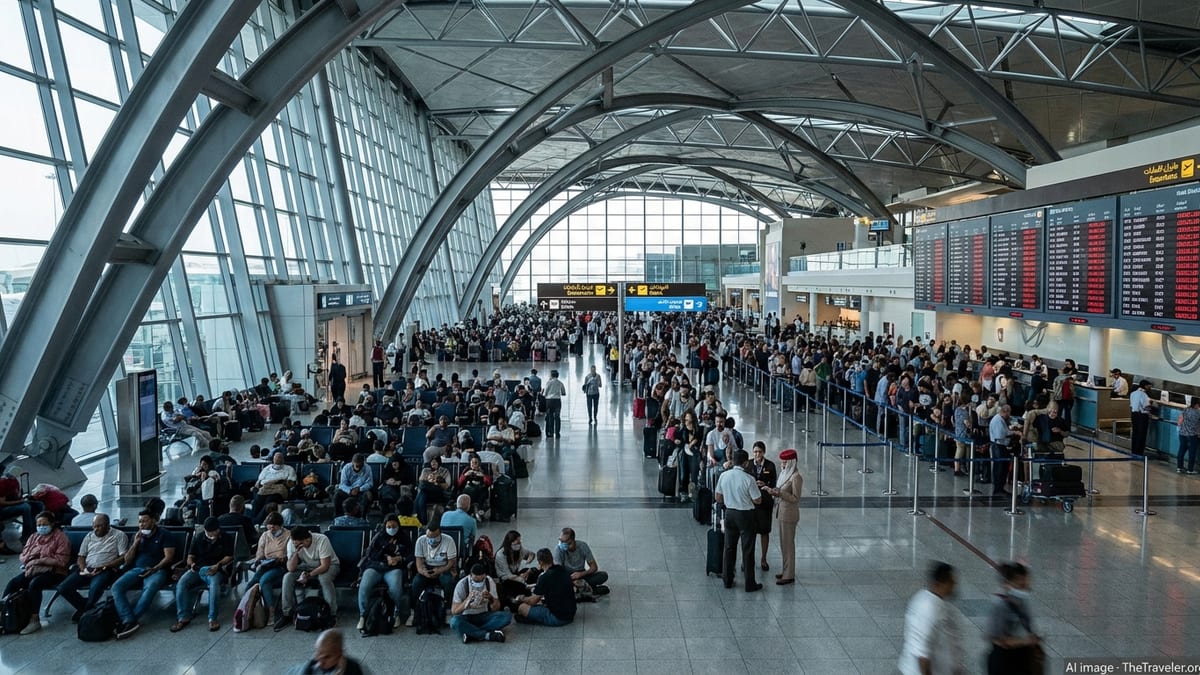
Targeted cancellations on Kuwait and Bahrain routes
Recent coverage from regional media shows that the sharpest impact is on links between UAE hubs and Kuwait and Bahrain, where a mix of suspensions and reduced frequencies remains in place. Emirates has kept services between Dubai and Kuwait suspended, following earlier cancellations of multiple daily flights on the route, while gradually restoring limited operations to Bahrain after an extended pause.
Reports indicate that only a portion of Emirates’ previous Bahrain schedule is currently operating, with at least one daily rotation active while other flights remain withdrawn from sale. This follows several weeks in which all Dubai–Bahrain services were removed, reflecting continuing caution over routings through sensitive Gulf airspace.
Abu Dhabi-based Etihad Airways is operating a trimmed network on the same city pairs. According to published schedules, selected daily return flights between Abu Dhabi and Bahrain have been cancelled on an ongoing basis, while Kuwait is served by a reduced number of frequencies compared with the timetable that was in place earlier in the summer.
Low-cost carriers flydubai and Air Arabia, which also connect Dubai and Sharjah with Kuwait and Bahrain, continue to fly some services but with ad hoc cancellations and delay risks. Coverage from UAE outlets highlights that these airlines are keeping their schedules under review, with passengers advised to check flight status before setting out for the airport.
Majority of UAE departures operating, but delays possible
Despite the focused disruption on certain Gulf routes, publicly available information suggests that airports in Dubai, Abu Dhabi and Sharjah remain open, with most flights taking off broadly as scheduled. Recent airport status updates describe operations as largely normal, albeit with some departures listed as delayed or re-timed as airlines adjust routings around areas of potential conflict.
Flight-status tools provided by UAE airports and airlines continue to display full departure and arrival boards, even as individual services are periodically removed or re-timed. Where technical issues limit real-time updates on public portals, travellers are being directed to use airline apps and direct booking-management pages for the most accurate view of last-minute schedule changes.
Industry tracking data compiled by aviation analytics providers further indicates that overall activity by the four main UAE carriers remains high. Emirates, Etihad, flydubai and Air Arabia continue to operate extensive networks across the Middle East, Asia, Africa and Europe, pointing to a targeted, route-specific response rather than widespread grounding of fleets.
Nonetheless, passengers booked on flights transiting Gulf airspace are being cautioned that departure times may shift at short notice as carriers respond to changing advisories. This is particularly relevant for those with tight onward connections, who may need to build in additional buffer time or consider rebooking to more robust itineraries.
Security advisories highlight risk of sudden airspace changes
Travel advisories from foreign ministries and government travel sites continue to flag an unpredictable security environment across parts of the Gulf region. Recent updates note that military activity and missile or drone incidents have previously led to short-notice airspace closures, with knock-on effects for commercial aviation.
Publicly available guidance stresses that airspace restrictions can be imposed or lifted with little warning, prompting airlines and air navigation authorities to reroute or suspend flights for safety reasons. In practice, this can translate into temporary holds on departures, diversions to alternative airports, or same-day cancellations on specific corridors such as those linking the UAE to Kuwait or Bahrain.
These advisories underline that, while UAE airports themselves may remain operational, carriers must factor in regional risk assessments and overflight permissions when planning day-of-operation schedules. Travellers are therefore encouraged to remain flexible, particularly if their journeys involve destinations that have seen recent disruptions.
For passengers, the immediate implication is that “on time” status can change quickly, especially around periods of heightened tension. Monitoring official channels and signing up for airline notifications is presented as the most reliable way to anticipate any last-minute adjustments.
What affected passengers can expect from UAE carriers
Emirates and Etihad outline standard disrupted-travel policies on their customer-support pages, explaining how rebooking and refunds are handled when flights are delayed or cancelled. According to these publicly available guidelines, passengers on disrupted services are typically offered accommodation on the next available flight operated by the same airline, subject to seat availability.
Both carriers encourage travellers to keep contact details up to date in their bookings so they can receive email and SMS alerts about changes. Where flights are significantly altered or cancelled, customers may be able to request alternative travel dates or, in some circumstances, refunds or travel credits in line with fare rules.
Budget operators flydubai and Air Arabia publish similar advice, directing passengers to manage reservations online or through call centres if their flights are among those cancelled. In earlier disruption episodes involving Kuwait and certain Saudi destinations, these airlines have provided options to shift travel dates without penalty within specified windows, highlighting a degree of flexibility when operational decisions are beyond travellers’ control.
However, policies vary by ticket type, route and timing, so passengers are advised to consult the exact conditions listed on their booking confirmations. Travellers connecting on separate tickets, particularly across different airlines or alliances, may have less protection and should verify how any missed onward flights would be treated.
Practical advice for travellers flying from the UAE today
For anyone scheduled to depart from Dubai, Abu Dhabi or Sharjah today, the primary recommendation from airlines and airports is to check flight status repeatedly in the hours before leaving home. Airline websites and mobile apps typically refresh more quickly than third-party trackers and remain the reference point for gate and timing changes.
Where possible, travellers are encouraged to enable push notifications and SMS alerts on their bookings, which can provide early warning of delays or cancellations on routes affected by Kuwait and Bahrain restrictions. Those with early-morning departures or complex connections may wish to arrive at the airport slightly earlier than usual, in case security queues lengthen during peak disruption.
Passengers whose flights are cancelled outright are generally advised, through public guidance, not to proceed to the airport and instead to rearrange travel through official channels. In recent weeks, airlines have emphasised that walk-up changes at airport desks may be slower than managing bookings digitally, given the volume of passengers seeking assistance during periods of regional tension.
With the situation still fluid, travellers are being reminded that schedules can stabilise or tighten again as geopolitical conditions change. Checking both airline advisories and reputable news sources on the day of travel remains key for anyone flying from the UAE on routes exposed to evolving Gulf airspace restrictions.
Gulf News: UAE flight updates today The National: Emirates to resume Bahrain flights, Kuwait still suspended Smartraveller: United Arab Emirates travel advice Emirates: Travel updates Emirates: Disrupted travel FAQ