


More news on this day
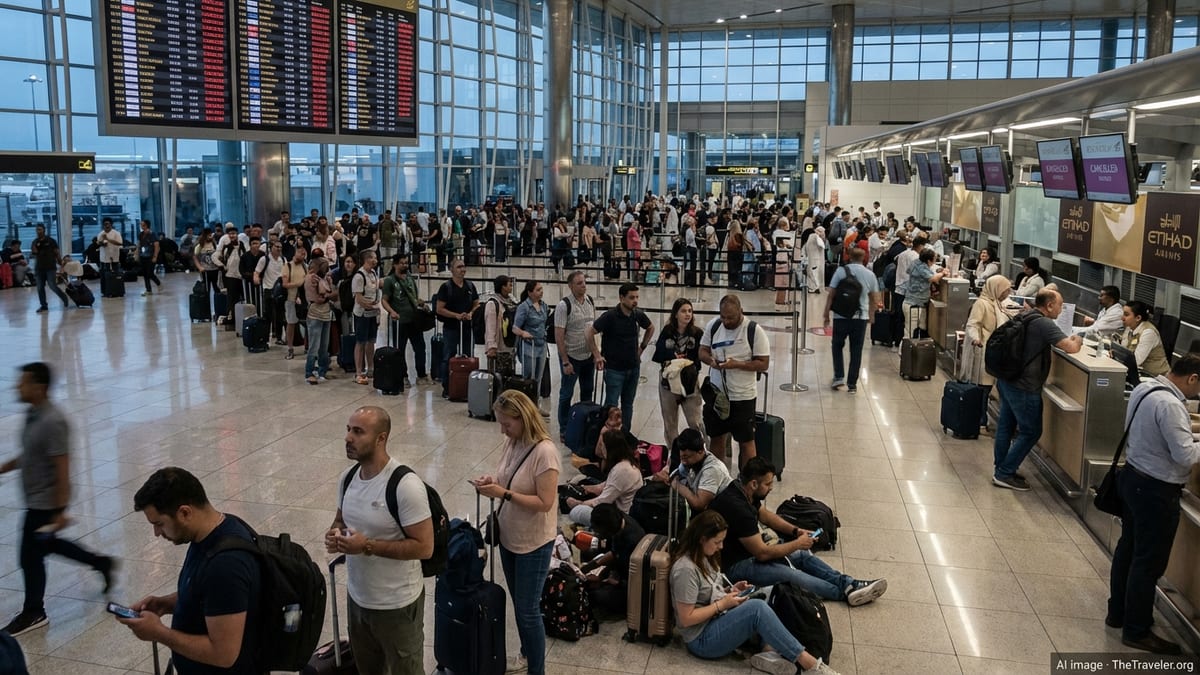
The United Arab Emirates has introduced a 30-day visa grace window for foreign nationals affected by recent regional flight disruptions, a move that offers critical breathing space to Kenyans and other travelers who were stranded when airspace closures and reduced schedules threw journeys into disarray.
Get the latest news straight to your inbox!
Targeted Relief After Weeks of Regional Disruption
Publicly available information shows that the Federal Authority for Identity, Citizenship, Customs and Ports Security has approved a 30-day grace period for people who were unable to leave the country because of exceptional regional conditions. The decision applies to visitors and residents who had already been exempted from overstay fines after flight cancellations and airspace restrictions took hold in late February 2026.
The grace window runs from 10 June to 9 July 2026 and is designed as a final opportunity for affected travelers to either regularize their immigration status in the UAE or make arrangements to depart. Reports indicate that this measure sits alongside earlier waivers on overstay penalties, which were introduced as a humanitarian response to an unprecedented period of aviation disruption across the Gulf and wider Middle East.
While the grace period is not limited to any single nationality, travel industry coverage highlights that Kenyan nationals are among those most affected. Nairobi–Dubai and Nairobi–Abu Dhabi routes serve as key corridors for migrant workers, business travelers and passengers transiting onward to Asia and Europe, and were heavily impacted when airlines cut frequencies and rerouted aircraft.
The new window follows a gradual easing of the crisis, with aviation regulators confirming that UAE airspace is now fully open and carriers restoring much of their pre-disruption capacity. However, schedules remain uneven on some African routes, leaving many Kenyans in particular still working through missed connections, expired visas and disrupted work or family plans.
Who Qualifies for the 30-Day Grace Window
According to published coverage from UAE-based outlets, the grace period is aimed at foreign nationals who were already recognized as having been affected by the crisis and granted earlier exemptions from overstay fines. This includes visitors whose entry visas expired while they were unable to depart, residents whose permits were cancelled but who could not leave, and holders of departure permits stuck in the country because flights were not operating as scheduled.
For Kenyans in the UAE, this captures several common scenarios. Many migrants holding short-term visit visas had been exploring job opportunities or waiting for employment visas to be processed when the disruption hit. Others were transiting through Dubai or Abu Dhabi on their way to or from Europe and Asia and found their onward legs cancelled or significantly delayed. In both cases, visa validity periods ran down as flights were repeatedly rescheduled.
The new decision does not create an open-ended amnesty. Instead, it offers a defined 30-day period for affected individuals to regularize their status under existing immigration rules. Travel and legal briefings stress that people who fall within the scope of the measure should confirm their individual records through official channels, since eligibility depends on how their previous exemptions were recorded by the authorities.
Crucially, the grace window does not change the underlying system of fines for ordinary overstays going forward. Rather, it bridges the gap between the emergency waivers introduced during the worst of the aviation crisis and a return to normal enforcement of visa and residency rules from mid-July 2026.
Practical Options for Kenyans Caught in the Disruption
For Kenyan nationals currently in the UAE, the 30-day window opens two clear pathways. Those who wish to remain can seek to change their status to a new visa category, such as employment, long-term residency or a fresh visit visa, depending on their circumstances and eligibility. Immigration specialists note that such changes may involve sponsorship by an employer, a family member, or a licensed agency, and often require medical tests, insurance and documented proof of means.
Alternatively, affected travelers can arrange to leave the UAE within the grace period without incurring the overstay penalties that would normally apply. Airline and booking platforms show that seats between Dubai or Abu Dhabi and Nairobi have gradually become more available since May, though fares can still fluctuate significantly around peak travel dates. For those trying to reconnect with onward itineraries to other destinations, coordination with airlines remains essential to avoid further complications at immigration checkpoints.
Community groups and travel advisers are encouraging Kenyans in the UAE to act as early as possible rather than waiting until the final days of the window in July. Regularizing status or securing exit tickets can involve processing times, limited appointment slots and occasional backlogs at service centers. Travelers are also being urged to keep copies of their previous exemption documents and any airline communications that show their flights were disrupted, in case additional proof is requested.
The grace period is particularly significant for low-income migrant workers and domestic staff, many of whom lack the financial cushion to absorb fines, last-minute ticket prices or extended periods without employment. For this group, a clear deadline and penalty-free exit option can spell the difference between returning home in relatively stable circumstances and facing mounting debts.
Humanitarian Rationale and Legal Significance
Statements carried in UAE media frame the decision as part of a broader effort to align immigration enforcement with humanitarian considerations during exceptional crises. Earlier in the year, the authorities introduced wide-ranging waivers for travelers stuck in the country from 28 February 2026 onward, citing airspace closures and large-scale flight suspensions that were beyond individual control.
Legal and corporate mobility briefings describe the move as a continuation of a pattern seen during previous regional and global shocks, in which Gulf states temporarily relax visa penalties to avoid criminalizing stranded visitors and residents. For multinational employers with Kenyan staff based in or transiting through the UAE, the latest grace window provides a formal structure for stabilizing workforce movements that have been in flux since March.
The decision also underscores how tightly immigration status is linked to aviation stability in major hub countries. Dubai and Abu Dhabi rely on high volumes of connecting passengers, and any prolonged disruption can quickly push large numbers of people up against visa expiry dates. By offering a discrete period for regularization after airspace fully reopens, the UAE is attempting to reset its system without triggering a wave of overstay cases and potential deportations.
For Kenyans and other affected nationals, the grace period carries important legal implications. Those who make use of it to exit or secure new status are expected to leave with a clean immigration record, which is likely to ease future applications for work, residency or tourism in the UAE and wider Gulf region. In contrast, remaining in the country beyond 9 July 2026 without a valid status could lead to renewed fines and restrictions on re-entry.
What Travelers and Agents Are Watching Next
As the 30-day clock runs down, attention is turning to how smoothly the policy will work in practice. Travel agents and corporate mobility teams are monitoring whether appointment slots, visa processing systems and airline schedules can handle a potential surge in demand from those trying to regularize at the same time.
Kenyans planning to fly into the UAE in the coming weeks are being advised, through publicly accessible travel advisories and airline updates, to double check the validity of their visas, return tickets and transit arrangements. While the grace window is primarily aimed at those already inside the country, its existence highlights the need for robust contingency planning when routing itineraries through major hubs during periods of regional tension.
Industry coverage also notes that airlines serving East Africa, including carriers on the Nairobi–Dubai and Nairobi–Sharjah sectors, are gradually rebuilding frequencies that were cut at the height of the disruption. This is expected to make it easier for stranded passengers to find seats out of the UAE before the grace period closes, although availability may remain tight around weekends and school holidays.
Looking ahead, policy analysts suggest that the experience could feed into longer-term reforms of visa rules across the Gulf, where governments are seeking to balance tighter immigration controls with the practical realities of being heavily reliant on global air connectivity. For travelers from Kenya and other African countries, the current grace period offers short-term relief, but it also serves as a reminder of how quickly shifting geopolitical conditions can turn a routine trip into a complex immigration puzzle.