


Standing among the cypresses and crumbling columns of Hadrian’s Villa in Tivoli, it can be hard to believe you left central Rome less than an hour ago. This vast archaeological complex, once the emperor’s private retreat, is one of the most atmospheric sites near the capital. But is it worth dedicating one of your precious Rome days to a day trip? The answer depends on what you love most about travel, how you like to move around, and how much time you are prepared to spend off the standard tourist trail.
Get the latest updates straight to your inbox!
What Makes Hadrian’s Villa Special Compared With Rome’s Ruins
Hadrian’s Villa, or Villa Adriana, is not just another Roman ruin. This was the countryside retreat of Emperor Hadrian in the 2nd century, a sprawling estate that once covered hundreds of acres near ancient Tibur, today’s Tivoli. Walking the site, you get a rare sense of how an emperor actually lived away from the political stage of the Forum and Palatine Hill. Instead of a compact forum or single temple, you explore baths, theatres, libraries, guest houses and ornamental lakes spread across a rural landscape.
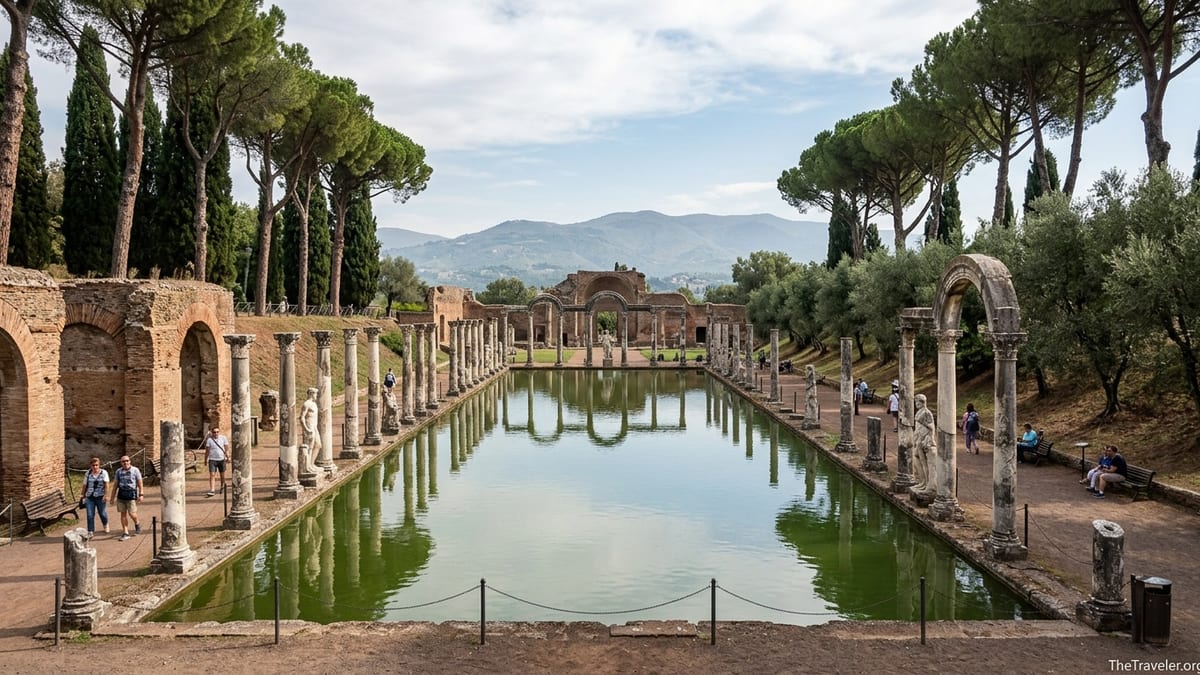
Visitors often compare the feel of Hadrian’s Villa to places like Pompeii or Ostia Antica, because you wander through an entire environment rather than viewing one monument at a time. You might start at the model of the complex near the modern entrance, then continue to the Maritime Theatre, where a circular colonnade surrounds an island villa, and on to the Canopus, an elongated pool lined with statues. The scale surprises many day trippers who expected a quick photo stop and instead find themselves immersed in ruins for several hours.
Another reason the villa stands out is how quiet it can feel compared with Rome’s big-ticket sights. Even in high season, crowds are thinner than at the Colosseum or Vatican Museums. It is not unusual to have entire stretches of shady path or whole structures almost to yourself, especially in the late afternoon. For travelers who love space, slow wandering and photography without jostling, that alone can justify the trip.
Finally, Hadrian’s Villa gives context to what you see in Rome. After touring the emperor’s retreat, elements of Hadrianic architecture in the city itself, such as the Pantheon’s dome or Castel Sant’Angelo, can feel more personal. You have literally walked through the spaces where the same emperor experimented with architectural forms and displayed the art and ideas he brought back from Greece and Egypt.
How Long You Really Need and Whether a Day Trip Is Enough
On paper, Hadrian’s Villa looks like an easy side trip. The archaeological park alone can be visited in about three hours at a steady pace, which still leaves time in the day for travel and a relaxed lunch. In reality, how long you need depends on your level of interest and whether you plan to combine it with other Tivoli sights such as Villa d’Este or Villa Gregoriana.
Travelers who focus only on Hadrian’s Villa typically devote around half a day door to door. A common pattern is to leave Rome around 9:00 in the morning, arrive at the site late morning, explore until mid-afternoon and be back in the city by early evening. That schedule suits most visitors who want an in-depth visit but still plan dinner in Trastevere or a twilight walk around the Trevi Fountain. History enthusiasts and photographers often stretch their visit to four or five hours, especially if they linger at the Canopus pool or climb viewpoints over the estate.
Trying to see Hadrian’s Villa and Villa d’Este in a single day is possible but can feel rushed. Many tour companies that run full-day excursions from Rome allocate roughly three hours at Hadrian’s Villa in the morning and three hours at Villa d’Este in the afternoon, with an early departure and an early evening return. Independent travelers attempting the same by public transport sometimes find that bus or train waiting times cut into their sightseeing. If you are the kind of traveler who reads plaques, takes lots of photos and likes a sit-down lunch, you may prefer to dedicate almost a full day just to Hadrian’s Villa and Tivoli’s countryside.
If your time in Rome is extremely limited, say three full days or less, leaving the city for an entire day is a significant trade-off. In that case, Hadrian’s Villa is most rewarding for those who are especially drawn to Roman history or who have already seen the main sights in the center and want something more offbeat yet still close.
Getting to Hadrian’s Villa From Rome: Trains, Buses and Tours
Reaching Hadrian’s Villa from Rome is relatively straightforward once you understand your options. The villa sits a few kilometers outside Tivoli, east of the city, and can be reached by regional train plus local bus, direct intercity bus, guided tour coach or private driver. Each route suits a different type of traveler and budget.
One of the most popular budget-friendly routes is to take Rome’s Metro Line B to Ponte Mammolo, then transfer to a blue Cotral bus heading toward Tivoli that stops near Hadrian’s Villa. Travelers often buy Cotral tickets from the newsstand or café inside Ponte Mammolo station before boarding, at a cost that is typically only a few euros each way. The ride from the metro station to the stop for Villa Adriana usually takes about 40 to 50 minutes depending on traffic. From the bus stop, it is a short walk to the modern entrance of the archaeological park. This combination keeps costs low but requires basic comfort with Italian regional bus systems and a bit of patience if schedules slip.
An alternative is to use the regional FL2 train from Roma Tiburtina to Tivoli, with journey times averaging around 45 to 50 minutes and tickets often priced in the range of 3 to 8 euros one way depending on advance purchase and class. From Tivoli station, you connect to a local CAT bus or a taxi to reach Hadrian’s Villa. The CAT bus is inexpensive but its timetable can be irregular; many independent travelers report waiting longer than expected or having to work around gaps in service. A taxi from the station to the villa typically takes around 10 minutes and can be reasonable if shared by two or three people.
For travelers who prefer a seamless experience, numerous tour operators in Rome run half-day and full-day excursions by coach. Prices commonly range from about 60 to 120 euros per person, depending on group size, whether Villa d’Este is included and whether lunch is provided. A typical example is a full-day small-group tour that departs central Rome by air-conditioned minibus, offers guided visits at Hadrian’s Villa and Villa d’Este, and returns you to the city in the early evening. While more expensive than public transport, this option removes the stress of navigating tickets and bus stops in a foreign language.
Tickets, Opening Hours and Seasonal Considerations
Hadrian’s Villa operates as a state archaeological site, with opening hours that vary slightly by season. In broad terms, the complex opens in the morning and closes around sunset, which in summer can mean evening closing times and in winter a much earlier finish. Closing days or schedule adjustments can occur, particularly on certain holidays or during restoration work, so it is wise to check the most current information on an official tourism or cultural heritage website shortly before your visit.
Standard entry tickets for Hadrian’s Villa are typically under 20 euros for adults, with reduced and free options for qualifying visitors such as EU students or children. Combination tickets that include Tivoli’s “Villas” network, for example pairing Hadrian’s Villa with Villa d’Este, are sometimes available and can offer savings if you plan to see more than one site within a set window of days. At the entrance, you will also find a visitor center with restrooms, a small bookshop and occasionally temporary exhibitions that are either included in the main ticket or cost a small supplement.
Summer brings long daylight hours and lush green surroundings but also heat. Large parts of the site are exposed, and walking between areas like the Maritime Theatre and the Canopus means covering significant distances in full sun. In July and August, mid-afternoon temperatures can be intense, so many travelers aim for a morning or late-afternoon visit. In winter, the air is cooler and the site can feel even more tranquil, but rain or early dusk may limit how long you want to linger outdoors.
On weekends and public holidays, Italian families and school groups are more likely to visit, though Hadrian’s Villa rarely feels as crowded as central Rome on a busy Saturday. If you want maximum quiet, a weekday visit outside peak holiday periods, such as a Tuesday or Wednesday in spring or autumn, usually provides a calm experience and easier photography without many people in your shots.
What It Is Actually Like to Walk the Site
Many travelers picture Hadrian’s Villa as a compact cluster of ruins. In reality, you walk along gravel paths and uneven stone for considerable stretches, often between olive groves and low hills. Comfortable walking shoes are essential. A typical visit begins with the scale model of the estate, which helps you understand how the scattered ruins once fit into a coherent plan, then continues along signed routes to key structures.
The Maritime Theatre often becomes a favorite stop. Surrounded by a moat-like circular pool, it once housed a small island villa, perhaps Hadrian’s private refuge. Even in partial ruin, the ring of columns and curves of brickwork create photogenic angles in morning or late-afternoon light. From there, paths lead past bath complexes, nymphaea and courtyards where you can still see floor mosaics and fragments of colored marble. Information panels in Italian and English give context, but those wanting deeper stories tend to benefit from either a guided tour or a good printed or digital guidebook.
Downhill, the Canopus stretches out in a long rectangular pool lined with replica statues of caryatids and classical figures. This is one of the most evocative spots in the complex, especially reflected in still water on a calm day. Benches along the sides invite breaks, and it is common to see travelers enjoying a simple picnic here, perhaps with focaccia picked up at a bakery in Tivoli town. Beyond the Canopus are further baths, service quarters and viewpoints across the surrounding countryside.
Facilities within the archaeological area are basic but adequate: a café or vending area for drinks and snacks, restrooms near the main entrance and a few shaded seating areas. It is sensible to bring a refillable water bottle, sunscreen and perhaps a hat, particularly between May and September. The terrain is not ideal for travelers with very limited mobility, although certain sections near the entrance are more accessible and some guided tours can adapt their route to minimize steep or rough paths.
Costs, Value for Money and Who Will Enjoy It Most
When you add up transport, entry and incidentals, a self-organized day trip to Hadrian’s Villa from Rome can be relatively modest in cost. A round-trip metro ticket within Rome plus Cotral buses or regional trains to Tivoli typically comes to well under 20 euros per person. Entry to the villa itself adds under 20 euros more for most adults, and lunch in Tivoli or a simple picnic from a Roman bakery might cost another 10 to 20 euros depending on your choices. For many travelers, experiencing an emperor’s countryside estate and a slice of small-town Lazio life for the price of a mid-range dinner in Rome feels like good value.
Guided coach tours raise the overall cost but also bundle in transportation and expertise. A higher-end small-group tour with both Hadrian’s Villa and Villa d’Este might run between 90 and 130 euros per person, including transport and guided visits but not always lunch. The value here comes from time saved, reduced stress about timetables and the added layer of storytelling from a licensed guide who can explain details you might otherwise walk past. Solo travelers or couples who are short on time and do not speak Italian often find this a reasonable trade-off.
In terms of who will love Hadrian’s Villa, history and archaeology enthusiasts are the clear winners. If you found the Roman Forum thrilling, lingered at the Palatine Hill overlooks or are excited by sites like Ostia Antica, this countryside complex is likely to become a highlight of your trip. Photographers who enjoy weathered textures, reflections in water and expansive landscapes also tend to rate the site highly. Children with active imaginations may enjoy the sense of exploring a “lost palace,” though the lack of interactive exhibits means patient adults are needed to keep the visit engaging.
On the other hand, travelers who are indifferent to ruins or who prefer lively urban neighborhoods, shopping and contemporary culture may not feel the trip is essential. If standing among fragments of brick and marble does not spark your curiosity, the hours invested in transit and walking may feel long, especially in the heat. For such visitors, time may be better spent exploring additional Roman districts such as Testaccio, Monti or the Appian Way, which offer history with more modern-life energy.
Combining Hadrian’s Villa With Villa d’Este or Staying Overnight
Many people considering a day trip from Rome wonder whether to combine Hadrian’s Villa with Villa d’Este in Tivoli town. Villa d’Este, a 16th-century villa famous for its terraced gardens and fountains, lies about 4 kilometers from Hadrian’s Villa. Together, the two sites showcase very different eras: imperial Rome on one hand and Renaissance water engineering on the other. If you are reasonably fit and comfortable with a full sightseeing day, pairing them can be richly rewarding.
A typical independent itinerary might involve leaving Rome early, heading first to Hadrian’s Villa by bus, spending three to four hours at the archaeological park, then taking a local bus or taxi up into Tivoli historic center for a late lunch and an afternoon at Villa d’Este. From there, you return to Rome by train from Tivoli station or by Cotral bus to Rome’s eastern metro stations. The main risk is that delays with local buses can eat into your time; for some travelers, that uncertainty is part of the adventure, while for others it is a source of stress.
Staying overnight in Tivoli is an underappreciated option. Small guesthouses and boutique hotels in the old town allow you to experience the villas with more breathing space. You might visit Hadrian’s Villa in the late afternoon when tour groups have departed, dine in a local trattoria on dishes like fresh pasta with porcini mushrooms, then explore Villa d’Este’s gardens the following morning before day-trippers arrive. This slower rhythm suits travelers on longer Italy itineraries or those who prefer to avoid packing too much into a single day.
If your main question is simply whether Hadrian’s Villa is “worth it” specifically as a day trip, the possibility of combining it with Villa d’Este or an overnight stay only strengthens the case for those who value depth and variety in their travels. You can shape the excursion to match your energy and interests rather than forcing the villas into a rigid timetable.
The Takeaway
For travelers who care about Roman history, architecture and atmosphere, Hadrian’s Villa is very often worth the time and effort of a day trip from Rome. It offers a rare combination of grandeur and quiet, with monumental ruins spread across a rural landscape that feels worlds away from the city even though it lies less than an hour from major stations like Roma Tiburtina. The site deepens your understanding of imperial life and gives tangible context to the monuments you see in the capital.
However, “worth it” is not universal. If your stay in Rome is short and you are still juggling must-see landmarks such as the Colosseum, Vatican Museums and Borghese Gallery, leaving the city for a full day may not be the best choice, especially if ruins are not a passion. The trip involves at least a couple of hours of travel, a fair amount of walking on uneven ground and some navigation of Italian regional transport unless you join a tour.
Ultimately, Hadrian’s Villa rewards those who slow down. If you like the idea of wandering among cypress trees and crumbling walls, pausing by a reflecting pool where an emperor once entertained guests, and seeing a softer side of Lazio beyond Rome’s urban streets, then dedicating a day to Villa Adriana can become a highlight of your trip. If not, you can rest easy knowing that Rome itself offers more than enough layers of history without ever crossing the city limits.
FAQ
Q1. Is Hadrian’s Villa really worth a full day trip from Rome?
For travelers interested in Roman history, archaeology or quieter, less crowded sites, a day trip to Hadrian’s Villa is usually very rewarding. You gain a deeper sense of imperial life than you get in central Rome alone, and the surrounding countryside offers a refreshing change of pace.
Q2. How long does it take to get to Hadrian’s Villa from central Rome?
Most routes take around one to one and a half hours door to door each way. For example, the metro to Ponte Mammolo plus a Cotral bus or a regional FL2 train from Roma Tiburtina to Tivoli followed by a short bus or taxi ride typically fall within that time frame, depending on connections and traffic.
Q3. Can I visit Hadrian’s Villa and Villa d’Este in one day?
Yes, many visitors do both in one day, especially with organized tours. Independently, it is feasible if you start early and keep a steady pace, but it can feel rushed. If you prefer to explore slowly, you may want to dedicate most of the day to Hadrian’s Villa or consider an overnight stay in Tivoli.
Q4. Is it better to go by public transport or book a guided tour?
Public transport is cheaper and suits confident travelers comfortable with metro, regional trains and local buses. Guided coach tours cost more but remove the stress of ticketing and timetables and often include a licensed guide. If you are short on time, traveling with children or do not speak Italian, a tour can be the smoother option.
Q5. How much should I budget for a day trip to Hadrian’s Villa?
A self-planned trip using metro, bus or regional train plus entry ticket and a simple lunch typically totals somewhere between 30 and 50 euros per person. Guided tours that include transport and a professional guide often range from about 60 to 120 euros per person, depending on group size and what is included.
Q6. What should I wear and bring for the visit?
Wear comfortable walking shoes, as paths are often uneven and distances between ruins can be long. In warmer months, bring a hat, sunscreen and a refillable water bottle. A light jacket is useful in cooler seasons, and many visitors appreciate having a small backpack for snacks, a guidebook and a camera.
Q7. Is Hadrian’s Villa suitable for children and older travelers?
Children who enjoy exploring outdoor spaces and using their imagination often like the site, especially the large pool at the Canopus and the sense of “discovering” ruins. Older travelers who are steady on their feet usually manage well, but those with mobility issues may find parts of the terrain challenging. It helps to plan rest stops and focus on areas near the main paths and entrance.
Q8. Are there food and restroom facilities at Hadrian’s Villa?
Yes, there are restrooms near the entrance and usually at least basic options for drinks and snacks, such as a café or vending machines. For a more substantial meal, most visitors either bring a picnic or eat in Tivoli town before or after their visit.
Q9. Do I need to book tickets to Hadrian’s Villa in advance?
Advance booking is not always essential, and many visitors simply buy tickets on arrival. However, during busy periods such as spring and early autumn weekends, checking official sites and pre-purchasing when possible can save time and provide peace of mind, especially if you are coordinating with train or bus schedules.
Q10. When is the best time of year and day to visit?
Spring and autumn are ideal, with mild temperatures and greener landscapes. In summer, early morning and late afternoon visits help you avoid peak heat and enjoy softer light for photography. Winter can be atmospheric and quiet, but you should be prepared for cooler weather and potentially shorter opening hours.