


More news on this day
The United States has placed Uganda, Somalia and South Sudan under its strictest Level 4 “Do Not Travel” advisory in 2026, signaling serious security and health concerns that are reshaping how Americans plan trips to East Africa.
Get the latest news straight to your inbox!
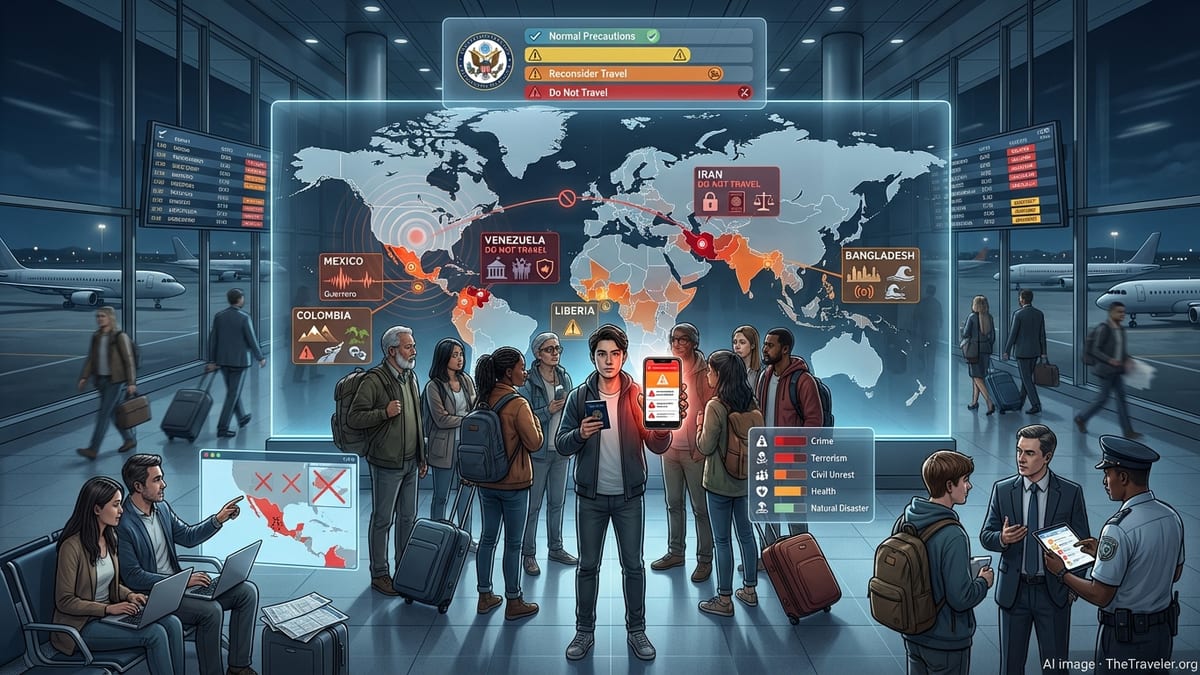
What a Level 4 Travel Advisory Means for Visitors
The U.S. Department of State uses a four-tier system to describe risks to travelers, with Level 4 representing the highest category. Public guidance explains that Level 4 advisories are reserved for destinations where there is a greater likelihood of life-threatening risks and where consular assistance may be highly constrained during an emergency.
Under this designation, U.S. citizens are urged not to travel to the affected countries, and those already present are encouraged in official materials to leave when it is safe to do so. The underlying reasons can include terrorism, armed conflict, crime, health risks, civil unrest, kidnapping, and the absence of reliable medical care or evacuation options.
For travelers, a Level 4 advisory has immediate practical implications beyond the warning itself. Travel insurance providers may exclude coverage for trips to countries in this category, airlines and tour operators may cancel or re-route services, and some employers and universities treat Level 4 destinations as off-limits for staff and students. Travelers holding nonrefundable tickets or prepaid tours often find that flexibility depends on the policies of carriers and agents rather than any formal government requirement.
Security-clearance holders, government contractors and humanitarian workers also face additional layers of internal review before any travel can be authorized. Publicly available guidance for such travelers emphasizes the need for detailed risk assessments and contingency plans when a destination is under a Level 4 advisory.
Uganda’s Elevation to Level 4 and Its Impact
In early June 2026, the State Department revised its country page for Uganda and raised the advisory to Level 4. The notice cites concerns related to crime, terrorism, civil unrest and health, alongside references to broader political and human-rights tensions. The change marked a significant tightening compared with the Level 3 “Reconsider Travel” guidance that had been in place for much of the previous two years.
Public information on the advisory states that travelers face heightened risks in crowded areas, tourist sites and religious venues, and highlights a potential for attacks against locations frequented by foreigners. The same materials describe armed robbery, opportunistic theft and road accidents as ongoing concerns, particularly outside central urban areas or after dark.
Uganda’s tourism sector, which had been working to rebuild international arrivals, now has to navigate the perception challenges that follow a Level 4 classification. Industry commentary and regional press coverage note that safari operators, national parks and city hotels are reassessing security protocols, from vehicle routing to guest screening, in an effort to reassure visitors from markets beyond the United States as well.
For independent travelers, the change means more stringent due diligence is required. Trip planners now regularly monitor official advisories, review local news about security incidents, and check refund rules on flights and lodgings before committing to itineraries that include Kampala, Entebbe or key wildlife destinations.
Somalia: Long-Standing Security Risks Underline Strict Warning
Somalia has been listed in the highest risk category for several years, and the advisory was most recently updated in May 2026. Publicly available text on the State Department site notes that the country remains a complex security environment marked by terrorism, crime, kidnapping, piracy and restricted access to routine consular services.
The advisory indicates that violent crime, including kidnapping and murder, is common, and that illegal roadblocks and improvised checkpoints are widespread outside limited secured areas. It also notes that extremist groups continue to plan attacks on government facilities, hotels, restaurants and other public spaces, often with little or no warning.
Commercial travel options into Somalia reflect those conditions. Most international airlines do not serve Mogadishu directly, and itineraries that do exist typically involve regional carriers with specific security arrangements on the ground. Aid organizations and specialized security firms working in the country publicly describe reliance on armored transport, movement restrictions, and detailed evacuation plans.
Travelers contemplating trips linked to business or family ties increasingly turn to comparatively more stable parts of the Horn of Africa, such as neighboring Kenya or Djibouti, where consular support and air links are significantly more robust and where advisory levels are generally lower.
South Sudan: Ongoing Conflict and Limited Consular Access
South Sudan remains on the Level 4 “Do Not Travel” list under an advisory updated in May 2026. The notice points to armed conflict, crime and kidnapping risks, as well as severe constraints on the ability of U.S. officials to provide emergency assistance outside the capital, Juba.
Public security and country information reports describe frequent clashes between armed groups, unpredictable checkpoints and the presence of landmines and unexploded ordnance in certain regions. Inter-communal violence, carjackings and robberies on major roads are also cited as concerns that make surface travel particularly hazardous.
Infrastructure limitations compound the risks. Many parts of South Sudan have poor road conditions, minimal medical facilities and limited communications, making it difficult to obtain help in an emergency. Published guidance notes that even in Juba, high costs and scarce services complicate medical evacuation, while conditions outside the city can make evacuation impossible during periods of fighting or flooding.
For families in the diaspora and humanitarian staff, these constraints translate into difficult travel decisions. Organizations deploying personnel commonly require senior-level approvals, pre-arranged secure transport, and detailed contingency planning before authorizing any presence in the country.
How Travelers and the Tourism Industry Are Responding
The clustering of Uganda, Somalia and South Sudan on the State Department’s Level 4 list underscores the varied but serious risks across East Africa’s political and security landscape. While Somalia and South Sudan have long been associated with conflict and instability in foreign advisories, Uganda’s inclusion in 2026 has drawn fresh attention from airlines, tour operators and regional tourism boards.
Travel companies that sell multi-country safaris or overland trips are adjusting itineraries to route clients through destinations with lower advisory levels, such as Kenya, Tanzania or Rwanda. Industry bulletins and trade media coverage show a renewed focus on flexible cancellation policies and clear communication of advisory changes to customers.
Prospective travelers are responding by engaging more closely with official information before departure. Many now check advisory levels repeatedly in the weeks leading up to a trip, register their journeys in traveler enrollment programs where available, and examine whether their insurance will cover evacuation or medical care if conditions deteriorate.
For U.S. citizens still considering essential travel to any Level 4 destination, public safety guidance stresses the importance of contingency planning, from maintaining reliable communication arrangements to having funds and documentation ready for rapid departure should local conditions change quickly.