


More news on this day
The United States has drawn renewed attention to its strict Level 4 “Do Not Travel” category after highlighting 23 countries where American travelers are urged to avoid all visits because of severe security threats and limited ability to obtain consular help.
Get the latest news straight to your inbox!
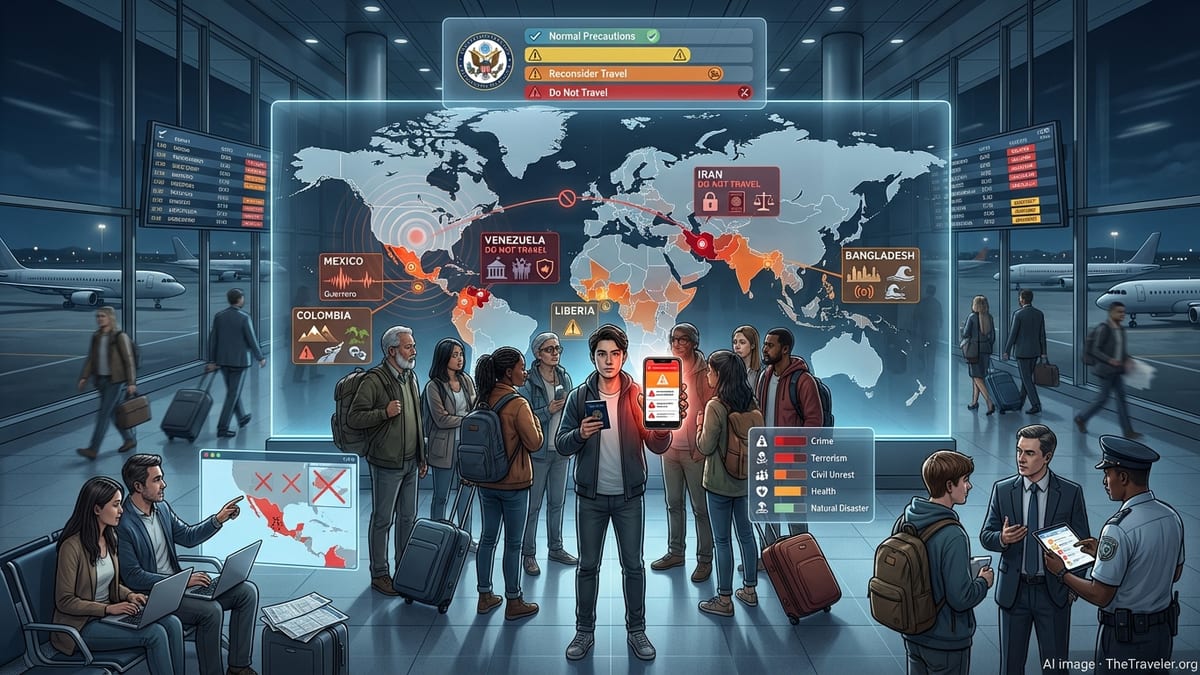
What the Level 4 ‘Do Not Travel’ Warning Means
Publicly available guidance from the US Department of State describes Level 4 as its highest travel advisory, advising citizens not to travel to the listed destinations for any reason. The warning is reserved for places where local conditions pose a serious and often unpredictable threat to personal safety, or where the US government has a limited or nonexistent capacity to assist its nationals in an emergency.
The Level 4 label can be triggered by a range of conditions, including active armed conflict, terrorism, widespread violent crime, kidnappings, civil unrest, disease outbreaks, arbitrary detention, or a breakdown in basic government services. Travel-risk monitoring sites that track the advisories note that the designation is not used lightly and tends to remain in place where security environments are volatile and slow to improve.
The advisory system is structured into four tiers: Level 1 urges normal precautions, Level 2 calls for increased caution, Level 3 recommends that travelers reconsider their trips, and Level 4 instructs that travel should not be undertaken at all. The 23 countries now at Level 4 sit at the most severe end of that spectrum, signalling that travel plans involving these destinations require complete reassessment.
The 23 Destinations Now at Level 4
Recent coverage of the updated advisory highlights 23 countries now grouped under the Level 4 “Do Not Travel” category. These are Afghanistan, Belarus, Burkina Faso, Burma (Myanmar), Central African Republic, Chad, Democratic Republic of the Congo, Haiti, Iran, Iraq, Lebanon, Libya, Mali, Niger, North Korea, Russia, Somalia, South Sudan, Sudan, Syria, Uganda, Ukraine and Yemen.
Travel-risk trackers that collate State Department notices show that these destinations span multiple regions, with a particularly high concentration in Africa and the Middle East. Some, such as Afghanistan, Syria and Yemen, are experiencing long-running armed conflicts and the presence of non-state armed groups. Others, including Haiti and parts of the Sahel region, are grappling with severe gang violence, insurgencies or chronic political instability that can disrupt transport, communications and access to basic services.
Several European and Eurasian states appear on the Level 4 list because of wartime conditions or the risk of arbitrary treatment of foreign nationals. Russia and Ukraine remain on the highest warning level due to the ongoing full-scale war, while Belarus is cited in public reporting as part of a broader conflict-affected environment with restrictions that complicate consular assistance. North Korea continues to carry a separate, long-standing prohibition on the use of US passports for travel there, on top of the Level 4 categorization.
Why These Countries Face the Strongest Warning
According to published summaries of the individual advisories, the reasons for Level 4 status differ from country to country but share recurring themes. Armed conflict, terrorism and indiscriminate violence are major drivers in places such as Syria, Libya, Mali, Niger, Somalia, South Sudan and Sudan, where front lines can shift and authorities may not control all parts of the territory. In these environments, routes to airports and border crossings can close suddenly, and security incidents may occur with little warning.
In Haiti, reports point to pervasive gang control over key roads and neighborhoods, frequent kidnappings and disruptions to fuel and food supplies, conditions that have led foreign governments to caution that evacuation or consular rescue operations could be extremely difficult. In parts of the Democratic Republic of the Congo and neighboring states on the list, security alerts also mention risks linked to armed groups, as well as occasional health emergencies, which can strain already limited infrastructure.
For Iran and Iraq, advisory text reviewed in open sources cites terrorism, civil unrest, kidnapping and the possibility of arbitrary arrest or wrongful detention of foreign nationals, including US citizens. Lebanon is listed for overlapping reasons, including the risk of spillover from regional conflict and political and economic fragility. In Uganda, regional security concerns and public health measures related to serious disease outbreaks have contributed to the heightened warning environment described in regional coverage.
Implications for US Travelers and Trip Planning
The expansion and renewed prominence of the Level 4 list carry significant implications for travelers based in the United States and for travel providers that serve them. While the advisories are not legally binding bans on private travel in most cases, they influence how airlines, tour operators, cruise companies and insurance providers assess risk and decide whether to offer services that transit or serve the affected countries.
Insurance companies commonly reference official government advisories when determining coverage. Public information from the travel insurance industry indicates that some policies may exclude cover for trips booked to destinations flagged at the highest warning level or may not pay out for losses linked to security incidents in those places. Prospective travelers are therefore encouraged in media and industry guidance to check both the latest advisory level and the fine print of any policy before paying deposits.
For individuals with essential reasons to be in a Level 4 country, such as dual nationals, aid workers or staff of international organizations, travel-security specialists recommend preparing robust contingency plans. This can include identifying multiple exit routes, registering details with available alert systems, tracking local developments closely and maintaining reserves of cash, food and medicine in case normal services are disrupted.
How to Check for Future Changes
Travel advisories are not static, and the number of countries at Level 4 can change over the course of a year. Monitoring tools that scrape official feeds show that some destinations move between Levels 3 and 4 as conflicts intensify or ease, while others may stay at the highest level for extended periods when security conditions remain dangerous. Newly issued notices are dated, allowing travelers to see when a particular warning was last updated.
Publicly accessible government resources encourage travelers to look up country-specific advisories before booking flights or accommodation and again shortly before departure. Interactive advisory maps produced by independent monitoring platforms can help visualize risk levels across regions by comparing US advisories with those issued by other governments, such as the United Kingdom and Canada.
For US citizens planning complex itineraries, especially multi-country trips that include connections through higher-risk regions, travel analysts suggest checking not only the final destination but also any transit points that might be affected by changing advisories or airspace restrictions. Conditions in and around the 23 Level 4 destinations demonstrate how quickly circumstances can shift, reinforcing the importance of up-to-date information in international trip planning.