


More news on this day
Uganda, Somalia and South Sudan have all been placed under the United States government’s highest travel warning, a Level 4 “Do Not Travel” advisory, highlighting escalating security and health concerns that are already rippling through East Africa’s tourism and aviation sectors.
Get the latest news straight to your inbox!
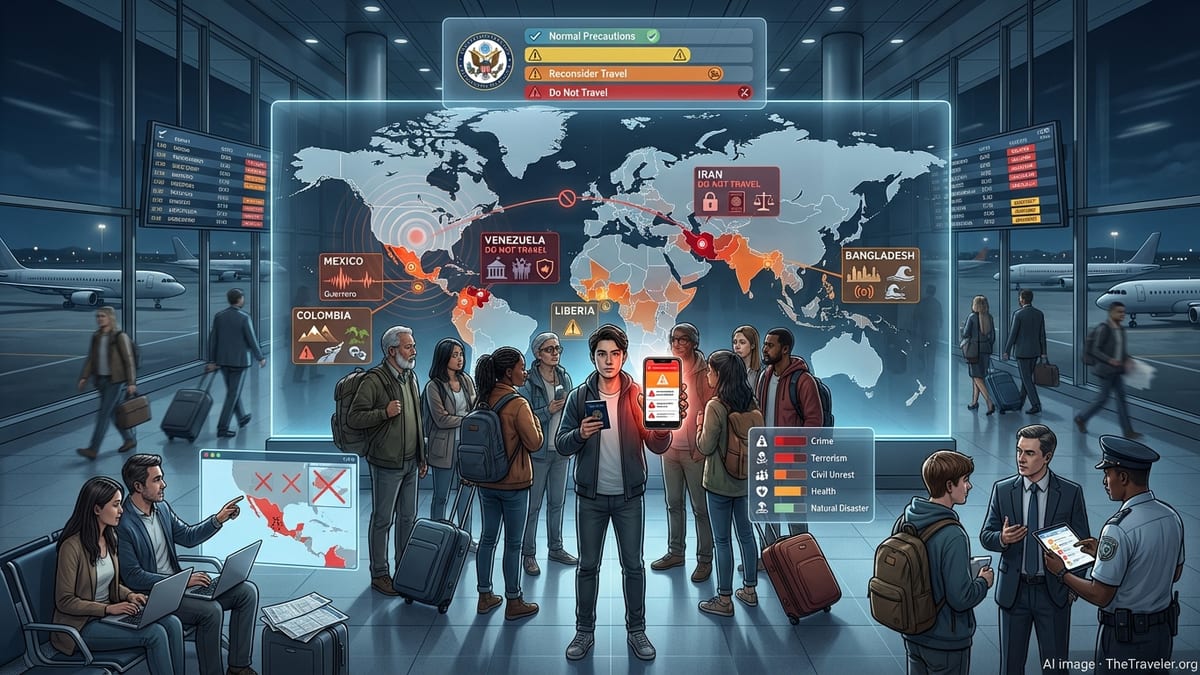
How the US Level 4 travel warning system works
Publicly available guidance from the US State Department describes Level 4 advisories as the strictest category in its four-tier system, reserved for destinations where there is a heightened likelihood of life-threatening risks and where US assistance may be severely constrained. The department’s own safety documentation explains that under a Level 4 advisory, US citizens are urged not to travel or to leave as soon as it is safe to do so if they are already present in the country.
Recent advisory tables on the State Department’s consular website list Somalia and South Sudan as Level 4 destinations, while recent defense and health surveillance reporting notes that Uganda, alongside the Democratic Republic of Congo, has also been under a Level 4 rating during the current Ebola emergency. These classifications place the three East African states in the same highest-risk bracket as countries such as Afghanistan, Iran and North Korea.
The system is not a legal ban on travel, but it has practical consequences. Airlines, insurance companies and large tour operators often reference State Department advisory levels in their own risk assessments, influencing which routes are marketed, what coverage is available, and how travel policies are priced for American customers.
Uganda’s shift from adventure hub to high-risk destination
Uganda has long promoted itself to international visitors as the “Pearl of Africa,” known for mountain gorilla trekking in Bwindi Impenetrable National Park, wildlife viewing in Queen Elizabeth and Murchison Falls national parks, and cultural tourism centered on Kampala and regional towns. Before the current health crisis, the country often featured prominently in safari itineraries that combined Kenya, Tanzania and Rwanda.
In the past, travel advisories for Uganda typically fell below the highest category, emphasizing risks from terrorism, crime and sporadic unrest while stopping short of a blanket “Do Not Travel” label. However, during 2026, official US health surveillance reporting tied to a major Ebola outbreak in the wider region has referenced a Level 4 advisory for Uganda, citing elevated public health risk alongside broader security concerns. Local and regional media coverage now reports that Uganda appears in US alerts alongside Somalia and South Sudan as part of a cluster of African destinations under the strictest warning.
Tourism-linked businesses in Uganda have publicly expressed concern that the Level 4 status is deterring US visitors even in areas far from reported health clusters or security incidents. Industry commentary circulating in regional outlets indicates that some American safari bookings were either postponed or re-routed through neighboring countries perceived as lower risk, altering long-planned multi-country trips.
Travel planners also point out that while the advisory applies to the country as a whole, conditions can vary significantly between urban centers, national parks and border regions. For now, though, the blanket Level 4 classification is shaping overall demand, particularly from first-time visitors who rely heavily on official advisories when choosing destinations.
Somalia remains under long-standing “Do Not Travel” guidance
Somalia has appeared on the US government’s strictest warning lists for years, and recent updates on the State Department advisory page continue to rate the country at Level 4 “Do Not Travel.” The current advisory highlights a wide range of risks, including terrorism, armed conflict, kidnapping, crime, widespread illegal roadblocks, health concerns and the presence of landmines. It also notes that US consular support inside Somalia is extremely limited.
The advisory language cites attacks and threats from militant groups, including incidents targeting government facilities, hotels, public places and transportation hubs. International risk trackers that aggregate government travel warnings from the United States, United Kingdom, Canada and Australia all presently classify Somalia as a country where non-essential travel should be avoided.
For leisure tourism, these advisories have effectively frozen almost all mainstream activity. While a small number of specialized operators continue to arrange tightly controlled visits, including security-escorted stays in Mogadishu for business or media purposes, these remain exceptional and are framed as high-risk undertakings. For most travelers, flight schedules and insurance exclusions make even transit through Somali territory a complex proposition.
South Sudan’s security and infrastructure challenges
South Sudan, the world’s youngest country, is also listed at Level 4 “Do Not Travel” in current US State Department advisory tables. Recent updates cite armed conflict, crime, kidnapping, critical infrastructure gaps and limited medical facilities as primary reasons for the rating. Information made available through the State Department notes that the US government has a reduced capacity to provide emergency consular services throughout much of the country.
Humanitarian and diplomatic assessments over recent years have consistently described a fragile security environment, with localized fighting, banditry and intercommunal violence reported outside the capital, Juba. A publicly released consular information sheet for South Sudan emphasizes that poor road conditions, seasonal flooding and a lack of functioning services can significantly slow or prevent evacuation in a crisis.
Despite these conditions, some visitors still travel to South Sudan for family reasons or for work in aid, energy and infrastructure projects. However, risk advisories from the United States and other governments specify that any travel should only take place with robust security planning, secure accommodation and reliable communication arrangements in place.
Implications for US travelers and East African tourism
The grouping of Uganda, Somalia and South Sudan on US Level 4 lists is reshaping how American travelers and companies view East Africa as a whole. Regional news coverage this week highlights that these three countries appear alongside several other African states in the highest-risk category, prompting renewed debate over how health emergencies, security events and political developments are reflected in travel warnings.
For individual US travelers, the advisories carry several concrete implications. Many comprehensive travel insurance policies either exclude coverage for destinations under a “Do Not Travel” warning or require special underwriting, which can raise costs or block claims. Some US-based employers and universities also prohibit official travel to Level 4 countries, preventing staff and students from undertaking research, fieldwork or conferences in the affected territories without high-level waivers.
On the ground in East Africa, local tour operators, lodge owners and transport providers are recalibrating marketing strategies and source markets. Industry voices quoted in regional outlets report growing reliance on visitors from Europe, the Middle East and within Africa itself, as American bookings soften. At the same time, officials in the tourism sector are using the spotlight on advisories to call for greater investment in health surveillance, road safety and crisis response systems, arguing that improved standards could help persuade foreign governments to revise warnings.
Travel analysts caution that advisory levels can change as conditions evolve, sometimes with little notice. Prospective visitors are therefore encouraged by publicly available consular information to check the latest US State Department advisories, Centers for Disease Control and Prevention health notices, and their own government’s guidance before committing to trips involving Uganda, Somalia or South Sudan.