


More news on this day
Spain’s cruise sector is riding a powerful new wave of demand, with passenger arrivals climbing at a double-digit pace as strong source markets led by the United Kingdom and France help deliver fresh records for the country’s ports.
Get the latest news straight to your inbox!
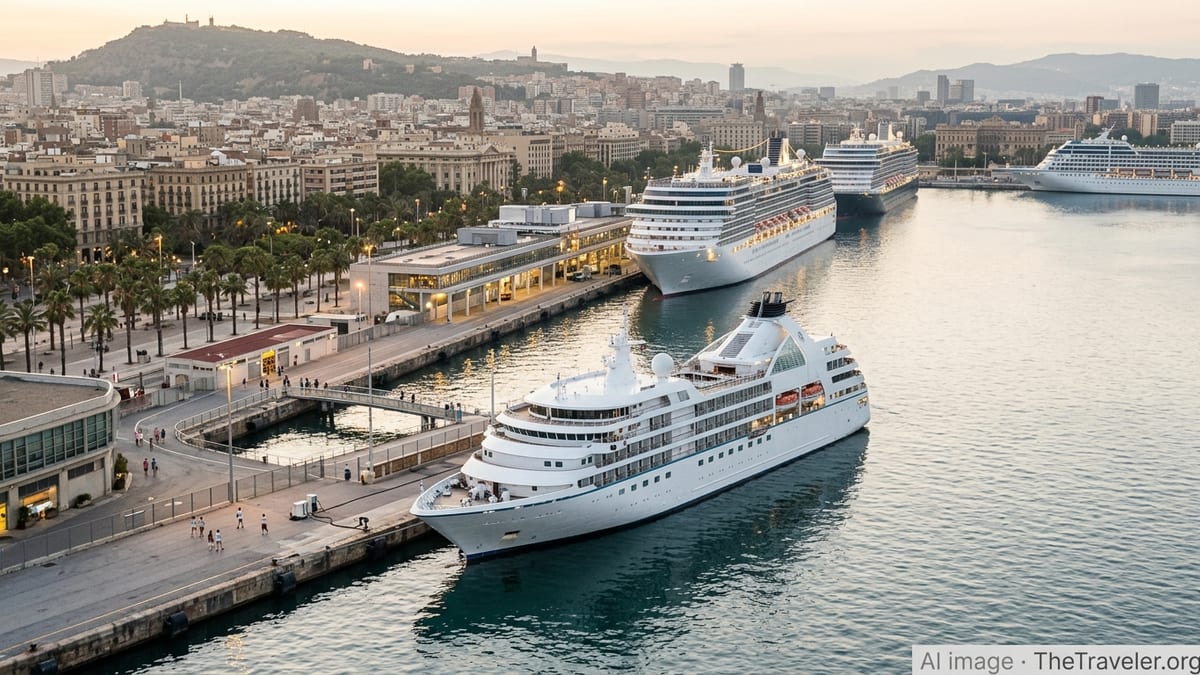
Double-digit growth lifts Spain’s cruise recovery
Recent data from Spain’s state-owned port system indicates that cruise passenger traffic has extended its post-pandemic rebound, with Spanish ports collectively notching close to a 10 percent rise in cruise arrivals compared with the previous record year. Between January and November 2025, ports across the country welcomed more than 13.1 million cruise passengers, up nearly 9.9 percent on the same period of 2024, when annual traffic had already reached an all-time high of about 11.9 million travelers, according to compiled figures from Puertos del Estado and Spanish business media.
The latest numbers build on the strong recovery reported for 2023, when cruise traffic through Spanish ports surpassed 12 million passengers and decisively overtook the pre-pandemic benchmark set in 2019. Publicly available statistics show that this momentum has continued into 2024 and 2025, with more ship calls and larger vessels concentrating on key hubs such as Barcelona, the Balearic Islands and the Canary Islands, alongside faster growth rates in secondary ports.
Industry observers note that the near-10 percent year-on-year rise in 2025 cruise arrivals, on top of earlier double-digit rebounds, places Spain firmly among the top global destinations for ocean cruising. The segment now forms a visible part of the broader tourism surge that has seen Spain welcome more than 94 million international visitors in 2024 and approach 97 million in 2025.
UK remains the powerhouse source market
Behind the record cruise volumes is the continued strength of the UK outbound market. Cruise Lines International Association (CLIA) data for Europe shows that the UK and Ireland remain the second-largest source market on the continent, with about 2.54 million cruise guests in 2025, a 5.7 percent increase on 2024. Over the period from 2022 to 2025, the UK and Ireland segment has expanded from roughly 1.66 million to more than 2.5 million guests, highlighting sustained appetite for holidays at sea.
Broader tourism indicators underline the UK’s central role in Spain’s visitor economy. Spain’s statistical releases on tourist movements and independent analysis report that the United Kingdom remains the single largest source of foreign tourists to Spain, ahead of France and Germany. In 2024, Spain received around 94 million international visitors, with British travelers once again topping the table and contributing significantly to overall spending.
For cruise operators, this deep base of British holidaymakers, combined with a dense network of air connections and ex-UK departures into the Mediterranean and Atlantic, has translated into robust demand for itineraries featuring Spanish ports. Travel trade coverage indicates that UK-focused brands are continuing to schedule extended Mediterranean and Canary Islands sailings, while also testing shoulder-season voyages that include city stops such as Barcelona, Valencia and Málaga.
France and Southern Europe add fresh momentum
While the UK continues to dominate in volume terms, France and other Southern European markets are adding important incremental growth. CLIA’s latest European market report shows that Spain and France both rank among the top five cruise source markets on the continent. Spanish residents generated about 635,000 cruise passengers in 2025, a rise of just over 4 percent compared with 2024, while France contributed around 584,000 guests, posting growth close to 2 percent.
These increases come after an earlier surge from France between 2022 and 2023 and a strong rebound in Spain’s own outbound cruise demand. Taken together, the main continental markets of Spain, France and Italy provide an expanding pool of regional travelers who often choose itineraries that begin or end in Spanish ports, reinforcing Spain’s role as both a destination and a turnaround base for Mediterranean cruises.
Reports on wider tourism flows also show France consolidating its position as Spain’s second-largest or third-largest source of visitors, depending on the year, with double-digit percentage gains in 2024. This broader trend feeds into cruise demand, as growing numbers of French holidaymakers look to combine beach, culture and city experiences with port calls in Catalonia, the Balearics and along the southern coast.
Port investments and regional winners
Spain’s ability to absorb rising demand has been supported by sustained investment in port infrastructure. Puertos del Estado’s statistical yearbooks and related commentary highlight new terminals, upgraded berths and improved passenger facilities across the national port system. These enhancements are designed to handle larger new-build ships, many of which are being delivered into European fleets through the end of the decade.
Several ports have emerged as stand-out performers. Business press coverage points to strong multi-year growth in cruise traffic at Cádiz, which has reported increases well above the national average, and at Galician ports such as Vigo and A Coruña, where passenger volumes rose by around a quarter in 2024 compared with 2023. The Balearic Islands, meanwhile, have welcomed more than 2.4 million cruise passengers in the first ten months of 2025, while the port authority of Santa Cruz de Tenerife now ranks as one of Spain’s leading gateways by total passenger traffic.
Barcelona and Palma de Mallorca continue to anchor itineraries in the Western Mediterranean, while Canary Islands ports remain central to winter sun and transatlantic routes. New and expanded terminals in Valencia and Málaga are also bringing more turnaround operations to mainland Spain, which can amplify economic benefits in accommodation, transport and local services.
Economic impact and sustainability pressures
The surge in cruise tourism arrives at a time when overall visitor numbers to Spain are setting new highs. According to international tourism statistics for 2025, Spain welcomed about 96.8 million foreign visitors, up 3.2 percent on 2024. Tourism as a whole accounted for more than 12 percent of national GDP in 2024, with recent estimates indicating that the sector contributed a majority share of Spain’s economic growth that year.
For port cities, cruise activity forms a visible component of this expansion. Industry and government studies emphasize the contribution of cruise passengers to local spending on guided tours, dining, retail and cultural attractions, as well as the impact of provisioning and maintenance services for vessels. At the same time, the speed of growth is sharpening focus on sustainability, congestion and housing pressures in some destinations.
In response, authorities at several Spanish ports have adopted or are considering measures such as caps on daily ship calls, tighter rules on emissions at berth and incentives for shore power connections. Municipal debates in cities including Barcelona and Palma are closely watched by other European destinations facing similar questions about how to balance cruise-related income with environmental and social concerns.
With the UK and France continuing to funnel large volumes of travelers toward the Western Mediterranean, and with Spain’s ports reporting another year of near-10 percent growth in cruise arrivals, the country’s challenge will be to manage this momentum in a way that maintains both competitiveness and community support.
CLIA Europe Market Report 2025
Puertos del Estado Annual Port Statistics