


More news on this day
Britain’s aviation map is being redrawn as Birmingham Airport posts record growth while London’s airports battle a steady drumbeat of delays, cancellations and wavering passenger loyalty.
Get the latest news straight to your inbox!
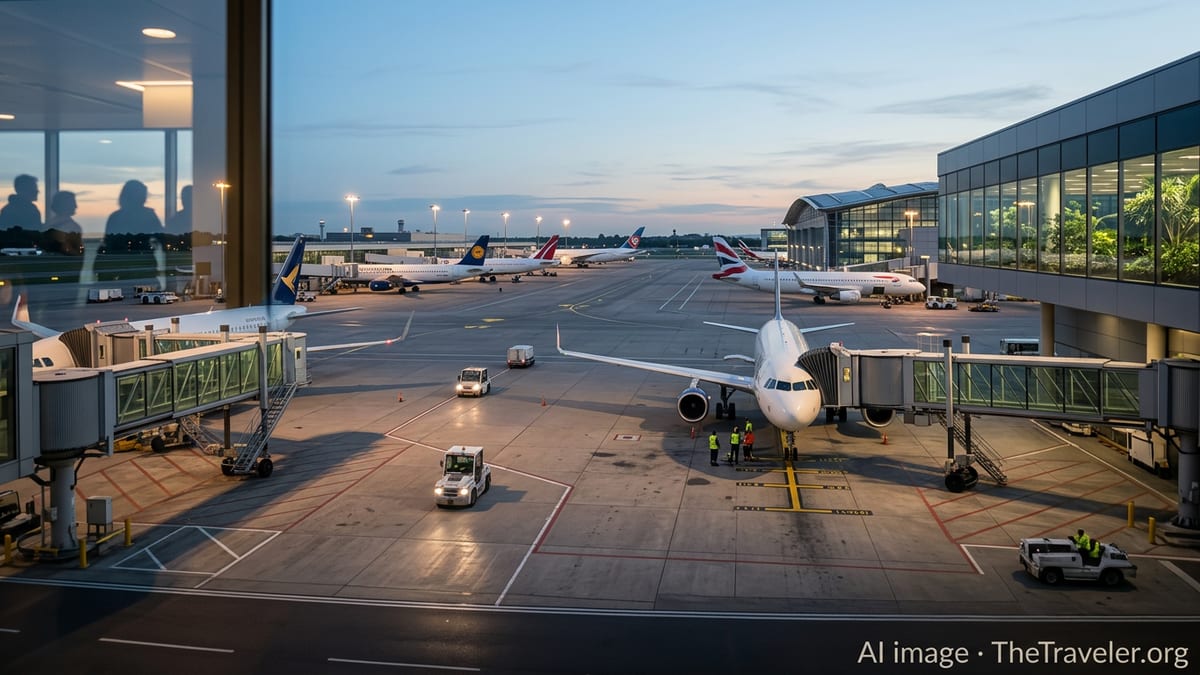
Birmingham’s Record-Breaking Surge Redefines the Midlands
Birmingham Airport has emerged as one of the strongest symbols of the United Kingdom’s regional aviation rebound, with a series of recent statistics pointing to sustained and accelerating growth. Publicly available airport data show that Birmingham handled about 13.7 million passengers in 2025, the highest annual total in its history and a marked rise on pre-pandemic volumes. Monthly figures underline that momentum, with more than 1.45 million travellers passing through in July 2025, the busiest month the airport has ever recorded.
Industry briefings indicate that Birmingham’s growth has outpaced the national average, as airlines quietly shift capacity away from some crowded southern hubs toward the Midlands. The airport has been positioning itself as a primary international gateway for central England, supported by investments in terminal facilities, upgraded security screening and additional retail and hospitality space. Local business groups regularly highlight the airport’s expanding route map as a selling point for foreign investment and tourism.
Airline strategy is a central driver of this surge. Carriers have publicly announced expanded schedules from Birmingham, including new bases and additional aircraft that significantly increase the number of destinations on offer. Low cost and leisure operators are using the airport to connect the Midlands directly to major European cities, Mediterranean resorts and key UK domestic points, capturing passengers who previously travelled via London. For many travellers, Birmingham’s smaller scale, shorter queues and easier surface access are becoming decisive advantages.
The result is that Birmingham is no longer viewed only as an overspill option for London; it is increasingly seen as a first-choice gateway for a large catchment stretching from the West Midlands into parts of Wales and the north of England. As capacity pressures continue at the capital’s airports, analysts suggest that Birmingham’s trajectory could further accelerate, especially if long-discussed rail and road upgrades are delivered in full.
London Airports Face Cancellations, Delays and Fraying Confidence
While Birmingham’s numbers climb, London’s major airports are experiencing a more complicated picture. Overall passenger totals at Heathrow and Gatwick remain high, but a combination of operational disruptions, air traffic control problems and weather-related cancellations has kept many travellers on edge. Consumer-rights organisations and claims specialists report that up to one in three passengers departing UK airports in 2024 experienced some form of delay or cancellation, reinforcing perceptions of a system under strain.
Gatwick has repeatedly drawn attention for its punctuality record. Official performance data compiled by media outlets and based on civil aviation statistics show that Gatwick was the UK’s most delayed airport in 2024, with average departures running more than 20 minutes late despite some year-on-year improvement. Staffing challenges in the airport’s control tower and restrictions linked to national air traffic services have contributed to persistent bottlenecks, even as management teams stress that short-term fixes and longer-term recruitment drives are under way.
Heathrow, meanwhile, continues to operate close to its capacity limits, amplifying the impact of any disruption. Guidance from the UK Civil Aviation Authority indicates that the airport occasionally asks airlines to pre-emptively cancel a proportion of flights during forecast periods of severe weather or other operational risks in order to protect overall safety and manage congestion. Each such episode leads to thousands of passengers rebooked, rerouted or forced to abandon trips entirely, often at short notice.
Technical issues in the wider air traffic control network have compounded these local problems. A high-profile system failure during the summer 2025 peak led to the grounding of flights nationwide for a period, with Heathrow and Gatwick particularly hard hit as dozens of services were cancelled in a single afternoon. News coverage at the time highlighted scenes of long queues, stranded passengers and complex knock-on effects as aircraft and crew were left out of position. Even where disruption lasted only hours, the recovery took days.
Passenger Flows Shift as Travellers Seek Reliability
The result of these strains is a slow but noticeable change in how passengers choose to travel. Data on the United Kingdom’s 2025 airport league table show that national traffic reached a record 302 million passengers, yet not all airports shared equally in that growth. While Heathrow and several regional hubs recorded small but steady increases, Gatwick and at least one other major London-area airport saw declines in passenger numbers despite the buoyant overall market.
Analysts point to this divergence as evidence that some travellers are voting with their feet. Reports in trade publications and from regional airports indicate that passengers from the Midlands and northern Home Counties, who once habitually drove to Heathrow or Gatwick, are increasingly opting for Birmingham, Liverpool or Manchester instead. Shorter journeys to the airport, lower parking costs and a perception of fewer last-minute cancellations are frequently cited as reasons for the switch.
Survey findings from passenger advocacy groups suggest that reliability and predictability now rank alongside price as top priorities for many travellers. After several years of pandemic disruptions followed by system failures, staffing shortages and weather-related chaos, consumers appear more willing to forgo the very widest choice of long-haul connections in exchange for smoother departure experiences. This trend benefits airports that can maintain robust on-time performance and clear communication when things go wrong.
For airlines, these shifting preferences are encouraging a recalibration of their UK networks. Carriers that can redeploy aircraft to regional airports with room to grow may be better placed to protect schedules and customer satisfaction. The strong performance of Birmingham, coupled with growth at other regional gateways, suggests that the balance of power between London and the rest of the country is gradually evolving, even if Heathrow remains the dominant national hub.
Structural Pressures Behind the UK’s Sky Crisis
Behind the visible queues and cancellations lie deeper structural pressures facing UK aviation. Air traffic across Europe has climbed steadily, with pan-European network managers reporting more than 34,000 daily flights by mid-2025 and en-route delays still being driven by pockets of staffing shortages. In the United Kingdom, the August 2023 national air traffic control failure and subsequent technical incidents have prompted repeated reviews of contingency planning, engineering support and system resilience.
Industry commentators argue that capacity constraints at airports and in national airspace are interacting with labour challenges in a way that makes the system more fragile. Recruiting and training air traffic controllers and security staff takes years, while airlines continue to add flights to meet strong leisure and visiting-friends-and-relatives demand. Even modest weather events or localised technical problems can therefore trigger a cascade of delays and cancellations, particularly at already-saturated hubs in the South East.
Environmental and regulatory factors are adding further complexity. Discussions about expanding Heathrow, and parallel debates over second-runway plans at Gatwick, remain politically contentious. While the government has indicated support in principle for additional capacity, climate obligations and community concerns mean that any concrete moves will take time. In the interim, pressure is growing on existing infrastructure, reinforcing the strategic appeal of underused regional airports such as Birmingham.
For travellers, the immediate impact is a more fragmented landscape of risk. Flying from London can still offer unparalleled global connectivity, but the probability of encountering a delay or schedule change remains higher than many would like. Regional airports, on the other hand, may provide a calmer experience but with fewer long-haul options and, in some cases, tight peak-hour pinch points as their own growth accelerates.
What Growing Regional Power Means for Future Travel
The contrast between Birmingham’s buoyant numbers and the recurrent turbulence at London’s airports is reshaping expectations about the future of UK air travel. If current trends continue, more airlines are likely to treat Birmingham as a core part of their national network strategy rather than a peripheral outpost. The airport’s record passenger totals in 2025, combined with ongoing investments in terminal expansion and security technology, suggest that it is planning for further double-digit growth in the medium term.
From a traveller’s perspective, this could translate into a broader choice of direct routes from the Midlands, including additional year-round leisure services and potentially new long-haul links. Travel trade sources already point to strengthened connectivity to European hubs, which in turn open one-stop options to North America, Africa and Asia without the need to transit through Heathrow. As airlines fine-tune their schedules, Birmingham’s catchment area may extend even further, drawing in passengers who currently rely on London or Manchester.
For London’s airports, the emerging competitive landscape adds urgency to efforts to improve reliability. Airport operators and national agencies are under pressure to minimise the kind of high-profile failures that lead to mass cancellations, while also demonstrating that investment in staff, technology and infrastructure can keep pace with demand. If they succeed, the capital is likely to retain its central role in global aviation. If not, the gradual diversion of traffic to regional alternatives may accelerate.
What is already clear is that the UK’s so-called sky crisis is not only about one-off episodes of chaos. It reflects a deeper rebalancing of where and how Britons choose to fly. Birmingham’s explosive growth and London’s recent struggles illustrate a market in transition, with travellers quietly rewriting the country’s air travel map one booking at a time.