


More news on this day
Royal Caribbean is closing out July on solid financial footing while pressing ahead with its newest Icon Class ship and continuing to fine-tune itineraries across the Caribbean and beyond, according to recent filings and industry coverage.
Get the latest news straight to your inbox!
Second-Quarter Results Top Expectations and Guidance Raised
Royal Caribbean Group reported second-quarter 2026 earnings that surpassed analyst expectations, underscoring continued strength in demand for cruise vacations even as pricing moderates from post-pandemic peaks. Publicly available financial statements dated July 28 show net income of about 1.1 billion dollars and earnings per share ahead of prior guidance, with management citing robust load factors and healthy onboard spending.
The company also lifted its full-year earnings outlook for 2026, signaling confidence in forward bookings through the key late-summer and holiday periods. Industry coverage notes that the updated guidance reflects both higher ticket revenue and disciplined cost controls, with fuel efficiency and scale from newer, larger ships contributing to margins.
Royal Caribbean’s performance arrives as global capacity has largely returned to pre-2020 levels, and competition for discretionary travel dollars has intensified. The latest results suggest that the company is still benefiting from pent-up demand for cruising and from the introduction of high-profile vessels that command premium pricing.
Analysts tracking the sector indicate that Royal Caribbean’s balance of short Caribbean getaways and longer, higher-yield itineraries continues to support revenue per available berth, even as consumers become more price sensitive. The improved outlook will be closely watched through the remainder of the year as booking patterns evolve.
Icon Class Expansion Advances With Legend of the Seas
Alongside its financial update, Royal Caribbean is highlighting momentum in its Icon Class expansion, with Legend of the Seas moving closer to entry into service. Trade publications and shipyard updates from Meyer Turku in Finland describe sea trials commencing in April and continuing through the early summer, marking a significant milestone for the line’s third Icon Class vessel.
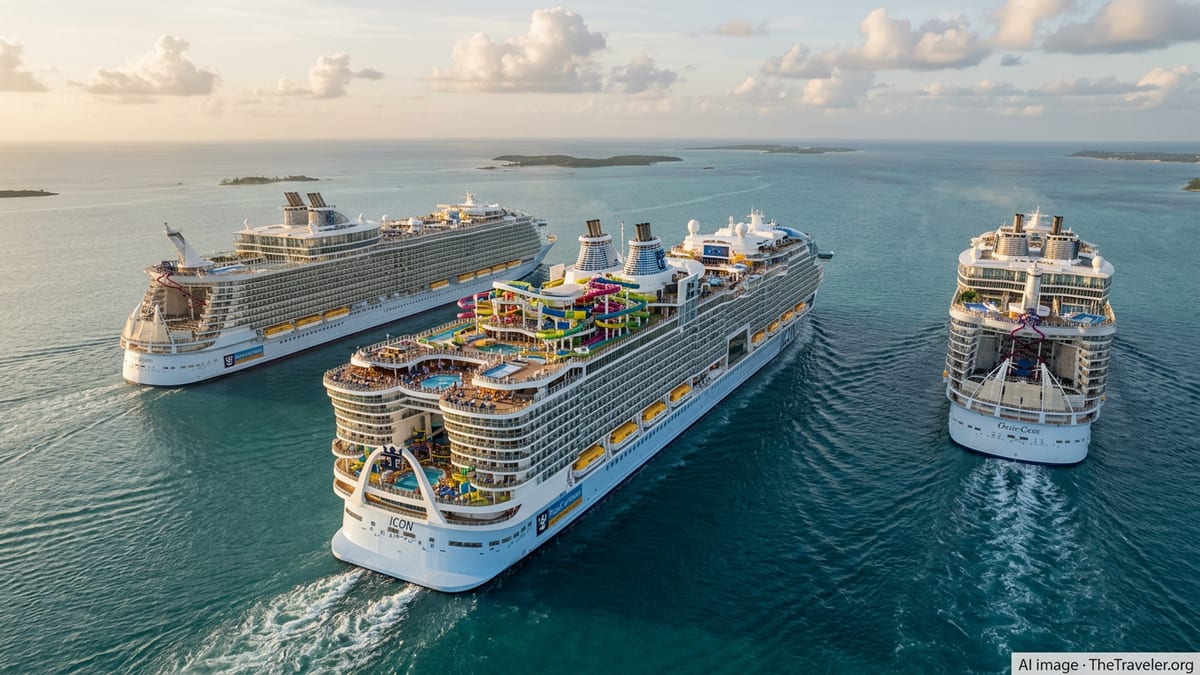
Legend of the Seas is part of a multi-ship program that began with Icon of the Seas in 2024 and Star of the Seas in 2025. Reference materials on the fleet outline Legend as an LNG-powered megaship of roughly 250,000 gross tons, designed to carry more than 5,000 guests and thousands of crew while showcasing large-scale water attractions, neighborhood-style public spaces, and expanded family accommodations.
Royal Caribbean’s recent promotional materials focus on the broader Icon platform as a key growth engine, positioning the series as “family-first” with dedicated neighborhoods, multiple pools, and substantial entertainment venues. The brand has also indicated that a fourth Icon Class vessel, Hero of the Seas, is scheduled for 2027, further extending the class into the latter part of the decade.
Industry observers note that the Icon rollout is central to Royal Caribbean’s capacity and revenue strategy, allowing the line to gradually retire or redeploy older tonnage while concentrating marquee ships in high-demand markets such as the Caribbean and North America. The progress on Legend of the Seas helps underpin the company’s forward-looking guidance and long-term investment narrative.
Ongoing Itinerary Adjustments Across the Caribbean
While the company focuses on new hardware, Royal Caribbean continues to adjust sailings across its existing fleet, particularly in the Caribbean. The line’s travel updates page, revised at intervals since early 2026, details continuing suspension of calls to Labadee, Haiti through the end of 2026, with affected cruises being rerouted to alternative ports or given additional sea days.
Separate coverage from cruise-industry outlets in recent weeks has highlighted a series of smaller itinerary changes tied to operational and weather-related factors. For example, a summer sailing of Navigator of the Seas departing July 24 was reshaped to avoid developing storms, with port calls shuffled to maintain safe operating conditions while still offering a full cruise experience.
Earlier in the season, Royal Caribbean also modified a voyage on Allure of the Seas due to a technical issue, cancelling a call in Jamaica and adjusting the schedule. Reports on that change indicate that the ship remained in service while the company arranged repairs, illustrating how mechanical considerations can impact port sequences even when a voyage is not fully cancelled.
Industry commentary notes that itinerary changes are not unusual at this time of year, given the Atlantic hurricane season and port-capacity constraints across popular Caribbean destinations. The line generally communicates schedule revisions directly to booked guests and through its travel advisory pages, encouraging travelers to monitor their reservations for updates.
Ship Deployments and Pricing Dynamics for Future Seasons
Beyond near-term changes, Royal Caribbean is refining its deployment and pricing strategy for the mid-2020s and late decade. Press-center releases issued over the past several months describe expanded 2027 and 2028 Caribbean programs featuring Icon Class ships such as Star of the Seas and Oasis Class vessels including Utopia of the Seas and Harmony of the Seas after a scheduled amplification.
Separate investor and media materials outline redeployments in Asia, including plans to shift Spectrum of the Seas to new markets in summer 2027 following a series of itinerary adjustments in East Asia for 2026. Those changes reflect both geopolitical considerations and evolving demand patterns, with the line reallocating capacity to itineraries that offer stronger yields or more reliable access to ports.
At the same time, traveler commentary and booking data discussed in consumer coverage suggest that pricing on some of Royal Caribbean’s newest ships remains dynamic. Prospective guests tracking future sailings of Star of the Seas and other high-profile vessels have reported price movements months or years ahead of departure, with periodic opportunities to reprice existing reservations when fares decline.
Analysts view this flexible approach as part of a broader revenue-management strategy that seeks to fill large-capacity ships at optimal rates, using a combination of early-booking incentives, periodic promotions, and last-minute offers. The pattern is expected to continue as more Icon Class and Oasis Class hardware enters service and the company adjusts to competitive pressure from rivals launching their own newbuilds.
What Cruisers Should Watch in the Months Ahead
With the Atlantic hurricane season under way and new tonnage nearing delivery, Royal Caribbean guests are likely to see a mix of opportunity and uncertainty in the coming months. Travelers booked on Caribbean sailings involving currently suspended ports or during peak storm periods may want to keep a close eye on their online cruise documentation and the company’s travel update pages for changes to ports of call or embarkation timings.
For those interested in the newest ships, the rollout of Legend of the Seas and future Icon Class vessels will shape itineraries and pricing across multiple homeports. As deployment plans for 2027 and beyond are refined, certain markets, particularly Florida and key European gateways, are expected to see a concentration of the largest ships, potentially influencing airfares, hotel demand, and pre- and post-cruise travel patterns.
Investors and industry watchers, meanwhile, will look to Royal Caribbean’s next earnings update to gauge whether the raised 2026 guidance remains on track, especially if economic conditions soften or competitive capacity grows faster than demand. The interplay between strong onboard spending, evolving itinerary strategies, and the integration of new ships will remain central to the company’s story through the end of the year.
For now, the latest financial results, incremental deployment announcements, and a steady stream of itinerary fine-tuning collectively point to a brand focused on balancing growth with operational resilience as it navigates the midpoint of 2026.