

More news on this day
Aerial footage from rural mid Wales shows emergency crews clustered around two damaged passenger trains after a recent collision, with responders treating injured passengers beside the tracks and on nearby embankments.
Get the latest news straight to your inbox!
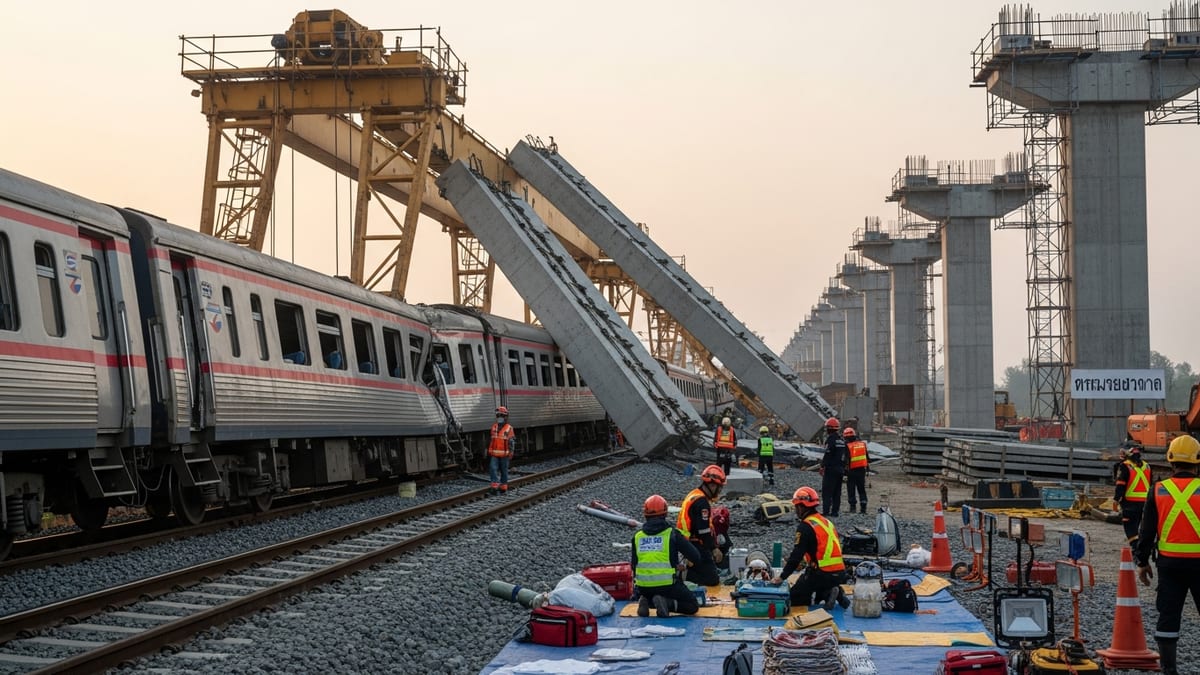
Images capture scale of response on remote Welsh line
The collision occurred on a single‑track section near Talerddig in Powys, where two passenger services came into contact on a stretch of line running through open countryside. According to published coverage and official investigation material, around 15 people were injured in the impact and one passenger later died from a medical condition not directly linked to crash trauma.
Aerial images widely circulated by UK media outlets show carriages halted at an angle on the line, with doors open and passengers being helped to safety. High‑visibility‑clad crews can be seen moving between the train and a narrow access road, where ambulances and support vehicles were positioned.
The footage underlines the logistical challenge of responding to rail incidents in remote areas. Access for heavy rescue equipment and medical teams typically relies on farm tracks and minor roads, requiring a coordinated approach between rail staff and regional emergency services.
Observers note that, while the scene appears dramatic from above, the relatively low speed at the time of impact limited structural damage to the rolling stock, a factor that likely reduced the severity of injuries among those on board.
Emergency workers treat injured at trackside
Publicly available information indicates that the majority of the injured passengers sustained fractures, cuts and soft‑tissue injuries consistent with sudden deceleration and internal fittings becoming hazards within the carriage. A smaller number were reported with more serious trauma requiring hospital care.
Aerial shots show paramedics working on stretchers laid out near the track and on the adjacent embankment, with triage areas marked by clusters of medical staff and equipment. Patients appear to have been stabilised at the scene before being transferred by road to hospitals in mid and north Wales, with support from air ambulance services where required.
Specialist rail response teams also feature in the footage, inspecting the couplings, bogies and underframe of the units involved. These teams are tasked with making the train safe, checking for fuel leaks and electrical hazards, and supporting the subsequent recovery operation to clear the line.
Rail safety analysts point out that the visible organisation of on‑scene activity reflects regular multi‑agency planning exercises, in which local responders rehearse rail crash scenarios using rural locations similar to the Powys site.
Investigators focus on braking and signalling sequence
Reports from the Rail Accident Investigation Branch show that attention has centred on the performance of the braking systems and the way the signalling sequence unfolded in the minutes before impact. Preliminary findings indicate that one of the trains did not come to a halt as intended, despite use of the service and emergency brakes, on a section protected by a signal at danger.
Published material describes how investigators have gathered data from on‑board recorders, signalling logs and radio communications to reconstruct the trains’ movements. They are examining factors such as rail adhesion, the condition of the track, driver actions and the interface between legacy signalling technology and more modern safety systems being introduced on parts of the UK network.
The Talerddig crash has drawn comparisons with other recent incidents in Britain involving low‑speed collisions and derailments, where injuries were significant but fatalities were limited. Safety specialists note that modern rolling stock designs, including crumple zones and improved interior layouts, can reduce the risk of catastrophic outcomes when trains collide at moderate speeds.
The incident is also feeding into ongoing discussions about the pace of investment in digital signalling and automatic train protection across rural routes, which historically have lagged behind intercity main lines in terms of technology upgrades.
Disruption for passengers and local communities
The collision led to the closure of the affected section of line for several days while investigators worked on site and engineers repaired infrastructure damage. Replacement bus services were put in place between key mid‑Wales towns, significantly lengthening journey times for commuters, students and tourists travelling through the region.
Rail operators warned passengers of continued disruption as repair crews replaced damaged track components, checked signalling equipment and recovered the stricken units. Local hospitality businesses reported cancellations and delays as visitors struggled to reach rural destinations that rely heavily on the rail link.
For communities along the route, the images of damaged trains in open countryside served as a reminder of the importance of reliable transport connections. Campaigners have long argued that investment in both safety systems and day‑to‑day reliability is essential to support the local economy and to provide a viable alternative to car travel on narrow, winding roads.
Despite the disruption, commentators highlighted that the network’s overall resilience allowed services to be rerouted or replaced relatively quickly, minimising the long‑term impact on regular users of the line.
Context within UK rail safety record
The Powys collision has been widely discussed in the context of the UK’s broader rail safety record. According to compiled historical data and independent analysis, fatal passenger train collisions in Britain remain comparatively rare, and serious multi‑fatality crashes are now uncommon events.
Specialist coverage notes that previous major incidents, such as the Salisbury tunnel collision in 2021 and earlier accidents involving signal overruns or poor adhesion, prompted a series of technical and procedural reforms. These changes have included refinements to braking systems, driver training for low‑adhesion conditions and upgrades to line‑side and in‑cab signalling.
Experts stress, however, that the Powys crash illustrates how risk cannot be eliminated entirely, particularly on single‑track rural lines where head‑on encounters remain a possibility if multiple safeguards fail in sequence. The presence of trained staff, robust emergency plans and modern rolling stock is viewed as crucial to limiting casualties when such events occur.
As full findings from the investigation are awaited, rail users and industry observers are watching closely for recommendations that could influence future investment priorities on regional routes across Wales and the wider UK network.