


More news on this day
Two passenger trains traveling toward London St Pancras collided near Bedford on Friday afternoon, leaving at least one person dead, multiple passengers injured and rail links to the capital heavily disrupted, according to early reports.
Get the latest news straight to your inbox!
Collision on busy corridor north of the capital
Initial information from publicly available rail tracking data indicates that both trains were running southbound toward London St Pancras when they came into conflict on a section of line close to the town of Bedford, a key bottleneck on the Midland Main Line. The impact occurred during the late afternoon peak, as commuters and long-distance passengers headed into and out of the capital.
Coverage from national and regional outlets describes one of the services as the Corby to London St Pancras train and the other as a Nottingham to London St Pancras service. Images shared widely on social media and in local reports show several carriages damaged and at least some vehicles off the rails, though the overall train formations appear to have remained largely intact.
Emergency service summaries state that a major incident has been declared, with one fatality confirmed and a number of passengers suffering injuries ranging from minor to serious. Witness accounts carried in early reports describe passengers being thrown forward in their seats at the moment of impact, with visible broken bones and head injuries among some travelers.
Rail commentators following live feeds from the scene note that the location and timing of the collision, on a main approach into one of London’s key terminals, are likely to have a significant knock-on effect across the wider network through the evening.
Large-scale emergency response and on-scene conditions
According to published coverage and regional emergency service updates, multiple fire, ambulance and police units were deployed to the site within minutes of the first alerts. An air ambulance was dispatched to assist with transporting the most seriously injured passengers to specialist trauma centers, reflecting concerns about the severity of some injuries.
Photographs from the scene show rescue personnel working along trackside embankments and between carriages to reach those on board. Temporary triage areas appear to have been set up near the railway to prioritize treatment, with walking wounded guided away from the line while more seriously injured passengers were stabilized before transfer.
The condition of the rolling stock, while clearly damaged, has prompted early observations that modern crash-protection features may have helped prevent an even more catastrophic outcome. Carriages appear to have remained broadly upright and coupled, potentially reducing the risk of large-scale derailment or rollover that can cause mass casualties in high-speed rail crashes.
Overhead line equipment and track infrastructure in the immediate area also seem to have sustained damage, complicating access for both emergency responders and subsequent recovery teams. Rail engineers are expected to undertake detailed inspections before any attempt is made to move the trains or restore traffic through the affected section.
Severe disruption to St Pancras routes and passenger journeys
Travel updates from train operators and journey planners report that services between London St Pancras and key Midland destinations, including Leicester, Nottingham, Sheffield and Corby, are heavily disrupted following the collision. Some trains have been canceled outright, while others are terminating short of their planned destinations or being diverted where track capacity allows.
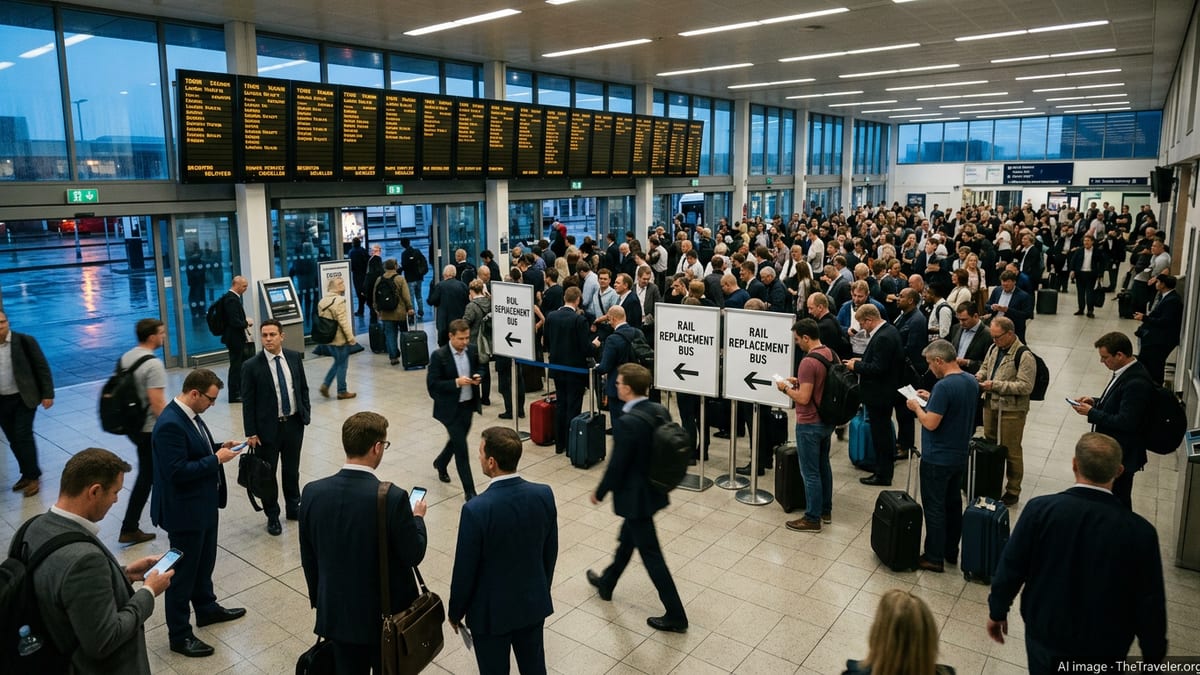
Passengers have been advised in operator statements to delay travel, seek alternative routes via other London terminals or use local transport where ticket acceptance arrangements are in place. Those already on the network are facing extended journey times, crowded replacement services and significant uncertainty as the scale of the disruption becomes clear.
Rail industry observers point out that the Midland Main Line is a crucial artery linking London with the East Midlands and beyond, and that the timing of the incident on a Friday evening intensifies the impact on both commuters and leisure travelers. With investigators and recovery teams needing unimpeded access, there is an expectation that disruption could extend into the weekend.
Some online journey planners and live departure boards have already flagged residual delays and potential short-notice cancellations for late-night and early-morning services, underlining the difficulty of restoring a normal timetable while the infrastructure and rolling stock remain under examination.
Early investigation focus and safety context
Specialist rail accident investigators are being deployed to the site to gather evidence, including data from on-board recording systems, signal logs and driver communications, as reported in national coverage. The focus will be on understanding how two southbound passenger trains came to collide on a heavily monitored main line equipped with modern signaling and safety protections.
Analysts following the incident note that the stretch north of London has been subject to extensive upgrades in recent years, including improvements to track layouts and signaling designed to reduce the risk of conflicting movements. The collision is therefore likely to prompt close scrutiny of both technical systems and operational procedures, including train routing, speed control and communication between control centers and drivers.
Recent rail safety reports in the United Kingdom have highlighted an overall long-term decline in serious train accidents, but they also stress that even rare events can have severe human consequences. Comparisons are already being drawn in commentary with earlier collisions on the national network, with particular attention on how modern crashworthiness standards and emergency protocols perform under real-world conditions.
Investigators are expected to examine whether factors such as signal interpretation, track maintenance, train positioning or human performance played a role. Any interim findings released in the coming days will be closely watched by regulators, operators and passenger groups concerned about maintaining confidence in long-distance rail travel.
Human impact and questions for passengers and operators
As news of the Bedford collision has filtered through, images of injured passengers and heavily damaged carriages are resonating far beyond the immediate region. Accounts shared in the media by those on board describe scenes of shock and confusion, with travelers helping one another, searching for loved ones and waiting for information amid the noise of alarms and arriving emergency vehicles.
Passenger advocacy groups and rail commentators are already raising questions about how quickly information was relayed to those on board and to people waiting at stations down the line. Early indications suggest that some travelers learned of the scale of the incident only after disembarking onto the trackside area or receiving messages from contacts following the situation online.
For operators, the collision adds fresh urgency to ongoing debates over capacity, signaling modernization and staffing levels on busy intercity corridors. While full responsibility and causation will only be determined by formal investigation, the visible outcome of today’s crash reinforces wider concerns about how resilient the network is when rare but high-impact events occur.
For now, attention remains firmly on supporting injured passengers, assisting families seeking information, and restoring at least limited service on one of the country’s most important rail approaches to London. Detailed answers about what went wrong and how similar incidents can be prevented are likely to emerge only after weeks or months of technical analysis and public reporting.