


More news on this day
United Airlines is delaying the launch of 10 new routes from Chicago O’Hare International Airport after federal regulators ordered airlines to trim schedules at the busy hub, disrupting the carrier’s growth plans across the Midwest.
Get the latest news straight to your inbox!
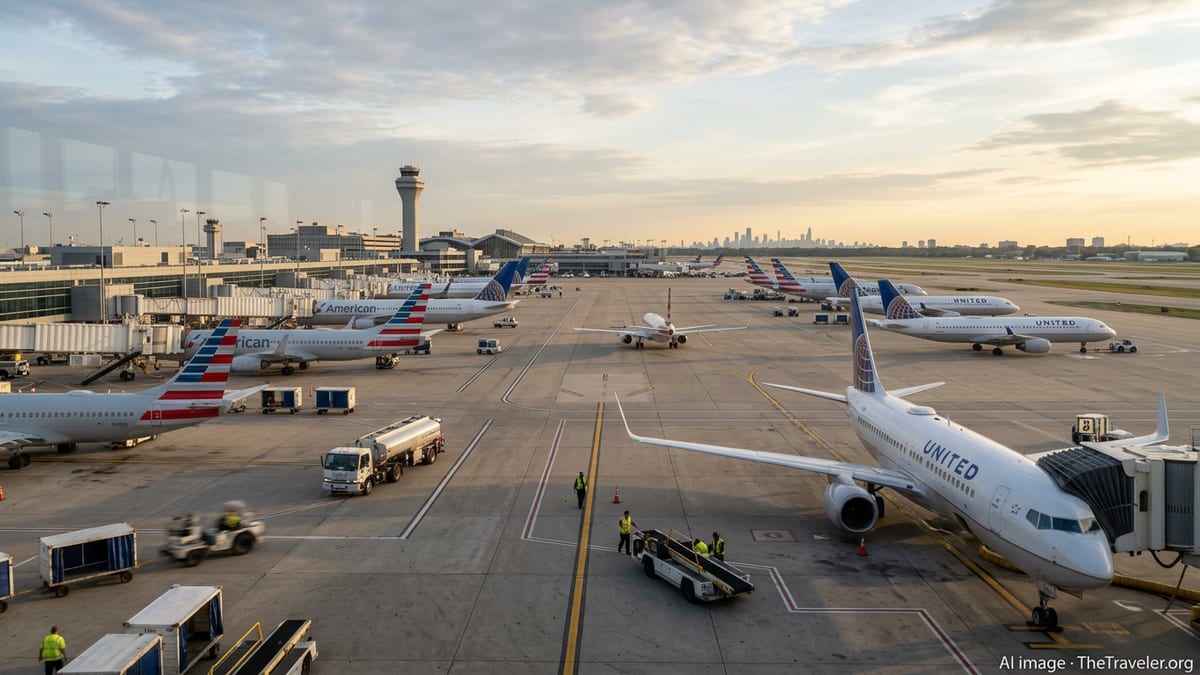
FAA Capacity Limits Force Schedule Rethink at O’Hare
Publicly available federal documents show that the Federal Aviation Administration has imposed temporary limits on flights at Chicago O’Hare for the peak 2026 summer season, citing concerns over congestion and delays during ongoing airfield and terminal construction. The cap effectively forces airlines using the airport to operate fewer daily flights than they had scheduled, particularly at peak times.
According to recent federal notices, the FAA is capping O’Hare’s daily operations at a level meaningfully below what airlines had planned, requiring roughly a double-digit percentage reduction in departures and arrivals during the May to October travel window. The move is described as a traffic management step designed to keep delays from cascading across the national airspace system during one of the busiest travel periods of the year.
The restrictions follow several years of heavy construction work tied to O’Hare’s terminal expansion and airfield reconfiguration, which has created temporary chokepoints for taxiing aircraft and runway use. Federal filings indicate that runway and taxiway closures associated with the modernization program have constrained the airport’s practical capacity even as airlines, led by United and American, have tried to add more flights to capture strong post-pandemic demand.
Industry analysts note that O’Hare’s combination of intense hub operations, variable Midwest weather and construction-related constraints has made it particularly vulnerable to ground delays. The FAA’s decision to intervene on scheduling is described in public records as a relatively rare step that underscores the operational pressures at one of the country’s largest connecting hubs.
United’s 10 New Regional Routes Put on Hold
Within this tighter operating environment, United has postponed the debut of 10 new regional routes that were slated to feed its Chicago hub. Based on airport and schedule data cited in aviation forums and local reporting, the affected routes primarily involve smaller Midwestern and Great Lakes communities that rely on O’Hare as a connecting gateway to the rest of the airline’s domestic and international network.
The planned launches, which were originally timed to coincide with the 2026 summer schedule, have been pushed back until at least late October, when the current round of FAA capacity limits is expected to expire. In several cases, travelers in smaller markets had already seen marketing for forthcoming United connections to O’Hare, only to find that start dates were quietly revised as the federal order took effect.
Public schedule information shows that United has opted to prioritize maintaining its core bank structure at O’Hare, preserving higher-demand trunk routes and long-haul operations while deferring new, thinner regional services. Airline observers point out that this approach allows the carrier to protect high-revenue connections and preserve international feed, even though it comes at the expense of new access for smaller communities.
In some cities, local airport announcements had highlighted the arrival of new United service to Chicago as a milestone, only for those inaugurals to be pushed into the off-peak period. Commentators tracking schedule changes note that this pattern reflects how quickly network plans can change when regulators alter capacity assumptions at a major hub.
Regional Communities Feel the Impact of Delayed Service
The delay of 10 new O’Hare routes has tangible effects for regional airports that were counting on expanded United service this summer. Communities in Illinois, Indiana, Michigan and neighboring states that use Chicago as a primary connection point will now need to wait longer for added frequencies or entirely new links to the hub.
Publicly available commentary from local stakeholders indicates that some airports had aligned ground handling, marketing and, in certain cases, terminal adjustments in anticipation of the new flights. With the launch dates slipped into the autumn shoulder season, these facilities may see lower-than-expected traffic during the peak months when additional connectivity would have been most valuable for leisure and business travelers.
For passengers, the most immediate effect is reduced choice and, in some markets, continued reliance on long drives to larger airports or on competing carriers with less convenient schedules. Travel discussion boards and regional forums suggest that travelers had been planning trips around the anticipated United flights to O’Hare, only to rebook through alternative hubs or delay travel when updated schedules appeared.
While some of these communities still have service from other airlines or ground transport links to Chicago, the postponement underscores how sensitive smaller markets are to hub-level decisions. When a major airline tightens or delays its expansion at a central node like O’Hare, the ripple effects can be felt hundreds of miles away.
Competitive Landscape at O’Hare Shifts Under Constraints
The FAA-imposed cuts arrive at a time when United and American are locked in a competitive contest for dominance at O’Hare. Both carriers have invested heavily in the airport as a central connecting hub, building dense banks of departures that maximize connection possibilities but also strain airfield capacity during peaks.
Recent analyses in aviation and business media describe how O’Hare’s schedule has grown increasingly concentrated in narrow time windows, with many flights arriving and departing within minutes of each other to support efficient connections. While this structure benefits passengers when operations run smoothly, it can amplify delays when weather, construction or air traffic control constraints arise, prompting regulators to seek a more balanced flow of traffic.
Within the new capacity limits, airlines are forced to make trade-offs about which flights to keep, defer or cancel. Industry observers suggest that United’s decision to delay 10 new routes, rather than make deeper cuts to established services, reflects a strategic calculation to protect existing market share and premium cabin demand on key domestic and international routes.
Competitors, including American and several smaller carriers, are making their own adjustments under the same cap. Public schedule filings suggest that some airlines were already operating closer to the new limit and therefore needed fewer changes, while those that had filed aggressive growth plans have had to scale back ambitions, particularly in more marginal markets.
What Travelers Through O’Hare Should Expect This Summer
For travelers connecting through Chicago O’Hare, the combination of FAA capacity caps, ongoing construction and weather risks points to a summer marked by tighter schedules and less redundancy. Airline and aviation experts quoted in public reports recommend that passengers building itineraries through O’Hare allow ample connection times and consider earlier flights in the day when possible.
The delayed launch of United’s 10 new routes means fewer new options for reaching Chicago from secondary cities, which could translate into fuller flights on existing services and less flexibility when irregular operations occur. Travelers may also see more schedule adjustments as airlines continue to fine-tune their operations within the federal limits.
At the same time, the FAA’s order is intended to prevent the kind of widespread gridlock that can occur when the number of scheduled flights outstrips what the airport can reliably handle. If the caps succeed in reducing extended taxi times, gate holds and late-evening delays, passengers may experience a more predictable, if somewhat less flexible, operation through one of the nation’s busiest hubs.
As the current order runs its course, regulators and airlines will reassess how much capacity O’Hare can sustain once construction milestones are met and operational bottlenecks ease. For now, however, United’s decision to hold back 10 planned routes illustrates how federal oversight of scheduling at a single airport can reshape air service patterns well beyond Chicago’s city limits.