


More news on this day
A fast moving storm system sweeping across the U.S. Northeast grounded 726 flights today, stranding thousands of passengers and highlighting how fragile airline mobile apps and digital support systems can become when weather and demand collide.
Get the latest news straight to your inbox!
Storm Slams Northeast Hubs and Ripples Nationwide
Publicly available flight tracking data shows that airports across the Northeast, including major hubs in New York, Boston, Philadelphia and Washington, experienced extensive disruptions as bands of heavy rain, low clouds and thunderstorms moved through the region. Ground stops and spacing restrictions imposed on arrivals quickly cascaded into widespread cancellations and rolling delays.
By midafternoon a total of 726 flights within, into or out of the United States had been canceled, with a disproportionate share touching the Northeast corridor. Disruptions were most visible at high‑traffic hubs, where limited runway capacity and tight schedules offer little margin when weather slows operations. Airlines also faced knock‑on effects as aircraft and crews scheduled to pass through the storm zone failed to reach their next destinations.
Even airports outside the immediate path of the storm reported residual delays as carriers struggled to reposition aircraft and staff. Travelers departing from Midwest and Southeast gateways for the Northeast encountered rolling departure holds, while some westbound flights were scrubbed entirely when their inbound aircraft were canceled upstream.
Digital Tools Overwhelmed at Peak Demand
As weather disruptions intensified, many travelers turned to airline apps and websites, only to find digital tools lagging or offering incomplete options. Social media posts and user forums described boarding passes that would not load, stalled payment screens, and contradictory rebooking information between apps, websites and airport departure boards.
Several passengers reported that flights shown as canceled in their airline app continued to appear on third‑party trackers as operating on time, or vice versa. In some cases, travelers said they were automatically removed from itineraries during schedule changes, then watched their original flights depart without them. These discrepancies left many unsure whether to remain at the gate, seek assistance in customer‑service lines, or attempt same‑day changes on competing carriers.
Published coverage of recent airline technology outages suggests that while core reservation systems are engineered for resilience, the consumer‑facing layers that power mobile apps can become a choke point when usage spikes. During major disruptions, airlines often prioritize operational systems used by dispatchers and crew schedulers, at times leaving passenger apps to update more slowly than internal tools.
Long Lines, Limited Information Inside Airports
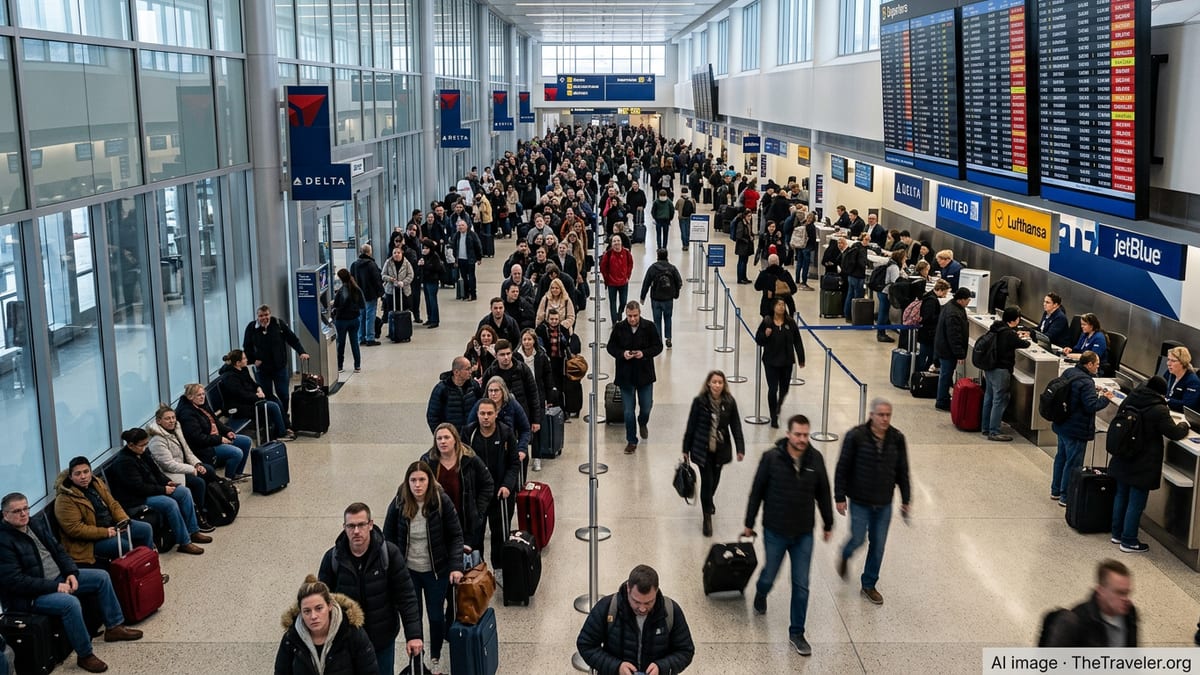
At many affected airports, extended lines formed at customer‑service counters as travelers sought human assistance after digital channels stalled. Photos and accounts shared publicly from Boston, New York and Washington showed crowded concourses and makeshift queues stretching deep into terminal corridors, with passengers waiting to confirm rebookings or request hotel and meal support.
Some travelers described being redirected from one support channel to another, with airport agents advising passengers to use the app at the same time that the app displayed generic error messages or failed to show alternative flights. Others reported that self‑service kiosks were unable to process complex rebookings involving multiple carriers or long‑haul international connections, forcing them into already long in‑person lines.
Industry observers note that such scenes have become more common as airlines encourage customers to rely on digital self‑service tools for check‑in, seat selection and same‑day changes. When those tools falter during irregular operations, there are often fewer staffed desks and call center agents available to absorb the sudden surge of demand for live assistance.
Lessons From Recent IT Outages and Past Storms
The latest disruption comes in a year when airlines have already faced several high‑profile technology incidents and repeated bouts of severe weather. Earlier outages involving major U.S. carriers led to large numbers of cancellations, and in some cases airlines needed days to fully restore their schedules even after the original problem was resolved. Those events prompted fresh scrutiny of how heavily carriers now depend on interconnected reservation, crew management and passenger service platforms.
Weather‑related research and past case studies show that extreme conditions can quickly expose weak points in the aviation system. When a dense network of flights intersects with constrained runways, crowded airspace and strict crew duty limits, even a few hours of storms can trigger a disproportionate volume of cancellations and missed connections. Once schedules become misaligned, digital tools designed for minor adjustments may struggle to offer viable options, particularly for travelers on full flights or multi‑segment itineraries.
Analysts have argued that airlines will need to invest not only in operational resilience but also in the robustness of customer‑facing technology. That includes building app and web platforms that can scale under stress, ensuring accurate synchronization with internal systems, and presenting clearer choices when automatic rebooking is not possible. Without such upgrades, they warn, each new storm or system hiccup risks producing the same cycle of confusion and congestion seen today.
What Travelers Can Do When Airline Apps Stall
Travel advocates and seasoned flyers frequently recommend a multilayered strategy for navigating days like this. Many suggest monitoring both airline apps and independent flight tracking services to cross‑check status information, while recognizing that neither source is infallible during fast‑moving disruptions. Keeping boarding passes downloaded to a device or wallet app before arriving at the airport can help if connectivity or app performance deteriorates later.
Specialists in air travel planning also highlight the value of acting quickly when cancellations begin to spike. Rebooking inventory on remaining flights can disappear within minutes, particularly in constrained markets along the Northeast corridor. Travelers who move fast to secure an alternate option, even if it does not perfectly match their original plans, often fare better than those who wait for automatic updates to appear.
For airlines, the combination of today’s 726 cancellations and visible frustration with digital tools underscores how tightly customer experience is now bound to technology performance. As climate‑driven weather volatility and air traffic growth continue, the gap between what airline apps promise and what they deliver during crises is likely to draw increasing attention from both passengers and policymakers.